Loading...
Daily Bible Verses | The Gospel Of Saint LukeDaily Bible Verses For Advent & Christmas

Solemnity Of Mary, The Mother Of God | The Shepherds Find Jesus, Mary And Joseph | Christmas Octave

Audio Bible | Christmas | The Shepherds Find Jesus And Mary

Luke 2: 16-21 – Solemnity of Mary, the Mother of God (Audio Bible, Spoken Word)

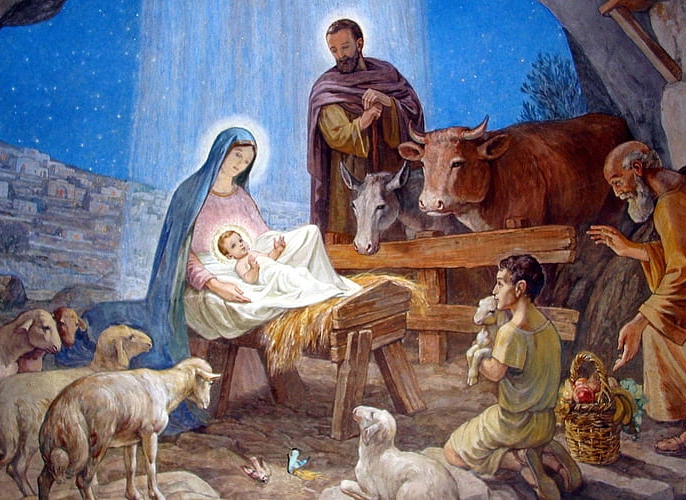
16 And they came with haste, and found Mary, and Joseph, and the babe lying in a manger.
17 And when they had seen it, they made known abroad the saying which was told them concerning this child.
18 And all they that heard it wondered at those things which were told them by the shepherds.
19 But Mary kept all these things, and pondered them in her heart.
20 And the shepherds returned, glorifying and praising God for all the things that they had heard and seen, as it was told unto them.
21 And when eight days were accomplished for the circumcising of the child, his name was called JESUS, which was so named of the angel before he was conceived in the womb.

We discover in these verses of the Bible two distinct and complementary impulses which are at work in our relationship with God, exemplified by the shepherds and by Mary.

The shepherds are the first to hear the good news about the birth of Jesus, proclaimed to them by angels, as heaven bows toward Earth, in order to include and redeem the Earth. It was to a shepherd, Abraham, that God gave his promise to save mankind. In Jesus’ time, the shepherds were marginal people, disrespected by mainstream society because they lived with the animals for which they cared. The incarnation, the key event in the history of mankind and our salvation, takes place in a sense very quietly indeed – though the shepherds experiencing the presence of the army of angels might have thought otherwise! God’s love so often comes to us on the periphery and as we least expect it to be made manifest in our lives.

The shepherds are full of joy and are eager to see the Lord. Their sense of God is not passive; rather they respond most actively, in haste, longing to find what has been announced to them. Theirs is a living faith. We may recall how Mary went with haste to see Elizabeth, when Mary had first received news that she was chosen by God to bear Jesus.

The testimony of the shepherds carries great conviction. The shepherds tell of what they have seen and heard and all who hear what they have to say are filled with wonder. The shepherds glorify and praise God. The most improbable people have found in the most improbable place the deliverance all Israel has long prayed and waited for. The people are in awe at the mystery of the Incarnation.

Mary’s response to the visit of the shepherds is of great serenity and gives to us a model of prayer and contemplation. Mary keeps these things, and ponders them in her heart. Here is silence and wisdom. Struck with the enormity of what is happening, Mary centres herself in a quiet space, showing great respect to the Lord and respect for His plans for us, at the heart of which our Lady has found herself.

We are invited through the reading of these verses to imitate both the shepherds and Mary, to rush toward Jesus and give powerful witness to the wonderful news, that God has saved us, and to keep these truths close by us and ponder them in our hearts. There is great energy and prayerful contemplation in balance. We discover that God is with us.

God, our Father,
since you gave mankind a saviour through blessed Mary,
virgin and mother,
grant that we may feel the power of her intercession
when she pleads for us with Jesus Christ, your Son,
the author of life,
who lives and reigns with you and the Holy Spirit,
God, for ever and ever.

Christian Prayer | George Herbert | Temple | Baptism

Meditations On The Love Of Jesus Christ | Word Aloud | Prayer And Reflection
  • Angel Gabriel And Mary | Annunciation

    In this reading, Bernard of Clairvaux reflects on the moment of the annunciation, focusing on Mary’s reply to the angel Gabriel. The reading does not retell the biblical narrative in a descriptive way but pauses at the moment before Mary speaks, treating her response as a decisive point in salvation history [ … ]

  • The Virginity Of Mary And The Birth Of Christ | Hail Mary, Full Of Grace | Annunciation

    Sometimes, when I read my Bible, I pause in the reading and say to myself: ‘This bit’s real.’ It would be fair to say, I have issues with Mary, because, contrary to what we are taught to say, Mary isn’t my mother. Rather: Mum is. One bit of the Bible-text says this: And when his family heard it, they went out to seize him, for people were saying, “He is beside himself.” … And his mother and his brothers came; and standing outside they sent to him and called him. And a crowd was sitting about him; and they said to him, “Your mother and your brothers are outside, asking for you.” And he replied, “Who are my mother and my brothers?” And looking around on those who sat about him, he said, “Here are my mother and my brothers! Whoever does the will of God is my brother, and sister, and mother.” (Mark 3: 21; 31-35.) Here she comes. She is in considerable distress. I can imagine that. I can relate to that. To save her boy from whatever he’s got himself into this time. And you’re not telling me there isn’t something inside that. Her boy is beside himself. Radical. Radicalized. Radicalizing. A misunderstood word.  /ˈradɪk(ə)l/ adjective & noun. 1 Forming the root, basis, or foundation; original, primary. 2a Inherent in the nature of a thing or person; fundamental. b Of action, change, an idea: going to the root or origin; far-reaching, thorough. c Advocating thorough or far-reaching change. d Characterized by departure from tradition; progressive; unorthodox. ‘He has a demon! And he is mad!’ – thus ‘the Jews’. (e.g. John 10: 20.) Come home! It’s all she wants. His family want him back now. But it is an exclusive cult: there is an inside and there is an outside; and on the outside, they are not meant to understand, lest they be converted. He has defined himself as different from anything she was. Only at the end does Jesus say to his Mum – and with savage, bitter irony: ‘Woman, behold your son.’ And then he dies. Hail Mary, full of grace, the Lord is with thee. Blessed art thou among women and blessed is the fruit of thy womb Jesus. Holy Mary, Mother of God, pray for us sinners now and at the hour of our death.   We ask that we might find Mary in our hearts as a Yes! place for Jesus. It is also recommended that we pray to Jesus that we may be further in oneness with Mary. It is self-emptying, such that we only exist insofar as we are responsive to God’s Word. * Last term, and put-out to pasture, the old Archbishop Emeritus came over to stay for a few days and did the odd class with us. He spoke of Yes! as the meaning of Mary’s virginity. And we were not very nice about him. One or two took umbrage. One or two got the hump. In a sense, his Grace, the Arch, basically wanted to move anyone he’d ever known from a high-place – a mountain – received theological ‘truth’ – to an imminent, human plane. Earthing the spiritual. Recalibrating metrics of life’s believability toward a spiritual sense of things. He might have asked the impermissible question: what happened? His Grace described it. God’s love as a cloud. This descended upon Mary – and subsumed her. Within the cloud, Mary capitulated utterly. She became only and purely a response to God’s love. As he spoke, the Arch cradled her. He carried her in his lap – in his hands. His Grace was a consecrated bishop. He was faith. He sat squat, a rounded man, hands cupped and ankles crossed, fingers interlocked, with parted thighs. Rumpled, washed, speckled. A lifetime’s skin… There could be no doubt His Grace spoke through long-term personal relationship with Mary. It was Julian went for him: ‘So are you saying Mary was a Virgin? Or are you not saying Mary was a Virgin?’ Nasty. No, it wasn’t pretty. Julian twisting his silver ring. For a moment, what Julian had said to the Arch simply failed to communicate. No, for a moment, that dumped on the air meant nothing. Then His Grace said: ‘There is a range of possible meanings we may understand in the question of Mary’s virginity. For example, there are understandings of the word virginity entailed in the action of giving birth.’ Julian said: ‘Duh! So had she had sex or hadn’t she?’ Trigger words. No, it wasn’t pretty. On that went for a little while. At length, Julian’s point seemed reluctantly conceded. Then the Arch told us a new story, an additionally human event, the more to baffle us. Controversially, he told us that Mary could not have been Joseph’s first wife, for this would not have been the way of things in the society of that time. His belief was that Joseph must have taken Mary into his household through pity. That would be normal, he said, for Joseph to bring a young, vulnerable girl, who is about to have a baby, within his protection, not meaning to enjoy with her marital relations, but through kindness. ‘And this story of the inn and stable,’ the Archbishop said, ‘it can’t have been like that really. Joseph has travelled with Mary to stay with his family, at home in Bethlehem, and they don’t want Mary in their house, for reasons which I am sure we can understand. It must have been there was considerable resistance to Mary. But Mary gives birth, and who can resist a baby? That’s what happened. It must have been. ‘I’m convinced that must have been how it happened really.’ Later that term, toward the beginning of Advent, we met boys who had been here before, in Valladolid, and now were in regular seminary. They had heard and recited verbatim all the Archbishop had said to them. Their spot-on impressions of each of the fathers were scathing. […]

  • Audio KJV | Daily Bible | Jesus In Nazareth | A Prophet In His Own Country | Oliver Peers

    The three synoptic Gospels tell us of this episode of Jesus’ life, when he returned home to Nazareth and preached in the synagogue there. Luke’s Gospel gives us the text of Isaiah read by Jesus, in which Jesus’ announces his messianic mission – to bring the good news to the poor, to live and to identify with the poor, to heal us and set us at liberty from sin. As Jesus closes the book, he omits the following from Isaiah 61: 2: ‘…and the day of vengeance of our God.’ This is deliberate interruption. Jesus is not come to maintain old enmities. Jesus’ way is peace. It is the people of all the world who are to be blessed in Christ [ … ]

Search Google Here | A Holy Land Jerusalem Pilgrimage? | A Safari? | An Escape..