
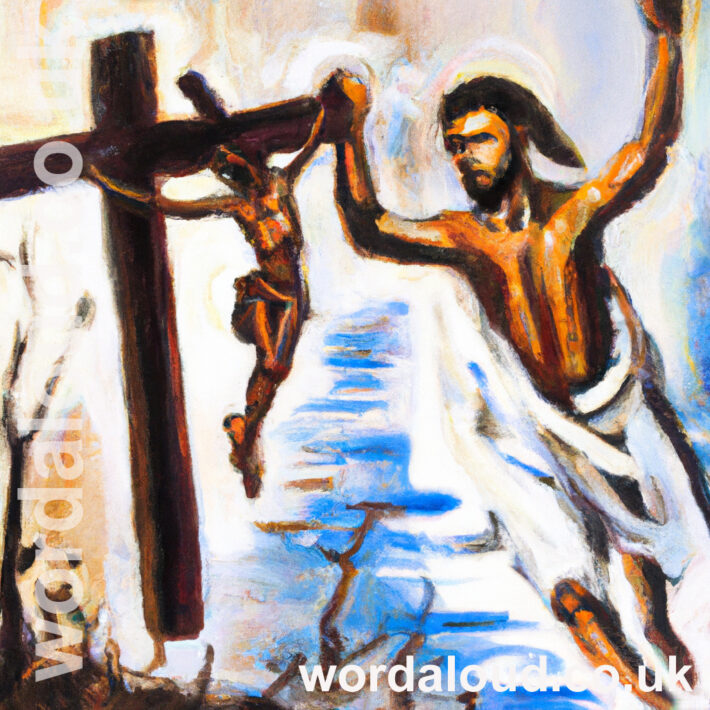
Christian Art | Crucifixion | Gethsemane
Luke 21: 12-19 | Audio Bible KJV
Jesus promises his disciples that they shall be persecuted. It is an extraordinary knowledge to impose. We might wonder at the courage and bravery inspired by Jesus in these most early Christians to witness Jesus Christ and to be the first Christian Church. Gradually, through his time with his disciples, Jesus teaches his disciples to anticipate and to understand the crucifixion – the Christian Cross. ‘I am the way, the truth and the life,’ he said. And yet this leads through the Passion of the Christ, crucifixion of Jesus.
True to his promise, and such being the extraordinary truth of what it is to be saved in Jesus Christ, early Christians were indeed persecuted, called as it were with Jesus to endure their Gethsemane, their Cross.
Jesus paid it all. ‘I am the light of the world,’ he taught us. Many early Christian martyrs embraced this gift.

The Roman Empire And Religious Minorities
Early Christians presented a unique challenge to the Roman Empire. Theirs was a new and mysterious religion. The Christians’ monotheistic faith and refusal thereby to acknowledge in pantheon the Roman Emperor as a god were not in themselves unique: the Jews maintained a ruthless exclusion of other, false gods, and an absolute commitment to God – to Yahweh – our Judeo-Christian known-to-be-true realization of God. And yet the Jews’ was an ancient and respectable religion. Christianity was new. And Christianity was radically mysterious. Indeed, we now as Christians may encounter our faith in Jesus as radically subversive – we may encounter Jesus as radically subversive.
Justo L. Gonzalez, a religious historian, explains: ‘The Roman Empire was tolerant of religious diversity, but at the same time demanded loyalty to the state religion.’ The early Christians’ refusal to comply with this expectation set them apart and put them at odds with the Roman government and society.
The Roman Empire initially showed a limited tolerance of Christians, allowing them to practise their faith and worship in private. However, as the Christian community grew and its beliefs and practices became more widely known, the Roman Empire began to see them as a threat to stability and initiated persecution.
Persecution Of Christians: Political And Cultural Factors
The Roman persecution of Christians was driven by both political and cultural factors. Politically, the early Christians were seen as a threat to the stability of the empire, in part due to their refusal to worship the emperor as a god. This was perceived as a direct challenge to the authority of the emperor and the Roman state.
Culturally, the early Christians’ beliefs and practices were rumoured to be very strange and contrary to Roman values. The celebration of the Eucharist was understood as an exercise in cannibalism. It is perhaps of great encouragement to Christians today to know of the rapidity with which Jesus’ celebration of the Last Supper with his disciples was communicated as what we know today as Holy Mass through such large swathes of empire. There was a secrecy to Christian worship, a process of Christian initiation through baptism, and this in itself provoked suspicion.


Roman Emperors | Their Role In Persecution Of Christians | Nero, Trajan, Diocletian
Nero is known for his persecution of Christians following the fire in Rome in AD 64. According to the Roman historian Tacitus, Nero blamed the disaster on the Christians and used it as an opportunity to persecute. Tacitus writes: ‘Nero fastened the guilt and inflicted the most exquisite tortures on a class hated for their abominations, called Christians by the populace. Christus, from whom the name had its origin, suffered the extreme penalty during the reign of Tiberius at the hands of one of our procurators, Pontius Pilatus, and a most mischievous superstition, thus checked for the moment, again broke out not only in Judaea, the first source of the evil, but even in Rome.’
Historian Paul Johnson notes: ‘Nero’s persecution of Christians was one of the earliest and most severe persecutions in the history of the Roman Empire.’
Trajan’s reign saw sporadic persecutions of Christians, but it was under Diocletian that the empire underwent the most severe persecution of Christians, known as the Great Persecution. According to the church historian Eusebius, Diocletian’s persecution was characterized by widespread destruction of Christian scriptures and places of worship, as well as the imprisonment and torture of Christians. Eusebius writes: ‘The works of piety were everywhere destroyed with fire and sword… numbers, both of men and women, were put to death in the various cities and provinces, after undergoing cruel punishments, while others were led into captivity, and many of the more prominent persons were subjected to fines and other penalties.’
Historian J.C. Dolan writes: ‘Diocletian’s Great Persecution was the most severe and systematic attempt by the Roman Empire to eradicate Christianity.’
Legacy Of Persecution Of Christians
The Roman Empire’s treatment of Christians has had a profound impact on Christian tradition and identity. The early Christian martyrs, who suffered and died for their faith, have served as powerful symbols of devotion and courage for generations of Christians. Their stories of perseverance in the face of persecution have been passed down through the centuries and continue to inspire believers today.
Martyrs were highly revered in early Christian tradition, and their sacrifice and devotion inspired the formation of the concept of saints, who are seen as examples of faith and holiness.
The legacy of persecution also shaped the development of Christian theology and practice. Martyrdom played a significant role in shaping the doctrine of atonement in early Christian thought.
The willingness of early Christians to suffer and die for their faith was seen as evidence of the truth of their beliefs and the power of God’s love, and played a significant role in the spread of Christianity. By choosing to remain steadfast in their faith even in the face of persecution, early Christians inspired others to convert to the religion and helped to solidify the beliefs and practices of the early Christian community.
As noted by historian J.C. Dolan: ‘The witness of the martyrs inspired countless conversions to the faith and helped spread Christianity throughout the Roman Empire.’
According to Pope Benedict XVI: ‘Early Christian martyrdom represents a powerful example of religious devotion and courage, and its legacy continues to shape the Christian faith and tradition.’
One of the key figures in this development was Irenaeus, a bishop in the late second century. In his work ‘Against Heresies’ Irenaeus argued that the death and resurrection of Jesus was a sacrifice for the sins of humanity and that this sacrifice was made manifest in the martyrdoms of Christians. As Irenaeus wrote: ‘The blood of the martyrs is the seed of the Church.’
This idea of the atoning power of the martyrs was further developed by Tertullian, a North African theologian in the late second and early third centuries. Tertullian saw the suffering of the martyrs as a participation in the suffering of Jesus, who died for the salvation of humanity.
These early Christian thinkers helped to shape the doctrine of atonement and establish the importance of martyrdom in Christian tradition and identity. As historian Justo L. Gonzalez notes, ‘The early Christians saw their own suffering and death as participation in the suffering and death of Jesus, and this understanding became a central part of the doctrine of atonement.’
The Roman Empire’s persecution of Christians helped to solidify the identity of the Christian community as a distinct religious group. The shared experience of suffering and persecution helped to foster a sense of unity and solidarity among Christians, strengthening their sense of belonging to a larger spiritual community.
As religious historian Justo L. Gonzalez notes, ‘The legacy of the Roman Empire’s treatment of Christians continues to shape the Christian tradition and identity, serving as a powerful reminder of the faith and devotion of the early Christian martyrs.’
Christian Martyrs As Sign Of Jesus In The Garden Of Gethsemane
As martyrdom may be considered baptism of blood as path to sainthood, and as we recall from the cruelty of the death and of the form of death, brutal executions which included being fed to the wild beasts, and which included being burnt as ‘Roman candles’, smeared in oils and wax and strung-up to burn, such being the grotesque reality of life in Ancient Rome, so we are encouraged through the witness of martyrdom to recall Jesus in the Garden of Gethsemane, and the passion of the Christ, Jesus’ crucifixion.
As Jesus prayed in the Garden of Gethsemane, Jesus sweated blood. He was in agony, knowing what was to follow. As Jesus prayed he acknowledged himself as torn between the necessity of what must be gone through in order to save humanity, and the desire to get away from it. It has been said that in martyrdom, the Christian unites in unique fashion with Jesus. It is said we die in Christ in baptism. Christians have longed to offer themselves in martyrdom, as the most complete offering of themselves possible to God.


We are taught to use the great gifts God has given us, not to bury our abilities, to take risks, not to be afraid of your Master, to work the gifts we have received to bear fruit for God and the Kingdom, to open ourselves fully to God in the spirit of the New Law, then the Kingdom will grow and welcome all of us. In the Parable of the Talents, the gifts each servant receives are not identical [ … ]

The poem reflects a meditation on human suffering and redemption, as well as a call for divine assistance to transcend the human condition. It is structured in two stanzas, each beginning with the poet’s reflection on human limitations, followed by a plea for union with God, and concluding with a hope for spiritual elevation [ … ]

The psalm begins with a declaration, ‘Behold, how good and how pleasant it is for brethren to dwell together in unity!’ This opening line serves as a thesis statement, asserting the intrinsic value and pleasantness of communal harmony. The emphasis here is on the collective experience of togetherness, highlighting the inherent goodness found in unity among God’s people [ … ]
