Loading...
Daily Bible Verses | The Gospel Of Saint MatthewDaily Bible Verses For Advent & Christmas

Daily Bible For Advent | Healing Miracles | Faith And Sin | Prayer | Jesus Heals Two Blind Men | King James Audio Bible

Audio Bible | Jesus Heals Two Blind Men | Oliver Peers
Christian Art | King James Audio Bible KJV | Daily Bible Verses For Advent
Matthew 9: 27-31 | Advent Friday Week 1 | King James Audio Bible KJV | Daily Bible Verses

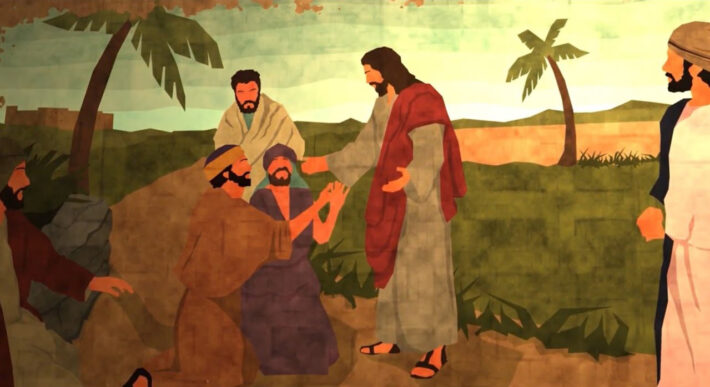
27 ¶ And when Jesus departed thence, two blind men followed him, crying, and saying, Thou Son of David, have mercy on us.
28 And when he was come into the house, the blind men came to him: and Jesus saith unto them, Believe ye that I am able to do this? They said unto him, Yea, Lord.
29 Then touched he their eyes, saying, According to your faith be it unto you.
30 And their eyes were opened; and Jesus straitly charged them, saying, See that no man know it.
31 But they, when they were departed, spread abroad his fame in all that country.

While the Pharisees deny him, two blind men, who because of their blindness would be excluded from normal Jewish worship, are able to see Jesus for who and what he is. The way in which the blind men hail Jesus is significant: ‘Thou Son of David.’ This implies recognition of Jesus as the Messiah. It is as if, despite physical blindness, there is an inner light – and this is a thought we may all take to ourselves as we seek Jesus.

Through touch, through a sacramental laying on of hands, and through faith the blind men are healed by Jesus. The physical disability is overcome; spiritual healing is symbolized.

Once again in these verses we are confronted with the puzzle as to why Jesus wants a miracle of healing to be kept secret. After all, he has healed people before crowds of thousands, so why do we so often in the Gospels encounter this little detail, the enjoinder to keep a miracle secret?

We cannot say with any certainty. We know that Jesus did not wish to be acclaimed as a secular warrior leader, which would be the Messiah hoped for by the Jewish people. We may very clearly infer that Jesus is against armed resistance to the occupying power, i.e. the Roman Empire. But this does not fully account for these injunctions to secrecy.

No matter how closely we read the Gospels, the text bristles with a life of Jesus which is to an extent hidden. Perhaps this is a part of the mystery of how Jesus can be human being and God in one. Perhaps these Gospel puzzles are moments when we can closely confront and be excited by the mystery of Christ as God and man. Perhaps, through this, we may encounter the intersection of the divine and of the earthly humanity in our own lives.

‘Enter into the inner chamber of your soul, shut out everything save God and what can be of help in your quest for him and having locked the door seek him out. Speak now, my whole heart, speak now to God: “I seek your countenance, O Lord, your countenance I seek.”’ St Anselm

Concluding Prayer

Call forth your power, Lord;
come and save us from the judgment
that threatens us by reason of our sins.
Come, and set us free.
We make our prayer through our Lord.

Jesus And A Child | God Is Love

Meditations On The Love Of Jesus Christ | Word Aloud | Prayer And Reflection
  • Miracle | Jesus | Audio | Miracles | Audio KJV | Oliver

    In the Bible, a miracle is an event that is not explicable by natural or scientific laws and is therefore attributed to a divine agency. Miracles are often seen as a sign of the intervention of God in the affairs of human beings. In the Old Testament, the most famous miracles are the Ten Plagues of Egypt, in which God punished the Pharaoh for refusing to release the Israelites from slavery, and the parting of the Red Sea, in which God allowed the Israelites to escape from the pursuing Egyptians by opening a path through the sea. In the New Testament, the miracles of Jesus are a central part of his ministry and are seen as evidence of his divinity. These include healings, such as the restoration of sight to the blind and the raising of the dead, and acts of nature, such as turning water into wine and walking on water. Is There A Theological Significance To Jesus’ Miracles? In the Christian tradition, the miracles performed by Jesus are seen as a manifestation of his divinity and as proof of his authority to teach and heal. Many of these miracles are described in the Gospels of the New Testament, which are the primary source of information about the life and teachings of Jesus. The purpose of the miracles, according to the Gospels, was to demonstrate Jesus’ power over natural forces and to show that he had the authority to forgive sins and offer salvation to those who believed in him. Why Did Jesus Ask To Keep His Miracles Secret? ‘Tell No One Of This.’ In the Gospels, there are a few instances where Jesus tells people not to tell others about what he has done for them. For example, in the Gospel of Matthew, after Jesus healed a man who was possessed by demons, he told the man, ‘See that you tell no one anything, but go, show yourself to the priest and offer the gift that Moses commanded, as a proof to them’ (Matthew 8:4). In this case, it seems that Jesus was concerned that the man’s testimony might not be believed or might be misunderstood, and so he asked him to keep the experience to himself for the time being. It is difficult to say for sure why Jesus might have asked someone to keep quiet about a miracle without knowing the specific context in which the request was made. However, some possible reasons that come to mind include: To avoid drawing unnecessary attention to himself. In the Gospels, Jesus often tries to avoid drawing too much attention to himself, especially from the authorities who are hostile to him. Asking someone to keep quiet about a miracle might be one way of avoiding unwanted attention and allowing Jesus to continue his ministry without interference. To allow the person who was healed to experience the transformation for themselves. In some cases, the person who was healed might have been skeptical or unsure of what had happened to them. Asking them to keep quiet about the miracle might have given them time to reflect on the experience and come to their own understanding of it without being influenced by others. To test the person’s faith. In some cases, Jesus might have asked someone to keep quiet about a miracle as a test of their faith. If they were truly grateful for what Jesus had done for them, they would be willing to follow his instructions and trust that he had a good reason for asking them to keep quiet. These are just a few possible reasons why Jesus might have asked someone to keep quiet about a miracle. It is important to remember that the Gospels are ancient texts and that we must be careful not to impose our own interpretations on them without considering the historical and cultural context in which they were written. To avoid creating conflict or division. In the Gospels, Jesus often encounters people who are skeptical or hostile to his teachings, and he sometimes tries to avoid confrontations with them. Asking someone to keep quiet about a miracle might be one way of avoiding a confrontation or a heated debate that could disrupt his ministry. To avoid being misunderstood or misrepresented. In some cases, the person who was healed might not have understood the full significance of what Jesus had done for them, and they might have tried to explain it in a way that distorted or misrepresented the truth. Asking them to keep quiet might have given Jesus time to explain things to them more fully and help them to understand the true meaning of the miracle. To avoid becoming a spectacle. In the Gospels, there are many instances where people are amazed by the miracles that Jesus performs, and they often try to make him into a kind of celebrity or showman. Asking someone to keep quiet about a miracle might have been one way of avoiding this kind of attention and keeping the focus on the message that Jesus was trying to convey. What Is The Significance Of Miracle Of The Wedding At Cana? In the Christian tradition, the wedding at Cana is significant because it is the first of the miracles performed by Jesus that is recorded in the Gospels of the New Testament. This event is described in the Gospel of John, where it is said that Jesus, along with his mother Mary and his disciples, attended a wedding in the town of Cana. At the wedding, the host ran out of wine, and Mary asked Jesus to help. In response, Jesus turned water into wine, which is seen as a miraculous act that demonstrated his power and authority. In the Gospel of John, after Mary asks Jesus to help with the wine at the wedding in Cana, he replies, “Woman, what does this have to do with me? My hour has not yet come” (John 2:4). This statement is often seen as indicating that Jesus was aware […]

  • Jesus | Miracle Prayer | Healing

    Saint Gregory’s theology is deeply shaped by the Eastern Christian doctrine of theosis, or divinisation. For Gregory, salvation is not merely juridical or moral but ontological: to be saved is to become by grace what Christ is by nature. When Gregory writes that Christians must examine their thoughts, words, and deeds to see whether they are ‘directed toward Christ’, he is describing a dynamic process of transformation. This process, which begins in baptism and continues throughout life, involves increasing conformity to the divine image. In this sense, Christian perfection is not a static achievement but an unending ascent towards God, as expressed in his Life of Moses [ … ]

  • Audio Bible | Jesus Weeps Over Jerusalem

    Jesus is so very sorry for a city and a people he loves that he must weep at the sight of Jerusalem. Here is the centre of Jewish faith, while the Jews are the people to whom he has directed most of his teaching, and they are the first chosen people of God [ … ]

Search Google Here | A Holy Land Jerusalem Pilgrimage? | A Safari? | An Escape..