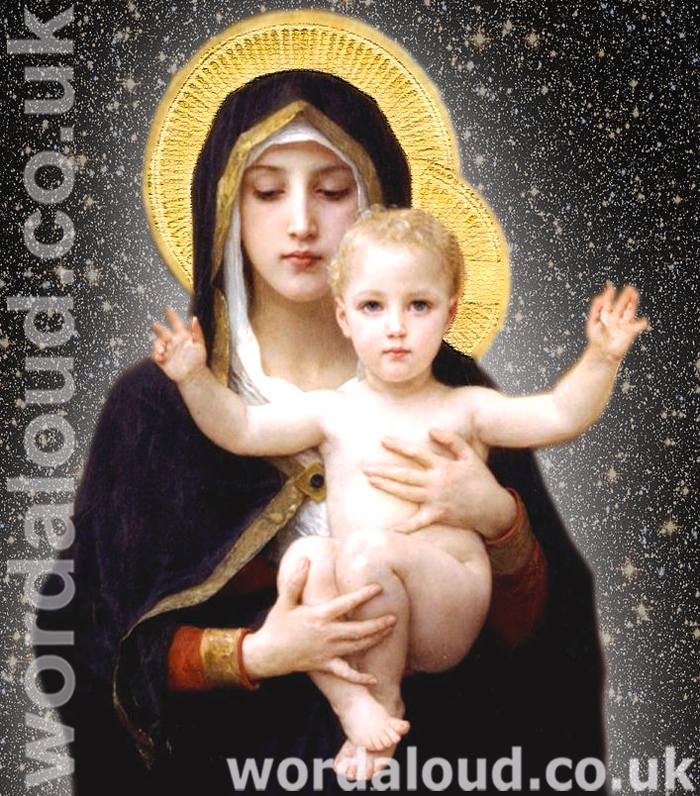
Christian Art | Mary And Baby Jesus
Matthew 1: 1-17 | 17th December Advent Weekday (Audio Bible, Spoken Word)
1 THE book of the generation of Jesus Christ, the son of David, the son of Abraham.
2 Abraham begat Isaac; and Isaac begat Jacob; and Jacob begat Judas and his brethren;
3 And Judas begat Phares and Zara of Thamar; and Phares begat Esrom; and Esrom begat Aram;
4 And Aram begat Aminadab; and Aminadab begat Naasson; and Naasson begat Salmon;
5 And Salmon begat Booz of Rachab; and Booz begat Obed of Ruth; and Obed begat Jesse;
6 And Jesse begat David the king; and David the king begat Solomon of her that had been the wife of Urias;
7 And Solomon begat Roboam; and Roboam begat Abia; and Abia begat Asa;
8 And Asa begat Josaphat; and Josaphat begat Joram; and Joram begat Ozias;
9 And Ozias begat Joatham; and Joatham begat Achaz; and Achaz begat Ezekias;
10 And Ezekias begat Manasses; and Manasses begat Amon; and Amon begat Josias;
11 And Josias begat Jechonias and his brethren, about the time they were carried away to Babylon:
12 And after they were brought to Babylon, Jechonias begat Salathiel; and Salathiel begat Zorobabel;
13 And Zorobabel begat Abiud; and Abiud begat Eliakim; and Eliakim begat Azor;
14 And Azor begat Sadoc; and Sadoc begat Achim; and Achim begat Eliud;
15 And Eliud begat Eleazar; and Eleazar begat Matthan; and Matthan begat Jacob;
16 And Jacob begat Joseph the husband of Mary, of whom was born Jesus, who is called Christ.
17 So all the generations from Abraham to David are fourteen generations; and from David until the carrying away into Babylon are fourteen generations; and from the carrying away into Babylon unto Christ are fourteen generations.
Christ is to be saviour of all mankind, in accordance with the promise to Abraham, and he is to bring an everlasting kingdom to the Jewish people, as prophesized to King David. He is identified right at the start of Matthew’s Gospel as the son of David and the son of Abraham. From one perspective, the genealogy then presented confirms these truths and roots Christ in a line that is itself a record of salvation history, which in the birth of the Son of God reaches its climax.
Genealogies were of tremendous importance for the Jews because they were seen as doing much to define a person’s identity, this because of the nomadic origins of the people, such that place of birth would be of lesser importance. Great care would be taken to record and preserve genealogies, the details of which could entail certain rights and duties. Christ’s genealogy follows a threefold division, each of 14 generations, 14 being the number of David, first from Abraham to David, then from David to the Babylonian exile, and thence to Christ. We move, then, from the promise to Abraham to the temporary fulfilment of a great kingdom under David, through the falling away through sin into defeat and exile, and the hope of the Messiah to come.
As companions to Mary, four women are, unusually, mentioned in the genealogy: Tamar, Rahab, Bathsheba and Ruth. The character of these women is also unusual. They are foreigners. Two are certainly sinners – Tamar disguised herself as a prostitute to oblige the Patriarch Judah, her father-in-law, to be faithful to the law by impregnating her (Genesis 38); Rahab was a prostitute who helped the Israelites by betraying Jericho (Joshua 2). In the case of Bathsheba, while there is sin, we might say that she perhaps is more the victim of sin, as King David seduces and has sex with her, then has her husband Uriah killed (2 Samuel 11).
The four companions, then, are quite different from Mary. They are outsiders – outside of Jewish norms – and they would be understood to need redemption, grace, to bring them into the fold. Through this, the teaching is reinforced that Christ came to call all of us. God saves us and calls us to do good despite our sins, and He has left evidence of this in the Son’s genealogy.
There is, though, a further twist on this record of ancestry, of identity. ‘Abraham begat Isaac; and Isaac begat Jacob; and Jacob begat Judas and his brethren…’ Or: ‘Abraham the father of Isaac, and Isaac the father of Jacob, and Jacob the father of…’ And so on. Only at the last step does the terminology change, the pattern abruptly halt: ‘…and Matthan begat Jacob; And Jacob begat Joseph the husband of Mary, of whom was born Jesus, who is called Christ.’ Not, then, and for obvious reasons, ‘Joseph begat Jesus’, or ‘Joseph the father of Jesus’; rather, ‘Joseph, the husband of Mary, of whom was born Jesus’.
The virgin birth – Christ born of Mary and the Holy Spirit. At the climax, the pinnacle, of Christ’s genealogy, that whole male line of father to son through the ages, since Genesis, might simply evaporate and Mary and Jesus could still be there, true, divine identity intact. It is a suggestive textual moment: Christ comes to us as the highpoint of salvation history – we have in the genealogy rehearsed the Old Testament – and he slips in, as it were, from the outside, into history, someone quite new, free of history, his identity pre-defined outside of history, and come to redeem history, through his mother.
‘Father, by your will your Son took upon himself that human nature which you fashioned and redeemed. Grant that the Word who took flesh in the womb of the ever-virgin Mary and became a man like us, may share with us his godhead. We make our prayer through Christ our Lord. Amen’


In this reflection on Psalm 126, Saint Augustine teaches that the true Solomon is not simply Israel’s famous king, but Jesus Christ himself. Solomon’s name means ‘Bringer of Peace’. While Solomon built the first temple in Jerusalem, Christ builds the true temple, the Church—made not from stones but from living people, drawn from every nation and brought into unity [ … ]

The fourth commandment, ‘Honour your father and mother,’ instructs Christians to show respect, love, and obedience to their parents. This commandment is important because it reflects the natural order of the family and promotes harmony within the family unit. It is a way for Christians to fulfil their responsibilities and duties as children, and to show gratitude for the love and care that their parents have provided for them [ … ]

Saint John Chrysostom was born into a wealthy family in Antioch, which was then one of the largest and most cosmopolitan cities in the Roman Empire. He received an excellent education in rhetoric and philosophy, which prepared him for a career in law or public speaking. However, he was drawn to Christianity and eventually decided to become a monk [ … ]