
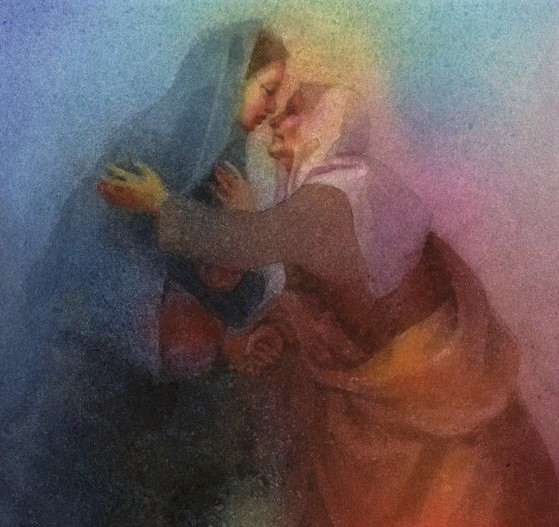
Christian Art | Mary And Elizabeth
Luke 1: 39-45 – 4th Sunday of Advent Year C, also 21st December Weekday (Audio Bible, Spoken Word)
39 And Mary arose in those days, and went into the hill country with haste, into a city of Juda;
40 And entered into the house of Zacharias, and saluted Elisabeth.
41 And it came to pass, that, when Elisabeth heard the salutation of Mary, the babe leaped in her womb; and Elisabeth was filled with the Holy Ghost:
42 And she spake out with a loud voice, and said, Blessed art thou among women, and blessed is the fruit of thy womb.
43 And whence is this to me, that the mother of my Lord should come to me?
44 For, lo, as soon as the voice of thy salutation sounded in mine ears, the babe leaped in my womb for joy.
45 And blessed is she that believed: for there shall be a performance of those things which were told her from the Lord.
Mary has expressed complete obedience to the angel Gabriel and to the will of God, declaring herself the handmaid of the Lord. Now she shows her love and compassion for her cousin and friend as she travels with haste to visit Elizabeth, who, she has learnt from Gabriel, is miraculously pregnant, despite her age.
This is an act of great charity. The journey would not have been easy – it is a considerable distance from Nazareth to the hill country of Judea – but Mary is shown to have no selfish concerns. She is whole-heartedly responding to what the angel has told her.
We may think of Elizabeth as representing the New Testament which is coming to an end, Mary the New which is coming into being. When Mary greets Elizabeth there is the most joyful moment of recognition as the Holy Spirit floods the scene, causing the child John to leap in Elizabeth’s womb, and then Elizabeth to recognize and to proclaim the truth about Mary, rejoicing that the Mother of God should be present with her.
We are taught that John the Baptist, though conceived like other men in original sin, was born without sin because he was sanctified in the womb by the presence of Jesus Christ. Though he is not yet born, he rejoices in the womb – announcing Jesus as the Son of God now, even before either Jesus or John is born! Such is the overwhelming joy of the scene – two beautiful women, concerned for one another, both family and loving friends, and the children they will bring into the world who will transform the world, the Precursor and his Lord and ours, the Son of God. This is such an exciting moment that John cannot contain himself: he bursts with his need to witness Jesus.
We may wonder how much time John and Jesus might have spent with each other while they were growing up and before their respective public ministries. We may wonder where they may have travelled, perhaps which religious communities, such as the Essenes, and teachers they may have spent time with. We may wonder how Jesus as both God and man grew and developed in knowledge, wisdom, and consciousness, and how John might perhaps have related to such processes that must be to us a great mystery. What we can see in these verses is that John’s response to Jesus is a resounding ‘Yes’.
‘The infant leaped, the mother was filled with the Spirit. The mother was not filled before the son, but after the son was filled with the Holy Spirit, he filled his mother too. John leaped and the spirit of Mary rejoiced. As John leaped, Elizabeth is filled, but we know that Mary was not filled but her spirit rejoiced. For he who cannot be comprehended was working in his mother’s womb in ways beyond comprehension. Elizabeth was filled with the Spirit after she conceived, and Mary before.’ St Ambrose



Saint Clement I, Bishop of Rome, likely writing around AD 96, addresses this letter to the Corinthian church during a period of turmoil. Corinth was a Roman colony steeped in competition for status and influence, and such cultural factors likely influenced tensions within the Christian community there. The division in question seems to have been caused by a rebellion against duly appointed presbyters, leading to strife and disunity [ … ]

‘Behold the Lamb of God.’ Throughout the Bible, we are called to know and to develop our relationship with the Lamb. It is in Genesis the Lamb is first mentioned, provided by God as a sacrifice to take the place of Isaac. Through the history of Jewish ritual, a lamb is offered in sacrifice, for expiation, reparation, sanctification. The prophets speak of a meek, tame lamb, sheared without opening its mouth. In the Book of Revelation, or Apocalypse, the full meaning of the Lamb will be revealed, as the king, the Spouse, the lamp, the temple, the place of our eternal dwelling. The Lamb spans all history. And John the Baptist has already, in John’s Gospel, recognised and declared Christ as the Lamb of God who will take away the sins of the world [ … ]
Psalm 81 is a beautiful and sensitive call to worship God. The psalm becomes a tapestry of remembrance, recounting the historical journey of the Israelites from the land of Egypt and God’s faithfulness in delivering them. The psalmist invites the people to celebrate the appointed feasts, recalling the statutes and laws established by the God of Jacob. In this call to celebration is a reminder of human disobedience and consequences of turning away from God’s loving guidance. There is earnest plea for Israel to heed the divine voice, embrace obedience, and receive abundant blessings promised by their covenant-keeping God [ … ]
