

Christian Art | Healing And Preaching The Gospel
Matthew 9: 32-38 – Week 14 Ordinary Time, Tuesday (King James Audio Bible KJV, Spoken Word)
32 ¶ As they went out, behold, they brought to him a dumb man possessed with a devil.
33 And when the devil was cast out, the dumb spake: and the multitudes marvelled, saying, It was never so seen in Israel.
34 But the Pharisees said, He casteth out devils through the prince of the devils.
35 And Jesus went about all the cities and villages, teaching in their synagogues, and preaching the gospel of the kingdom, and healing every sickness and every disease among the people.
36 ¶ But when he saw the multitudes, he was moved with compassion on them, because they fainted, and were scattered abroad, as sheep having no shepherd.
37 Then saith he unto his disciples, The harvest truly is plenteous, but the labourers are few;
38 Pray ye therefore the Lord of the harvest, that he will send forth labourers into his harvest.
Matthew’s account of Jesus’ healing of the dumb man through exorcism, by casting out the demon possessing him, is brief, and in Matthew’s Gospel Jesus does not respond to the Pharisees’ malicious accusation, as if to say, their evil is evident and does not merit response. Rather, Jesus pours immense effort into his Galilean ministry, teaching and healing, and bringing the people to God.
The situation of the people to whom Jesus ministers must have been truly desperate. Their illnesses were many, and these themselves a manifestation of real underlying evils, of their material and spiritual abandonment. They are as sheep without a shepherd. The religious leaders do not help them to be strong to endure with God’s help; rather the people are taught that illness is God’s punishment for sin. It seems there is so little love in the religion of the day, when in truth God Himself is love, as Jesus came to prove to us absolutely, once and for all. The harvest is plentiful, but the labourers are few. There is so much suffering and poverty, and so much love and selflessness lacking and needed to claim the people for God. The Pharisees are certainly incapable of this task. Theirs is the historically falsified, official religion, which left so many excluded and despised.
These verses of the Bible conclude the narrative account of chapters eight and nine, and lead into the second great discourse of Jesus, the Discourse of the Mission, in chapter ten. It is fitting, then, that we are asked to pray for there to be labourers for God’s harvest. This is a prayer for vocation, and an injunction to us all to play a part in the apostolate, to bring the knowledge of God to the world and the world to God. Our own times are similarly clogged with obstacles that stand in the way between people and God, whether poverty or the malaise of crass over-consumption, and the spiritual and physical disease that comes thereby. Through prayer, we are asked to align ourselves ever more closely with God’s intentions, such that we may continue Jesus’ work, reflecting Jesus’ light, as shining lights in a fallen world.
Concluding Prayer
True Light of the world, Lord Jesus Christ,
as you enlighten all men for their salvation,
give us grace, we pray,
to herald your coming
by preparing the ways of justice and of peace.
Who live and reign with the Father and the Holy Spirit,
God, for ever and ever.

King James Audio Bible | Endnotes
The Harvest Truly Is Plenteous, But The Labourers Are Few
The passage in Matthew 9:32-38 recounts a scene in which Jesus heals a mute man possessed by a devil. Jesus then sees the crowds of people who have gathered to witness this miracle. Jesus is moved with compassion, and Jesus tells his disciples: ‘The harvest truly is plenteous, but the labourers are few. Pray ye therefore the Lord of the harvest, that he will send forth labourers into his harvest.’
Jesus highlights a crucial aspect of the Christian mission: the need for more workers to spread the Gospel and bring people into the kingdom of God.
One of the earliest Christian leaders to emphasize the importance of evangelism was the apostle Saint Paul, who wrote in Romans 10:14-15: ‘How then shall they call on him in whom they have not believed? and how shall they believe in him of whom they have not heard? and how shall they hear without a preacher? And how shall they preach, except they be sent?’ Saint Paul saw himself as a sent messenger of the Gospel, and he encouraged other believers to share the good news with those who had not yet heard it.
The importance of evangelism was also emphasized by early Church fathers such as Saint Augustine of Hippo, who wrote in his Confessions: ‘For all those whom Thou hast predestined, Thou hast also called; and those whom Thou hast called, Thou hast also justified; and those whom Thou hast justified, Thou hast also glorified. Therefore, no one ought to say to himself, “I am not called,” for he is not yet justified; nor should he say, “I am not justified,” for he is not yet glorified.’
Protestant reformers also emphasized the importance of evangelism and missions. Martin Luther wrote: ‘We must not sit still and look for miracles; up and doing, and the Lord will be with thee. Prayer and pains, through faith in Christ Jesus, will do anything.’ Similarly, John Wesley, the founder of Methodism, wrote: ‘You have one business on earth – to save souls.’
In more recent times, evangelism and missions have been a central focus of many Christian movements and organizations. The evangelist Billy Graham, for example, preached to millions of people around the world and urged Christians to share the Gospel with others. Mother Teresa, the Catholic nun who ministered to the poor in India, saw her work as a form of evangelism, saying, ‘We are not social workers. We do it for Jesus, for the salvation of souls, for the glory of God.’
Despite the importance of evangelism, however, many Christians today struggle with sharing their faith with others. Some may feel inadequate or unsure of what to say, while others may be afraid of rejection or persecution. In his book, Evangelism And The Sovereignty Of God, theologian J.I. Packer writes: ‘We must be ready to risk embarrassment, rejection, or even persecution as we speak for Christ. But our confidence is not in ourselves, our methods, or our message. It is in the Lord of the harvest, who has promised to be with us always.’
Ultimately, the message of Matthew 9:32-38 is a call to action for all Christians. The harvest is indeed plenteous, but labourers are few. We must pray for God to send more workers into his harvest, and we must be willing to answer that call ourselves. As Jesus said in Matthew 28:19-20: ‘Go ye therefore, and teach all nations, baptizing them in the name of the Father, and of the Son, and of the Holy Ghost: Teaching them to observe all things whatsoever I have commanded you.’
Mission For Christians
This Great Commission is a call for every Christian to be a witness for Christ and share the good news of salvation with those who have not yet heard it.
In his letter to the Galatians, Saint Paul wrote: ‘But the fruit of the Spirit is love, joy, peace, longsuffering, gentleness, goodness, faith, meekness, temperance: against such there is no law.’ (Galatians 5:22-23) When we bear these fruits of the Spirit, we demonstrate the power of God at work in our lives, and people are drawn to the love and peace that we possess.
Jesus himself modeled this kind of witness, not only by preaching the Gospel but also by ministering to people’s physical and emotional needs. He healed the sick, fed the hungry, and comforted the brokenhearted. In doing so, he showed that the love of God was not just a message to be proclaimed but also a reality to be experienced.

Pope Francis
Pope Francis has emphasized the importance of evangelism and sharing the Gospel with others. In his apostolic exhortation Evangelii Gaudium, Pope Francis wrote: ‘The joy of the Gospel fills the hearts and lives of all who encounter Jesus. Those who accept his offer of salvation are set free from sin, sorrow, inner emptiness, and loneliness. With Christ, joy is constantly born anew.’ (Evangelii Gaudium, 1)
Pope Francis has called on Christians to be ‘missionary disciples’, who not only receive the Gospel but also share it with others. He wrote: ‘In virtue of their baptism, all the members of the People of God have become missionary disciples (cf. Mt 28:19). All the baptized, whatever their position in the Church or their level of instruction in the faith, are agents of evangelization, and it would be insufficient to envisage a plan of evangelization to be carried out by professionals while the rest of the faithful would simply be passive recipients. The new evangelization calls for personal involvement on the part of each of the baptized.’ (Evangelii Gaudium, 120)
Moreover, Pope Francis has stressed the importance of showing mercy and compassion to those who are suffering and marginalized, as a way of demonstrating the love of Christ. He has said: ‘The Church’s pastoral ministry cannot be obsessed with the transmission of a disjointed multitude of doctrines to be imposed insistently. We have to find a new balance; otherwise even the moral edifice of the Church is likely to fall like a house of cards, losing the freshness and fragrance of the Gospel. The proposal of the Gospel must be more simple, profound, radiant. It is from this proposition that the moral consequences then flow.’ (Interview with La Civiltà Cattolica, September 2013)
Pope Francis emphasizes the importance of evangelism and sharing the Gospel with others, but he also emphasizes the importance of showing mercy and compassion to those who are suffering and marginalized. This approach aligns with the message of Matthew 9:32-38, where Jesus not only preached the Gospel but also ministered to people’s physical and emotional needs.


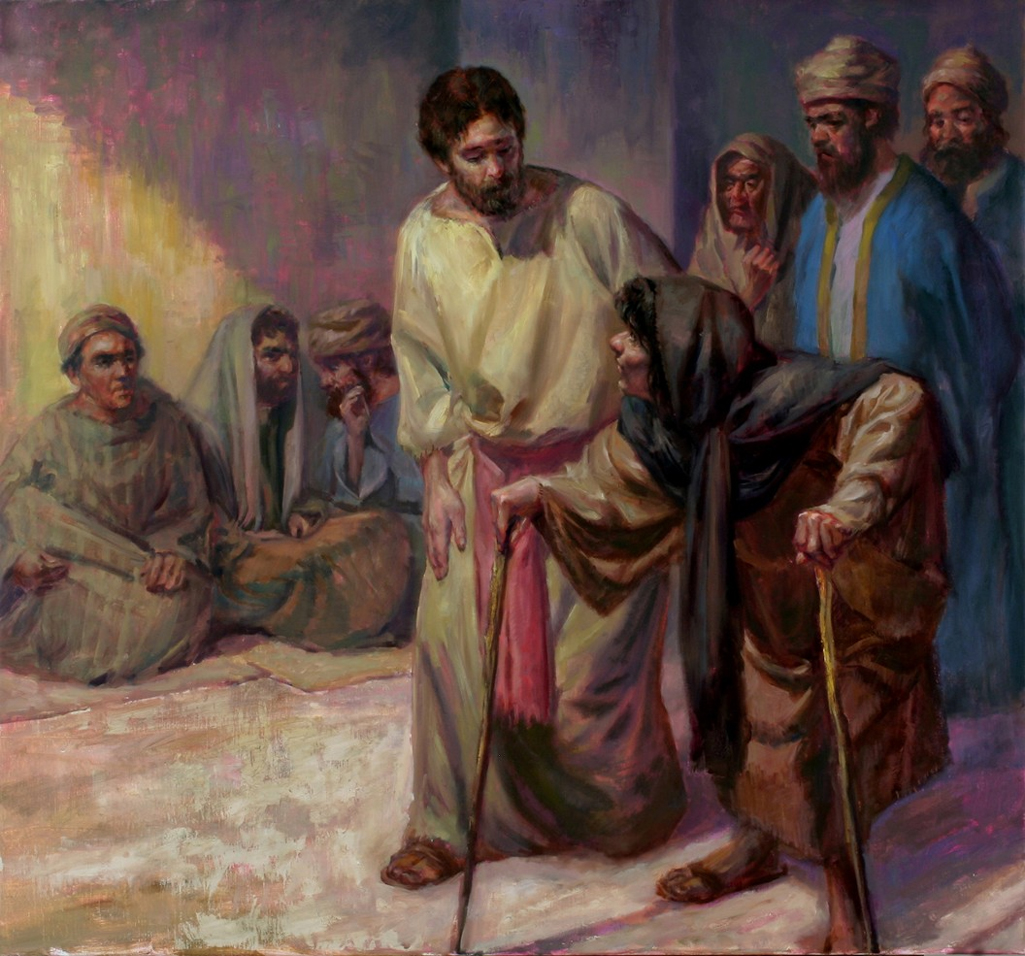
It was customary to go to the synagogue on the Sabbath, to read and study Scripture and praise God, and our Lord Jesus is observant, assuming a teaching role in the synagogue. It is in this context that the crippled woman becomes a type of Christ’s teaching. She has been an abject figure, bowed down for eighteen years. She does not come to the synagogue asking to be healed; she seems quite passive [ … ]

Saint Bede the Venerable (c. 673–735), monk of Wearmouth-Jarrow and the most eminent Anglo-Saxon theologian, offers in this passage a profound meditation on 1 Peter 2:9, wherein the Apostle applies Old Testament imagery to the new People of God. Bede’s theological genius lies in his ability to interweave patristic exegesis, liturgical spirituality, and historical typology into a cohesive vision of the Christian life as pilgrimage from darkness to light, from Egypt to the Promised Land [ … ]
Christian Art | Parousia | Second Coming | Lamb Of God, You Take Away The Sins Of The World Luke 17: 26-37 (Audio Bible KJV, Spoken Word) Early Christian thought about the Parousia – the second coming – was largely influenced by the teachings of Jesus and the writings of Saint Paul. In the early Christian community, expectation of Christ’s return was strong, and many Christians believed that it would happen in their lifetime. This belief is evident in the New Testament, where the authors express a sense of urgency in their writings and encourage their readers to be prepared for Christ’s imminent return. As Christianity spread throughout the Roman Empire, the idea of the Parousia became more complex and nuanced. Theological debates arose around the nature of Christ’s return and the events that would precede it. Some theologians, such as Origen and Augustine, saw the Parousia as a spiritual event that was already happening in the Church. Others, such as the Montanists and the millenarians, believed in a literal, physical return of Christ and the establishment of a new, earthly Kingdom. In the Middle Ages, the Parousia was often associated with apocalypticism and the idea of a final, cataclysmic battle between good and evil – the last battle. The idea of the Antichrist, who would precede Christ’s return, became a popular theme in Christian literature, and the book of Revelation (Apocalypse – meaning to reveal, to uncover) was interpreted as a prophetic guide to the end of the world. Biblical Basis For The Parousia | The Second Coming The concept of the Parousia, or the Second Coming of Jesus Christ, is central to Christian eschatology and is supported by numerous biblical passages in both the Old and New Testaments. In the Old Testament, there are numerous passages that refer to the coming of a Messiah who will restore Israel and bring about the final judgment. For example, in Daniel 7:13-14, it is written: ‘I saw in the night visions, and, behold, one like the Son of man came with the clouds of heaven, and came to the Ancient of days, and they brought him near before him. And there was given him dominion, and glory, and a kingdom, that all people, nations, and languages, should serve him: his dominion is an everlasting dominion, which shall not pass away, and his kingdom that which shall not be destroyed.’ This passage describes a divine figure who comes in the clouds and is given dominion over all nations. In the New Testament, the Parousia is described in greater detail, particularly in the teachings of Jesus and the writings of Saint Paul. Jesus speaks of his return in many passages, including Matthew 24:30-31, where Jesus says: ‘And then shall appear the sign of the Son of man in heaven: and then shall all the tribes of the earth mourn, and they shall see the Son of man coming in the clouds of heaven with power and great glory. And he shall send his angels with a great sound of a trumpet, and they shall gather together his elect from the four winds, from one end of heaven to the other.’ Here, Jesus describes his return in power and glory, accompanied by angels who gather Jesus’ elect from all over the world. In Saint Paul’s letters, the Parousia is also described in detail. In 1 Thessalonians 4:16-17, Saint Paul writes: ‘For the Lord himself shall descend from heaven with a shout, with the voice of the archangel, and with the trump of God: and the dead in Christ shall rise first: Then we which are alive and remain shall be caught up together with them in the clouds, to meet the Lord in the air: and so shall we ever be with the Lord.’ This passage describes a resurrection of the dead and the gathering of believers to meet the Lord Jesus in the air. The language and imagery used to describe the Parousia are often dramatic and apocalyptic in nature. The Parousia is often described as a time of judgment, when the righteous will be separated from the wicked, and God’s justice will be fully revealed. The imagery of clouds, trumpets, and angels is used to depict the power and glory of Christ’s return. Theological Interpretations Of The Parousia | Jesus’ Second Coming The concept of the Parousia has been interpreted in a variety of ways throughout Christian history. Dispensationalism Dispensationalism is a theological framework that emerged in the 19th Century and has since become popular among some evangelical and fundamentalist Christians. Dispensationalists believe that history is divided into distinct periods or ‘dispensations’, each of which is marked by a particular mode of divine revelation and a specific plan of salvation. According to dispensationalist theology, the Parousia will be preceded by a period of tribulation, during which the Antichrist will establish a one-world government and the Jews will be restored to their homeland. The Parousia itself will involve a physical, visible return of Christ, who will establish a thousand-year reign on earth before the final judgment. Preterism Preterism is a theological interpretation of the Parousia that holds that many of the prophecies in the New Testament, particularly those in the book of Revelation, were fulfilled in the first century AD. According to this view, the Parousia occurred in a spiritual sense when Christ ascended to heaven and sent the Holy Spirit to empower the Church. Preterists argue that the tribulation and other end-time events predicted in the New Testament were fulfilled in the destruction of the Temple in Jerusalem in AD 70. Postmillennialism Postmillennialism is a theological view that holds that the Parousia will occur after a period of history in which the Church will gradually bring about the kingdom of God on earth. According to this view, the Church will spread the gospel throughout the world, and social, political, and economic conditions will gradually improve. Eventually, Christ will return to a world that has been largely transformed by the Gospel. Amillennialism […]