
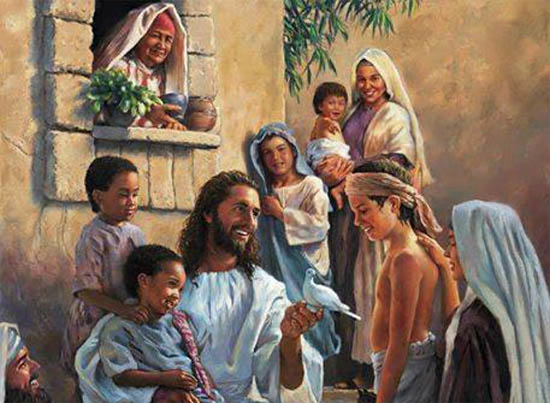
Christian Art | Christian Family | King James Audio Bible KJV
Matthew 12: 46-50 – Week 16 Ordinary Time, Tuesday (King James Audio Bible KJV, Spoken Word)
46 ¶ While he yet talked to the people, behold, his mother and his brethren stood without, desiring to speak with him.
47 Then one said unto him, Behold, thy mother and thy brethren stand without, desiring to speak with thee.
48 But he answered and said unto him that told him, Who is my mother? and who are my brethren?
49 And he stretched forth his hand toward his disciples, and said, Behold my mother and my brethren!
50 For whosoever shall do the will of my Father which is in heaven, the same is my brother, and sister, and mother.
We learn in Mark’s Gospel that Jesus’ friends are concerned about Jesus, thinking that he is beside himself, and intending to restrain him (Mark 3: 21). Shortly afterwards, in Mark’s Gospel, Mary and others of Jesus’ family make the journey recounted in today’s Gospel verses to try to see Jesus.
Jesus’ reaction may seem quite strange to us, and it has been said by some that these Gospel verses, together with other teachings of Jesus concerning the family, tell us that Jesus was to some extent alienated from his own family, that his mission had set Jesus at odds with his family, hence perhaps his moving some distance away.
It is important to think of the role of the extended family, or clan, in Jesus’ time when making sense of Jesus’ remarks in these verses. The family – the large family – was the basis for social living. It was through the family that values and identity were transmitted. The family constituted such security as people had. The family was at the heart of a prayerful relationship with God. And, through the family, one could come to own property.
It was through the various oppressions of the Jewish people, in terms, for example, of occupation, taxation and threats of violence, as through some absorption of a Hellenistic individualistic mentality, that families had tended to close in upon themselves, to look after their own interests at the expense of larger community. Religious prescriptions and proscriptions, the laws of ritual purity, similarly excluded many people from healthy community and family life. Many were marginalized: women, children, Samaritans, foreigners, lepers, possessed persons, tax collectors or publicans, the sick, mutilated persons and paraplegic persons. The concept of family needed opening, to become inclusive, to include all in God’s family, such that all might know they were and are accepted by God.
And so Jesus makes this grand gesture, using the opportunity of his mother’s and brothers’ visit to enlarge for all the notion of Christian family. All those present are privileged to be able to call Jesus their brother. This is no mere form of words. The love we have for Jesus is a family love. We now are a part of Jesus’ family. The change in life, the new life, this gives to us all is palpable. Our concept of family now is not exclusive; it is all inclusive. We experience the joy of being a part of Jesus’ family each day.
Concluding Prayer
Grant us, O Lord Jesus, to imitate faithfully the example of your Holy Family and to make our home another Nazareth.
May peace, love and happiness prevail.
Grant us the grace to be the children and the parents we should be.
Grant that our children may find solid support for their human dignity and for their growth in truth and love.
When the time comes for each of us to go to the everlasting home you have prepared for us, may your glorious Mother and St. Joseph take us to you, after the final grace of a happy death. Amen.

King James Audio Bible | Endnotes
We Are Family In Jesus Christ | Christian Truth
Matthew 12:46-50 is a Gospel passage speaking to the unique and profound relationship that believers share with Jesus Christ. In this passage, Jesus is approached by his mother and brothers, who are seeking to speak with him. Jesus responds by saying: ‘Who is my mother? and who are my brethren? And he stretched forth his hand toward his disciples, and said, Behold my mother and my brethren! For whosoever shall do the will of my Father which is in heaven, the same is my brother, and sister, and mother.’ (Matthew 12:48-50)
This passage is often used to emphasize the spiritual kinship that exists among believers, regardless of biological relationships. Jesus makes it clear that those who do the will of God are his family, and that familial bonds are not limited to blood relations. This idea of a spiritual family in Christ has been important throughout Christian history.
One of the earliest examples of this thought of Christian family can be found in the writings of the apostle Saint Paul. In his letter to the Galatians, Saint Paul writes: ‘For ye are all the children of God by faith in Christ Jesus.’ (Galatians 3:26) Saint Paul emphasizes the idea that believers are united as children of God through their faith in Christ, rather than through biological relationships.
The thought of Christian family is developed in the writings of the Church Fathers. Saint Augustine wrote extensively on the concept of the Church as a spiritual family. In his book, The City of God, Saint Augustine writes: ‘The Church, therefore, is the people of God, who have been called according to his purpose and made partakers of his divine nature, and who are knit together in a unity of spirit and purpose which transcends all earthly ties.’ Saint Augustine emphasizes the spiritual unity that exists among believers, and sees the Church as a family bound together by their common faith in Christ.
This idea of a spiritual family is also reflected in Catholic teaching. The Catechism Of The Catholic Church states: ‘The Church is a family of God’s children, united in Christ and guided by the Holy Spirit.’ (CCC, 1655) The Catechism emphasizes the importance of the Church as a family, and the role of the Holy Spirit in bringing believers together in spiritual unity.
Protestant theologians have also emphasized the idea of a spiritual family in Christ. Martin Luther wrote: ‘The Church is a spiritual, holy, and divine family, built up of living stones, and united in Christ as their head.’ Luther emphasizes the spiritual unity that exists among believers, and the importance of Christ as the head of this spiritual family.
That we are a spiritual family in Christ continues to be vital to Christian thought. Pope Francis has spoken extensively on the importance of unity among believers. In his encyclical Fratelli Tutti, Pope Francis writes: ‘We are all brothers and sisters. The pandemic has reminded us that no one is saved alone. What ties us to one another is what we commonly call “humanity”.’ Pope Francis emphasizes the importance of unity among believers, and sees this unity as essential to the Christian faith.
Furthermore, the concept of spiritual family in Christ is not limited to theological discussions or religious authority figures; it is also a lived experience among believers. Christian communities and churches provide a space for believers to come together and experience the bonds of a spiritual family. In this way, the concept of spiritual family is not just an abstract idea, but a tangible reality for many believers.
The idea of being a spiritual family in Christ has practical implications for how Christian believers are called to live our lives. In the passage from Matthew, Jesus links spiritual kinship with doing the will of God. This suggests that living in accordance with God’s will is a central aspect of being part of the spiritual family of Christ. Indeed, Jesus makes this connection explicit in other passages as well. In John 15:14, Jesus says: ‘Ye are my friends, if ye do whatsoever I command you.’ Here, the concept of friendship is used to describe the relationship between Jesus and his followers, and this friendship is based on obedience to Christ’s commands.
This idea of obedience as a key aspect of spiritual family is reflected in 1 John 2:3-4, which says: ‘And hereby we do know that we know him, if we keep his commandments. He that saith, I know him, and keepeth not his commandments, is a liar, and the truth is not in him.’ This passage emphasizes the importance of obedience to Christ’s commands as a sign of true spiritual kinship.
The commandment to love one another is central to our being spiritual family in Christ. In fact, the apostle John goes so far as to say: ‘If a man say, I love God, and hateth his brother, he is a liar: for he that loveth not his brother whom he hath seen, how can he love God whom he hath not seen?’ (1 John 4:20)
Thus, the concept of spiritual family in Christ has practical implications for how believers are called to live their lives. It emphasizes the importance of obedience to Christ’s commands and love for one another as essential aspects of spiritual kinship. This is not an abstract idea, but a lived reality for many believers. In the Church, believers find a spiritual family where they can experience the bonds of love and unity that come from being part of the family of Christ.


Psalm 53 reflects on faith and consequences of disbelief. The psalm echoes themes found in Psalm 14, offering a compelling exploration of the nature of human folly and the importance of seeking God [ … ]
The scribes and Pharisees were two groups of religious leaders in ancient Judea, during the time of Jesus. The scribes were scholars who were responsible for copying and interpreting the Hebrew Scriptures (also known as the Old Testament). They were experts in the law and were often consulted on matters of religious practice and doctrine [ … ]

There is a beautiful lesson in love, which is to test ourselves when we are offering gifts of love to our beloved/s, and this is by imagining that we actually don’t know the person or people to whom we are giving. This way, we can make sure that what we are doing is giving, rather than making an investment and expecting something in return [ … ]