
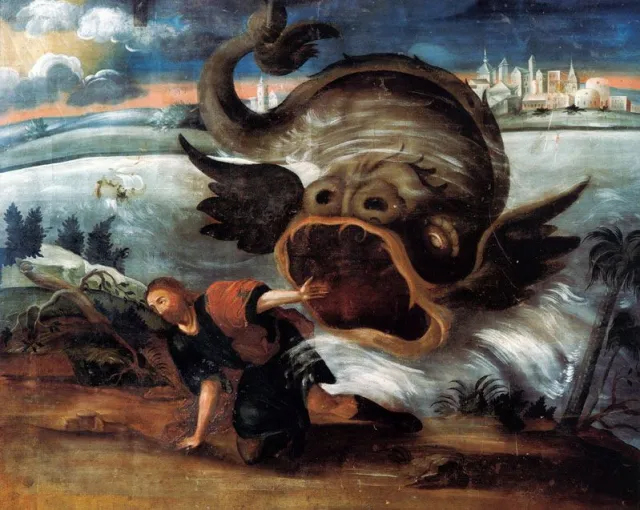
Christian Art | Miracles Of Jesus | Sign Of Jonah (Jonas) | Jonah In The Belly Of The Whale
Matthew 12: 38-42 – Week 16 Ordinary Time, Monday (King James Audio Bible KJV, Spoken Word)
38 ¶ Then certain of the scribes and of the Pharisees answered, saying, Master, we would see a sign from thee.
39 But he answered and said unto them, An evil and adulterous generation seeketh after a sign; and there shall no sign be given to it, but the sign of the prophet Jonas:
40 For as Jonas was three days and three nights in the whale’s belly; so shall the Son of man be three days and three nights in the heart of the earth.
41 The men of Nineveh shall rise in judgment with this generation, and shall condemn it: because they repented at the preaching of Jonas; and, behold, a greater than Jonas is here.
42 The queen of the south shall rise up in the judgment with this generation, and shall condemn it: for she came from the uttermost parts of the earth to hear the wisdom of Solomon; and, behold, a greater than Solomon is here.
Jesus has performed many healing miracles in his homeland, the area in the region of the Sea of Galilee – also known as the Lake of Tiberius and the Lake of Gennesaret. These miracles, or signs, have communicated something of the truth of Jesus to the people, who have responded to Jesus’ miracles and to his teaching. It is through the Sermon on the Mount and other teachings as much as through the healing miracles that people have responded to Jesus, recognizing in Jesus the answer to questions they have long asked, and prayers they have prayed for generations.
It is in this context, against a background of the joyful release from sin and disease experienced by so many, that certain of the scribes and the Pharisees come to Jesus, to demand a sign.
Already the Pharisees’ question defeats them. The sign the Pharisees demand would be some prodigy, a category apart from the beauty and simplicity of Jesus’ teaching and healing – indeed outside of and contradictory to reason and order.
It is for Jesus to deepen our understanding of the Cross through his commentary upon and refutation of the Pharisees’ evil intentions. Jesus’ words evoke the prophet Hosea: it is an evil and adulterous generation that seeks after a sign.
Jesus’ announces the mystery of his death and resurrection, which will be the definitive sign, par excellence, of his divinity and of the truth of his teaching. This must have been baffling to those who first heard these words. They must have wondered what Jesus meant by them.
Jesus speaks also of pagans who have been converted by the prophet Jonah and accepted his teaching, and of the pagan Queen of Sheba who came to visit Solomon, in awe of the wisdom with which God had endowed the King of Israel. There is a marked contrast between the receptivity of these pagans and the hostile refusal of the Pharisees to acknowledge the truth of Christ.
Jesus tells his listeners, somewhat understating the case, that ‘a greater than Solomon is here’. Yet no matter that this is understatement, Jesus nonetheless draws the Gospel toward himself, and declares, in as yet a hidden way, the true and full meaning of the Gospel, which is faith in Jesus as the Son of God, as God the Son. This is indeed the great stumbling block. It is this great truth that emerges, through Christ’s ministry, as he walks to his place on the cross, where he is crowned.
Concluding Prayer
Thy testimonies are wonderful: therefore doth my soul keep them.
The entrance of thy words giveth light; it giveth understanding unto the simple.
I opened my mouth, and panted: for I longed for thy commandments.
Look thou upon me, and be merciful unto me, as thou usest to do unto those that love thy name.
Order my steps in thy word: and let not any iniquity have dominion over me.
Deliver me from the oppression of man: so will I keep thy precepts.
Make thy face to shine upon thy servant; and teach me thy statutes.
Rivers of waters run down mine eyes, because they keep not thy law. (Psalm 119/118, 129-136, Pe)

King James Audio Bible | Endnotes
Doubt And Faith | Three Days In The Belly Of The Whale
Matthew 12:38-42 records an incident where the scribes and Pharisees asked Jesus for a sign, and Jesus responded by pointing to the prophet Jonah as a sign of his coming resurrection. This passage raises questions about faith and doubt, which are explored in Alan E. Lewis’ book A Theology Of Holy Saturday.
Lewis argues that faith and doubt are inextricably linked, and that doubt is not necessarily the opposite of faith. Instead, doubt can be a necessary component of faith, as it forces us to grapple with the paradoxes and mysteries of God.
This idea is reflected in the story of Jonah, which Jesus cites as a sign of his own resurrection. The book of Jonah is full of paradoxes and ambiguities: the prophet initially tries to run away from God, but ultimately ends up doing God’s will; he preaches repentance to the pagan city of Nineveh, which surprisingly responds with genuine remorse; and Jonah himself is both a faithful servant of God and a deeply flawed human being.
The story of Jonah teaches us that faith is not a matter of simply accepting easy answers or clear-cut solutions. Instead, it involves a willingness to engage with ambiguity, paradox, and even doubt. As Lewis writes: ‘We must live within the ambiguities of God’s revelation… we must acknowledge our ignorance and cling to God’s grace.’
This theme of wrestling with doubt and uncertainty can also be found in the writings of many religious authorities throughout history. For example, the Protestant reformer Martin Luther famously struggled with doubts and fears, even as he preached a message of salvation through faith alone. In one of his letters, Luther wrote:
‘I am more afraid of my own heart than of the pope and all his cardinals. I have within me the great pope Self, and over against him the divine pope Christ… Therefore, dear brother, learn Christ and him crucified. Learn to pray to him and, despairing of yourself, say: “Thou, Lord Jesus, art my righteousness, but I am thy sin.”’
Luther’s words remind us that faith is not a matter of having all the answers, but of trusting in the grace of God, even in the midst of our doubts and fears.
Similarly, the Christian theologian Thomas Aquinas recognized that doubt and uncertainty are a natural part of the human condition. In his Summa Theologica, Aquinas writes:
‘Faith is a habit of the mind, whereby eternal life is begun in us, making the intellect assent to what is non-apparent. And since the intellect assents to such things, through being moved by the will, the certainty that is essential to faith, is not derived from the evidence of the thing, but from the will of God Who reveals, and Who cannot be deceived nor deceive.’
Aquinas reminds us that faith is not based on logical proofs or empirical evidence, but on a trusting relationship with a God who is beyond our comprehension.
The story of Jonah teaches us that faith is not a matter of easy answers or clear-cut solutions, but involves a willingness to engage with ambiguity, paradox, and even doubt. Throughout history, religious authorities from both Catholic and Protestant traditions have recognized that doubt and uncertainty are a natural part of the human condition, and that faith involves a trusting relationship with a God who is beyond our comprehension. As we navigate the complexities of our own lives, may we be open to the mysteries of God, and may we cling to the grace that sustains us in the midst of our doubts and fears.



In this account, King Nebuchadnezzar ordered Shadrach, Meshach and Abednego, three faithful Hebrews, to be thrown into a fiery furnace as punishment for refusing to bow down to the golden idol he had erected. Miraculously, when the three were thrown into the furnace, the king witnessed a fourth person walking with them, whom he described as being like the Son of God. The men remained unharmed by the flames, and Nebuchadnezzar acknowledged the power of the God of Israel, recognizing that an angel had delivered the three Hebrews from the fiery ordeal [ … ]
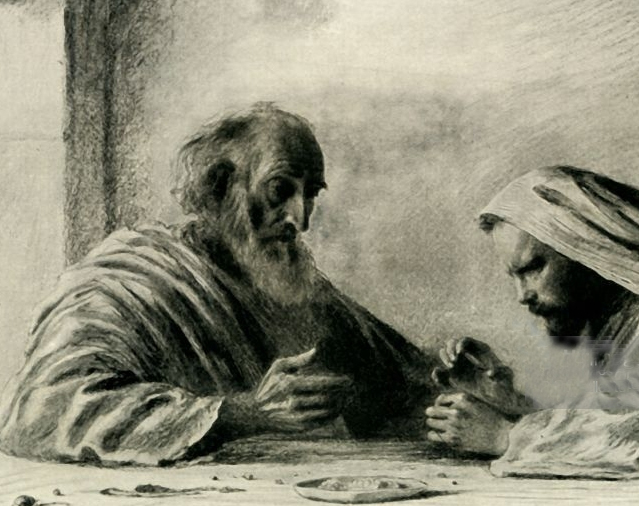
The three parables follow one upon another, and they are addressed in Matthew’s Gospel to the disciples, rather than to the crowds. The parables of the hidden treasure and of the pearl clearly develop upon the same theme, and then the parable of the net follows and expands upon their meaning, magnifying it, while also relating to the disciples’ apostolic mission. We are taught through each parable of the supreme value of the gift of grace and of the Kingdom, and also of judgement, the rightful valuing of our gifts such that we live in accordance with God’s will [ … ]
Saint Bernard returns us to the core Advent mystery: Christ comes to us not only in history and at the end of time, but also now—quietly, inwardly, transforming the heart. Bernard’s teaching is characteristically clear and architectural: three comings, three modes of divine presence, three points along the path of Christian life. Yet the emphasis is unwaveringly experiential. Bernard is not giving us a speculative map but a description of how grace actually works in the soul [ … ]
