
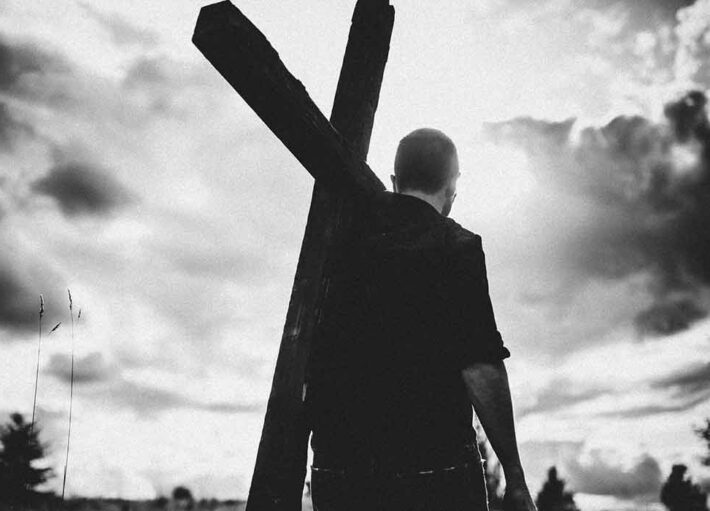
Christian Art | Take Up Your Cross And Follow Jesus | Meditations On The Love Of Jesus Christ
Matthew 16: 24-28 – Week 18 Ordinary Time, Friday (King James Audio Bible KJV, Spoken Word)
24 ¶ Then said Jesus unto his disciples, If any man will come after me, let him deny himself, and take up his cross, and follow me.
25 For whosoever will save his life shall lose it: and whosoever will lose his life for my sake shall find it.
26 For what is a man profited, if he shall gain the whole world, and lose his own soul? or what shall a man give in exchange for his soul?
27 For the Son of man shall come in the glory of his Father with his angels; and then he shall reward every man according to his works.
28 Verily I say unto you, There be some standing here, which shall not taste of death, till they see the Son of man coming in his kingdom.
Jesus invites us to a life of giving. Jesus declares for the Christian an end to egotism, that hoarding of self as of property which can so restrict our lives, distancing us from God and from our fellow human beings, ultimately from perfect happiness. Our happiness is to be found in the service of God, which is also the service of others. As we give our lives away in this sense, as we deny ourselves, so we grow in community as a Christian people.
We are asked to live the life of the Beatitudes, in particular to identify with those who have little and who experience hardship, with those who are marginalized and live their lives far removed from those who might conventionally be seen to embody worldly success. The riches of the world are potentially a hindrance, where they are seen as an end and not a means to an end, to our ultimate end, God Himself.
Jesus speaks figuratively of the cross we are to carry, while knowing the cross that awaits him. The cross was the imperial Roman death sentence inflicted on the lowest in society. It is a sign of the imperial subjugation, as of the gross and dehumanizing brutality of imperial Rome. Jesus takes this sign and overturns its meaning. For Christians, because of Jesus, the ghastly image of a terrible death becomes the ultimate promise of hope fulfilled, Christ’s throne and the gateway to heaven. By carrying our cross as we follow Jesus, we are refusing the allure of the riches of the world to live in accordance with the higher good. And really, as Jesus tells us, his burden is light.
There were those early Christians who expected the end of the world to come in their lifetimes, interpreting Jesus’ words to mean this. Contrary to this interpretation, we hear Jesus speaking of how his Kingdom will grow and flourish through time, from the most humble of beginnings, to encompass the whole world. It seems Jesus may refer in these verses to his death and resurrection, or to the presence of the Kingdom among Christians, as we welcome Christ into our hearts and as we see our Lord in every other person we encounter. As we ask God for the Kingdom, so the Kingdom is with us, a foretaste of the ultimate goal of our lives, when our relationship with God will be perfected.
Concluding Prayer | Love Revealed By Jesus Christ
Lord Jesus Christ,
who on the cross called the penitent thief into your kingdom,
in faith and trust and confessing our sins
we implore your mercy
that after our death
you will lead us rejoicing through the gates of paradise.
Who live and reign for ever and ever.

King James Audio Bible | Endnotes
What Does It Mean For Christians To Take Up Their Cross And Follow Jesus?
To take up one’s cross means to be willing to endure suffering for the sake of Christ. It means that we must be willing to lay down our own desires, ambitions, and even our lives, for the sake of the Gospel. The cross was an instrument of death and it represents the sacrifice that Jesus made for our sins. When we take up our cross, we are acknowledging the sacrifice that Jesus made for us and we are committing to following him, even if it means suffering and persecution.
This call to discipleship is not an easy one. It requires us to deny ourselves, to put aside our own desires, and to submit to the will of God. In doing so, we are called to love God and to love our neighbours as ourselves. As the Apostle Paul wrote in Galatians 2:20: ‘I am crucified with Christ: nevertheless I live; yet not I, but Christ liveth in me: and the life which I now live in the flesh I live by the faith of the Son of God, who loved me, and gave himself for me.’
Many Christians have spoken of the vital importance of taking up one’s cross. In the early Church, Tertullian wrote: ‘The flesh is the hinge of salvation. The flesh is the hinge of salvation. . . . Therefore, the flesh is to be trained to be a minister to the spirit. . . . The flesh must be subdued and brought into subjection, and made a servant of the spirit.’ (On The Resurrection Of The Flesh, 8)
Saint Augustine, in his book The City Of God, wrote: ‘The whole life of a good Christian is a holy desire… But in order that this desire may be fulfilled, we must first take up our cross and follow Him. And what does it mean to take up our cross, but to prepare ourselves for what is good and holy, and to be ready to endure all things for the sake of Christ?’ (The City Of God, Book X, Chapter 2)
In the Protestant tradition, John Calvin wrote: ‘We must be prepared to suffer for Christ, if we desire to be His disciples. For this is the only path that leads to the kingdom of heaven.’ (Institutes Of The Christian Religion, Book III, Chapter 8)
The Catholic Catechism teaches: ‘The disciple of Christ must not only keep the faith and live on it, but also profess it, confidently bear witness to it, and spread it: “All however must be prepared to confess Christ before men and to follow Him along the way of the cross, amidst the persecutions which the Church never lacks.”’ (CCC 1816)
Persecution And Martyrdom Of Christians
Many Christians have taken this call to discipleship to heart and have suffered greatly for the sake of Christ. The early Christian martyrs, for example, were willing to face torture and death rather than deny their faith in Jesus Christ. Saint Polycarp, an early Christian bishop and martyr, is said to have exclaimed, ‘Eighty and six years have I served Him, and He never did me any injury: how then can I blaspheme my King and my Saviour?’ before being burned at the stake for refusing to renounce his faith.
In more recent times, Christians in countries such as China, North Korea, and Sudan have faced persecution and even death for their faith. According to the International Christian Concern, approximately 260 million Christians worldwide currently face high levels of persecution for their faith.
Despite the challenges and suffering that may come with following Jesus, Christians are called to take up their cross and follow. As the Apostle Paul wrote in Philippians 3:7-8: ‘But what things were gain to me, those I counted loss for Christ. Yea doubtless, and I count all things but loss for the excellency of the knowledge of Christ Jesus my Lord: for whom I have suffered the loss of all things, and do count them but dung, that I may win Christ.’
Pope Francis has spoken frequently about the need for Christians to embrace a life of sacrifice and service, echoing the call of Jesus to take up one’s cross. In a homily in 2013, he said: ‘We are called to follow Jesus along the way of the cross, carrying our own cross with him. The cross is not a piece of jewelry or an accessory; it is the mystery of God’s love, which brings redemption to the world.’
In another homily in 2018, Pope Francis emphasized the importance of persevering in the face of difficulty, saying: ‘The Christian life is a journey, a pilgrimage, and we must be prepared to walk along the path of the cross. We must be prepared to suffer for the sake of Christ, to endure the hardships of life with faith and courage.’
Pope Benedict XVI also spoke frequently about the call to take up one’s cross and follow Jesus. In a homily in 2007, he said: ‘To take up the cross means to identify oneself with him who was crucified, to become one with him who bore our sins and our sufferings. It means to follow him on the way of love, which is the way of the cross.’
In his book ‘Jesus of Nazareth’, Pope Benedict XVI also reflected on the meaning of taking up one’s cross, saying: ‘Taking up the cross means following Jesus on his path of love, which leads through suffering and death to resurrection. It means being willing to suffer for the sake of love, to bear the burden of the world’s pain and brokenness in solidarity with Christ.’



The homily reflects the concerns of an early Christian community navigating moral uncertainty, delayed fulfilment, and the practical demands of discipleship. Its tone is pastoral rather than speculative, grounding theological claims in concrete habits of life. The homilist’s central conviction is that the believer’s return to God is both possible and urgent, and that this return takes shape through self-control, repentance, charity, and mutual responsibility within the community [ … ]

Melito of Sardis, writing in the second century, gives us one of the earliest and most powerful reflections on the mystery of Easter. His homily, poetic and theological, offers not just a celebration of the resurrection but a sweeping vision of salvation history fulfilled in Jesus Christ. The tone is triumphant and exultant—fitting for the season of Easter—but the substance is rich with meaning. At its heart, the homily proclaims a profound truth: that in Christ, death is not the end, but the beginning of new and eternal life [ … ]

Saint Ambrose opens with a sweeping affirmation: though all of Scripture breathes God’s grace, the Book of Psalms possesses a distinctive attractiveness. This is not mere literary charm; it is the fruit of divine inspiration that speaks directly to the human heart. The Psalms do not merely record history or doctrine—they pray, praise, plead, and weep with the reader. They give voice to every spiritual state, forming what Ambrose calls a gymnasium for the soul, a place where each believer can exercise the virtues and train for heaven [ … ]