
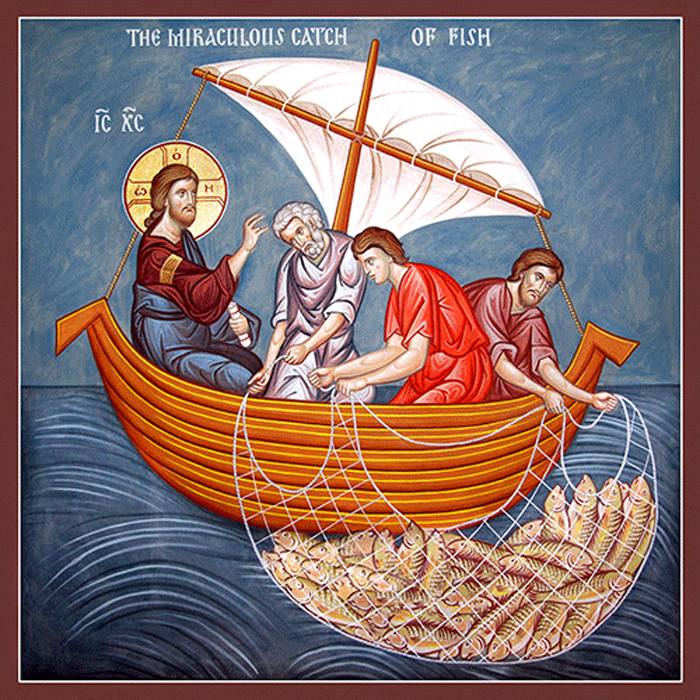
Christian Art | Easter To Pentecost | Miraculous Catch Of Fish | Miracles Of Jesus
John 21: 1-14 Audio Bible KJV | King James Version | Daily Verses
1 AFTER these things Jesus shewed himself again to the disciples at the sea of Tiberias; and on this wise shewed he himself.
2 There were together Simon Peter, and Thomas called Didymus, and Nathanael of Cana in Galilee, and the sons of Zebedee, and two other of his disciples.
3 Simon Peter saith unto them, I go a fishing. They say unto him, We also go with thee. They went forth, and entered into a ship immediately; and that night they caught nothing.
4 But when the morning was now come, Jesus stood on the shore: but the disciples knew not that it was Jesus.
5 Then Jesus saith unto them, Children, have ye any meat? They answered him, No.
6 And he said unto them, Cast the net on the right side of the ship, and ye shall find. They cast therefore, and now they were not able to draw it for the multitude of fishes.
7 Therefore that disciple whom Jesus loved saith unto Peter, It is the Lord. Now when Simon Peter heard that it was the Lord, he girt his fisher’s coat unto him, (for he was naked,) and did cast himself into the sea.
8 And the other disciples came in a little ship; (for they were not far from land, but as it were two hundred cubits,) dragging the net with fishes.
9 As soon then as they were come to land, they saw a fire of coals there, and fish laid thereon, and bread.
10 Jesus saith unto them, Bring of the fish which ye have now caught.
11 Simon Peter went up, and drew the net to land full of great fishes, an hundred and fifty and three: and for all there were so many, yet was not the net broken.
12 Jesus saith unto them, Come and dine. And none of the disciples durst ask him, Who art thou? knowing that it was the Lord.
13 Jesus then cometh, and taketh bread, and giveth them, and fish likewise.
14 This is now the third time that Jesus shewed himself to his disciples, after that he was risen from the dead.
This is an amazing encounter! The disciples have returned to Galilee, where their story with Jesus began. It was natural for them to return home, while awaiting further instruction from Jesus. It is natural also for the disciples to wish to engage in their old and familiar work. It seems a typically spontaneous gesture of Simon Peter when he declares: ‘I am going fishing!’ Things have changed, though. Through their time with Jesus, the lives of the disciples have changed. They are no longer fishers of fish; they have been called by Jesus to be fishers of men. It must have been a frustrating night for the disciples, to feel one’s experience as a fisherman seemingly counting to no effect. The disciples’ true vocation awaits them.
Jesus is near to the disciples, waiting for them on the shore, though they do not recognize him. He is waiting to help them, to let them know again that anything is possible, to bring them faith.
It must have seemed unusual to be told what to do by a seeming stranger in order to catch some fish. Perhaps what Jesus says goes against their experience; he asks them to do something in a different way from that to which they are accustomed. Nevertheless, they obey him, and the catch of fish that results is miraculous, so many fish that the disciples cannot haul the net in, though the net does not break.
It is now that the disciple whom Jesus loved, whom we think to be John, recognises Jesus: ‘It is the Lord!’ he cries with all the joy of recognition. Their master is with them. The true meaning of their life is here. Peter leaps into the water to be with Jesus first, personifying faith and with energy and daring.
Jesus, now glorified, appears to his disciples in a way which is homely and reassuring. After the night spent fishing, they will be hungry; he has prepared them a meal. There is such tenderness as Jesus makes use of natural things, the fire, the fish, to express his love for his disciples. There is a wonderful sense of togetherness as brothers, of mutual knowledge borne of all the time they have spent together.
As Jesus takes the bread and breaks it to give to the disciples, we are reminded once more of our connection with Jesus through the Eucharist. We celebrate the Supper of the Lord to be at one with Christ, so that we too may be brothers with Jesus, in this life and for evermore.
30 The God of our fathers raised up Jesus, whom ye slew and hanged on a tree.
31 Him hath God exalted with his right hand to be a Prince and a Saviour, for to give repentance toIsrael, and forgiveness of sins.
32 And we are his witnesses of these things; and so is also the Holy Ghost, whom God hath given to them that obey him. (Acts of the Apostles 5: 30-32)


Audio Bible KJV | King James Audio Bible | Endnotes
The Character Of Saint Peter In The Gospels
Saint Peter was born in Bethsaida, a small fishing village on the northern shore of the Sea of Galilee. He was the son of Jonah and had a brother named Andrew, who was also a disciple of Jesus. Peter and Andrew were both fishermen by trade and were working together when Jesus called them to be his followers.
According to the Gospels, Jesus first met Peter and Andrew while they were fishing on the Sea of Galilee. In Matthew 4:18-20, Jesus sees them casting their nets into the sea and calls out to them, saying, ‘Follow me, and I will make you fishers of men.’ Peter and Andrew immediately leave their nets and follow Jesus, becoming his disciples.
Throughout the Gospels, Saint Peter is portrayed as a complex and multifaceted character, with both strengths and weaknesses. There is an immediacy about Saint Peter. This is reflected in this passage of the Gospels: ‘I’m going fishing!’ Saint Peter is known for his impulsiveness, his loyalty to Jesus, and his leadership role among the Apostles. The others of the disciples come fishing too!
Saint Peter Is A Man Of Action
One of Peter’s most notable traits is his impulsiveness. Peter is quick to act and speak without fully considering the consequences of his actions, which often leads him into trouble. For instance, in Matthew 14:28-31, Peter asks Jesus to let him walk on water, but when he becomes frightened, Peter starts to sink. Similarly, in Matthew 26:35, Peter boldly declares that he will never deny Jesus, only to do so three times in the following verses.
However, Peter’s impulsiveness is also a sign of his deep love and devotion to Jesus. In John 21:7, Peter is the first to recognize Jesus on the shore and jumps out of the boat to reach him. Later, when Jesus asks Peter three times if he loves him, Peter responds with increasing intensity, affirming his love and devotion each time.
Saint Peter’s Loyalty To Jesus
Fundamental to Peter’s character is his loyalty to Jesus. Peter is one of Jesus’ closest friends and disciples, and he shows great courage and bravery in defending him. For instance, in John 18:10, Peter draws his sword to defend Jesus when he is arrested in the garden of Gethsemane. However, Peter’s loyalty is also tested when he denies Jesus three times during Jesus’ trial. Peter’s denials of knowledge of Jesus reveal Peter’s fear and weakness, as well as his need for forgiveness and redemption.
You Are Peter And Upon This Rock I Found My Church
In Matthew 16:16-19, and punning on the Greek word for ‘rock’, which is to say ‘petra’, Jesus declares that Peter is the rock upon which he will build his Church, and Jesus gives to Peter the keys to the kingdom of heaven. This passage denotes Peter’s leadership role among the Apostles and his authority over the Church.
In the Catholic Church, Saint Peter is regarded as the first Pope, and so the successors of Saint Peter have continued to lead the Church in his name. This view is based on Jesus’ words to Peter in Matthew 16, as well as other passages that emphasize Peter’s role as a leader among the Apostles, such as Acts 2:14 and Galatians 2:7.
Fishers Of Men
Saint Peter’s transformation from a simple fisherman to a leader of the early Church is a testament to the transformative power of Jesus’ teachings and the work of the Holy Spirit. Throughout the Gospels, Peter’s experiences with Jesus and his struggles with faith and doubt provide important lessons for Christians today.
Saint Peter’s leadership role among the Apostles is further emphasized in the Book of Acts. After Jesus’ ascension, Peter takes charge of the group and leads them in selecting a replacement for Judas Iscariot. Peter is also the first to preach to a large crowd on the Day of Pentecost, resulting in the conversion of thousands of people. Throughout the rest of the book of Acts, Peter plays a central role in the growth and organization of the early Church.
Martyrdom Of Saint Peter
According to tradition, Saint Peter was martyred in Rome during the reign of Emperor Nero. The exact circumstances of his death are unclear, but early Christian writings suggest that he was crucified upside down. This gruesome method of execution was considered especially humiliating, and some believe that Peter may have requested it as a way of honoring Jesus’ own death.
The details of Saint Peter’s martyrdom have been the subject of debate. Some scholars have questioned whether Peter was actually martyred in Rome, while others have suggested that he may have been executed at an earlier date. However, the majority of early Christian writers, including Tertullian, Clement of Rome, and Eusebius, all attest that Peter died in Rome.



Saint Ambrose begins his meditation on the Psalms by praising their special role in Scripture: not simply as theological texts, but as a unique blending of prayer, beauty, and doctrine. He writes that a psalm is ‘a blessing on the lips’, ‘a cry of happiness’, and ‘a promise of peace and harmony’. Such language reflects the early Christian sense that the Psalms were the heartbeat of both private devotion and public worship — the school of prayer, to use a phrase echoed by Saint Augustine and, centuries later, by Pope Benedict XVI [ … ]

This remarkable 6th century reflection from an anonymous African author offers a rich theology of Pentecost, drawing together ecclesiology, pneumatology, and missiology with great pastoral clarity. Writing within the context of the post-Roman North African Church—one marked by persecution, doctrinal strife, and cultural transition—this author bears witness to a theology of hope, rooted in the enduring and unifying presence of the Holy Spirit [ … ]

The early Christian community reminds us that our possessions are not to be the source of our identity or security. Rather, they are to be seen as tools for serving and blessing others. It calls us to reimagine our relationships with material wealth, recognizing that true fulfilment comes from using our resources to uplift others and build the kingdom of God [ … ]
