
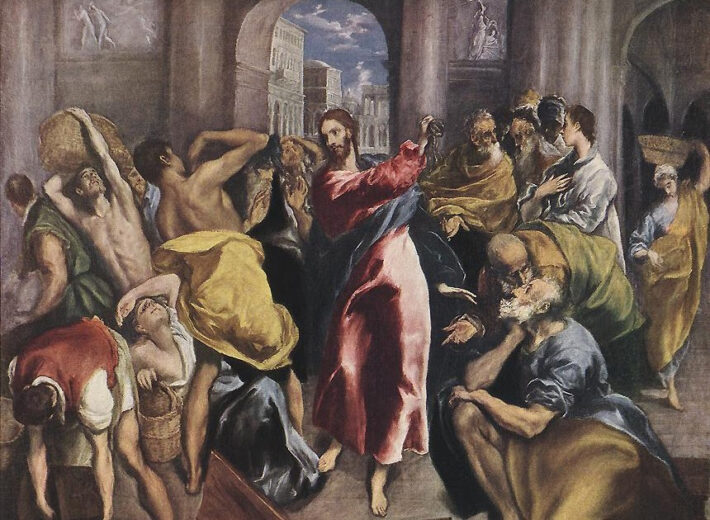
Christian Art | Jesus In The Temple
This audio is chapter 16 of the Gospel of Saint John | King James Audio Bible
37 In the last day, that great day of the feast, Jesus stood and cried, saying, If any man thirst, let him come unto me, and drink.
38 He that believeth on me, as the scripture hath said, out of his belly shall flow rivers of living water.
39 (But this spake he of the Spirit, which they that believe on him should receive: for the Holy Ghost was not yet given; because that Jesus was not yet glorified.)
26 But when the Comforter is come, whom I will send unto you from the Father, even the Spirit of truth, which proceedeth from the Father, he shall testify of me:
27 And ye also shall bear witness, because ye have been with me from the beginning.
12 I have yet many things to say unto you, but ye cannot bear them now.
13 Howbeit when he, the Spirit of truth, is come, he will guide you into all truth: for he shall not speak of himself; but whatsoever he shall hear, that shall he speak: and he will shew you things to come.
14 He shall glorify me: for he shall receive of mine, and shall shew it unto you.
15 All things that the Father hath are mine: therefore said I, that he shall take of mine, and shall shew it unto you.
The Bible verses for the Pentecost Vigil tell of Jesus’ words in the Temple on the last day, the eighth and most solemn, of the feast of Tabernacles. On each day of the feast, the high priest of the Temple would go to the pool of Siloam, bringing water in a golden cup to sprinkle on the altar, and so recalling the water which sprang up in the desert during the Exodus, while reciting Isaiah’s teachings about the coming of the Saviour and the new outpouring of heavenly gifts which would accompany him. ‘Therefore with joy shall ye draw water out of the wells of salvation.’ (Isaiah 12: 3)
It is now, at the centre of events, that Jesus stands before the crowds and proclaims: ‘If any man thirst, let him come unto me, and drink…’ Christ, the fount of living water, offers himself to the crowds of people as the one who can fill our hearts, our souls, and bring us life and peace.
We think also of the book of Ezekiel:
25 ¶ Then will I sprinkle clean water upon you, and ye shall be clean: from all your filthiness, and from all your idols, will I cleanse you.
26 A new heart also will I give you, and a new spirit will I put within you: and I will take away the stony heart out of your flesh, and I will give you an heart of flesh.
27 And I will put my spirit within you, and cause you to walk in my statutes, and ye shall keep my judgments, and do them. (Ezekiel 36: 25-27)
The Holy Spirit has been active during the Old Testament of the Bible: he has spoken through the prophets. We have experienced his presence also in the New Testament, inspiring Mary at the Annunciation, leading Zechariah to prophecy concerning his son and the Lord, and Simeon to see that the Saviour has come. The coming of the Holy Spirit which will follow Christ’s ascension is to be a new revelation, announcing and empowering the birth of the Church and the sacred mission of the Apostles to preach Christ to all. The truth of Christ, God’s plan for our salvation, will then be fully revealed, and embodied in the Church.
In these verses for Pentecost, we learn more of the mystery of the Trinity. All that the Father has belongs to the Son; all that the Son has belongs to the Father. The Holy Spirit is sent by the Son from the Father. He proceeds from the Father, and Father and Son possess everything in common – three persons, one divine essence, the Holy Spirit receiving from, revealing and glorifying Father and Son. It is a great mystery of oneness, relationship and interconnectedness, a model for us all.
In our time, we rejoice as the disciples rejoiced. The Holy Spirit is given to us. We have the truth of our salvation in Jesus Christ. We are moved to pray and to glorify the Lord. Through grace, we are enabled to live lives of faith, hope and charity. We are one with each other in the body of Christ, the Church.
We recognize ourselves in the account of the Acts of the Apostles:
AND when the day of Pentecost was fully come, they were all with one accord in one place.
2 And suddenly there came a sound from heaven as of a rushing mighty wind, and it filled all the house where they were sitting.
3 And there appeared unto them cloven tongues like as of fire, and it sat upon each of them.
4 And they were all filled with the Holy Ghost, and began to speak with other tongues, as the Spirit gave them utterance. (Acts 2: 1-4)
‘Therefore the Lord promised to send us the Holy Spirit to make us fit for God’s purposes. Just as dry flour cannot coalesce into a lump of dough, still less a loaf, without moisture, so too we, being many, could not become one in Christ Jesus without the water which comes from heaven. And just as dry soil cannot bear fruit unless it receives moisture, so we, who to begin with are dry wood, can never bear the fruit of life unless the rain from heaven falls upon our wills.
‘For our bodies through the water of baptism have received the unity which leads to freedom from corruption; but our souls have received it through the Spirit.’ St Irenaeus



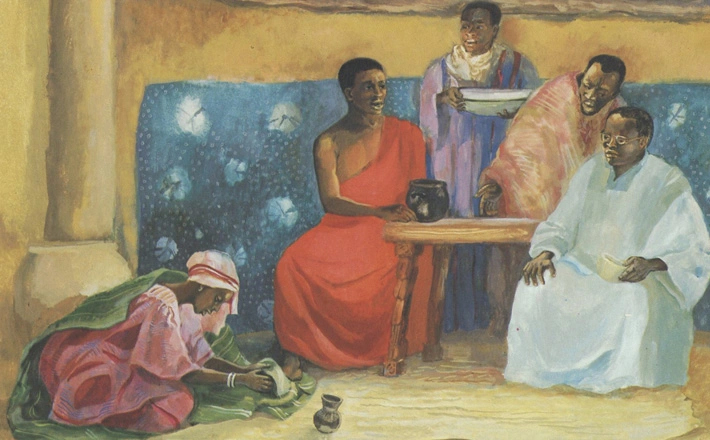
Jesus has been invited to dinner by Simon the Pharisee, which occasion in itself reminds us of the inclusivity of Jesus’ mission. There it would be customary for the men to recline on low divans, leaning on their left arm with their legs tucked under them, away from the table. It would also be customary for the host to honour his guests with a kiss of greeting, with water for their feet, and with perfumes [ … ]

The story of Joseph is of a young man who endured trials and triumphs, demonstrating the power of faith, forgiveness, and God’s providence. Joseph was the favoured son of Jacob, receiving from his father the gift of his coat of many colours, causing jealousy among his brothers. In a moment of jealousy, they sold him into slavery. Joseph was taken to Egypt, where he served in the house of Potiphar. However, he was falsely accused of sexual assault and imprisoned [ … ]

The poem reflects a meditation on human suffering and redemption, as well as a call for divine assistance to transcend the human condition. It is structured in two stanzas, each beginning with the poet’s reflection on human limitations, followed by a plea for union with God, and concluding with a hope for spiritual elevation [ … ]
