
Christian Art | Easter To Pentecost
Luke 24: 35-48 Audio Bible KJV | King James Audio Bible | King James Version | Daily Verses
35 And they told what things were done in the way, and how he was known of them in breaking of bread.
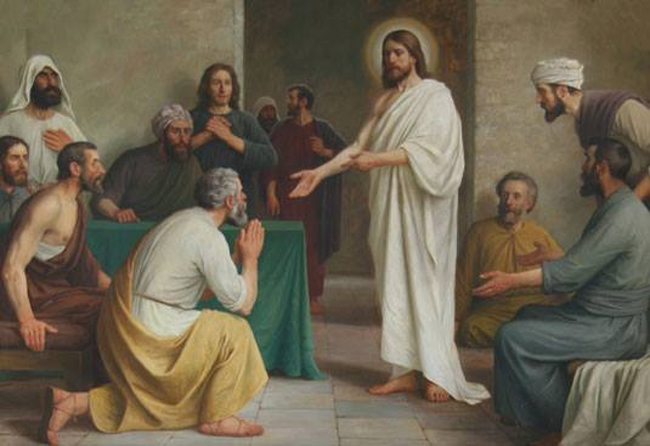
36 ¶ And as they thus spake, Jesus himself stood in the midst of them, and saith unto them, Peace be unto you.
37 But they were terrified and affrighted, and supposed that they had seen a spirit.
38 And he said unto them, Why are ye troubled? and why do thoughts arise in your hearts?
39 Behold my hands and my feet, that it is I myself: handle me, and see; for a spirit hath not flesh and bones, as ye see me have.
40 And when he had thus spoken, he shewed them his hands and his feet.
41 And while they yet believed not for joy, and wondered, he said unto them, Have ye here any meat?
42 And they gave him a piece of a broiled fish, and of an honeycomb.
43 And he took it, and did eat before them.
44 And he said unto them, These are the words which I spake unto you, while I was yet with you, that all things must be fulfilled, which were written in the law of Moses, and in the prophets, and in the psalms, concerning me.
45 Then opened he their understanding, that they might understand the scriptures,
46 And said unto them, Thus it is written, and thus it behoved Christ to suffer, and to rise from the dead the third day:
47 And that repentance and remission of sins should be preached in his name among all nations, beginning at Jerusalem.
48 And ye are witnesses of these things.
These verses are as those for Thursday of Easter Week 1.
The disciples who encountered Jesus on their way to Emmaus have returned in haste to tell the disciples in Jerusalem what they have heard and seen. Jerusalem has long been a city special to God. It is the Holy City. The Church of Christ is described, in the New Testament, as the Jerusalem above, the heavenly Jerusalem, and the new Jerusalem. It is here that Christ suffered. It is from here that the Kingdom of God begins to spread.
When Jesus appears to the disciples in Jerusalem, they are in hiding behind locked doors. They are afraid of the Jewish authorities; the threat of death hangs over them. They are also afraid when they see Jesus because they think they are seeing a spirit, no matter Christ’s first words of reassurance: Peace be with you.
Through these verses, we are brought to understand something more about the nature of Christ’s glorified body and of our own resurrection. Christ’s nature is not now incorporeal. He can be touched. He reassures his disciples further by asking them to give him something to eat. And yet he is not bound by the limitations of time and space. His body is totally subject to his soul. He is free to enter within locked spaces. The resurrection is of flesh and spirit.
It is a beautiful scene, as Jesus offers his body to his disciples again, to assist their belief, so that they may recognize the risen Christ as Jesus of Nazareth, who was crucified, whose hands and feet are pierced. Contrary to all that the disciples have feared, given the shame of death by crucifixion, which indeed was held as a sign of having been cursed by God, Jesus their Lord has returned to them.
Just as he spoke to the disciples on the road to Emmaus, so now Jesus teaches those present to understand the Scriptures anew. He opens the disciples’ minds and they understand. They see now how the Old Testament pointed toward Christ, telling of what must happen to him and of how he would rise. Their minds are illuminated. And, through this, there is the injunction once again to spread the good news, to teach repentance and the forgiveness of sins through Jesus. For the time to come, the disciples are to be witnesses of Jesus’ teaching and of his glorious resurrection which makes our life possible.
10 And if Christ be in you, the body is dead because of sin; but the Spirit is life because of righteousness.
11 But if the Spirit of him that raised up Jesus from the dead dwell in you, he that raised up Christ from the dead shall also quicken your mortal bodies by his Spirit that dwelleth in you. (Romans 8: 10-11)

Audio Bible KJV | King James Audio Bible | King James Version | Endnotes
How Are We To Understand The Doctrine Of The Physical (Bodily) Resurrection Of The Dead?
The doctrine of the physical resurrection of the dead is grounded in the belief that Jesus himself was resurrected in bodily form. This doctrine has been affirmed by both Catholic and Protestant traditions throughout Christian history.
The Resurrection of Jesus Christ in bodily form is the cornerstone of the Christian faith. As the Apostle Saint Paul writes in 1 Corinthians 15:17: ‘And if Christ be not raised, your faith is vain; ye are yet in your sins.’ Thus, the physical resurrection of the dead is not just a belief, but a fundamental aspect of Christian salvation.
Saint Paul wrote in 1 Corinthians 15:20-22: ‘But now is Christ risen from the dead, and become the firstfruits of them that slept. For since by man came death, by man came also the resurrection of the dead. For as in Adam all die, even so in Christ shall all be made alive.’
The Resurrection is a mystery that has been the subject of theological reflection and debate throughout Christian history. While the precise nature of the resurrected body remains unknown, the reality of the Resurrection serves as a testament to the power of God and the hope of eternal life that is promised to all who believe.
Luke 24: 35-48 recounts the story of the resurrected Jesus appearing to his disciples, and subsequent doubts and amazement of his followers as they struggled to comprehend the reality of his Resurrection.
That Jesus appeared to his disciples in the body is a foretaste of the Christian resurrection to come. As the Apostle Paul wrote in 1 Corinthians 15:20-22: ‘But now is Christ risen from the dead, and become the firstfruits of them that slept. For since by man came death, by man came also the resurrection of the dead. For as in Adam all die, even so in Christ shall all be made alive.’
Some have said that the resurrection is to be understood as purely spiritual; others have denied the possibility of bodily resurrection altogether. This is heresy.
One of the earliest articulations of the doctrine of the physical resurrection can be found in the Apostle’s Creed, which states: ‘I believe in the resurrection of the body, and the life everlasting.’ This statement affirms the reality of bodily resurrection and underscores its importance as a precursor to eternal life.
In the Catholic tradition, the Catechism states: ‘The ‘resurrection of the flesh’ [the literal formulation of the Apostles’ Creed] means not only that the immortal soul will live on after death, but that even our ‘mortal body’ will come to life again.’ (CCC 1016) The Catechism goes on to explain that the resurrection will be a transformation of the body, not a simple reanimation of the corpse. The resurrected body will be ‘spiritualized’ and ‘transfigured’, no longer subject to sickness or death.
In the Protestant tradition, the Westminster Confession Of Faith also affirms the physical resurrection of the dead, stating that ‘At the last day, such as are found alive shall not die, but be changed; and all the dead shall be raised up, with the selfsame bodies, and none other’ (Chapter 32, Section 2). Like the Catholic tradition, the Confession emphasizes the transformative nature of the resurrection, stating that ‘the bodies of the just, by the Spirit of Christ, and by virtue of his Resurrection as their head, shall be raised in power, spiritual, incorruptible, and made like to his glorious body’ (Chapter 32, Section 2).
The reality of the resurrection gives Christians purpose and motivation to live lives of service and love, knowing that our labor is reflected in the life to come.
The Human Body In Christian Thought | I Am My Body And The Body Of Christ
The doctrine of the physical resurrection emphasizes the importance of the body in Christian thought. Unlike some other religious traditions that view the body as a hindrance to spiritual enlightenment, Christianity affirms the inherent value and dignity of the body as a creation of God. The resurrection of the body affirms this belief and emphasizes the importance of caring for the physical needs of others, including the sick and the poor.
In contemporary discussions, some have argued that the doctrine of the physical resurrection is scientifically implausible or outdated. In response it has been said that the resurrection of the body is not primarily a scientific claim, but a theological one. It is a set of theological claims about the nature and power of God, rather than a set of empirical or historical claims.
Orthodox belief is that the resurrection of the body is axiomatic.



The psalm opens with an exuberant summons: ‘O come, let us sing unto the Lord: let us make a joyful noise to the rock of our salvation.’ This lively call to worship sets the tone for a collective celebration, a harmonious expression of gratitude and joy directed towards God. The reference to the ‘rock of our salvation’ reminds of God’s steadfastness and reliability, a foundation on which believers can confidently stand [ … ]

The poem explores themes of worship, reverence, and obedience to divine authority. The poem religious tensions of the Reformation era. It expresses Herbert’s struggle with the practice of venerating saints and Mary, this with an unwavering commitment to Christ’s commands. Herbert knows truth, and yet refrains from seeking angels’ and saints’ intercession, with the thought that all worship belongs solely to God [ … ]
The homily, continued, belongs to the early tradition of pastoral exhortation in which Christian teachers address communities facing both internal moral uncertainty and external cultural pressures. The homilist begins by locating himself within the same condition as his hearers. His confession of sin and susceptibility does not function as rhetorical modesty but as a reminder that Christian life is undertaken together. The salvation of each becomes bound up with the fidelity of all. This interdependence reflects an early understanding of the Church as a community shaped by shared discipline rather than by individual achievement [ … ]
