
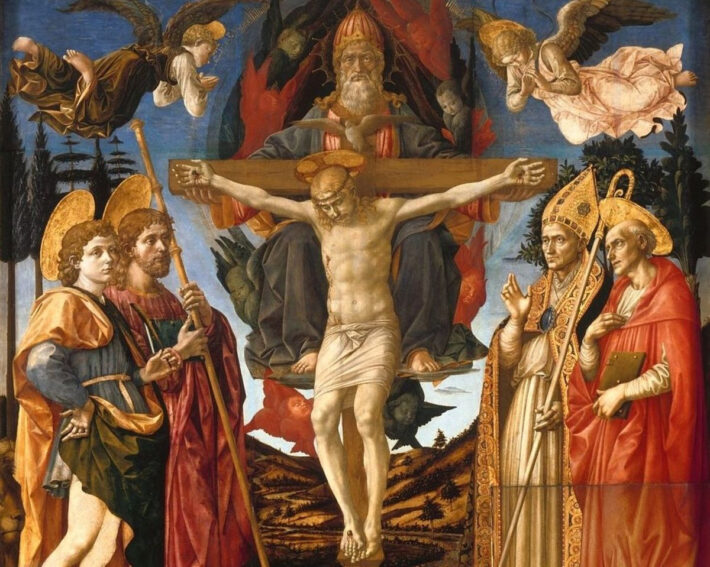
Christian Art | The Holy Trinity At Pentecost
John 16: 16-20 | King James Audio Bible | Daily Verses
16 A little while, and ye shall not see me: and again, a little while, and ye shall see me, because I go to the Father.
17 Then said some of his disciples among themselves, What is this that he saith unto us, A little while, and ye shall not see me: and again, a little while, and ye shall see me: and, Because I go to the Father?
18 They said therefore, What is this that he saith, A little while? we cannot tell what he saith.
19 Now Jesus knew that they were desirous to ask him, and said unto them, Do ye inquire among yourselves of that I said, A little while, and ye shall not see me: and again, a little while, and ye shall see me?
20 Verily, verily, I say unto you, That ye shall weep and lament, but the world shall rejoice: and ye shall be sorrowful, but your sorrow shall be turned into joy.
We are presented in these Bible verses with a peculiar sense of our understanding of time, our human time, in relation to God’s great plan for our salvation, and to the fact of God’s encompassing all time, from which perspective we are born and pass on within the blink of an eye.
‘A little while… and again, a little while…’ The Greek word, micron, is so translated. Really, it could mean ‘an instant’: less than a little; the tiniest amount. This conveys to us something of the immediacy and urgency of the plan of salvation in our lives. The overwhelming of sin and the acceptance of grace and life, the revolution we are called to embrace in our lives, can be the work of a moment and instantaneous; a lifetime, a life eternal, can hinge on what is happening right now in this moment.
In an instant, the Christ the disciples know will be taken away from them. In an instant, their knowledge of Christ will be restored and renewed. The repetition of the verb ‘to see’ is important. Through Christ’s death on the cross, one mode of seeing is come to an end. Through Christ’s glorious resurrection, a new mode of seeing, and so knowing, understanding, is come into fruition. This is now how we see and know Christ.
The disciples do not know what Jesus means. They talk among themselves, as if not daring to display their ignorance to Jesus. Jesus, though, knows what they are thinking. This too is a mark of Jesus’ divinity: where people may not really know of each other, no matter how close to each other we may be, the deepest, most secret thoughts that we carry inside ourselves, Christ as God knows everything about us, indeed more about us individually than we might know ourselves.
Jesus, then, takes care to encourage his disciples to speak their questions openly and to understand. He tells them that, though they will be sorrowful for a while, soon their sorrow will be turned to joy. They will both witness the risen Christ and, ultimately, come to the full knowledge of God when they have passed from this world to live forever.
‘16 A little while, and ye shall not see me: and again, a little while, and ye shall see me, because I go to the Father.
17 Then said some of his disciples among themselves, What is this that he saith unto us, A little while, and ye shall not see me: and again, a little while, and ye shall see me: and, Because I go to the Father?
18 They said therefore, What is this that he saith, A little while? we cannot tell what he saith.
19 Now Jesus knew that they were desirous to ask him, and said unto them, Do ye inquire among yourselves of that I said, A little while, and ye shall not see me: and again, a little while, and ye shall see me?
20 Verily, verily, I say unto you, That ye shall weep and lament, but the world shall rejoice: and ye shall be sorrowful, but your sorrow shall be turned into joy.’ Hebrews 9: 23-28
King James Audio Bible | Endnotes
Faith In Jesus And Uncertainty | Unknowing As A Gateway | Toward Nothing Then Everything
Some may see faith and uncertainty as inherently opposed; others see faith and uncertainty as complementary and even necessary for a deepening of spiritual life.
In the Gospel of John, we see this tension between faith and uncertainty in the disciples’ reactions to Jesus’ teachings. In John 16:16-20, Jesus is preparing his disciples for his departure and the coming of the Holy Spirit, but the disciples are uncertain and confused about what he means. Jesus uses the phrase ‘a little while’ to refer to the time between his departure and his return, which will bring joy to the disciples. However, the disciples do not understand what Jesus is talking about and question among themselves what he means by ‘a little while’. Jesus responds by telling them that they will weep and mourn while the world rejoices, but that their sorrow will turn to joy when they see him again.
This passage highlights the tension between faith and uncertainty, and how Jesus calls his disciples to have faith in him, even when they do not fully understand his plan. The Catholic Catechism similarly notes the importance of faith in the face of uncertainty, stating that ‘Faith is a supernatural gift from God which enables us to believe without doubting whatever God has revealed’ (CCC 153). However, the Catechism also acknowledges that faith can be difficult to maintain in times of uncertainty or crisis, stating that ‘Faith is often lived in darkness, with moments of doubt’ (CCC 164).
Protestant theologian Paul Tillich also recognized the importance of faith in the face of uncertainty, arguing that faith is the ‘state of being ultimately concerned’ (Tillich 1951, p. 4). According to Tillich, this state of ultimate concern is not based on certainty or knowledge, but on a fundamental trust in the ultimate reality that underlies all of existence.
John Calvin emphasized the importance of faith in the face of uncertainty, arguing that ‘Faith is the assurance of things hoped for, the conviction of things not seen’ (Hebrews 11:1). For Calvin, faith was not about having all the answers or being free from doubt, but about placing one’s trust in God even in the midst of uncertainty and struggle.
Protestant theologian Jurgen Moltmann argued that faith is not opposed to doubt, but rather is characterized by a continual struggle between belief and unbelief (Moltmann 1967, p. 68). Similarly, the Catholic theologian Richard McBrien emphasized the importance of doubt in the development of faith, arguing that ‘doubt is not a denial of faith but a stage in its growth’ (McBrien 1994, p. 50).
Protestant theologian Søren Kierkegaard argued that doubt is essential to faith, and that faith is not something that can be fully understood or grasped by the human mind. He wrote, ‘Faith is not a matter of understanding but of willing; it is not a question of grasping the meaning of life but of living a life that has meaning’ (Kierkegaard 1850, p. 278).
Thomas Aquinas recognized that faith is not about having all the answers or being free from doubt, but about trusting in God’s revelation. He wrote, ‘The object of faith is not something seen or understood, but something believed in.’ (Aquinas, Summa Theologica, II-II, Q. 1, A. 1)
Protestant theologian Karl Barth also emphasized the importance of faith in the face of uncertainty, arguing that faith is not based on human knowledge or understanding, but on God’s self-revelation. He wrote, ‘Faith is a gift of God’s grace, and its object is not something that can be grasped by human knowledge, but something that is revealed by God’ (Barth 1956, p. 62).
Catholic theologian Richard Rohr argues that faith is not about having all the answers, but about living with the questions. He writes, ‘Faith is not a matter of having all the answers, but of being willing to live with the questions, to embrace the mystery, and to trust that there is something beyond our own limited understanding.’ (Rohr 2011, p. 8)
Similarly, Protestant theologian Peter Rollins emphasizes the importance of embracing uncertainty and doubt in the development of faith. He writes, ‘Faith is not about being certain, but about being willing to take risks, to live with uncertainty, and to embrace the unknown.’ (Rollins 2006, p. 7)




The two miracles, which occur almost simultaneously in these Gospel verses, shed light upon one another, as Jesus brings two people back to their communities, the woman with the issue of blood, a haemorrhage, because this would render her impure and so outcast, and the girl from death. Two aspects of the Law regarding purity are juxtaposed, and with them sin and death [ … ]
Psalm 67 expresses faith, supplication and universal adoration [ … ]
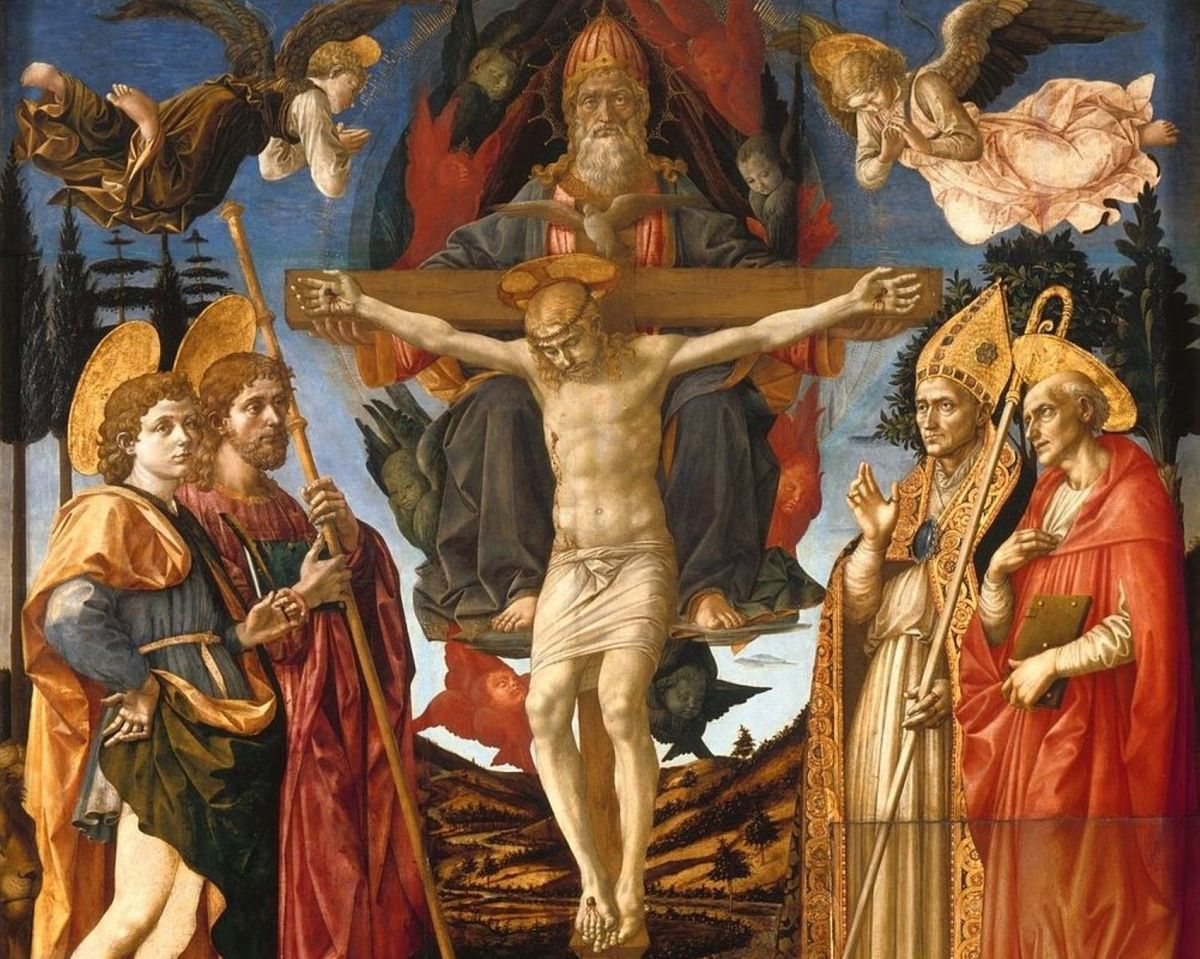
We are presented in these Bible verses with a peculiar sense of our understanding of time, our human time, in relation to God’s great plan for our salvation, and to the fact of God’s encompassing all time, from which perspective we are born and pass on within the blink of an eye. ‘A little while… and again, a little while…’ The Greek word, micron, is so translated [ … ]
