
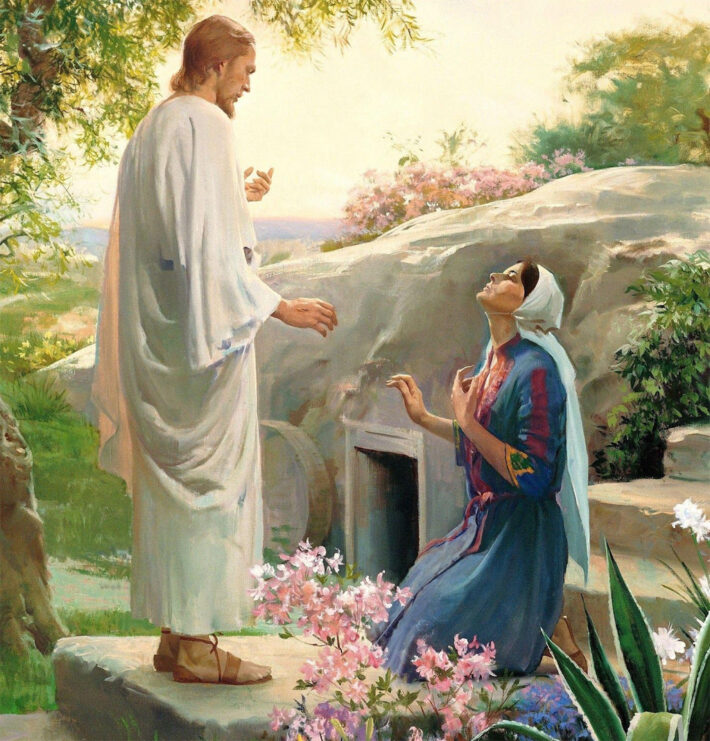
Christian Art | Jesus With Mary Magdalene
The Gospel Of Saint John 20: 11-18 | King James Audio Bible | KJV
11 ¶ But Mary stood without at the sepulchre weeping: and as she wept, she stooped down, and looked into the sepulchre,
12 And seeth two angels in white sitting, the one at the head, and the other at the feet, where the body of Jesus had lain.
13 And they say unto her, Woman, why weepest thou? She saith unto them, Because they have taken away my Lord, and I know not where they have laid him.
14 And when she had thus said, she turned herself back, and saw Jesus standing, and knew not that it was Jesus.
15 Jesus saith unto her, Woman, why weepest thou? whom seekest thou? She, supposing him to be the gardener, saith unto him, Sir, if thou have borne him hence, tell me where thou hast laid him, and I will take him away.
16 Jesus saith unto her, Mary. She turned herself, and saith unto him, Rabboni; which is to say, Master.
17 Jesus saith unto her, Touch me not; for I am not yet ascended to my Father: but go to my brethren, and say unto them, I ascend unto my Father, and your Father; and to my God, and your God.
18 Mary Magdalene came and told the disciples that she had seen the Lord, and that he had spoken these things unto her.
Mary Magdalene, out of whom seven demons were cast, has remained faithful to Jesus, providing for him through his ministry and staying with him through his death on the cross. Now, while the disciples go back to their homes, Mary remains by the tomb, weeping for Jesus. Her love and sensitivity have led her to be greatly concerned about Jesus. She longs to take care of his body.
In these verses of the Bible, Mary’s journey from sorrow to overwhelming joy happens in stages. She remains by the tomb, seeking Jesus, looking into the tomb. The angels tend the place where Jesus’ body has rested. This is a holy place. The angels see Mary’s distress and, to help her on her journey of faith and understanding, they ask her what is wrong. Mary responds frankly. She is upset because she believes someone has taken Jesus’ body; she wishes to find him.
Mary does not yet know that Jesus’ teachings about his resurrection were a true account of what was to happen. The disciples did not know this either. It is understandable. Christ’s resurrection from the dead is a complete conquest of sin and death, a complete overwhelming of the Old Law. The Jesus Mary seeks is the Jesus she knew just a couple of days ago. She is devoted to the Jesus she knew and continues to love. It is entirely fitting that she should be the first to whom Jesus, now glorified, reveals himself.
Mary’s recognition is not instant. In a similar way, the disciples on the way to Emmaus do not recognise Jesus straight away. Assuming him to be a gardener, Mary persists in her search, begging to be told where Jesus’ body has been taken.
It is when Jesus calls Mary by her name that Mary recognizes Jesus. Jesus now speaks Mary’s name in just the way he must have said it many times before, lovingly, with absolute friendship and intimacy. She is called individually in this way to recognize Jesus, in just the way that we are all called by name, individually, to believe in our Lord and to follow him. Our vocation to be with Christ is, for all of us, a deeply personal and loving calling.
Mary is overwhelmed with love and joy. She clings to her Lord. She has found the man she was looking for. This is the Jesus she knew, and now also he has become more than this, exceeding our human knowledge. Jesus is with us, and yet he transcends our incomplete understanding. Through his sacrifice, we may truly regard his Father as our Father. Jesus knows the Father as the Son. We are now sons by adoption, through Jesus Christ.
Mary must not now cling to Jesus. She will see him again. There is a necessary letting go of her knowledge of Jesus to date, in order to appreciate the new and full knowledge of the Son of God and the New Covenant. And Mary has her mission to fulfil. She is chosen by Jesus to be first to spread the good news to his brothers, the disciples. And what a loving way of speaking of his followers this is, as brothers. May we hear the good news, which Mary was the first to share, as brothers and sisters in Christ.
29 And when they had fulfilled all that was written of him, they took him down from the tree, and laid him in a sepulchre.
30 But God raised him from the dead:
31 And he was seen many days of them which came up with him from Galilee to Jerusalem, who are his witnesses unto the people.
32 And we declare unto you glad tidings, how that the promise which was made unto the fathers,
33 God hath fulfilled the same unto us their children, in that he hath raised up Jesus again; as it is also written in the second psalm, Thou art my Son, this day have I begotten thee. (Acts 13: 29-33)


Audio Bible KJV | King James Version | Endnotes
Faith Of Mary Magdalene With Jesus | Jesus Call Me By Your Name
When Mary sees Jesus, she mistakes him for the gardener, but Jesus reveals himself to Mary by calling her by name. However, when Mary tries to touch him, Jesus says: ‘Touch me not; for I am not yet ascended to my Father.’ (John 20:17 KJV)
This statement might seem to contradict other accounts of the resurrection in which Jesus invites his disciples to touch him and see that he is not a ghost or an apparition. Catholic theologian St. Thomas Aquinas wrote about this passage in his commentary on the Gospel of John. He suggests that Jesus’ words were not a prohibition against touching him, but rather an invitation to a more profound kind of contact. Aquinas writes: ‘Christ did not forbid her to touch him, but rather he showed her a more excellent way of touching him, namely, by believing in him with a faith that surpasses sense.’
In other words, Jesus may have been telling Mary not to cling to him physically, but rather to recognize him in a spiritual way. He was not simply back from the dead in the same way that Lazarus had been brought back to life. Rather, his resurrection was a transformative event that had changed the very nature of his being.
Protestant theologian D.A. Carson also comments on this passage, writing that ‘Jesus’ reference to his not yet having ascended to the Father has been taken to suggest that he had to go through some ritual or ceremony in order to complete his resurrection.’
Carson further suggests that Jesus’ words to Mary may have been meant to assure her that he was not simply a resuscitated corpse, but a glorified and resurrected being. By telling her not to touch him, Jesus was affirming the spiritual nature of his resurrection and inviting her to recognize him as such in a deeper way.
Jesus may have been warning Mary not to cling to him in a possessive or selfish way. Jesus knew that his time on earth was limited and that he would soon ascend to heaven. He may have been reminding Mary that his mission was not to stay on earth forever, but to return to the Father and send the Holy Spirit to guide his followers.
Theologians have noted the significance of Jesus’ use of the phrase ‘Touch me not’ in the original Greek language. The phrase is ‘mē mou haptou’ and is used only twice in the New Testament, both times in John 20:17. In other places where Jesus invites his disciples to touch him, a different Greek word ‘psēlaphaō’ is used. This has led some scholars to suggest that Jesus was not simply telling Mary not to touch him, but rather not to hold on to him in a way that would prevent him from ascending to the Father.
Catholic theologian Cornelius Lapide suggests that Jesus may have been telling Mary not to cling to him as if he were still dead, but rather to recognize the new life that he had attained through his resurrection. He writes: ‘The reason why he forbade her to touch him is that she might not believe that he was alive, as if he were a spirit, but he wished her to understand that he was alive, and the same Jesus whom she had known before, but clothed with a new and divine life.’
Catholic theologian Raymond Brown notes: ‘Mary’s clinging to Jesus as the man she knew was inappropriate after his resurrection; what she must do is recognize him as the one who has triumphed over death and is about to ascend to the Father.’
Protestant theologian J. Vernon McGee suggests that Jesus’ words were not a prohibition against physical contact, but rather a statement of his authority and power. McGee writes: ‘Jesus was saying, “Don’t hang on to Me now. You’re going to have plenty of time to do that later on. I have not yet ascended to My Father, and I have some business to attend to.”’
McGee further notes that Jesus’ words to Mary demonstrate his sovereignty over death and his power to give eternal life. He writes: ‘When Jesus said to Mary, “Touch Me not,” he was revealing to her that he had complete control over death and the grave. He could have life or death, whichever He chose.’
R.C. Sproul suggests that Jesus’ words to Mary may have been intended to emphasize the spiritual nature of Jesus’ resurrection, and to teach Mary a lesson about faith. He writes: ‘Jesus wanted Mary to understand that his resurrection was not simply a return to life, but a transformation into a spiritual body. He was teaching her that faith is not based on sight, but on the testimony of the Word of God.’


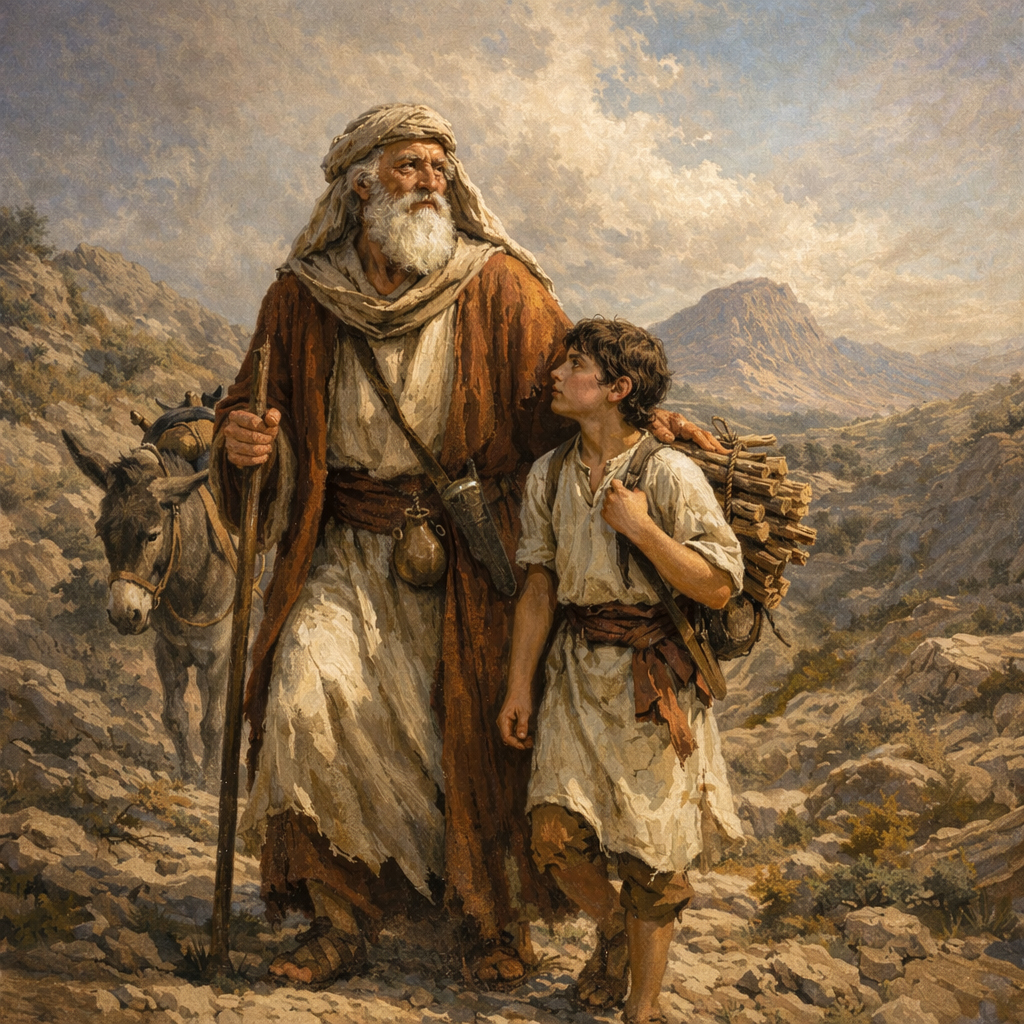
In this homily on Genesis, Origen offers a close and symbolic reading of the sacrifice of Abraham, interpreting it as a figure that points forward to Christ. Origen’s method is not to deny the historical reality of the event, but to read it as part of a larger pattern within God’s saving plan [ … ]

In this passage from Against the Heresies, Saint Irenaeus presents a sweeping vision of salvation history, showing how God, from the very beginning, has been preparing humanity for full communion with God. Central to Irenaeus’ theology is the idea that divine pedagogy unfolds in stages, accommodating human weakness while always pointing toward Christ. Through the law, the prophets, and acts of providence, God was training his people, drawing them from earthly concerns to heavenly realities [ … ]
Divine Majesty: The psalmist begins by acknowledging the greatness of God’s name, reflecting on the divine presence and influence across the Earth and heavens. | Innocence and Humility: The psalmist marvels at the power of innocence and humility, highlighting their role in silencing opposition and adversaries. | Contemplation of the Cosmos: The psalmist reflects on the heavens, the moon, and stars as creations that inspire awe and contemplation [ … ]
