
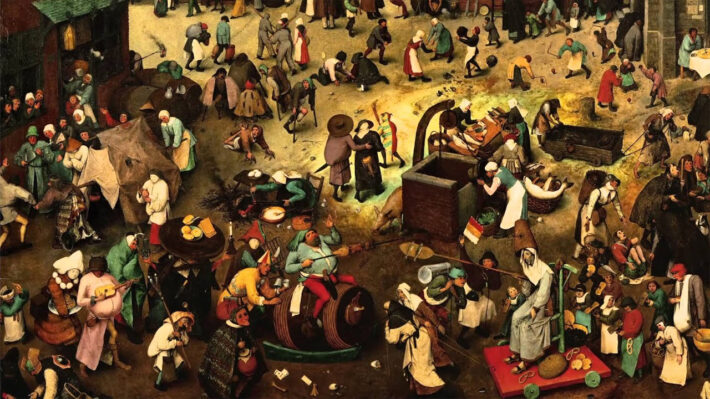
The image is Pieter Brueghel the Elder “The Fight Between Carnival And Lent” 1559
Matthew 6: 1-6, 16-18 – Ash Wednesday & Wednesday of Ordinary Time week 11 (King James Audio Bible, Spoken Word)
1 TAKE heed that ye do not your alms before men, to be seen of them: otherwise ye have no reward of your Father which is in heaven.
2 Therefore when thou doest thine alms, do not sound a trumpet before thee, as the hypocrites do in the synagogues and in the streets, that they may have glory of men. Verily I say unto you, They have their reward.
3 But when thou doest alms, let not thy left hand know what thy right hand doeth:
4 That thine alms may be in secret: and thy Father which seeth in secret himself shall reward thee openly.
5 ¶ And when thou prayest, thou shalt not be as the hypocrites are: for they love to pray standing in the synagogues and in the corners of the streets, that they may be seen of men. Verily I say unto you, They have their reward.
6 But thou, when thou prayest, enter into thy closet, and when thou hast shut thy door, pray to thy Father which is in secret; and thy Father which seeth in secret shall reward thee openly.
16 ¶ Moreover when ye fast, be not, as the hypocrites, of a sad countenance: for they disfigure their faces, that they may appear unto men to fast. Verily I say unto you, They have their reward.
17 But thou, when thou fastest, anoint thine head, and wash thy face;
18 That thou appear not unto men to fast, but unto thy Father which is in secret: and thy Father, which seeth in secret, shall reward thee openly.
In these Bible verses, from the Sermon on the Mount, Jesus gives to his people instruction regarding the three traditional works of mercy of the Jews, namely almsgiving, prayer and fasting. A key message is that, when we pray, when we fast and when we give charity, this is not supposed to be because we wish to be seen as pious by other people. Jesus satirizes those hypocrites who wish to be glorified by other people for their fasting, their giving of alms and their prayers. They sound a trumpet in the streets and strike extravagant attitudes in the synagogues. They visibly mortify their bodies and pull dismal expressions. Jesus portrays such hypocrites as ridiculous. Their piety is not to do with their love of God; it is to do with their wish to be seen as ‘pious’ by their fellow man. And such will be their reward.
Jesus teaches us that, when we give, we must not then declare how much we are giving to others, or even that we are giving. We should, as it were, smuggle our small mite into the offertory. This may then be the act of giving which is most valuable. We are then giving solely through love, of God and of other people, and indeed of ourselves.
Jesus teaches us how to pray. While we share in our community of faith, we are called additionally to be alone with our Father. This is where we meet the truth and the reality of ourselves. While we pray, we are with Jesus. It is beautiful to recall how Jesus prayed, and this at some of his most difficult moments. As we pray, we follow Jesus’ example. We pray to him and through him and with him.
Jesus also teaches us that, when we pray, simplicity and honesty, sincerity, are everything. God already knows our needs. He knows our thoughts. He knows what we keep in our heart of hearts. It is pointless to heap up empty phrases, as if we are going to fool God through a profusion of big, complicated words. It is the truth that we carry inside ourselves, and our being with that truth, that really matters. And so he teaches us the Lord’s Prayer, the Our Father.
As Lent begins, it is perhaps Jesus’ teaching regarding fasting that is uppermost in our minds. And it is a beautiful thought, true to the reality of our faith, that as we give up certain pleasures for the duration of Lent, we should express happiness, really the joy that Christ’s message brings to us.
Lent is a time of penance. We might ask ourselves why we are giving things up for Lent. What is the point of, for example, not eating meat or drinking alcohol? Why ‘mortify’ ourselves, even in small, symbolic ways, when we could easily just roll along with all life’s pleasures? Why remind ourselves that this flesh and the pleasures thereof are temporary; that it is the life of the world to come that really matters? The questions, once we have remembered to ask them, seem to answer themselves.
As we embark on our Lenten journey, may we make each day a day of prayer and of giving and of fasting. Let us seek to imitate Christ each day. May we acknowledge our sins and seek reconciliation. May we give ourselves more and more fully to God in every moment.
And perhaps, when people ask us what we are giving up for Lent, we should keep that our own little secret, between ourselves and God.
‘Let us fix our thoughts on the blood of Christ; and reflect how precious that blood is in God’s eyes, inasmuch as its outpouring for our salvation has opened the grace of repentance for all mankind… Let us turn our eyes to the Father and Creator of the universe, and when we consider how precious and peerless are his gifts of peace, let us embrace them eagerly for ourselves.’ Pope St Clement I to the Corinthians


King James Audio Bible | Endnotes
What is Ash Wednesday?
Ash Wednesday is a Christian religious holiday that marks the beginning of Lent, the 40-day period of fasting and reflection leading up to Easter. On Ash Wednesday, participants attend church services where they receive ashes in the form of a cross on their forehead as a symbol of penance and mortality. The ashes are typically made from palm branches that were blessed on the previous year’s Palm Sunday.
When did Ash Wednesday start?
The exact origins of Ash Wednesday are uncertain, but it has been observed by the Catholic Church for several centuries. The use of ashes as a symbol of repentance dates back to the Old Testament, and early Christians also used ashes as a sign of mourning and penance. The imposition of ashes on the forehead in the form of a cross became a common practice in the Western Church during the eighth century. Since then, Ash Wednesday has been established as an important liturgical observance and a central part of the season of Lent, celebrated annually by millions of Christians around the world.
Why is Lent 40 days?
Lent is observed for 40 days to commemorate the 40 days Jesus spent fasting in the wilderness, as described in the New Testament. According to the Gospels, Jesus was tempted by the devil during this time, but he resisted temptation and emerged from the wilderness strengthened in his resolve to fulfill his mission. The 40-day period of Lent is seen as a time for Christians to imitate Jesus’ fasting and self-discipline, to reflect on their own spiritual lives, and to prepare for the celebration of Easter. The 40 days of Lent are also meant to symbolize the 40 years that the Israelites spent wandering in the wilderness before they entered the Promised Land.
Who celebrates Ash Wednesday?
Ash Wednesday is primarily celebrated by Christians, particularly those of the Catholic and some Protestant denominations, such as Anglicans and Methodists. It is observed by millions of people around the world, including those in North America, Europe, and Latin America, as well as other countries with significant Christian populations. Ash Wednesday is considered an important observance in the liturgical calendar, and many people choose to participate in the traditions and rituals associated with the day as a way of marking the beginning of the season of Lent and preparing for Easter.
What happens on Ash Wednesday?
Ash Wednesday is a solemn day of fasting and reflection observed by Christians, especially Catholics. On this day, people attend Mass or church services where they receive ashes, usually made from palm branches blessed the previous year on Palm Sunday, which are then imposed on the participants’ foreheads in the shape of a cross. Here the priest says to each penitent: ‘Remember you are dust and to dust you shall return.’ This is a sign of penance and mourning for past sins. In addition to the imposition of ashes, Ash Wednesday services often include the singing of hymns, prayers, and homilies or sermons about the significance of the day and the season of Lent. Some people may also choose to fast or give up certain luxuries or pleasures for the duration of Lent as a form of self-discipline and spiritual reflection.
What is the purpose of Ash Wednesday?
Ash Wednesday marks the beginning of the season of Lent, which is a period of reflection, fasting and penance leading up to Easter. On this day, ashes made from palm branches blessed on the previous year’s Palm Sunday are placed on the foreheads of participants in a sign of repentance, humility and mortality. It is a reminder to live a life of devotion and to seek forgiveness for past wrongs.


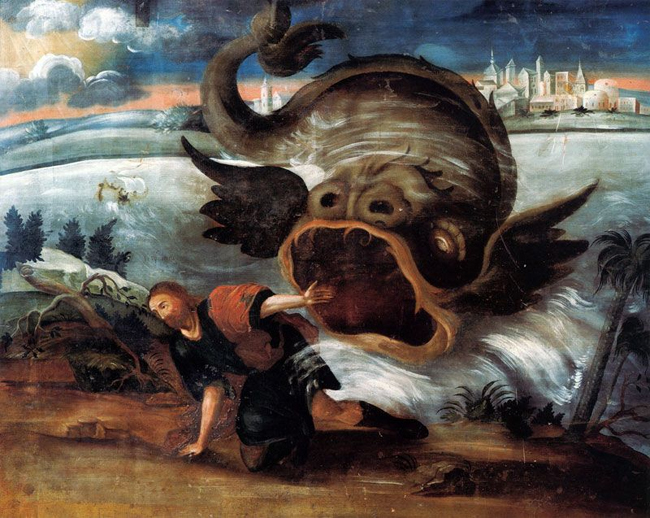
The crowds gather to see and to hear Jesus. Among them, as Matthew relates in his Gospel (Matthew 12: 38-42), are the scribes and Pharisees, who ask for a sign from Jesus to prove his divinity. Jesus refuses to confirm his preaching with dramatic signs. It is his teaching Jesus wishes the people to hear. Through seeking to taunt Jesus, and through their unbelief, the scribes and the Pharisees express the hardness of their hearts. Christ is present to them and they refuse to see. Christ is speaking to them and they refuse to hear. Through the Gospel, we have witnessed Christ’s miracles. And we are called to hear his word. ‘An evil and adulterous generation seeketh after a sign.’ [ … ]

Saint Ambrose is addressing new Christians during the Easter season, shortly after they have received baptism. These ‘neophytes’ have just emerged from the waters of rebirth, wearing white robes to signify purity and new life. Now, he prepares them to receive the Eucharist — not just as a symbol or ritual, but as the real Body and Blood of Jesus Christ [ … ]

Psalm 78 is a compelling narrative recounting the historical journey of the people of Israel, their encounters with God’s miraculous wonders, and their recurrent acts of rebellion. Asaph, the psalmist, takes on the role of a storyteller, urging the people to listen and learn from the lessons of their forefathers. The psalm serves as both a historical reflection and a cautionary tale, emphasizing the importance of remembering God’s deeds and remaining steadfast in obedience [ … ]
