

Christian Art | Daily Verses For Lent
Matthew 5: 20-26 – Lent Week 1, Friday; also Thursday, Ordinary Time, Week 10 (King James Audio Bible KJV, King James Version, Spoken Word)
20 For I say unto you, That except your righteousness shall exceed the righteousness of the scribes and Pharisees, ye shall in no case enter into the kingdom of heaven.
21 ¶ Ye have heard that it was said by them of old time, Thou shalt not kill; and whosoever shall kill shall be in danger of the judgment:
22 But I say unto you, That whosoever is angry with his brother without a cause shall be in danger of the judgment: and whosoever shall say to his brother, Raca, shall be in danger of the council: but whosoever shall say, Thou fool, shall be in danger of hell fire.
23 Therefore if thou bring thy gift to the altar, and there rememberest that thy brother hath ought against thee;
24 Leave there thy gift before the altar, and go thy way; first be reconciled to thy brother, and then come and offer thy gift.
25 Agree with thine adversary quickly, whiles thou art in the way with him; lest at any time the adversary deliver thee to the judge, and the judge deliver thee to the officer, and thou be cast into prison.
26 Verily I say unto thee, Thou shalt by no means come out thence, till thou hast paid the uttermost farthing.
As we progress through Lent, we listen to Christ’s teaching of the limitations of the Old Law and the complete fulfilment, transcendence and renewal of the Law which Christ, through his life, death and resurrection, gave to us. As St Paul will teach: through the Law, there can be no salvation; salvation is for us through Christ alone.
Christ clearly says, however, that he is not come to abolish the Law, but to fulfil it. Through this passage of the Bible, Christ explains how his teaching does in no way lessen the importance of the Ten Commandments; rather, Jesus tells us to hear again the commandments and to extend our understanding of their meaning through the gift of love. Just as God loves us, so we must fulfil his commandments with love both for God and for our fellow man. The letter of the Law is not enough. The letter of the Law will not bring about our salvation. It is the love that we must now know permeates the letter of the Law that brings salvation.
There is great respect demanded here for the Ten Commandments, and a new understanding also required. The Old Law was good and right for a particular stage of human history. The Law anticipated Christ. What has happened, though, is that the scribes and the Pharisees have distorted the spirit of the Law, turning it away from the message of love to an emphasis on external ritual observance. For them, an exact and hyper-detailed observance was the way to salvation. Jesus tells us this is false. It is in this sense that Christ both breaks the Law and re-affirms its core truth as being the justice of God which is love.
Salvation is not something we can achieve through our own works and merits, through our own observances. To be saved, we need God’s grace; we need the salvation Jesus came to give us. We do not deserve this. We cannot do this ourselves. The Old Law is, in this sense, both respected, maintained and transcended. The New Testament of Christ brings a greater truth.
This is why Jesus extends the injunction: you shall not kill. Of course, this law still pertains, but now we are taught to look at every instance where we do something to kill a little of the spirit of our neighbour, our fellow man. To be angry, to insult, to denigrate, these are an evil to our neighbour; they work against him and to kill a little of the spirit within him – and so we injure Christ and really we injure ourselves. We must avoid all thought of killing, and all thoughts which may lead to this most terrible of thoughts. These are negative injunctions which extend the original commandment. We may turn these into a positive, indeed into that positive which Christ explains to us: love your neighbour as yourself. In following this commandment of Jesus, we are in fact obeying the Ten Commandments by honouring God. We are taught by Jesus to abolish all tensions and prejudices and misunderstandings that may persist between us. We are taught to honour our neighbour and to honour God.
This passage of the Bible particularly highlights the fact that, as taught by Jesus, we must set our faith in God firmly in the context of our love of and good relationships with our fellow man. It may well be that, through Lent, as we discipline ourselves, we seek to cleanse also our thoughts of others: ‘Forgive us our trespasses, as we forgive those who trespass against us.’ Once more, our aspired to unity with God and with all other human beings is taught to us as being God’s plan for our salvation.
‘The highest type of brotherly love is to love our enemies and there is no greater encouragement to do this than the remembrance of the wondrous patience exercised by him who, fairest of the sons of men, offered his gracious body to be spat upon by his enemies… [I]f a man would really love himself he should avoid any corrupt love of the flesh. Not to be overcome by fleshly concupiscence, he should turn all his love to the sweetness of the flesh of our Lord. To love his brethren even more perfectly, he should open his arms to embrace even his enemies.’ St Aelred


King James Audio Bible | Endnotes
What Is Transformation Of The Heart? Jesus’ Revolutionary Message
The teachings of Jesus are revolutionary in many ways, perhaps none more so than his call to a deep transformation of the heart, an extreme and a radical conversion, which many Christians might yet find perplexing and a challenge to so much of how we live our lives, particularly as we are habituated to conform to worldly values.
In Matthew 5:20-26, Jesus challenges his listeners to go beyond mere external conformity to the law and to cultivate a deeper righteousness that overflows into their relationships with others.
Jesus begins by setting an extremely high standard for righteousness: ‘Unless your righteousness exceeds that of the scribes and Pharisees, you will never enter the kingdom of heaven’ (v. 20). The scribes and Pharisees were known for their strict adherence to the law, but Jesus teaches that true righteousness is much deeper than mere external conformity. It requires a transformation of the heart, a willingness to confront our own sin and brokenness, and a commitment to love even those who have hurt us.
Jesus calls his followers to this deeper righteousness is through the practice of reconciliation. He says, ‘So when you are offering your gift at the altar, if you remember that your brother or sister has something against you, leave your gift there before the altar and go; first be reconciled to your brother or sister, and then come and offer your gift’ (vv. 23-24). This is a radical challenge to the prevailing cultural norms of Jesus’ time, which often emphasized retaliation and revenge rather than reconciliation and forgiveness.
In this teaching, Jesus connects our human and specifically our family relationships with our relationship with God. Our sense of our relationship with God becomes more closely rooted in human society, which as a consequence may discover itself transformed.
Jesus also challenges his listeners to address the anger and resentment in their hearts, saying that anyone who is angry with their brother or sister will be liable to judgment (vv. 22, 25-26). Again, this is a call to a deep transformation of the heart, to confront and overcome our own sinful tendencies and to cultivate a spirit of love and forgiveness.
Jesus asks for deep-rooted conversion to Christian faith. Our conscience is central, our deep and abiding sense of what is truthful and loving in the heart and according to God’s truth.
Jesus calls to deeper righteousness that overflows into every aspect of our lives, and to a love for others that goes beyond what is expected or even demanded of us. And yet, at the same time, Jesus’ message is not one of despair or condemnation, but of hope and grace. Jesus invites us to trust in God’s transforming power in our lives, and to believe that with God’s help, we can become the people he has called us to be.
In a world that often values external appearances over inner transformation, Jesus’ message challenges Christians to go beyond the superficial, to confront our own brokenness and sin, and to cultivate a deep interior righteousness that overflows into human society. It is a message of hope and grace, reminding us that with God’s help, we can become the people we were meant to be.



Jesus himself experienced deep sorrow during his time on earth. Jesus wept at the tomb of his friend Lazarus and in the Garden of Gethsemane before his crucifixion. Jesus understands the pain we feel, and invites us to bring our sorrows to him. In our mourning, we can find solace and comfort in knowing that Jesus is with us, empathizing with our pain, and offering his peace [ … ]

‘What is truth?’ So asks Pontius Pilate at the show-trial of Jesus. Pilate’s question dismisses and inherently rejects categorical truth as value. Pilate throws the truth to the masses – who cry for the blood of Jesus. As Christians, we hope – we pray, we ask – to adhere to truth. This is our truth: that Jesus is the Son of God, that Jesus died for our sins, and that through Jesus we can attain salvation. Yet, even as we seek to live in the truth, we are tested and tempted, just as Jesus was in the wilderness by Satan [ … ]
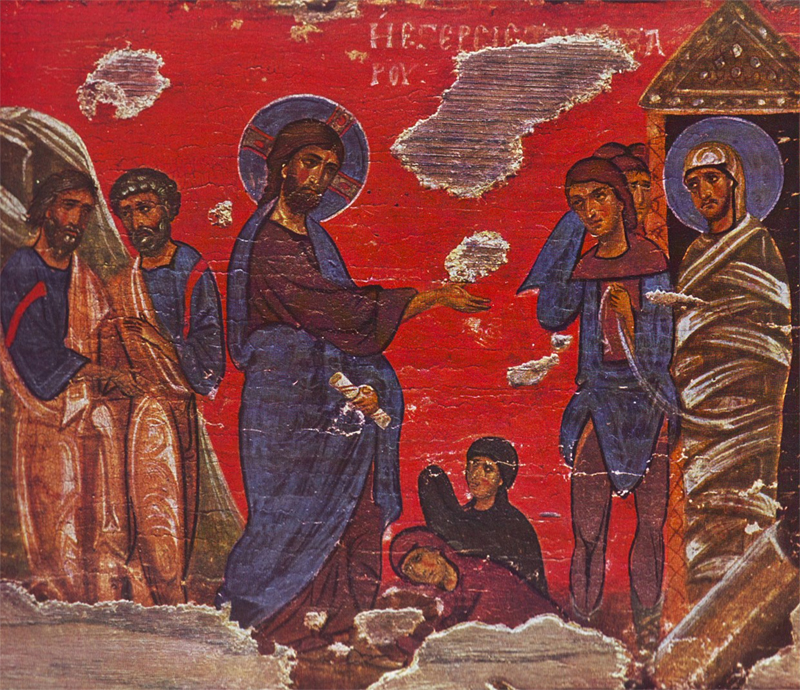
The Gospel Of Saint John, Chapter 11 | Jesus Wept | Death And Resurrection Of Lazarus | KJV The account of Lazarus’s death and resurrection in John 11:1-45 is profound and moving. Central to the story is the shortest verse in the Bible: ‘Jesus wept’ (John 11:35). At first glance, ‘Jesus wept’ appears to be a simple statement of human emotion. It shows Jesus expressing sorrow and empathy, sharing in the grief of Lazarus’s sisters, Mary and Martha, and the mourning community. The moment reveals profound humanity of Jesus. Despite Jesus’ divine knowledge that he would raise Lazarus from the dead, Jesus yet experiences fully human emotions. Jesus is not distant or detached but is intimately connected with the suffering of those he loves. The verse also underscores the reality of death’s impact, even for the Son of God. Although Jesus knows that death is not the final word and that he has power over it, Jesus still mourns. This weeping is not only for Lazarus but for the brokenness of the world that death represents. It reflects sorrow that God feels over the pain and suffering that humanity endures as a result of sin and death. The verse ‘Jesus wept’ highlights compassion of Jesus. Jesus’ tears are an expression of his deep love for Lazarus and Lazarus’ family. In the act of weeping, Jesus demonstrates that God’s response to human suffering is not indifference or cold logic, but rather profound empathy and compassion. The God of the universe is not immune to our pain but enters into it with us. Theologically, this moment is also significant because it foreshadows the passion of Christ. Just as Jesus wept over Lazarus, Jesus would later weep in Gethsemane over the soon-to-be agony of the Cross. Jesus’ tears in John 11 anticipate the suffering he will endure to conquer death once and for all. In weeping for Lazarus, Jesus reveals such depth of his commitment to overcome death and bring life. See also: Daily Bible Verses | Jesus Weeps Over Jerusalem | That Jesus Wept Means He Prayed For The Loss And The Futility | King James Audio Bible KJV