
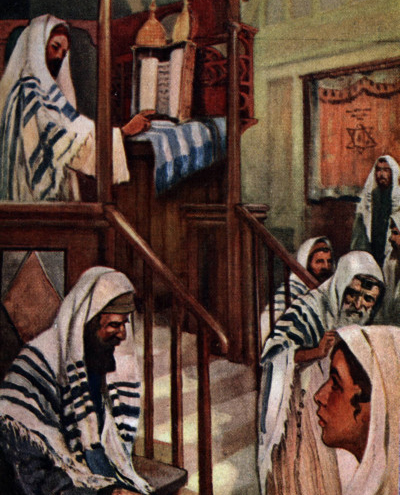
Christian Art | Jesus In The Synagogue In Nazareth
Luke 4: 24-30 – Lent Week 3, Monday (Audio Bible KJV, Spoken Word)
24 And he said, Verily I say unto you, No prophet is accepted in his own country.
25 But I tell you of a truth, many widows were in Israel in the days of Elias, when the heaven was shut up three years and six months, when great famine was throughout all the land;
26 But unto none of them was Elias sent, save unto Sarepta, a city of Sidon, unto a woman that was a widow.
27 And many lepers were in Israel in the time of Eliseus the prophet; and none of them was cleansed, saving Naaman the Syrian.
28 And all they in the synagogue, when they heard these things, were filled with wrath,
29 And rose up, and thrust him out of the city, and led him unto the brow of the hill whereon their city was built, that they might cast him down headlong.
30 But he passing through the midst of them went his way.
Christ has come to Nazareth, where he was brought up, and on the Sabbath day has entered the synagogue. He has been given the book of Isaiah to read. The passage he chooses is this (Isaiah 61):
THE Spirit of the Lord God is upon me; because the Lord hath anointed me to preach good tidings unto the meek; he hath sent me to bind up the brokenhearted, to proclaim liberty to the captives, and the opening of the prison to them that are bound;
2 To proclaim the acceptable year of the Lord…
It is at this point that Jesus has surprised all those present. In Isaiah, the verse continues: ‘…and the day of vengeance of our God.’ That, though, is not what Jesus is about.
The Jewish people long for their redeemer. They are oppressed by a foreign power and seek freedom. They are captives in what should be their own land. Jesus indeed says that he is come to bring liberty to captives. His mission on earth is good news. But he has not come to oppress others in return, to turn the masters into slaves and the slaves into masters. He is come to abolish that whole way of thinking. The good news is for all.
While the people marvel superficially at his words, Jesus sees their true cast of mind. The people of Nazareth want miracles, just as Jesus worked miracles in Capernaum. The spoken word and the real presence of the Son of God are not enough for them. It is in this context that Jesus rebukes the people in the synagogue.
Jesus recalls the fate of prophets in the Bible in Old Testament times. He aligns himself with a discourse that includes both wisdom and suffering. ‘No prophet is accepted in his own country.’ Where one should be most at home and most welcome, there is rather exclusion – as a people fails to recognize itself, as if we were to look in a mirror and fail to look in our own eyes. Locked within the prison of a false ideology, we refuse release. Such are those who reject the Messiah now living among them.
To teach the people of Nazareth to look beyond their own small sphere, and the Jewish people to look beyond their own nation, to show that his redeeming message is for all mankind, Jesus cites two instances of the Old Testament, one of Elijah and the other one of Elisha. Elijah was sent to the foreign widow of Zarephah (1 Kings 17: 7-16). Elisha was sent to take care of the foreigner of Syria (2 Kings 5: 14). God’s mercy is universal. The Messiah is for everyone. ‘Forgive us our trespasses, as we forgive those who have trespassed against us.’
The fury of the people is such that they wish to kill Jesus. It is an extreme, visceral response of anger, where reason could so easily have led them to see Christ for who he really is. Jesus does not respond with anger. He is calm as he moves effortlessly from this now murderous throng. This is the truth of God.
‘God has freed us from dangers beyond all human hope. “We felt,” [says Paul,] “that we had received the sentence of death, but that was to make us rely not on ourselves, but on God who raises the dead; he delivered us from so deadly a peril and he delivers us now. On him we have set our hope that he will deliver us again.”’ St Basil the Great
Audio Bible KJV | Endnotes
Jesus Of Nazareth In Nazareth | A Small Place
In Luke 4:24-30, Jesus returns to his hometown of Nazareth and preaches in the synagogue. At first, the people are amazed at his wisdom and gracious words, but as Jesus begins to challenge their preconceived notions and claim to be the fulfillment of Isaiah’s prophecy, their admiration turns to anger. They drive him out of town and attempt to throw him off a cliff.
The setting of this story in Nazareth is significant for several reasons. Nazareth was a small and insignificant village, located in a remote region of Galilee that was largely ignored by the Roman authorities. This meant that the people of Nazareth were not subject to the same level of taxation and oppression as those living in more prominent regions. As a result, they were more insulated from the outside world and perhaps more prone to develop their own particular religious and cultural traditions.
Furthermore, the fact that Jesus was from Nazareth carried a certain stigma. The people of Nazareth were not highly regarded by their Jewish counterparts, who saw them as uneducated and uncultured. This is why Nathanael, upon hearing that Jesus was from Nazareth, asked: ‘Can anything good come out of Nazareth?’ (John 1:46)
In this context, Jesus’ claims to be the fulfillment of Isaiah’s prophecy would have been particularly galling to the people of Nazareth. They saw themselves as the underdogs, oppressed by the Roman authorities and overlooked by the religious elite. To have someone from their own midst claim to be the Messiah and challenge their sense of victimhood would have been deeply threatening.
The fact that the people of Nazareth were so quick to turn on Jesus, even to the point of wanting to kill him, is a sobering reminder of how easily our admiration and respect can turn to anger and violence when our deeply-held beliefs and sense of identity are threatened. It also underscores the extent to which Jesus was an outsider, even to his own people.
As we enter the season of Lent and prepare for the Passion of Christ, we are reminded of the ways in which Jesus’ own life was marked by rejection and suffering. We are called to reflect on our own capacity for violence and to seek to cultivate a spirit of humility and openness to the ways in which God may be challenging us to grow and change.
At the same time, the story of Jesus in Nazareth reminds us that God is able to work in and through the most unlikely people and places. Despite the stigma attached to his hometown and the hostility of his own people, Jesus remained faithful to his mission and continued to proclaim the good news of the kingdom of God. As we journey through Lent, may we be inspired by Jesus and seek to be faithful witnesses to the gospel in our own time and place.




Saint Theodore the Studite’s homily on the Cross is a rich and theologically layered reflection that blends deep scriptural insight with liturgical devotion, patristic tradition, and the historical experience of Christian suffering. His words emerge not only as theological instruction but as a proclamation of Christian hope and glory through the paradox of the Cross [ … ]

When we are persecuted, it means that we are facing challenges or being treated unfairly because we are trying to live the way God wants us to. We might feel left out, made fun of, or even hurt because of it. But Jesus reminds us that in the end, we have a special place in the kingdom of heaven [ … ]

Saint Augustine continues his reflection on prayer, turning from its inner meaning to its outward rhythm and practice. Desire for God, he says, must be maintained through regular acts of prayer, for human attention is fragile. Involvement in daily affairs dulls the spiritual focus, and unless desire is repeatedly stirred, it fades into indifference. Prayer at appointed times therefore serves not to inform God but to recall the praying person to the direction of that desire [ … ]
