

Christian Art | The Road To Jerusalem
Mark 10: 32-45 – Week 8 Ordinary Time, Wednesday (King James Audio Bible KJV, Spoken Word)
32 ¶ And they were in the way going up to Jerusalem; and Jesus went before them: and they were amazed; and as they followed, they were afraid. And he took again the twelve, and began to tell them what things should happen unto him,
33 Saying, Behold, we go up to Jerusalem; and the Son of man shall be delivered unto the chief priests, and unto the scribes; and they shall condemn him to death, and shall deliver him to the Gentiles:
34 And they shall mock him, and shall scourge him, and shall spit upon him, and shall kill him: and the third day he shall rise again.
35 ¶ And James and John, the sons of Zebedee, come unto him, saying, Master, we would that thou shouldest do for us whatsoever we shall desire.
36 And he said unto them, What would ye that I should do for you?
37 They said unto him, Grant unto us that we may sit, one on thy right hand, and the other on thy left hand, in thy glory.
38 But Jesus said unto them, Ye know not what ye ask: can ye drink of the cup that I drink of? and be baptized with the baptism that I am baptized with?
39 And they said unto him, We can. And Jesus said unto them, Ye shall indeed drink of the cup that I drink of; and with the baptism that I am baptized withal shall ye be baptized:
40 But to sit on my right hand and on my left hand is not mine to give; but it shall be given to them for whom it is prepared.
41 And when the ten heard it, they began to be much displeased with James and John.
42 But Jesus called them to him, and saith unto them, Ye know that they which are accounted to rule over the Gentiles exercise lordship over them; and their great ones exercise authority upon them.
43 But so shall it not be among you: but whosoever will be great among you, shall be your minister:
44 And whosoever of you will be the chiefest, shall be servant of all.
45 For even the Son of man came not to be ministered unto, but to minister, and to give his life a ransom for many.
As Jesus walks ahead of his disciples on the road to Jerusalem, the people who follow Jesus are amazed and afraid. This is the response of the people, not merely to a great teacher or to a nice man, but to God among them. So often in the Bible, the response of a person to God or to one of God’s messengers, the angels, is just this: they are amazed and they are afraid. Mark’s Gospel is telling us here that, on his way to his Passion, his brutal death, Jesus is God become man.
These Bible verses flow from Jesus’ teaching to the rich young man and to his disciples that, to be perfect, we must give away all we have to follow Jesus. Jesus now proves that he is not asking us to do something that he would not do himself. He is heading to Jerusalem to be crucified, and as he does so his divinity is manifest, inspiring fear and wonder in those who witness this triumphal procession: they are watching God go to the place where he will give himself to be sacrificed; they see Jesus and see a man who is utterly liberated. This liberation and the crucifixion are identical, and that is a shocking fact: no wonder there is fear and wonder here.
The two disciples now ask Jesus a favour. They want to sit beside him in the places of honour when Jesus is glorified. They desire status. The fact that this moment is recorded in the Bible is a testament to the modesty of the disciples. They do not disguise from us their initial failings to live in accordance with the teachings of Jesus. They got it wrong, to begin with, and then they went on to become the strong pillars of the Church. It is a lesson for us all.
Jesus teaches the two disciples that they will share with him both in glory and suffering, but this question of status and hierarchy is an irrelevance to the task in hand. In the light of the enormity of what is happening, God going to be crucified to save mankind, it is facile to wonder as to who will be most glorified in the kingdom of heaven.
Jesus now uses the disciples’ question as an opportunity to expand upon his teaching and so to help the disciples to understand better. The last shall be first. The disciples are not sent to lord it over other people but to serve them. They are to be the slaves of all. They must give and give and give and then give some more, just as Jesus gives everything.
‘When once I shall be united to you with all my being, there shall be no more grief and toil, and my life will be alive, filled wholly with you. You raise him up whom you fill.’ St Augustine
King James Audio Bible Spoken Word | Endnotes
Amazed And Afraid, They Follow Jesus
Mark 10:32-45 tells the story of Jesus’ journey with his disciples towards Jerusalem, where he will ultimately be crucified. The passage begins with Jesus leading his followers towards Jerusalem, and the crowds who follow Jesus are amazed and afraid. There is a narrative recognition of Jesus’ power – though as yet unrecognized divinity.
As they walk, Jesus speaks to the disciples, telling them that he will be betrayed, condemned, and ultimately killed. This news shocks and terrifies them. Despite their fear, they continue to follow Jesus, not fully understanding what is to come.
The disciples’ reactions are understandable, given that Jesus’ message was a radical departure from what they had been taught. Jesus taught that the first shall be last and the last shall be first, that those who exalt themselves will be humbled, and those who humble themselves will be exalted. These teachings went against the traditional view that the powerful and wealthy were blessed by God.
The disciples’ fear is also a reminder that following Jesus is not an easy path. It requires courage and the willingness to face persecution and suffering.
Throughout the centuries, religious leaders have written and spoken about the challenges of following Jesus. In his book The Cost Of Discipleship, theologian Dietrich Bonhoeffer wrote that ‘when Christ calls a man, he bids him come and die’. Bonhoeffer’s words remind us that following Jesus requires sacrifice and a willingness to let go of our own desires and ambitions.
Similarly, in his book Mere Christianity, C.S. Lewis wrote that ‘the Christian is to surrender himself to God, to offer all his desires and hopes and fears, to Him; to stake his whole being upon the truth of Christ’s words’.
The disciples’ journey with Jesus towards Jerusalem also teaches us about the nature of leadership. Jesus reminds his followers that ‘whosoever will be great among you shall be your minister: And whosoever of you will be the chiefest, shall be servant of all’ (Mark 10:43-44).
This message of servant leadership has been echoed by many religious leaders throughout history. In his book The Servant As Leader, Robert Greenleaf wrote that ‘the servant-leader is servant first… It begins with the natural feeling that one wants to serve, to serve first. Then conscious choice brings one to aspire to lead.’
Similarly, Pope Francis has spoken extensively about the importance of servant leadership. In his book The Joy Of The Gospel, Pope Francis writes that ‘to be a Christian leader is to serve… It is not a question of being in charge but of shouldering responsibility’.
The disciples’ journey with Jesus towards Jerusalem is a reminder that following Jesus requires courage, sacrifice, and a willingness to serve others. It is a reminder that true leadership is not about power or authority, but about serving others with humility and love. As we continue to walk with Jesus on our own journeys, may we be inspired by the example of Jesus’ disciples and may we strive to follow in their footsteps.





In this sermon, Saint Leo the Great invites us to contemplate one of the deepest mysteries of Christian faith: the living presence of Christ in his Church. Leo’s message is profoundly Eucharistic, ecclesial, and incarnational—rooted in both Scripture and the lived experience of Christian community. Though composed in the fifth century, Leo’s words continue to resonate with clarity and pastoral care [ … ]
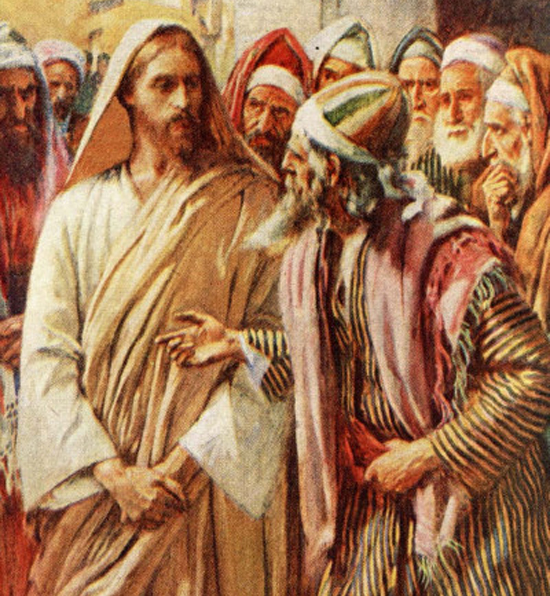
The Sadducees are explicitly held up for criticism in the Gospels less often than the Pharisees, even though they provided the elite which ran the Temple. This is partly because, with the destruction of the Jerusalem Temple in AD 70, the Sadducees were wiped out as a force in Jewish religious life and politics. The Judaism which survived, to regroup and forge a new identity, was that of the Pharisees. Consequently, when there were rivalries between Jews and Christians, it was the Pharisees with whom Christians would find themselves in conflict, and this would colour the memory of earlier times [ … ]

In our Gospel verses this Thursday and Friday, and also Sunday (B), Jesus develops on the parable of the vine and the branches with an injunction for us to be at one with each other, as with Jesus and the Father, through love. The love to which we are called is of a special quality. It is divinely inspired and a reflection of Jesus’ love for us, itself a reflection of the love between the Son and the Father. This is the new commandment [ … ]
