
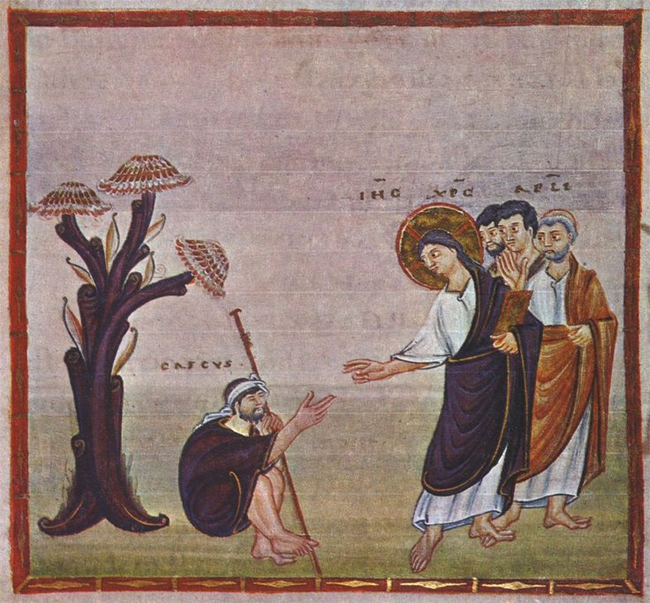
Christian Art | Jesus Heals The Blind Man Of Jericho | Miracles Of Jesus
Luke 18: 35-43 – Week 33 Ordinary Time, Monday (King James Audio Bible KJV, Spoken Word)
35 ¶ And it came to pass, that as he was come nigh unto Jericho, a certain blind man sat by the way side begging:
36 And hearing the multitude pass by, he asked what it meant.
37 And they told him, that Jesus of Nazareth passeth by.
38 And he cried, saying, Jesus, thou Son of David, have mercy on me.
39 And they which went before rebuked him, that he should hold his peace: but he cried so much the more, Thou Son of David, have mercy on me.
40 And Jesus stood, and commanded him to be brought unto him: and when he was come near, he asked him,
41 Saying, What wilt thou that I shall do unto thee? And he said, Lord, that I may receive my sight.
42 And Jesus said unto him, Receive thy sight: thy faith hath saved thee.
43 And immediately he received his sight, and followed him, glorifying God: and all the people, when they saw it, gave praise unto God.
Jesus is very close to Jerusalem now and a great multitude are processing with him. There is a tremendous sense of triumph in the air, even as Jesus approaches the cross, which indeed will be the sign of his victory.
The blind man of Jericho cannot at first know what is happening, but when he hears that it is Jesus passing he responds with great urgency, shouting out to Jesus and acclaiming him as the Messiah with the title Son of David. This is a response of faith to Jesus’ presence, showing energy and conviction; the blind man will not be silenced when the crowds try to hush him; he will continue to pray to Jesus. We are called through this story to be constant and bold in our faith, no matter the reaction of other people, should people look to silence us. We are called not to hide our lifelong petition to Jesus.
We often think of sight as being symbolic of knowledge and understanding, while we might say people are metaphorically blind when their, or our, grasp of things is clouded and unclear. We should be careful with such symbol and metaphor, and clear that we are not implying blind people are intellectually ‘blinded’. This provides, though, a ready way in which we can pray to Jesus for an increase in faith and commitment, when perhaps we doubt or feel baffled by the ways God seems to be directing events. Lord, let me receive my sight.
We give thanks to God and the Father of our Lord Jesus Christ, praying always for you…
Giving thanks unto the Father, which hath made us meet to be partakers of the inheritance of the saints in light:
Who hath delivered us from the power of darkness, and hath translated us into the kingdom of his dear Son:
In whom we have redemption through his blood, even the forgiveness of sins. (1 Colossians 3, 12-14)


King James Audio Bible | Endnotes
Jesus Heals The Blind Man of Jericho
The blind man hears that Jesus is passing by and he cries out for mercy. The people around the blind man try to silence him, embarrassed by his loud cries to Jesus. Perhaps they were concerned about disrupting the social norms and conventions of the time.
However, the blind man’s cries persist and even become louder. Despite the potential for social ostracism, he calls out all the more to Jesus. The blind man recognizes that Jesus is his only hope for healing, and he will not be silenced. In doing so, the blind man exhibits a profound faith and a willingness to step outside the bounds of social conformity.
This encounter between the blind man and Jesus reveals the tension between the call to follow Jesus and the pressure to conform to societal norms. The people around the blind man were more concerned with maintaining the status quo than with helping him to receive the healing he needed from Jesus.
However, Jesus did not allow the opinions of others to prevent him from hearing the man’s cries and granting his request. Jesus recognized the blind man’s faith and persistence and responded with compassion and healing.
This story challenges us to consider our own attitudes towards those who are marginalized or different from ourselves. Are we more concerned with fitting in and conforming to societal expectations, or are we willing to step outside of our comfort zones to help those in need?
Additionally, the story invites us to consider the role of faith in our lives. The blind man’s persistence and faith enabled him to receive his sight. We too can experience the transformative power of faith if we are willing to call out to Jesus, even if it means going against societal norms or risking embarrassment.
Pope Francis has commented on this passage. In his homily on March 3, 2013, he spoke about the blind man’s persistence and how it can inspire us in our own lives. Pope Francis said: ‘The blind man was very brave, he shouted, he made himself heard. And when Jesus called him, he threw off his cloak and ran to him. This is a beautiful gesture. When the Lord calls us, we must do the same: throw off our cloak and run to him.’
In another homily on October 25, 2015, Pope Francis spoke about the blindness that can affect us all, both physically and spiritually. He said: ‘We are all a bit blind, all of us. We all have our limitations, our defects, our sins. But if we allow ourselves to be called by Jesus, if we cry out to Him with faith, He will heal us, He will open our eyes and our hearts.’
In his general audience on May 22, 2013, Pope Francis also spoke about the importance of persistence in prayer, using the blind man’s cries as an example. He said: ‘The Gospel of Luke presents the blind man who, despite being urged to be silent, does not give up and cries out all the more loudly: “Son of David, have mercy on me!” This is a beautiful example of prayer, which perseveres and overcomes all obstacles.’



Origen of Alexandria, also known as Origen Adamantius, lived during a formative period of Christian thought in the Roman East. His life was shaped by early Christian devotion, intense scriptural study, pastoral work, ecclesiastical conflict, and the intellectual currents of Alexandria and Caesarea. Origen’s writings occupy an important place in the history of biblical interpretation and early Christian theology. At the same time, doctrines associated with his name became sources of dispute long after his death, influencing the Catholic Church’s decision that he be not a saint [ … ]
In this reading, Gregory of Nyssa returns to the text of Ecclesiastes but reads it through a distinctly spiritual and moral lens. The apparent inevitability of birth and death—presented in Scripture as part of the natural order—is reinterpreted as referring not merely to biological events but to the inner life of the soul [ … ]
The Carrefour will be open, where I can buy nuts for the red squirrel, who lives in Campo Grande. The red squirrel is Valladolid’s best bit. Even as a child, I had never seen one before, apart from in picture books. It was last term’s discovery. The most beautiful encounter. I didn’t know it was there – in the park. A complete surprise. The tiny little thing bobbled and hopped, as it received in its little hands a nut from the man’s hands. Each surprising instant – it was childlike. I whispered: ‘Oh my wow.’ I walk toward the El Cortes Ingles. There is, for now, that settled feel of friends in bookshops. Though a null-affect, neutral day – it won’t glean, it is not to be scratched at. The queues are long in the Carrefour. Though, as it might be, on relatively modest incomes, many people live centrally. Their behaviours neither pinched nor stark. Yet the shop so busy while the street so empty… An error in the simulation, a glitch in the code. I potter about the aisles, which are pleasant enough, then at the tills I flinch at how expensive a little bag of up-sold nuts can be. Nonetheless, I queue for a packet of almonds. Two English men queue directly ahead of me. They are stocky, and have gay voices, their wheelie-bucket piled with soft drinks and party food, while they bitch to one another about the obviously terrible party they’re going to. The air heaves relief as I wander up the way to the broad plaza fringing Campo Grande. This is a place to see – a piece of Spain. There is a tourist information office, though unopened. At these fountains, three girls take selfies. Pompous-looking buildings, the military offices aside, line the park’s nearest vicinities. Hotel-bars have their patches. Liveried doormen idle time, for there are no paying customers, in and out the doorways’ shadows. A mixed group of kids play at the hoops on the pedestrian boulevard, and two boys practise on skateboards, working the thing out. I pass by them, touched by the thought, and happy that they are there. Wistful, I smile at the odds of the ball spilling over to me, and play in mind the agreeable scene of a fleeting connection. Then I am through the park gates. An air now – of humanity become self-selecting. Modestly understated. Understatedly modest. Campo Grande is nice but it isn’t grande… I walk slowly, and very soon hear for a second time English voices. Not them – it is an English family, just a little way ahead, a Dad and a Mum and a younger boy and an older girl, and theirs are Midlands accents. Dad seems to have been here and to know the place. He gestures panoramically. Mum wants her lunch. The girl at a difficult age. She carries a balloon-on-a-stick. Though she is sprouting – yet wears a loud dress. Then leggings, trainers. Her hair is nice… Maybe she is being okay about it. And not horrific. It’s okay once they get into it, but those months… Yet then, they mostly blossom, if they come from a good home, and become rounded personalities, entering into their womanhood. It was that… when yet they weren’t… I shudder to think of it. They walk toward the pond, and I trail, and would follow had I not been going that way. I wish I could say something so they might hear I am English too. (Fake a phone call?) How my voice might sound – there’d be all college hurling around in such matter I… a demented thing, ludicrous blurt – of Henry, Geoff, and all of them – not to mention the personal predicament. Maybe they’re a nice family. She is letting him explain what he needs to explain. And it would blow his fire, me being English. Mum and Dad. You’d probably see them all having their lunch in a little while. All sat round the table. With napkins and the menus out. Dad looks safe. I look into the pond. Terrapins live in there. But not today. I walk toward the join in the paths where the squirrel lives. There, I crumple the packet of almonds, making noise. I peer and I squat and crouch – chewing a mouthful. All the peacocks have perched right up in the trees’ branches. That never looks like something they should be doing. It’s disappointing that the squirrel isn’t here – but then the not-knowing-if is a part of it. Now, next, my visit to the National Sculpture Museum is an obligation. Canon Peter stood literally aghast when I hadn’t heard of it. Mortified, I made resolute promises. Though a few weeks have passed, it isn’t just any old something I could do on the hoof. A great commitment – it must command a known and prepared and anticipated not-just-any-old-time. But, rather, the sort you must wait for – and listen for. [ … ] Beyond Plaza Mayor, there would be a brief series of old-town alleyways. The National Sculpture Museum would be – just up there, this archway, this next…They are bleached and forgotten-looking walls, and the smoothed paving could be medieval. Not that it is making Tomàs anxious – I follow the map. A kind of place – uneasy credit-cards, and modern vaccinations, and a phone, might not help much. I fancy I feel the back-wall of a church, and that – fancifully – pressure-release drawn out of me. Only I am playing games in a nice way – making play-scared on the uncertainty – with only myself to see. The National Museum is there, modestly signed on stencilled plexiglass stuck to the stone wall. A uniformed lady sits just a little way inside the doorway. She reassures me there is no money required, and directs me over the courtyard into the planned route, showing me where I can pick up a free map. I get my […]
