
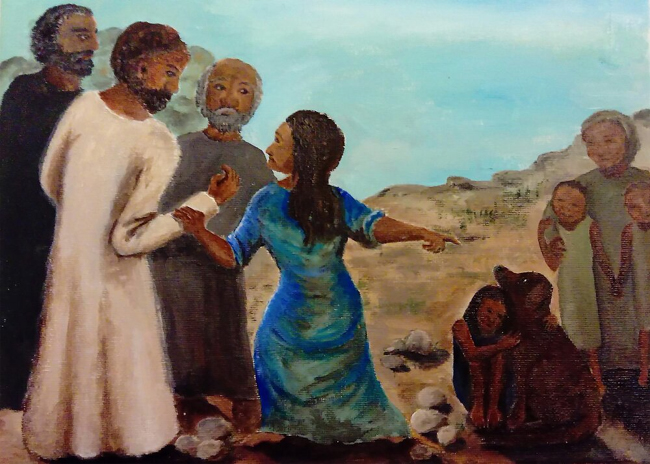
Christian Art | The Syrophoenician Woman
Mark 7: 24-30 – Week 5 Ordinary Time, Thursday (Audio Bible KJV, Spoken Word)
24 ¶ And from thence he arose, and went into the borders of Tyre and Sidon, and entered into an house, and would have no man know it: but he could not be hid.
25 For a certain woman, whose young daughter had an unclean spirit, heard of him, and came and fell at his feet:
26 The woman was a Greek, a Syrophenician by nation; and she besought him that he would cast forth the devil out of her daughter.
27 But Jesus said unto her, Let the children first be filled: for it is not meet to take the children’s bread, and to cast it unto the dogs.
28 And she answered and said unto him, Yes, Lord: yet the dogs under the table eat of the children’s crumbs.
29 And he said unto her, For this saying go thy way; the devil is gone out of thy daughter.
30 And when she was come to her house, she found the devil gone out, and her daughter laid upon the bed.
In today’s Bible reading, we hear how Jesus left Galilee to travel to Tyre and Sidon. These Phoenician cities on the Mediterranean coast were outside of the jurisdiction of Herod Antipas and they were largely non-Jewish, howbeit there would be a significant presence of those Hellenized Jews who constituted a general diaspora.
Much of our Christian faith flows from the impact of the Hellenized Jews – i.e. Jews who were Greek speaking and influenced by Greek culture and thought – which is why we recognize so much that is true and which tends towards Christian truth in classical Greek philosophy, perhaps especially the works of Plato.
We are taught that Jesus withdrew to this area to escape from persecution at the hands of Herod and of the Jewish authorities, and to concentrate on training his disciples.
Jesus has desired to be discretely present in the house he is staying at, but he cannot be hidden. This is significant given that this is a different area, though but 30 or thereabouts miles away, from the environs of Galilee – signifying cross-cultural fame. The Jews here will be for the most part quite culturally distant from those living more closely to Jerusalem – now, of course, destroyed at the time of Mark’s writing – and Jesus’ fame has also spread to the Gentiles.
In yesterday’s Gospel reading, of Mark 7: 14-23, we heard Jesus effectively abolish the dietary laws of the Jews and the requirements for ritual purifying prior to taking part in a meal. This reflects in Acts, when Peter has a vision telling him that all foods are clean, this enabling him to visit and convert the Gentile Cornelius.
Today’s Bible verses seem to work in counterpoint to yesterday’s. A Gentile woman, a Syrophenician – in the parallel episode in Matthew’s Gospel (15: 21-28) she is termed a Canaanite – approaches Jesus begging him to heal her daughter. Jesus’ reply seems to exclude the non-Jew from the meal that is faith in Jesus: ‘Let the children first be filled: for it is not meet to take the children’s bread, and to cast it unto the dogs.’
As we have it conventionally in English translation, this is very offensive language. The Jews would call non-Jews dogs. Today we would term such language grossly racist. However, something quite important has been lost in translation here. In the Greek, from which our English Bibles (New Testament) are translated, the word Jesus uses is not dogs, which would be the standard Jewish term of racist abuse; it is puppies – kunariois (transliterated). Jesus, in other words, is taking a Jewish saying and playing with it, shifting it by using the diminutive, and disarming it – abolishing the thought behind the racist exclusivity. In other words, with what is basically a light-hearted and pleasant play on words, Jesus takes a thought that is old and tired and wrong and puts some love in it, and so Jesus enables the woman to come back at him with her most humble response, expressing her faith absolutely, and thereby bringing about the healing of her daughter.
This little scene, which might initially seem to contradict previous verses, in fact presents a joyous affirmation of the truth of what Jesus has said already. All we need to do is to ask, to touch the hem of Jesus’ garment, and all can then be healed. Puppies included.
BLESSED is he whose transgression is forgiven, whose sin is covered.
2 Blessed is the man unto whom the Lord imputeth not iniquity, and in whose spirit there is no guile.
3 When I kept silence, my bones waxed old through my roaring all the day long.
4 For day and night thy hand was heavy upon me: my moisture is turned into the drought of summer. Selah.
5 I acknowledged my sin unto thee, and mine iniquity have I not hid. I said, I will confess my transgressions unto the Lord; and thou forgavest the iniquity of my sin. Selah.
6 For this shall every one that is godly pray unto thee in a time when thou mayest be found: surely in the floods of great waters they shall not come nigh unto him.
7 Thou art my hiding place; thou shalt preserve me from trouble; thou shalt compass me about with songs of deliverance. Selah.
8 I will instruct thee and teach thee in the way which thou shalt go: I will guide thee with mine eye.
9 Be ye not as the horse, or as the mule, which have no understanding: whose mouth must be held in with bit and bridle, lest they come near unto thee.
10 Many sorrows shall be to the wicked: but he that trusteth in the Lord, mercy shall compass him about.
11 Be glad in the Lord, and rejoice, ye righteous: and shout for joy, all ye that are upright in heart. (Psalm 32/31)
Concluding Prayer
Almighty ever-living God,
we make our prayer to you at morning, noon and evening:
dispel from our hearts the darkness of sin,
and bring us to the true light, Christ your Son,
who lives and reigns with you and the Holy Spirit,
God, for ever and ever.



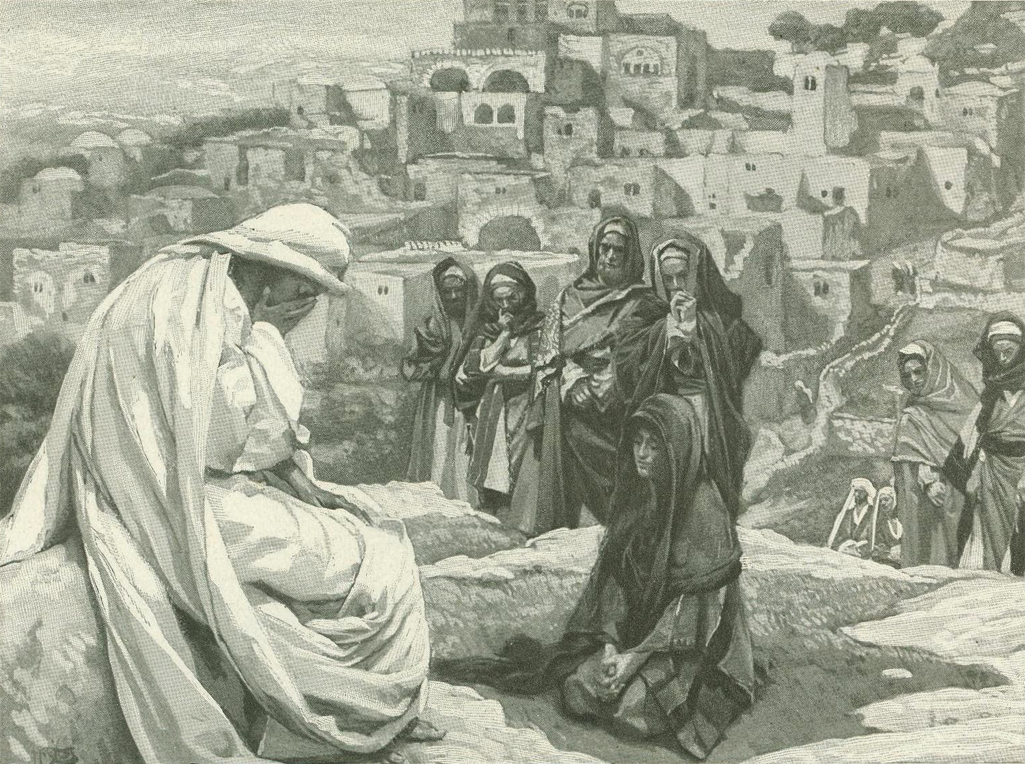
Jesus is so very sorry for a city and a people he loves that he must weep at the sight of Jerusalem. Here is the centre of Jewish faith, while the Jews are the people to whom he has directed most of his teaching, and they are the first chosen people of God [ … ]

The way of life of Jesus presents a marked contrast with that of guests at the house at the ruler of the Pharisees. Jesus has made his home among the poor and dispossessed, he is the model of the ways of perfection he presents to us in the Beatitudes, while the scribes and the Pharisees very much value their worldly importance, automatically choosing the places of honour at the meal [ … ]

Saint Mark, also known as John Mark, holds a significant place in early Christian history as the author of the Gospel of Mark and a companion to both Saint Peter and Saint Paul. Born in Jerusalem, Mark grew up in a devout Jewish household. His mother, Mary, was an early Christian convert whose home served as a meeting place for the apostles and early believers (Acts 12:12) [ … ]
