
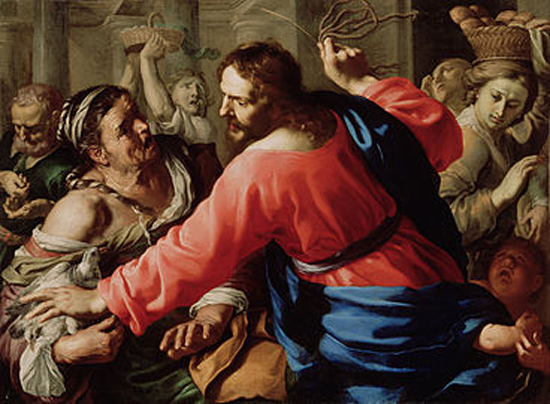
Christian Art | Destruction Of The Temple
Luke 21: 5-11 – Week 34 Ordinary Time, Tuesday (Audio Bible KJV, Spoken Word)
5 ¶ And as some spake of the temple, how it was adorned with goodly stones and gifts, he said,
6 As for these things which ye behold, the days will come, in the which there shall not be left one stone upon another, that shall not be thrown down.
7 And they asked him, saying, Master, but when shall these things be? and what sign will there be when these things shall come to pass?
8 And he said, Take heed that ye be not deceived: for many shall come in my name, saying, I am Christ; and the time draweth near: go ye not therefore after them.
9 But when ye shall hear of wars and commotions, be not terrified: for these things must first come to pass; but the end is not by and by.
10 Then said he unto them, Nation shall rise against nation, and kingdom against kingdom:
11 And great earthquakes shall be in divers places, and famines, and pestilences; and fearful sights and great signs shall there be from heaven.
In Luke’s account of the eschatological discourse, the apocalypse – from the Greek for revelation – is clearly envisaged as beginning in the destruction of Jerusalem and the Temple in AD 70. The natural world is portrayed as being in a state of turmoil, and this reinforces for the listener the impact of what will be – has been by the time of Luke’s writing – a political event. The Jewish rebellion and the sacking of Jerusalem will be brutal and bloody.
The destruction of Jerusalem, in Luke’s Gospel, is not however in itself the final, definitive revelation. In fact, Jesus tells his listeners that the fall of Jerusalem is not the end, when the Son of man will come. First, the times of the Gentiles must be fulfilled. We read this now to mean the period, up to and including our present, in which Gentiles, non-Jews, will become members of the new people of God, which is the Church. It is then, in a situation of similar distress and upheaval, that Christ will come again.
When speaking of the apocalypse, beyond the destruction of Jerusalem and the time of the Gentiles, Christ clearly does not mean that the end of time, the physical end of this world, is going to come anytime soon. He has said as much when, for example, speaking of the mustard seed, which begins as the smallest of seeds and is set to grow as the Church grows to include the whole world. Such growth and flourishing must imply a long history of human endeavour and missionary activity to follow.
Rather, Christ’s words in his apocalyptic teachings lie somewhere between metaphor and reality. It is a language which, while strange to modern listeners, the people of Christ’s time would have found familiar. Apocalypse was very much a live theme and literary genre in Christ’s day. Its subject is a charged reality through which faith breaks in upon us.
In the Gospels as a whole, Jesus’ apocalyptic vision proclaims an overhauling of old ways of being and the coming of new life, the Kingdom of God, of which we are called to be part through Jesus Christ. Our faith in Christ, our death and rebirth through baptism, our redemption in Christ, our adherence to Christ’s new Law, all this, our lived Christianity, can be understood as the Kingdom of God made manifest already in this world, while we anticipate eternal joy. It is because of Jesus and through his words that our life has a heavenly dimension. Heaven and Earth will indeed pass away, while through Christ we have life eternal.
These thoughts may help to clarify today’s Gospel verses, in which we are presented with a scene which might easily be recognized as contemporary by modern listeners, indeed suggesting just another day on planet Earth: ‘Nation shall rise against nation, and kingdom against kingdom: And great earthquakes shall be in divers places, and famines, and pestilences.’ We may be similarly alert to the impact of false prophets in our world, leading people astray and engendering discord.
Perhaps we sometimes feel that our world is fragmenting – and perhaps in this we are led to discern revelation; perhaps it is when we most starkly confront the rough edges of our known reality that we find God holding us, and so at the limits of human experience – of human awareness, human endurance – when our world, our sense of things, shivers and falls apart, then this everyday mini-apocalypse is indeed revelation, the eternal and the infinite touching us. This could be at a time of great personal upheaval. It could be in something so very simple as standing exhausted and hungry at the edge of a long road.
True Light of the World, Lord Jesus Christ,
as you enlighten all men for their salvation,
give us grace, we pray,
to herald your coming
by preparing the ways of justice and of peace.
Who live and reign with the Father and the Holy Spirit,
God, for ever and ever.




Psalm 33 is a song of praise celebrating the greatness of the Lord and the righteousness of His works. The psalm invites the righteous to offer praise, acknowledging the divine attributes that inspire awe [ … ]

Cyril begins by situating the sending of the Holy Spirit within the broader arc of salvation history. The Incarnation brought God into human history in the person of Jesus Christ; yet, it was not until Christ had completed his earthly mission – culminating in his Passion, Resurrection, and Ascension – that humanity could fully receive the indwelling of the Spirit [ … ]

We might imagine our gazing upon a breath-taking sunrise or a star-filled night sky. The opening lines of this psalm capture that moment, reminding us that the heavens declare the glory of God. The celestial display becomes a testament to divine craftsmanship, whispering its wisdom to all who observe it [ … ]
