
Christian Art | Kingdom Of God | Kingdom Of Satan
Luke 11: 15-26 – Week 27 Ordinary Time, Friday – also Lent Thursday 3 – partial( King James Audio Bible KJV, Spoken Word – King James Version)
15 But some of them said, He casteth out devils through Beelzebub the chief of the devils.
16 And others, tempting him, sought of him a sign from heaven.
17 But he, knowing their thoughts, said unto them, Every kingdom divided against itself is brought to desolation; and a house divided against a house falleth.
18 If Satan also be divided against himself, how shall his kingdom stand? because ye say that I cast out devils through Beelzebub.
19 And if I by Beelzebub cast out devils, by whom do your sons cast them out? therefore shall they be your judges.
20 But if I with the finger of God cast out devils, no doubt the kingdom of God is come upon you.
21 When a strong man armed keepeth his palace, his goods are in peace:
22 But when a stronger than he shall come upon him, and overcome him, he taketh from him all his armour wherein he trusted, and divideth his spoils.
23 He that is not with me is against me: and he that gathereth not with me scattereth.
24 When the unclean spirit is gone out of a man, he walketh through dry places, seeking rest; and finding none, he saith, I will return unto my house whence I came out.
25 And when he cometh, he findeth it swept and garnished.
26 Then goeth he, and taketh to him seven other spirits more wicked than himself; and they enter in, and dwell there: and the last state of that man is worse than the first.
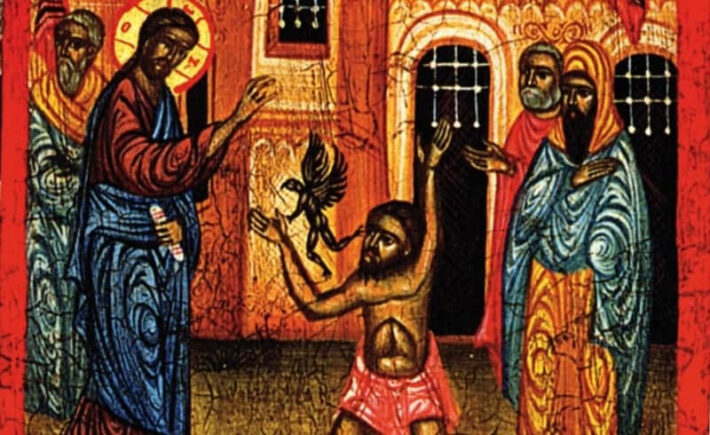
Jesus has come to break Satan’s hold – on the people of Jesus’ time and for all time. Accused by some of being a servant to Beelzebub, Jesus exposes the error and absurdity of what his accusers are saying. If Satan casts out Satan, then Satan is divided against himself and his house falls – he self-destructs.
Jesus is stronger than Satan, and infinitely so. Jesus has come to reclaim what Satan has but temporarily claimed for himself, and Jesus is irresistible. Jesus is truth. The truth sets us free. The demons, creatures of filth and lies, can only retreat in Jesus’ presence.
Yet there is a danger, a warning that a person, once healed by Jesus, can return to Satan’s grasp, which then can be stronger than ever. As we find ourselves walking in the light, we must remain alert for the work of the Devil, who prowls like a roaring lion, seeking one to devour. Our vigilance is called for. May we never become complacent as we celebrate our being in Jesus’ light.
Concluding Prayer
Almighty Father,
let yor light so penetrate our minds,
that walking by your commandments
we may always follow you, our leader and guide.
We make our prayer through our Lord.


King James Audio Bible | Endnotes
Kingdom Of Heaven
Jesus responds to accusations that he is casting out demons by the power of Beelzebub, the prince of demons. Jesus counters that a house divided against itself cannot stand, and that if he is casting out demons by the power of God, then the Kingdom of God has come upon them.
The Kingdom of Heaven has been understood in a variety of ways by Christians. Some have seen it as a future, apocalyptic event, in which God will finally establish his reign over all things. This view has been influential in many forms of Christian eschatology, including the popular Left Behind series of books.
Others have seen the Kingdom of Heaven as a present reality that can be experienced in the here and now. This view has been influenced by the teachings of Saint Augustine, who saw the Kingdom of Heaven as a spiritual reality that exists within the hearts of believers. Saint Augustine wrote: ‘The kingdom of heaven is within us when we love God and neighbor, when we rejoice in the truth, and when we live in peace and unity with one another.’
Martin Luther, a Protestant, saw the Kingdom of Heaven as a present reality that is experienced through faith in Jesus Christ. Luther wrote: ‘The kingdom of heaven is nothing else than faith and the knowledge of Christ. For Christ himself is the kingdom of heaven.’
One of the most interesting and challenging aspects of the Kingdom of Heaven is its relationship to social and political action. Some have interpreted it in a strictly spiritual sense, emphasizing personal salvation and the pursuit of holiness. Others have seen it as a call to work for justice and righteousness in the world, and to strive to build a society that reflects the values of the Kingdom.
Pope Francis has spoken extensively about the Kingdom of Heaven throughout his pontificate. In his 2013 apostolic exhortation Evangelii Gaudium, Pope Francis writes that ‘the Kingdom is not an exclusive domain of the Church’ but rather ‘precedes and transcends the Church’. Pope Francis emphasizes the importance of working towards a more just and peaceful world, saying that ‘the Gospel is not merely about our personal relationship with God; it also demands social engagement and a commitment to building a more just and fraternal world’.
Pope Francis has also emphasized the need for humility and simplicity in our pursuit of the Kingdom of Heaven. In his 2015 encyclical Laudato Si, he writes: ‘The Kingdom of God is not a matter of eating and drinking but of righteousness, peace, and joy in the Holy Spirit’ Pope Francis urges Christians to adopt a simpler, more sustainable way of life that is in harmony with God’s creation.
In addition to his writings, Pope Francis has also lived out his commitment to the Kingdom of Heaven through his actions. He has been a strong advocate for social justice, speaking out against poverty, inequality, and environmental degradation. He has also worked to build bridges between different religions and cultures, emphasizing the importance of dialogue and cooperation in building a more peaceful world.



Jesus identifies himself explicitly as the ‘bread of life’, contrasting the manna given to the Israelites in the wilderness with the living bread Jesus offers. The manna, though miraculous, was temporary and ultimately failed to give eternal life, as those who ate it eventually died. In contrast, the bread that Jesus offers is his flesh, which is given for the life of the world [ … ]
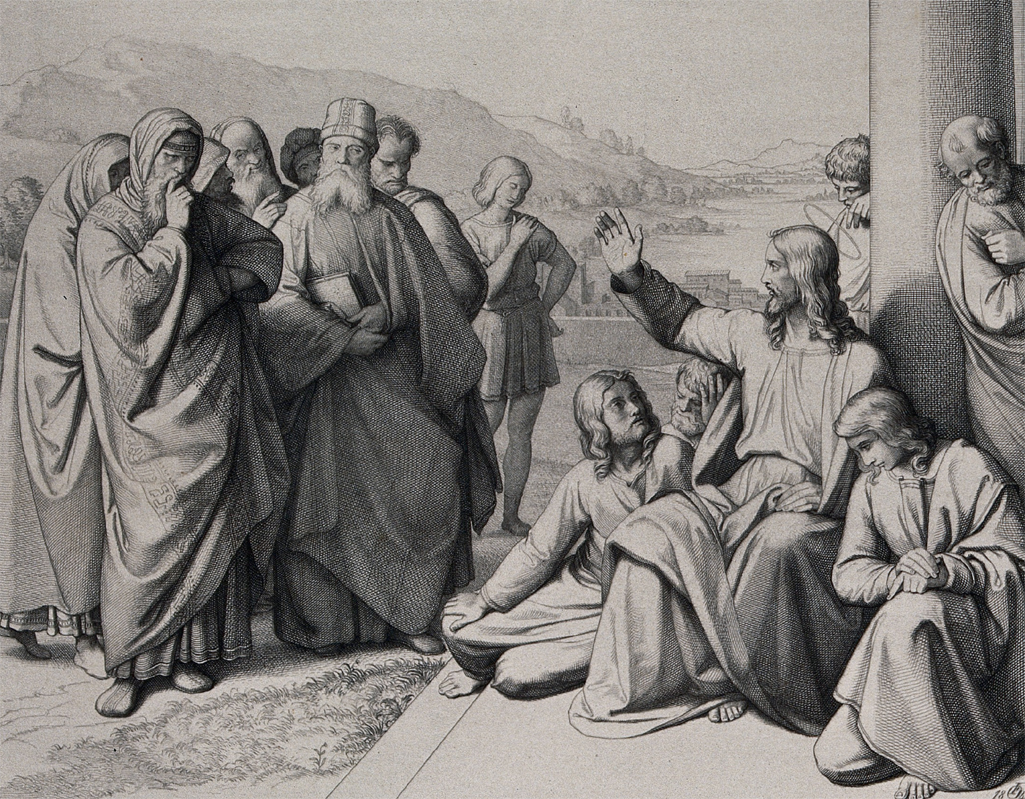
Through the Sermon in the Temple, Jesus’ attack on the Pharisees and the scribes who side with them is clear, hard and definitive. Their way of life is corrupt and vicious. They are blind guides and hypocrites. They will be condemned – ‘Woe to you’ – because they kill the true message of God through their failure of love, mercy, justice, faith. They are serpents who drag the people they preach to down with them [ … ]

Saint Columban continues his meditation on Christ as the fountain of life, drawing together biblical imagery from the prophets, the Psalms, and the Gospel of John. The text highlights the central Christian conviction that God is the source of all that sustains life, both physical and spiritual [ … ]
