
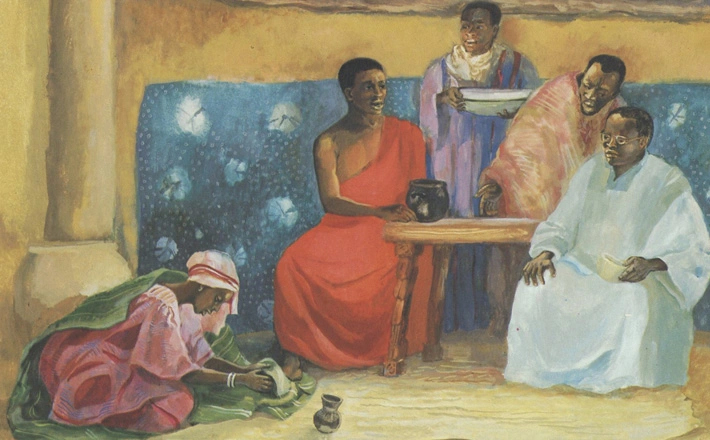
Christian Art | The Penitent Woman Anoints Jesus’ Feet | King James Audio Bible KJV
Luke 7: 36-50 – Week 24 Ordinary Time, Thursday (King James Audio Bible KJV, Spoken Word)
36 ¶ And one of the Pharisees desired him that he would eat with him. And he went into the Pharisee’s house, and sat down to meat.
37 And, behold, a woman in the city, which was a sinner, when she knew that Jesus sat at meat in the Pharisee’s house, brought an alabaster box of ointment,
38 And stood at his feet behind him weeping, and began to wash his feet with tears, and did wipe them with the hairs of her head, and kissed his feet, and anointed them with the ointment.
39 Now when the Pharisee which had bidden him saw it, he spake within himself, saying, This man, if he were a prophet, would have known who and what manner of woman this is that toucheth him: for she is a sinner.
40 And Jesus answering said unto him, Simon, I have somewhat to say unto thee. And he saith, Master, say on.
41 There was a certain creditor which had two debtors: the one owed five hundred pence, and the other fifty.
42 And when they had nothing to pay, he frankly forgave them both. Tell me therefore, which of them will love him most?
43 Simon answered and said, I suppose that he, to whom he forgave most. And he said unto him, Thou hast rightly judged.
44 And he turned to the woman, and said unto Simon, Seest thou this woman? I entered into thine house, thou gavest me no water for my feet: but she hath washed my feet with tears, and wiped them with the hairs of her head.
45 Thou gavest me no kiss: but this woman since the time I came in hath not ceased to kiss my feet.
46 My head with oil thou didst not anoint: but this woman hath anointed my feet with ointment.
47 Wherefore I say unto thee, Her sins, which are many, are forgiven; for she loved much: but to whom little is forgiven, the same loveth little.
48 And he said unto her, Thy sins are forgiven.
49 And they that sat at meat with him began to say within themselves, Who is this that forgiveth sins also?
50 And he said to the woman, Thy faith hath saved thee; go in peace.
Jesus has been invited to dinner by Simon the Pharisee, which occasion in itself reminds us of the inclusivity of Jesus’ mission. There it would be customary for the men to recline on low divans, leaning on their left arm with their legs tucked under them, away from the table. It would also be customary for the host to honour his guests with a kiss of greeting, with water for their feet, and with perfumes.
The woman is bold indeed to come to Jesus in this circumstance. Perhaps she lives so far outside the norms of society that she has additional strength of mind and purpose. Perhaps her circumstances mean that she is less inhibited, less bound in by convention, and so more capable of responding to the news of Jesus.
It is, then, ironic that when the woman comes to Jesus, she offers to Jesus in super-abundance the social niceties that, it seems, have been neglected by the Simon the host. Perhaps we may infer that it is because of her outcast state that she is able to give so lavishly of the good will that the social customs can too palely imitate.
Above all, we witness in raw fashion the woman’s true, absolute and devastating penitence. What a sign this woman is to recall us to ourselves and so to God. She cuts through hypocrisy – potentially our own. Here is knowledge of the absolute need to throw ourselves at Christ’s feet and to beg forgiveness, confessing our sins. Absolute and unconditional: how it should be for us all.
The Pharisee needs to be taught this lesson by Jesus. This knowledge contradicts what the Pharisee ‘knows’ about sin and righteousness. It is furthermore tied into the clearly implicit declaration by Jesus of his divinity, of Jesus’ being God the Son. We are not told how Simon the Pharisee individually responds; we are told of the murmurings, collectively, of those who are at the table, saying: ‘Who is this, who even forgives sins?’ Who can forgive sins but God alone?
Concluding Prayer | Love Revealed By Jesus Christ
Grant us, Lord, a true knowledge of salvation,
so that, free from fear and from the power of our foes,
we may serve you faithfully,
all the days of our life.
We make our prayer through our Lord.


King James Audio Bible | Endnotes
Jesus’ Forgiveness Of Sin
The story of Jesus’ forgiveness of sin in Luke 7:36-50 is a powerful example of the transformative power of God’s grace. In this passage, we see a woman who is known to be a sinner come to Jesus and anoint his feet with perfume, washing them with her tears and wiping them with her hair. The Pharisees, who were present, criticized Jesus for allowing such a woman to touch him, but Jesus saw her repentance and forgave her sins.
This story speaks to the central message of the Bible, that we are all sinners in need of God’s forgiveness. In the Old Testament, we see countless examples of God’s mercy and forgiveness towards his people, even in the face of their disobedience and rebellion. For example, in Psalm 103:10-12, we read: ‘He hath not dealt with us after our sins; nor rewarded us according to our iniquities. For as the heaven is high above the earth, so great is his mercy toward them that fear him. As far as the east is from the west, so far hath he removed our transgressions from us.’
In the New Testament, we see Jesus embodying this message of forgiveness and grace. In the Parable of the Prodigal Son (Luke 15:11-32), we see a father who forgives his wayward son and welcomes him back with open arms. This parable speaks to the heart of Jesus’ message, that no matter how far we may have strayed, God’s love and forgiveness are always available to us.
The story in Luke 7:36-50 also highlights the importance of repentance and faith in receiving God’s forgiveness. The woman who came to Jesus knew she was a sinner and humbled herself before him, expressing her love and faith in him through her actions. As Jesus says in Luke 7:47: ‘Wherefore I say unto thee, Her sins, which are many, are forgiven; for she loved much: but to whom little is forgiven, the same loveth little.’
Christians have reflected on the meaning and significance of Jesus’ forgiveness of sin. In the Catholic tradition, for example, the sacrament of confession is seen as a means of receiving God’s forgiveness through the ministry of the Church. The Catechism Of The Catholic Church states that ‘sin is before all else an offense against God, a rupture of communion with him’ (CCC 1849) and that ‘the sacrament of Penance is a whole consisting in three actions of the penitent and the priest’s absolution’ (CCC 1480).
Protestant theologians have also grappled with the question of forgiveness and salvation. Martin Luther, for example, emphasized the idea of justification by faith, the belief that salvation comes through faith in Christ alone. Martin Luther wrote: ‘The forgiveness of sins and justification are the same thing. Where there is forgiveness of sins, there is also life and salvation.’ (Luther’s Works, vol. 26, p. 354)
In conclusion, the story of Jesus’ forgiveness of sin in Luke 7:36-50 is a powerful reminder of the centrality of God’s grace in the Christian faith. It speaks to the heart of the Bible’s message, that we are all sinners in need of God’s forgiveness, and that this forgiveness is freely available to all who repent and believe.


The Sadducees deny the resurrection, because they are rich and so proclaim the false belief that the Messianic Kingdom has already arrived, their riches being their reward for living according to the Law. In order to challenge Jesus, they present him with a fictional case of a widow passed from brother to brother, according to the Levirate Law, hoping to make the resurrection look ridiculous [ … ]

Today’s Bible verses conclude the first half of John’s Gospel, known as the Book of Signs. The verses mark the end of Christ’s public ministry. He will go on, through the Last Supper, to teach his disciples, and then to endure his Passion and crucifixion. The verses bring together Christ’s teaching to now. Key, fundamental themes are restated. Christ and the Father are one. To believe in Jesus is to believe in God. To see Jesus is to see God [ … ]

Gregory centres his reflection on Jesus’ High Priestly Prayer: ‘That they may all be one, as you, Father, are in me and I am in you.’ (John 17:21) For Gregory, this unity is not merely institutional but ontological and mystical—rooted in the shared life of the Trinity and mediated to believers through the Holy Spirit [ … ]