
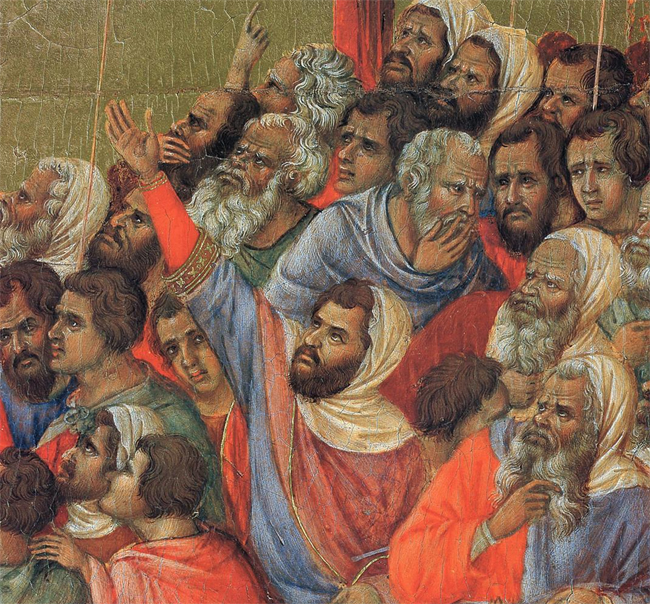
Christian Art | Jesus And The Pharisees
Mark 8: 11-13 – Week 6 Ordinary Time, Monday (Audio Bible KJV, Spoken Word)
11 And the Pharisees came forth, and began to question with him, seeking of him a sign from heaven, tempting him.
12 And he sighed deeply in his spirit, and saith, Why doth this generation seek after a sign? verily I say unto you, There shall no sign be given unto this generation.
13 And he left them, and entering into the ship again departed to the other side.
Jesus is saddened by the Pharisees’ heard-heartedness and their refusal to believe, despite the many and great healing miracles performed by Jesus, which all the world else is able to recognize and celebrate, filled with joy and wonder.
The Pharisees come to Jesus to test him, asking to see a new sign. They do not ask because they are sincerely seeking the truth, but rather out of ill will, trying to tempt God. They have already rejected the miracles God has offered to them. To require new miracles is to refuse the proper attitude to God, which is one of openness and complete humility, as it is to deny the witness of ages, through the history of salvation.
Jesus, therefore, will not give a new sign to the ‘generation’ of the Pharisees and those who follow them. They have enough information already, and they reject the obvious truth. Even were Jesus to give them something more, we have seen how the Pharisees misrepresent what they witness, twisting the truth, even to the point of attributing Jesus’ healing miracles to Satan (cf. Matthew 12: 28).
The Pharisees reject Jesus, therefore he withdraws from this place. It is through love and faith that we are asked to give welcome to Jesus, who wills that he be asked to stay with us, and not that we be left on the shore while he departs to the other side.
Blessed is that man that maketh the Lord his trust, and respecteth not the proud, nor such as turn aside to lies.
Many, O Lord my God, are thy wonderful works which thou hast done, and thy thoughts which are to us-ward: they cannot be reckoned up in order unto thee: if I would declare and speak of them, they are more than can be numbered.
Sacrifice and offering thou didst not desire; mine ears hast thou opened: burnt offering and sin offering hast thou not required.
Then said I, Lo, I come: in the volume of the book it is written of me,
I delight to do thy will, O my God: yea, thy law is within my heart. (From Psalm 40/39)
Concluding Prayer
All-powerful God,
since you have given us, your unworthy servants,
the strength to work through this day:
accept this sacrifice of praise
as we thank you for your gifts.
We make our prayer through our Lord.
Audio Bible KJV | Endnotes
What Does It Mean That Jesus Refuses To Give A Sign?
In Mark 8:11-13, the Pharisees came to Jesus and asked him for a sign from heaven, but Jesus refused to give them one. Jesus sighed deeply and said: ‘Why doth this generation seek after a sign? Verily I say unto you, There shall no sign be given unto this generation.’ This refusal to perform a sign raises important questions about the nature of faith, doubt, and the role of miracles in religious experience.
The request for a sign was not a new one. Throughout the Old Testament, God performed miraculous signs and wonders to demonstrate His power and authority. For example, He parted the Red Sea, sent plagues upon Egypt, and provided manna from heaven. In the New Testament, Jesus performed numerous miracles, such as healing the sick, feeding the multitudes, and raising the dead. These miracles were intended to confirm Jesus’ divine authority and to demonstrate God’s love and mercy.
However, in this passage, Jesus refused to give the Pharisees a sign. The reason for this is twofold. First, the Pharisees were not genuinely seeking the truth. They were looking for a sign to discredit Jesus and to confirm their own prejudices. Second, Jesus had already performed many signs and wonders. Jesus had healed the sick, cast out demons and fed the multitudes. Jesus had even raised the dead. Therefore, Jesus’ refusal to give a sign was not due to a lack of power, but rather to a lack of faith on the part of the Pharisees.
This passage raises important questions about the nature of faith and doubt. Faith, according to the Bible, is ‘the substance of things hoped for, the evidence of things not seen’ (Hebrews 11:1). Faith is not blind, but it is based on evidence. The evidence for faith is found in the person and work of Jesus Christ. Jesus performed many signs and wonders to confirm his authority and to demonstrate God’s love and mercy. These signs were intended to point people to the truth of Jesus’ claims.
However, doubt can also be a healthy and necessary part of faith. Doubt can lead to questions, and questions can lead to a deeper understanding of God’s truth. Doubt can also lead to a stronger faith, as we wrestle with our doubts and come to a deeper understanding of God’s love and mercy.
The refusal to give a sign also raises questions about the role of miracles in religious experience. Miracles are a part of the Bible’s narrative, and they are intended to confirm the truth of God’s message. However, miracles can also be misinterpreted and misunderstood. In the Bible, miracles were not performed for their own sake, but were always intended to point people to the truth of God’s message.
In the history of the church, there have been debates about the role of miracles in religious experience. Some have argued that miracles are a necessary part of the Christian faith, while others have argued that miracles are not necessary for faith. The Catholic Church, for example, teaches that miracles are a sign of God’s presence and power, but they are not necessary for faith. Protestants, on the other hand, have tended to be more skeptical of miracles, and have often focused more on the preaching of the Word of God as the primary means of communicating God’s truth.
Through history, the interpretation of Mark 8:11-13 has evolved. In the early church, this passage was understood as a warning against seeking signs and wonders as a means of verifying one’s faith. Saint Augustine wrote that ‘Faith does not come from signs, but signs come from faith’. Saint Augutine argued that seeking signs and wonders was a sign of weak faith, and that true faith came from a personal encounter with Jesus Christ.
In the Middle Ages, some theologians began to view miracles as essential to the Christian faith. Saint Thomas Aquinas argued that miracles were necessary to confirm the truth of Christian teachings. He wrote: ‘Miracles are a sign of the divine power which confirms the truth of the doctrine taught, and since the doctrine ought to be confirmed by divine testimony, it is necessary that miracles should be performed.’
During the Reformation, the interpretation of this passage was shaped by debates about the role of miracles in religious experience. Martin Luther, founder of the Protestant Reformation, was highly skeptical of miracles and argued that they were not necessary for faith. Martin Luther wrote: ‘Miracles do not create faith, but faith creates miracles.’ Luther believed that the preaching of the Word of God was the primary means of communicating God’s truth, and that miracles were secondary to this.
John Calvin, a prominent figure in the Reformation, held a similar view. Calvin argued that miracles were not necessary for faith, but that they could be a sign of God’s presence and power. Calvin wrote: ‘The miracles are like seals of the gospel, which confirm the truth of it, but they do not establish it.’
In the Catholic Church, the interpretation of this passage has been shaped by the doctrine of the Eucharist, which is viewed as a miraculous event. The Council of Trent, for example, declared: ‘In the most holy sacrament of the Eucharist, there is contained truly, really, and substantially, the body and blood, together with the soul and divinity, of our Lord Jesus Christ, and consequently the whole Christ.’ This doctrine is seen as a sign of God’s presence and power, and is often viewed as a miracle.
In more recent times, some religious figures have sought to re-interpret this passage in light of modern scientific knowledge. For example, theologian Karl Barth argued that miracles were not supernatural events, but rather were events that occurred within the natural world but were interpreted as signs of God’s presence and power.




In these Bible verses, Jesus begins his farewell to his disciples, and the chapter closes with the words: ‘Rise, let us go hence.’ The natural continuation would then be the verse which opens chapter 18: ‘When Jesus had spoken these words, he went forth with his disciples over the brook Cedron, where was a garden, into the which he entered, and his disciples.’ However, Jesus continues to teach his disciples through chapters 15 to 17. We are aware, then, of the rearrangements which seem to have taken place as John composed his Gospel [ … ]
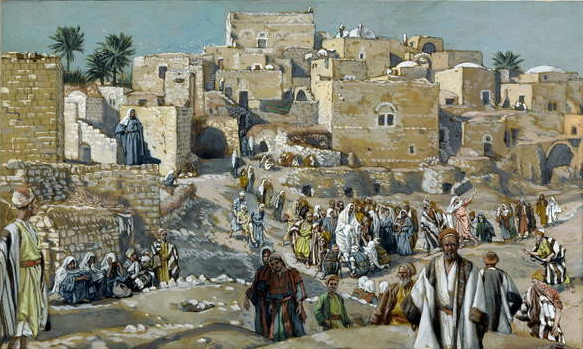
Many Christians live in places that are hostile to Christianity. This hostility takes different forms. In the United Kingdom, there is significant but often banal hostility to Christianity, including on the part of those who term themselves notionally Christian, but who really never want to gather to worship God. Christians in the United Kingdom are not generally at risk of physical harm. It is a sickening truth that where there is such risk, it is most often sectarian, for example in Belfast or Glasgow [ … ]
Psalm 72 is traditionally attributed to King Solomon and is a prayerful expression of the qualities and aspirations for a just and righteous ruler. It can be seen as a guide for leaders and a plea for divine wisdom in governance [ … ]
