
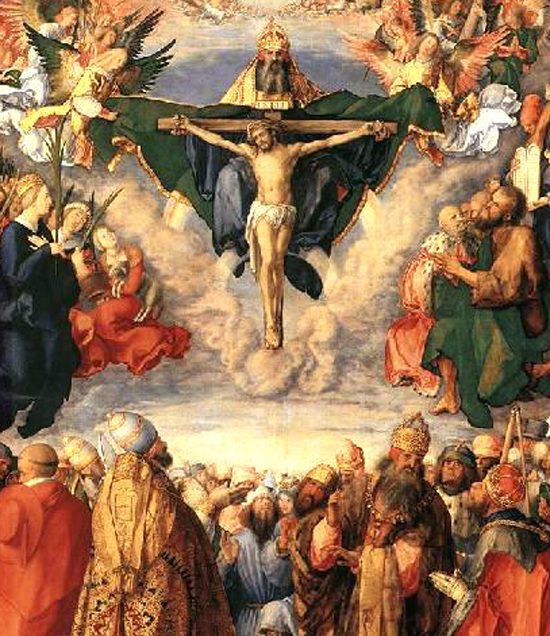
Christian Art | God The Son
Matthew 11: 25-27 – Week 15 Ordinary Time, Wednesday (King James Audio Bible KJV, Word Aloud Spoken Word)
25 ¶ At that time Jesus answered and said, I thank thee, O Father, Lord of heaven and earth, because thou hast hid these things from the wise and prudent, and hast revealed them unto babes.
26 Even so, Father: for so it seemed good in thy sight.
27 All things are delivered unto me of my Father: and no man knoweth the Son, but the Father; neither knoweth any man the Father, save the Son, and he to whomsoever the Son will reveal him.
It is in Chapter 11 of Matthew’s Gospel that Jesus’ mission has encountered serious difficulties. Through Chapters 11 and 12 there are challenges, which confirm what Jesus has told the disciples in the Discourse of the Mission, concerning his bringing not peace but a sword, of Jesus’ Mission being a sign of Christian contradiction. There is real enmity in the region of Galilee, the scribes and the Pharisees especially rejecting the truth of Jesus, while even John the Baptist fails to understand.
In the midst of such adversity, Jesus calls to his Father in celebration and prayer. Jesus acknowledges his divinity while thanking God the Father that the truth has been revealed to ‘babes’, infants, the humble, who give themselves little importance, while the wise and prudent, those who rely on their own judgement, their inevitably limited rational abilities, prove themselves incapable of accepting the revelation Christ has brought to us. The spiritual sense, a supernatural outlook, is always associated with humility.
Our creed, that Jesus God the Son is consubstantial with God the Father, is a Christian mystery. Jesus was in this life fully human – as he was fully God. This might seem an impossible mystery for human reason to encompass, and yet not for us to marvel at and grapple with. We are merely human: we are creatures. We are not as human in ourselves in any sense God. This is a most sacred and humanly important aspect of knowledge of true Christian faith.
Jesus teaches us that he, the Son, knows the Father by the same knowledge as that by which the Father knows the Son. There is an identity of knowledge, implying oneness of nature. The mutual knowledge of Father and Son are of a piece with their absolute intimacy. Jesus is God as the Father is God. All things have been delivered to Jesus by God the Father. It is only through Jesus that we may know God the Father. Nobody has ever known the Father save through the Son. The New Testament constitutes a final and complete revelation of God, such as the whole of salvation history through the Old Testament led to, preparing the way.
In the midst of accusation, Jesus calls us to know God the Father as He is revealed through His Son, to those who let go their egotism and become as infants. Through our humility, our letting go of ego and pretension, and so through our proper relationship with Jesus, we find the Father revealed to us.
Concluding Prayer
Lord God,
in your wisdom you created us,
by your providence you rule us:
penetrate our inmost being with your holy light,
so that our way of life
may always be one of faithful service to you.
We make our prayer through our Lord.
King James Audio Bible | Endnotes
Nazareth In The Time Of Jesus Of Nazareth
In the time of Jesus, Nazareth, a small town located in the region of Galilee, in northern Palestine, was a rural community of about 200 to 400 people. The town was situated on a hillside, overlooking a fertile valley. The people of Nazareth were primarily farmers, shepherds, and artisans.
It has been said that the name Nazareth is derived from the Hebrew word ‘netzer’, which means ‘branch.’ This name is significant because it is a reference to a Messianic prophecy found in Isaiah 11:1: ‘And there shall come forth a rod out of the stem of Jesse, and a Branch shall grow out of his roots.’
Historicity Of Nazareth
The town of Nazareth is not mentioned in any historical documents until the 4th century AD. However, the Bible tells us that Jesus grew up in Nazareth, and it was the place where Jesus began his ministry.
The Gospel of Matthew tells us that when Jesus returned to Nazareth, his hometown, to teach in the synagogue, the people were astonished at his wisdom and knowledge. They asked: ‘Is not this the carpenter’s son? is not his mother called Mary? and his brethren, James, and Joses, and Simon, and Judas? And his sisters, are they not all with us?’ (Matthew 13:55-56)
This passage tells us that Jesus was known in Nazareth as the son of Mary, and that Jesus had several close relations. The fact that Jesus was called a ‘carpenter’s son’ suggests that Jesus had learned his father’s trade and had worked as a carpenter himself.
The people of Nazareth were skeptical of Jesus’ claims to be the Messiah. They knew Jesus as a local boy who had grown up in their midst, and they could not believe that Jesus was the promised Saviour. As a result, Jesus said to them: ‘Verily I say unto you, No prophet is accepted in his own country.’ (Matthew 13:57)
Despite the skepticism of his hometown, Jesus continued to minister throughout Galilee, performing miracles and preaching the Gospel. The Gospel of Mark tells us that Jesus ‘went about all Galilee, teaching in their synagogues, and preaching the gospel of the kingdom, and healing all manner of sickness and all manner of disease among the people’ (Mark 4:23).
Today, Nazareth is a thriving city with a population of over 75,000 people. It is considered one of the holiest cities in Christianity and is home to many churches and holy sites associated with the life of Jesus.
Throughout the centuries, religious authorities of both Catholic and Protestant traditions have written about the significance of Nazareth in the life of Jesus. Saint Jerome, 4th Century Christian theologian, wrote that Nazareth was ‘a village of Galilee, where Christ was brought up, and in which He began to preach’ (Lives of Illustrious Men, Chapter 16).
Martin Luther, 16th Century Protestant theologian, also wrote of the importance of Nazareth in the life of Jesus. In his commentary on Matthew, he wrote: ‘Nazareth was a city of small account, yet from it came the greatest treasure of all, even the Son of God Himself.’ (Commentary on Matthew, Chapter 2)
Today, Nazareth continues to be a place of pilgrimage for Christians from around the world. The city’s many holy sites, including the Basilica of the Annunciation and the Church of St. Joseph, attract thousands of visitors each year. These sites serve as a reminder of the importance of Nazareth in the life and ministry of Jesus, and they provide an opportunity for Christians to connect with the history of their faith.
One of the most significant sites in Nazareth is the Basilica of the Annunciation. This church is built on the site where, according to tradition, the angel Gabriel appeared to Mary and announced that she would give birth to Jesus. The church is a major pilgrimage site, and it contains beautiful artwork and architecture that tell the story of the Annunciation.
Another important site in Nazareth is the Church of Saint Joseph. This church is built on the site where, according to tradition, Joseph’s workshop was located. It is believed that Jesus learned the trade of carpentry from Joseph, and the church contains a display of carpentry tools that are said to have belonged to Joseph.



Psalm 50 is a profound exploration of God’s authority, the meaning of true worship, and the imperative of righteous living. The psalm condemns empty rituals and hypocrisy while calling for genuine, heart-centred relationship with God. The psalm balances warnings of judgment with the promise of deliverance and salvation for those who seek God with sincerity and integrity [ … ]

There is something deeply human about Thomas the Apostle. He is not content with hearsay, not satisfied with the testimony of others, even those closest to him. “Unless I see… unless I touch… I will not believe.” His words are often remembered as a failure—but they may also be understood as a kind of honesty. Thomas refuses to pretend [ … ]
In this reflection on Saint Paul’s letter to the Galatians, Saint Augustine explores the Apostle’s pastoral concern and the meaning of the phrase ‘until Christ be formed in you’. His focus is on spiritual growth, imitation of Christ, and the role of patient guidance within the Church [ … ]
