

Christian Art | Jesus And The Rich Young Man | A Way Of Poverty
The Gospel Of Saint Matthew 19: 16-22 | Week 20, Monday | King James Audio Bible KJV
16 ¶ And, behold, one came and said unto him, Good Master, what good thing shall I do, that I may have eternal life?
17 And he said unto him, Why callest thou me good? there is none good but one, that is, God: but if thou wilt enter into life, keep the commandments.
18 He saith unto him, Which? Jesus said, Thou shalt do no murder, Thou shalt not commit adultery, Thou shalt not steal, Thou shalt not bear false witness,
19 Honour thy father and thy mother: and, Thou shalt love thy neighbour as thyself.
20 The young man saith unto him, All these things have I kept from my youth up: what lack I yet?
21 Jesus said unto him, If thou wilt be perfect, go and sell that thou hast, and give to the poor, and thou shalt have treasure in heaven: and come and follow me.
22 But when the young man heard that saying, he went away sorrowful: for he had great possessions.
The passage, Matthew 19:16-22, recounts the encounter between Jesus and a wealthy young man who asked Jesus what he must do to inherit eternal life. In response, Jesus told him to keep the commandments, to which the young man replied that he had done so since his youth. Jesus then told him to sell all his possessions, give the money to the poor, and follow him. The young man went away sorrowful because he had great possessions, which he finds himself unable to relinquish.
This story raises important questions about the relationship between wealth, poverty, and salvation. Jesus teaching is radical, and indeed challenges the thoughts and values of many people who identify as Christians today. Is there a way of poverty that leads to salvation? What does it mean to be poor in spirit, as Jesus teaches in the Sermon on the Mount? What do the Scriptures and religious authorities throughout history say about this topic?
In the Old Testament, there are examples of poverty and its spiritual significance. Job, for example, was a wealthy man who lost everything and was left with nothing but his faith in God. He declared, ‘Naked came I out of my mother’s womb, and naked shall I return thither: the LORD gave, and the LORD hath taken away; blessed be the name of the LORD.’ (Job 1:21) Through his suffering, Job learned to trust in God and to find his true wealth in his relationship with Him.
The Psalms also speak of the blessedness of the poor in spirit. Psalm 34:6 says, ‘This poor man cried, and the LORD heard him, and saved him out of all his troubles.’ And Psalm 41:1 says, ‘Blessed is he that considereth the poor: the LORD will deliver him in time of trouble.’
In the New Testament, Jesus teaches that poverty of spirit is a key to the Kingdom of Heaven. In the Sermon on the Mount, he says, ‘Blessed are the poor in spirit: for theirs is the kingdom of heaven.’ (Matthew 5:3) Jesus also warns that it is easier for a camel to go through the eye of a needle – or the Eye of the Needle, which was a low, narrow gate in Jerusalem – than for a rich man to enter the Kingdom of Heaven (Matthew 19:24).
Saint Francis of Assisi, who is known for his radical poverty and devotion to the poor, took Jesus’ words to heart and lived a life of voluntary poverty. Saint Francis saw poverty as a way to imitate Christ, who was born in a stable and lived a life of simplicity and humility. Saint Francis saw poverty as a way to detach himself from the things of this world and to focus on his relationship with God.
To this day, Franciscan friars live a life of poverty and of service to the poor. They live a life of extreme simplicity, embracing the radical message of Jesus to give away all wealth and possession.
Other Christian saints and writers have also seen poverty as a way of drawing closer to God. Saint Augustine, for example, wrote in his Confessions, ‘Thou hast commanded, and so it is, that every inordinate affection should be its own punishment.’ He saw wealth as an inordinate affection that could distract one from the love of God.
Martin Luther, father of the Protestant Reformation, also saw poverty as a way to detach oneself from the world and to focus on God. In his Treatise On Christian Liberty, he wrote, ‘The Christian man is the most free lord of all, and subject to none; the Christian man is the most dutiful servant of all, and subject to every one.’ He saw poverty as a way to be free from the tyranny of wealth and to serve others in humility.
In more recent times, Pope Francis has also emphasized the importance of poverty and simplicity in the Christian life. He has called for a ‘poor Church for the poor’ and has criticized the excesses of consumerism and materialism. He has said, ‘We need to reject the idolatry of money, and to rediscover the value of work, of solidarity, of generosity, and of compassion.’
The story of the rich young man in Matthew 19:16-22 challenges us to rethink our relationship with wealth and poverty. While it may not be inherently wrong to be wealthy, Jesus’ teachings remind us that our ultimate wealth is found in our relationship with God. Poverty, then, can be a means of detachment from the things of this world and a way to focus on our spiritual life.
As we navigate the complexities of modern life, it is helpful to turn to the wisdom of the Scriptures and the insights of religious authorities both past and present to guide us on our spiritual journey. May we all seek to cultivate a spirit of poverty and humility as we strive to follow Jesus Christ and to live out Jesus’ teachings in our daily lives.


King James Audio Bible | KJV | The King James Version | Endnotes
A Prayer To Jesus For Poverty
Dear Lord Jesus, you who chose to be born in a manger and lived a life of poverty and simplicity, we come to you seeking your help and guidance. Teach us to value the things that are truly important, such as love, compassion, and service, over the fleeting pleasures and temptations of the world.
We ask that you show us how to use our resources in ways that honour you and bless those around us. Help us to be mindful of the needs of others, especially the poor and marginalized, and to use our time, talents, and treasures to serve them.
As we seek to follow your example, we ask for your strength and grace to live a life of poverty, whether it be through voluntary simplicity or the recognition that all we have comes from you. Help us to let go of our attachment to worldly possessions and to trust in your provision and care for us.
We pray that through our poverty, we may grow in our love for you and deepen our trust in your unfailing love and mercy. May our lives be a testament to your grace and a source of hope and encouragement to those around us.
We ask these things in your holy name, Amen.


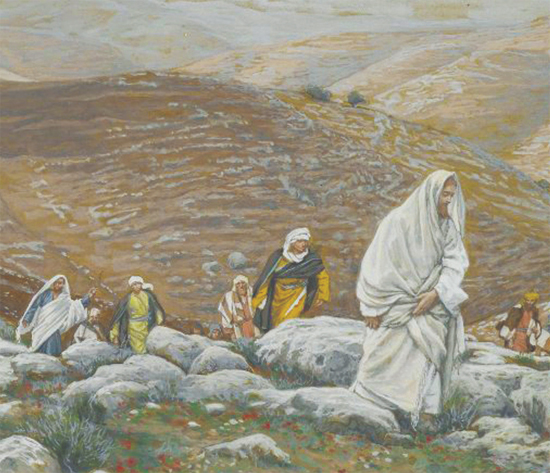
When Jesus returns to Nazareth, to his own country, he attends synagogue on the Saturday and teaches there, not as a leader of the synagogue but as a participant in the faith community. Nonetheless, Jesus’ teaching is different from other people’s. Jesus, we have been told, teaches with authority, and not as the scribes (Matthew 7: 29). Jesus does not merely interpret Scripture, according to scholarly tradition; rather, Jesus reworks Scripture, providing for the people a new Torah, which centres upon himself and which we may understand as Jesus himself. In this way, Jesus’ authority matches and exceeds that of Moses. Jesus is a new Moses, and then infinitely more [ … ]

The Jewish authorities have begun to take note of Jesus. While Jesus has attracted the people, now ‘the Jews’, a term which in John’s Gospel is often used to refer to the Jewish authorities, are beginning to murmur against him. Jesus’ relationship with the Jews is to become increasingly tense [ … ]
Psalm 73 is a reflective composition attributed to Asaph, a Levite and chief musician in the house of God. The psalm explores human experience of grappling with envy and doubt in the face of apparent prosperity among those who disregard God’s ways [ … ]
