
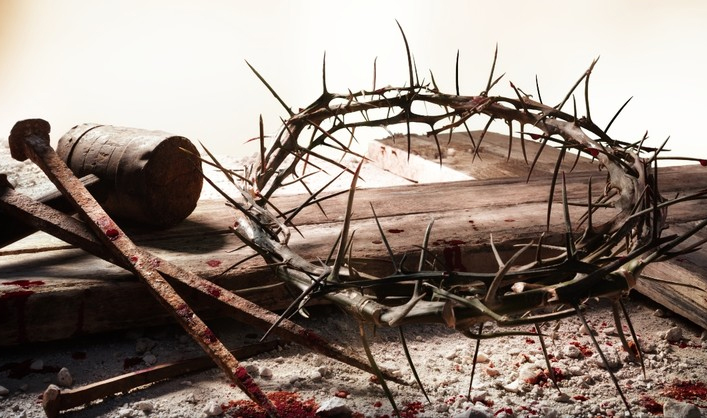
Jesus references this psalm when he is on the Cross.
‘My God, my God, why have you forsaken me.’
It is possible to read this utterance of the psalm as an act of despair.
Certainly we might know of Jesus’ agony as he was crucified.
We can only wonder at Jesus’ agony on the Cross. There are so many possible layers of the meaning here. At once, this utterance might seem to us an action of despair, or perhaps better of nullity, and at the same time an action of triumph, as the psalm moves to reaffirm and reinforces faith in God.
The psalmist is abject. In a sense, he complains against God. He speaks of trust, and yet says that God does not answer.
The psalmist considers his state – as a worm, scorned by men, mocked by men – the cause of God seems broken and lost.
There is a deep and prolonged itemization of the physical poverty of the psalmist. Truly, this is a person at the most abject. Starving, dogs are set to prey on him.
This is truth: the affirmation thereby of God-fear and God-love.
This is Jesus.
Jesus speaks to teach us how to pray through the psalms.
This is a most important text – chosen by Jesus upon the Cross.
We cannot assume irony. We cannot say that Jesus on the Cross recited this psalm as if having given up on his mission. We can only say that Jesus’s recitation of this psalm was perfect and that it was intended to express perfection.
This is Christian prayer at the utmost. So much is fused. Jesus calls upon the Father – on the Cross. SO much of Jewish history is included and resolved. Jesus took so much upon himself. Jesus became the subject of these psalms. That is scary and that is triumph.
There is a sense in which this should be Christian prayer.




Some few of the Pharisees now show solidarity with Jesus, warning him that Herod Antipas means to kill him. Herod has previously expressed a wish to meet Jesus (Luke 9: 9), about whom he was perplexed, wondering if John the Baptist had risen again. We do not know whether the Pharisees simply want to get Jesus to go away or if there is danger [ … ]

In this rich Eastertide reflection, Saint Fulgentius presents the Eucharist as both the source and summit of Christian unity, drawing the Church together into one spiritual body through the bond of love. His meditation resonates profoundly with the paschal season, in which the Church celebrates the risen life of Christ not merely as a past event, but as a present, living reality—embodied in the Eucharist and shared through the Spirit [ … ]
Psalm 59 is attributed to King David. The psalm resonates with themes of seeking protection from enemies, finding refuge in God, and grappling with the challenges of a troubled world. The psalm embodies a deep sense of trust and reliance on the divine, portraying God as the ultimate source of strength, defence, and justice in the face of adversity [ … ]
