

Christian Art | Parables Of Jesus | Parable Of The Marriage Feast / The Wedding Feast
Matthew 22: 1-14 | King James Audio Bible | King James Version KJV | Parables Of Jesus | Parable Of The Marriage Feast | Love Revealed By Jesus Christ
1 AND Jesus answered and spake unto them again by parables, and said,
2 The kingdom of heaven is like unto a certain king, which made a marriage for his son,
3 And sent forth his servants to call them that were bidden to the wedding: and they would not come.
4 Again, he sent forth other servants, saying, Tell them which are bidden, Behold, I have prepared my dinner: my oxen and my fatlings are killed, and all things are ready: come unto the marriage.
5 But they made light of it, and went their ways, one to his farm, another to his merchandise:
6 And the remnant took his servants, and entreated them spitefully, and slew them.
7 But when the king heard thereof, he was wroth: and he sent forth his armies, and destroyed those murderers, and burned up their city.
8 Then saith he to his servants, The wedding is ready, but they which were bidden were not worthy.
9 Go ye therefore into the highways, and as many as ye shall find, bid to the marriage.
10 So those servants went out into the highways, and gathered together all as many as they found, both bad and good: and the wedding was furnished with guests.
11 ¶ And when the king came in to see the guests, he saw there a man which had not on a wedding garment:
12 And he saith unto him, Friend, how camest thou in hither not having a wedding garment? And he was speechless.
13 Then said the king to the servants, Bind him hand and foot, and take him away, and cast him into outer darkness; there shall be weeping and gnashing of teeth.
14 For many are called, but few are chosen.
In the parable of the marriage feast, Jesus continues to attack the scribes and the Pharisees, the Jewish authorities, who have found themselves threatened by Jesus and who reject him. It is a bold and dangerous message to those who have established power in the Jewish community. Jesus could hardly be telling them more clearly that they have got it wrong, that they were called, by God, long, long ago, and yet they have rejected God’s invitation, that, for all their trappings of piety, they are not with God; they have rejected Him.
To put this in context, we may ask the question: what actually is it that the Jewish authorities fear about Jesus, dislike about Jesus, hate about Jesus, and so why are they seeking, ultimately, to discredit him and put him to death?
Christ’s message, that he is God the Son, that we are to love him and believe in who he is, is so extremely wrong to those who think that their understanding of the Law, of God, is the correct and only way. It is, in this theological sense, an affront. But it goes deeper than this. For all the theological objections, for all the sense that blasphemy is being committed, we find that the refusal of Jesus by the Jewish religious authorities is rooted in self-interest and self-preservation.
Jesus is obviously a good man, even if the Jews didn’t believe in his divinity. Jesus’ teachings offer a beautiful and radical shake-up of orthodoxy. Jesus’ teachings are all about love, of God, of our neighbour, and about how to love.
But these people are not listening to Jesus with an open mind. Their minds are closed because their mind-set is so much locked into their current worldly position, their status, their financial incentives in maintaining the status quo, such that their spiritual sense has atrophied, becoming occluded, and so the spiritual posturing of the scribes and Pharisees has more in common with the law of the market place than it does with God. These people have made themselves of the world, rather than of God.
Christ’s message, then, is uncompromising. He says to them: You were called to the banquet, to the kingdom of God, and you refused to show. You’ve made your excuses: you were busy on your farm or with your business; you have clung to your attachments to the business of the world, when heaven could have been yours. You’ve gone so far as to kill my messengers, who were the prophets. You have gone out of your way to refuse salvation, so entrenched in you is your refusal of God.
Well, says Jesus, so much for them. If the scribes and the Pharisees, the religious leaders of God’s first chosen people, don’t want to receive what could have been theirs, then we’ll go out there and invite everyone, both good and bad. The humblest sinner can have more than the scribes and the Pharisees. Indeed, he can have everything. The wedding hall will be filled with guests.
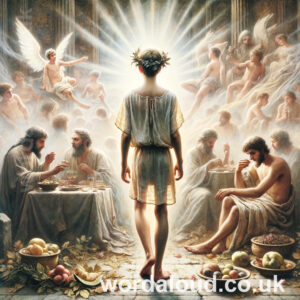
Verses 11-14 of this parable seem to be an addition from another saying of Jesus. They may seem not to flow particularly well from the preceding verses. After all, if we take this literally, it may seem a little unfair that a man has been pulled off the street to come to the wedding and is then punished for not wearing the right clothes. Of course, this is not Jesus’ intention.
We can, though, draw an important truth from these last verses of the parable. We are all called to the feast. We can all be God’s children. The Old Law is overwhelmed in the New. We are, though, called to approach the wedding feast in appropriate garments. We are called to live in the ways Jesus wants us to, not with the empty, ritualistic observances of the scribes and Pharisees, but with true, loving faith, our whole lives becoming focused around our relationship with Jesus. Then we shall be living God’s Law in ways which those Jewish elders could not bear to contemplate.
‘Let us be glad and rejoice, and give honour to him: for the marriage of the Lamb is come, and his wife hath made herself ready. And to her was granted that she should be arrayed in fine linen, clean and white: for the fine linen is the righteousness of saints. And he saith unto me, Write, Blessed are they which are called unto the marriage supper of the Lamb.’ Revelation 19: 7-9



Origen’s reflection on Jesus’ words in John’s Gospel, ‘Destroy this temple and in three days I will raise it up,’ (John 2:19) draws together several layers of meaning. At the literal level, Jesus refers to the temple in Jerusalem, a central symbol of Israel’s covenant with God. Yet Origen, following John’s own interpretation (John 2:21), sees that Jesus is ultimately speaking of his own body, which would be destroyed in death and raised in resurrection [ … ]

Saint Pacian, Bishop of Barcelona in the fourth century, presents baptism as the decisive passage from the old humanity of Adam to the new life in Jesus Christ. Drawing from Romans 5:12–21 and 1 Corinthians 15:45, he sets up a parallel: through Adam’s disobedience, sin and death entered the human race; through Christ’s obedience, grace and eternal life are offered to all. Pacian insists that just as Adam’s descendants inherit his fallen condition by birth, so believers receive Christ’s life by a different kind of descent—not physical but spiritual [ … ]
Today’s Gospel verses invite us once more to consider the true identity of Jesus. This scene is filled both with a sense of preconceptions and expectations, and with the over-riding knowledge of the new, which is the truth of Jesus. Additionally, we are asked by Jesus to declare the truth of our knowledge of who Jesus is. We are invited by Jesus to confess our Christian faith [ … ]
