
Christian Art | The Holy Spirit At Pentecost
Word Aloud Audio Bible KJV | King James Audio Bible | Acts Of The Apostles
Pentecost | Birthday Of The Church | Descent Of The Holy Spirit | Tongues Of Fire
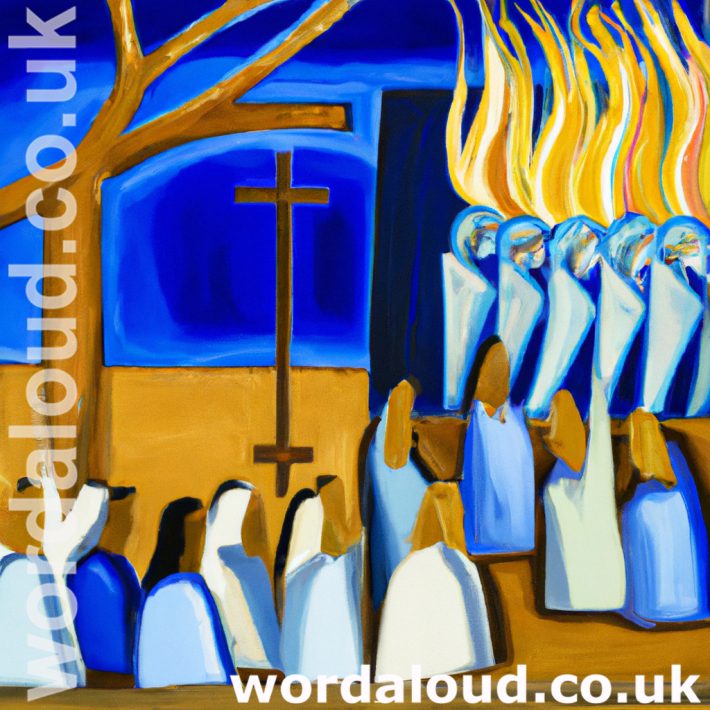
Pentecost is celebrated 50 days after Easter Sunday. It is considered the birth of the Church and marks the descent of the Holy Spirit upon the apostles and other followers of Jesus Christ. The Bible tells us that the Holy Spirit descended upon the apostles in the form of tongues of fire, and they were able to speak in multiple languages, allowing them to spread the message of Jesus to a wider audience.
The Catechism of the Catholic Church states that ‘Pentecost is the Church’s birthday’. (CCC 731) It is the day when the Holy Spirit descended upon the apostles and the first believers, endowing them with the gifts and charisms necessary for the spread of the Gospel. This event is seen as the beginning of the Church’s mission to bring the message of Jesus to the world.
One of the main themes of Pentecost is the unity of the Church. The apostles, who had previously been scattered, were brought together by the Holy Spirit and were able to speak in multiple languages, overcoming the barriers of language and culture. This event is seen as a symbol of the unity of all believers, regardless of their backgrounds or nationalities.
Pope Francis has said: ‘Pentecost is the feast of the Church, the feast of unity… It is the feast of the diversity of charisms, of the diversity of languages and cultures, but always in the unity of the Holy Spirit.’
Pentecost has enormous significance for Christians today, as it is considered the day when the Church received the gifts of the Holy Spirit, including wisdom, understanding, counsel, fortitude, knowledge, piety, and fear of the Lord. These gifts are considered necessary for the Church to continue its mission of spreading the Gospel to the world.
The Holy Spirit continues to empower the Church today, through the celebration of the sacraments, particularly the sacrament of Confirmation, which is seen as a strengthening of the Holy Spirit in the individual.
Who And What Is The Holy Spirit?
The Holy Spirit, or in English tradition the Holy Ghost, is the third person of the Holy Trinity in Christianity, and is considered to be co-equal with the Father and the Son. The Holy Spirit is a central figure in the Christian faith and is often described as the ‘Helper’ or ‘Advocate’ in the Bible. The Holy Spirit is said to be present at the creation of the world and throughout salvation history, and is believed to be the source of inspiration, guidance, and strength for believers.
In the New Testament, the Holy Spirit is said to have ‘fallen’ on the apostles at Pentecost, as recorded in the book of Acts. This event is seen as the birth of the Church, and marks the descent of the Holy Spirit upon the apostles and other followers of Jesus Christ.
According to Acts 2:1-4, the apostles were gathered together in one place when they suddenly heard a sound like a rushing wind and saw tongues of fire descend upon them. They were then able to speak in multiple languages, allowing them to spread the message of Jesus to a wider audience. This event is considered to be the beginning of the Church’s mission to bring the message of Jesus to the world.
The Holy Spirit is also associated with the concept of regeneration, or the spiritual rebirth of believers through faith in Jesus Christ. In John’s gospel, Jesus promises to send the Holy Spirit to his followers after his departure, and the Holy Spirit is promised as the ‘Helper’ or ‘Counsellor’ (John 14:16,26) and ‘will guide you into all the truth’. (John 16:13)
This is also affirmed in Titus 3:5: ‘He saved us, not because of works done by us in righteousness, but according to his own mercy, by the washing of regeneration and renewal of the Holy Spirit.’
The Holy Spirit And Baptism
The Holy Spirit is associated with the concept of baptism, and the sacrament of Confirmation is seen as a strengthening of the Holy Spirit in the individual. In the book of Acts, the Holy Spirit is said to have been given to the new believers through the laying on of hands by the apostles (Acts 8:17,19:6).
According to the Catechism of the Catholic Church: ‘Confirmation perfects Baptismal grace; it is the sacrament which gives the Holy Spirit in order to root us more deeply in the divine filiation, incorporate us more firmly into Christ, strengthen our bond with the Church, associate us more closely with her mission, and help us bear witness to the Christian faith in words accompanied by deeds.’ (CCC 1303)
The Eastern Orthodox Church, the Holy Spirit is believed to be the source of the gifts and charisms that are necessary for the Church to continue its mission of spreading the Gospel to the world. These gifts include wisdom, understanding, counsel, fortitude, knowledge, piety, and fear of the Lord, and are believed to be bestowed upon believers through the sacrament of Confirmation.
According to Eastern Orthodox theology, the Holy Spirit is the one who transforms believers into the image of Christ and enables them to live a life of holiness.
For Protestant theology, the Holy Spirit is seen as the one who brings new birth and regeneration to the believer, and is the one who empowers the believer for service and witness.
According to John Calvin, ‘the Spirit is given to us for the very purpose of renewing us in the image of God, and of fitting us to be partakers of the divine nature’. Martin Luther believed that the Holy Spirit is the one who creates faith in the hearts of believers, and that this faith is the only means by which a person can be justified before God.
The Pentecostal movement also emphasizes the work of the Holy Spirit in the believer’s life, particularly in the area of spiritual gifts, such as speaking in tongues, healing, and prophecy.
According to Pentecostal theologian David du Plessis, ‘the Pentecostal experience is the baptism in the Holy Spirit, which is distinct from the initial conversion experience and is the empowering of the believer for witness and service’.
In the Pentecostal theology, the emphasis is on the present work of the Holy Spirit in the believer’s life, and the belief that the gifts and charisms of the Spirit are available to believers today.
Another stream of theology that emphasizes the work of the Holy Spirit is the Charismatic Movement which is a movement within Protestant Christianity that emphasizes the work of the Holy Spirit, spiritual gifts, and modern-day miracles. Charismatic theology teaches that the Holy Spirit can be invoked for personal and corporate renewal and that the gifts of the Spirit, as outlined in 1 Corinthians 12, are available to believers today.
How Does The Pentecostal Church Reflect And Express The Spirit Of Pentecost?
Pentecostal Church services are centred around the belief that the Holy Spirit is actively working in the believer’s life, just as it did at the first Pentecost. These services often include a strong emphasis on worship, prayer, and the use of spiritual gifts.
During a Pentecostal service, worship often includes vibrant, emotive and energetic forms of singing, accompanied by instruments such as guitars, drums, and pianos. Worship is seen as a way to connect with God and to open oneself up to the work of the Holy Spirit. The congregants often raise their hands, clap, dance and even speak in tongues during worship to show their devotion and joy.
Prayer is also an important aspect of Pentecostal services, with a focus on seeking the presence and guidance of the Holy Spirit. Many services include a time for individuals to come forward for personal prayer and prophetic words. This is seen as a way for the Holy Spirit to speak directly to the believer and to provide guidance and encouragement.
The use of spiritual gifts is an integral part of Pentecostal services, with an emphasis on the gifts of healing, prophecy, and the word of knowledge. These gifts are believed to be available to all believers and are seen as a way that the Holy Spirit continues to work in the Church today. The use of these gifts is often associated with revival, renewal, and the demonstration of God’s power.
In addition to these elements, Pentecostal services often include preaching and teaching, with an emphasis on the Bible as the inspired word of God, and the importance of personal faith and transformation through the work of the Holy Spirit.
Pentecostal services aim to create an atmosphere of spiritual openness, where individuals can experience the power of the Holy Spirit in a tangible and personal way. Pentecostal services often include altar calls, where individuals are invited to come forward to receive prayer, to rededicate their lives to Jesus, or to be baptized in the Holy Spirit.
The practice of speaking in tongues, also known as glossolalia, is considered to be one of the most important manifestations of the Holy Spirit. During a Pentecostal service, individuals may speak in tongues, which is seen as a sign that they have been filled with the Holy Spirit. The use of tongues is also considered to be a sign of the unity of the Church, as it is believed to be a supernatural language that all believers can understand, regardless of their native language.
Pentecostal churches often have a strong sense of community and fellowship, with a focus on supporting and encouraging one another in the faith. This includes small groups and home Bible studies, as well as larger gatherings and events. These activities provide opportunities for believers to connect with one another, to share their experiences, and to learn and grow in their faith together.
Pentecostal churches also often have an emphasis on outreach and evangelism, with a focus on sharing the message of Jesus with those who have not yet heard. This may include local and international missions, as well as community outreach programs and services.
What Was The Pre-Christian Meaning Of Pentecost?
The word ‘Pentecost’ comes from the Greek word ‘Pentekoste’ which means ‘fiftieth.’ In the Jewish tradition, Pentecost was one of the three major annual festivals, along with Passover and the Feast of Tabernacles. It was also known as the Feast of Weeks, and it was celebrated 50 days after the Passover, hence the name ‘Pentecost.’
In pre-Christian times, Pentecost was a harvest festival that celebrated the end of the grain harvest and the beginning of the fruit harvest. It was also a time to give thanks to God for the bountiful harvest and to make offerings of the first fruits to God.
The feast of Pentecost was also known as the Feast Of The First Fruits, as it was customary to bring the first fruits of the harvest as an offering to God. This offering was known as the ‘two loaves of bread’ and it was made of wheat and symbolized the first fruits of the wheat harvest.
This is in line with the biblical description in Leviticus 23:15-16: ‘You shall count seven full weeks from the day after the Sabbath, from the day that you brought the sheaf of the wave offering. You shall count fifty days to the day after the seventh Sabbath. Then you shall present a grain offering of new grain to the Lord.’
In addition, it was customary to have a pilgrimage to the Temple in Jerusalem during the Feast of Pentecost, where people would offer sacrifices and make vows to God. It was also a time for families to come together to offer sacrifices and to make offerings to God.
In pre-Christian times, Pentecost was seen as a time of joy, thanksgiving, and gratitude. It was a time to give thanks to God for the blessings of the harvest and to reaffirm one’s commitment to God.
The Pentecost celebrates the Covenant with God on Mount Sinai.
Were Jesus’ Disciples In Hiding At The Time Of Pentecost?
According to the New Testament, the disciples of Jesus were in hiding at the time of the first Pentecost following the death and resurrection of Jesus. After the arrest and crucifixion of Jesus, the disciples were afraid and uncertain about what would happen to them. They had seen their leader arrested, tried, and executed, and they feared that they would be next.
In the book of John, it is stated that the disciples were together in a house in Jerusalem, with the doors locked, for fear of the Jewish leaders (John 20:19). In the book of Luke, it is stated that the disciples were gathered together in an upper room in Jerusalem, where they were ‘constantly devoting themselves to prayer’. (Acts 1:13-14)
It was only after the descent of the Holy Spirit at Pentecost, that the disciples were empowered and emboldened to go out and proclaim the message of Jesus to the world. The coming of the Holy Spirit at Pentecost is seen as the birth of the Church, and marks the beginning of the Church’s mission to bring the message of Jesus to the world.
What Does It Mean To Speak In Tongues?
Speaking in tongues, also known as glossolalia, is the practice of speaking in a language that is not known or understood by the speaker. In the context of Christianity, speaking in tongues is often associated with the Pentecostal and Charismatic movements, and is seen as a sign of the presence and work of the Holy Spirit in the believer’s life.
The Bible describes speaking in tongues as an act of praising God in an unknown language, as it is seen in Acts 2:4: ‘And they were all filled with the Holy Ghost, and began to speak with other tongues, as the Spirit gave them utterance.’
The phenomenon is described as one of the manifestations of the Holy Spirit’s work, as it is stated in 1 Corinthians 12:7-11: ‘To each is given the manifestation of the Spirit for the common good. For to one is given through the Spirit the utterance of wisdom, and to another the utterance of knowledge according to the same Spirit, to another faith by the same Spirit, to another gifts of healing by the one Spirit, to another the working of miracles, to another prophecy, to another the ability to distinguish between spirits, to another various kinds of tongues, to another the interpretation of tongues.’
Speaking in tongues is also considered to be a sign of the unity of the Church, as it is believed to be a supernatural language that all believers can understand, regardless of their native language. This can be seen in the passage in Acts 2:4: ‘And they were all filled with the Holy Ghost, and began to speak with other tongues, as the Spirit gave them utterance. And there were dwelling at Jerusalem Jews, devout men, out of every nation under heaven.’
The practice of speaking in tongues is not universally accepted among Christians, and opinions on the subject vary. Some believe that speaking in tongues is a necessary sign of the infilling of the Holy Spirit and that it is still a valid experience for believers today. Others believe that speaking in tongues was a temporary phenomenon that was limited to the early Church and that it is no longer necessary or relevant in contemporary Christianity.
Some Christian denominations, such as the Catholic and Eastern Orthodox churches, do not generally practise speaking in tongues as a regular part of their liturgy or worship. Other denominations, such as the Pentecostal and Charismatic movements, place a strong emphasis on the practice of speaking in tongues.
What Are The Gifts Of The Holy Spirit?
The gifts of the Holy Spirit refer to the spiritual abilities or charisms given by the Holy Spirit to believers for the building up of the Church and for the common good. The Bible describes these gifts as being given to individuals for the purpose of serving the Church and furthering the work of God.
The gifts of the Holy Spirit are listed in several passages in the New Testament, such as 1 Corinthians 12:4-11 and Romans 12:6-8.
The gifts of the Holy Spirit can be broadly grouped into three categories: revelation gifts, power gifts and utterance gifts.
Revelation gifts involve the ability to know and understand spiritual truths. Some of the gifts included in this category are:
- The word of wisdom: the ability to understand and communicate spiritual truths in a way that brings insight, guidance, and direction to the Church.
- The word of knowledge: the ability to know and understand spiritual truths in a way that brings understanding, insight, and revelation to the Church.
Power gifts involve the ability to do extraordinary things, such as healing and miracles. Some of the gifts included in this category are:
- Faith: the ability to trust in God and to believe that He will do what He has promised.
- Gifts of healing: the ability to heal the sick, whether through a direct act of God or through the use of natural means.
- Working of miracles: the ability to do extraordinary things that can only be explained as coming from God.
Utterance gifts involve the ability to communicate the truth of God in a way that brings people to salvation or to edification. Some of the gifts included in this category are:
- Prophecy: the ability to speak the truth of God to the Church in a way that brings understanding, direction, and encouragement.
- Different kinds of tongues: the ability to speak in a language that is not known to the speaker, as a sign of the presence and work of the Holy Spirit.
- Interpretation of tongues: the ability to understand and interpret the meaning of a message spoken in tongues.
Not all believers receive the same gifts. The use of these gifts is subject to the guidance and direction of the Holy Spirit.
How Is The Holy Spirit With Me As I Pray?
The Holy Spirit is with us as we pray:
- The Holy Spirit helps us to pray: The Bible states in Romans 8:26-27: ‘Likewise the Spirit helps us in our weakness. For we do not know what to pray for as we ought, but the Spirit himself intercedes for us with groanings too deep for words. And he who searches hearts knows what is the mind of the Spirit, because the Spirit intercedes for the saints according to the will of God.’ This passage suggests that the Holy Spirit helps us to pray, even when we don’t know how to pray or what to say. He helps us to express our needs and desires to God and to align our hearts with His will.
- The Holy Spirit guides us in our prayer: The Bible states in John 16:13: ‘When the Spirit of truth comes, he will guide you into all the truth, for he will not speak on his own authority, but whatever he hears he will speak, and he will declare to you the things that are to come.’ This passage suggests that the Holy Spirit guides us in our prayer, directing us to the truth that we need to know and helping us to understand God’s will for our lives.
- The Holy Spirit empowers us to pray: The Bible states in Ephesians 3:16: ‘that according to the riches of his glory he may grant you to be strengthened with power through his Spirit in your inner being.’ This passage suggests that the Holy Spirit empowers us to pray with confidence and authority, giving us the strength and the ability to approach God in prayer.
- The Holy Spirit fills us as we pray: The Bible states in Ephesians 5:18 ‘And do not get drunk with wine, for that is debauchery, but be filled with the Spirit’ this means that as we pray, the Holy Spirit fills us and empowers us to be more like Jesus, and to live according to His will.
- The Holy Spirit gives us spiritual gifts as we pray: The Bible states in 1 Corinthians 12:7-11: ‘To each is given the manifestation of the Spirit for the common good. For to one is given through the Spirit the utterance of wisdom, and to another the utterance of knowledge according to the same Spirit, to another faith by the same Spirit, to another gifts of healing by the one Spirit, to another the working of miracles, to another prophecy, to another the ability to distinguish between spirits, to another various kinds of tongues, to another the interpretation of tongues.’ This passage suggests that as we pray, the Holy Spirit gives us spiritual gifts that help us to serve and build up the Church.



Oh my Jesus, I come before you in faith and trust, asking for your healing touch upon my body. You are the great physician who can heal all afflictions, and I pray that you would bring your healing power into my life. May your love and mercy flow through me, renewing my body, mind, and soul. Grant me the strength to endure any pain and the courage to face any challenge. I ask this in your holy name. Amen [ … ]
In this poem, Herbert reflects on the limits of human strength and importance of divine assistance. The poem begins with the modest admission that ‘to write a verse or two is all the praise, / That I can raise’, indicating that any expression of gratitude or devotion Herbert offers to God is inherently limited. This acknowledgment of inadequacy runs throughout the poem, shaping a tone of humility and dependence on divine strength [ … ]
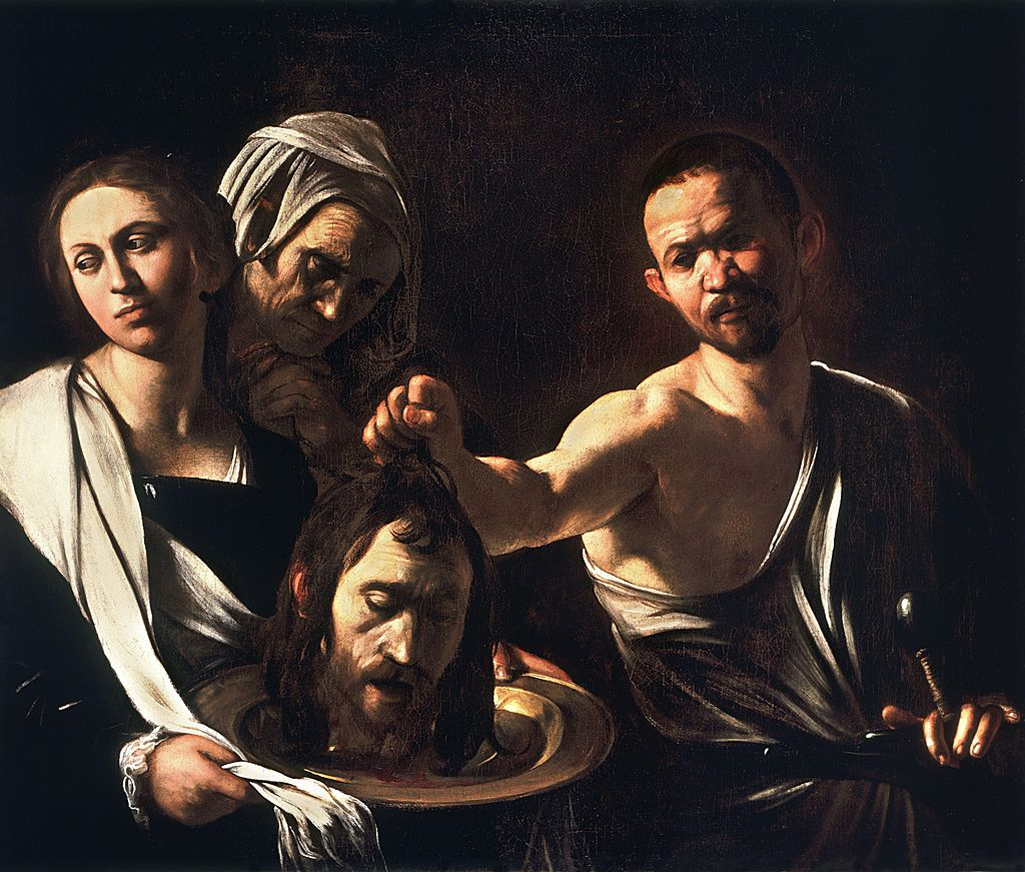
Herod the tetrarch, Herod Antipas, the son of Herod the Great, was a client ‘king’ of the Romans. He is highly alert to the in/stability of his region and to his own position within the Roman authority. We may imagine that the fear of a popular leader amassing a following and potentially threatening authority contributed to the arrest of John the Baptist, this in addition to the reason we are given in the Gospel, which is that John had told Herod how immoral he was being in marrying his brother’s wife Herodias [ … ]
