
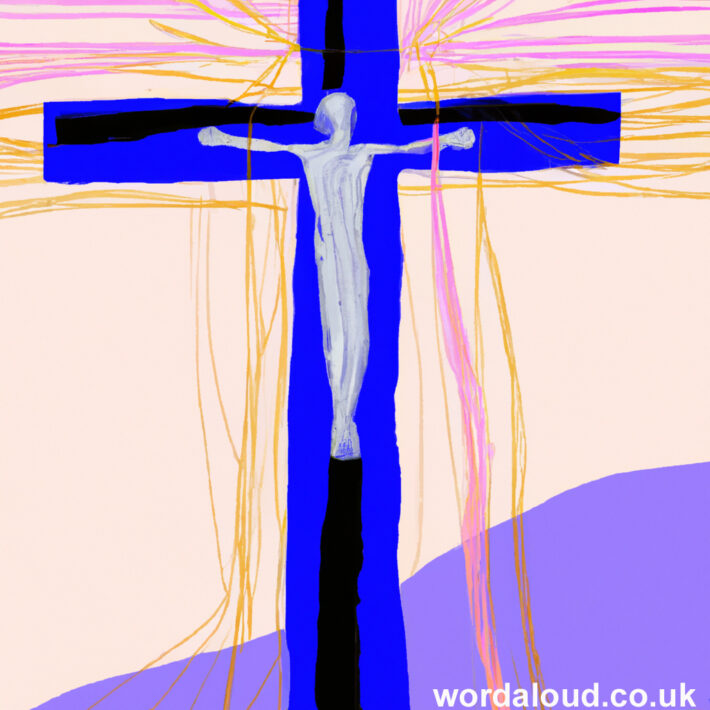
Christian Art | Prayer With Jesus | Psalms | True Greatness | Psalm Of Strength And Joy
Psalm 18 | King James Audio Bible
YouTube: Psalm 18 | KJV | King James Audio Bible | Psalms | Word Aloud
Psalm 18 is a song of faith, resilience and divine intervention, a picture of interaction between mortal struggles and God’s grace.
The psalmist stands amidst challenges. He seeks a source of strength and refuge. He shares an account of encountering God amidst life’s adversities. From the outset, he establishes a bond with the divine rooted in trust, an anchor that steadies him in life’s tempests. Through imagery as sturdy as a rock and as secure as a fortress, God is portrayed as a source of strength.
As the psalmist calls upon God, an acknowledgment of God’s intrinsic worthiness and an expression of his reliance on divine benevolence is witnessed. This call resonates through existence, recognizing challenges of the human journey.
Amidst trials, the psalmist’s plea reaches God, offering solace amidst turmoil. This exchange underscores the belief in the omnipresence of God. The interplay between the natural world and the divine is accentuated as elements respond to God’s presence. This portrayal evokes awe at cosmic echoes in response to divine presence.
The narrative takes a turn, as the psalmist paints a tableau of God descending amidst tumultuous elements. This descent symbolizes God’s involvement in mortal affairs, where the extraordinary meets the ordinary and the sacred intertwines with the mundane.
Images of darkness, clouds, and waters enshroud God’s presence in mystery, echoing depths of human experience where uncertainty often reigns. Amidst this enigma, thunderous divine voice and lightning emerge as symbols of theophanic revelation, evoking humility in presence of divine grandeur.
Account of divine arrows and upheaval is a reminder that God’s intervention is both transformative and disruptive, unearthing hidden truths and exposing vulnerabilities beneath the surface. Through tumult, the metaphor of being drawn from waters emerges as a portrayal of deliverance from affliction’s abyss. It captures divine assistance, extending a lifeline to those immersed in life’s torrents.
Emerging from adversity, the psalmist experiences liberation and rejoices in newfound freedom. This triumph is not only personal but a testament to triumph over adversity, where faith and resilience shatter shackles.
The narrative shifts to the principle of divine recompense, where righteousness and moral integrity find reward. This echoes cosmic justice, where actions are accounted for and vindicated in existence’s scheme.
In God’s justice, the psalmist’s commitment to uphold divine ordinances receives favour, underscoring divine symmetry where the virtuous find favour. The perspective of the psalmist widens, suggesting divine equity beyond character traits, encompassing humanity. This vision reflects universal divine justice. The symbol of light in darkness illustrates divine guidance illuminating murky life paths. This resonates with Christians pursuing guidance.
Psalm 18 | King James Audio Bible KJV
I will love thee, O Lord, my strength.
The Lord is my rock, and my fortress, and my deliverer; my God, my strength, in whom I will trust; my buckler, and the horn of my salvation, and my high tower.
I will call upon the Lord, who is worthy to be praised: so shall I be saved from mine enemies.
The sorrows of death compassed me, and the floods of ungodly men made me afraid.
The sorrows of hell compassed me about: the snares of death prevented me.
In my distress I called upon the Lord, and cried unto my God: he heard my voice out of his temple, and my cry came before him, even into his ears.
Then the earth shook and trembled; the foundations also of the hills moved and were shaken, because he was wroth.
There went up a smoke out of his nostrils, and fire out of his mouth devoured: coals were kindled by it.
He bowed the heavens also, and came down: and darkness was under his feet.
And he rode upon a cherub, and did fly: yea, he did fly upon the wings of the wind.
He made darkness his secret place; his pavilion round about him were dark waters and thick clouds of the skies.
At the brightness that was before him his thick clouds passed, hail stones and coals of fire.
The Lord also thundered in the heavens, and the Highest gave his voice; hail stones and coals of fire.
Yea, he sent out his arrows, and scattered them; and he shot out lightnings, and discomfited them.
Then the channels of waters were seen, and the foundations of the world were discovered at thy rebuke, O Lord, at the blast of the breath of thy nostrils.
He sent from above, he took me, he drew me out of many waters.
He delivered me from my strong enemy, and from them which hated me: for they were too strong for me.
They prevented me in the day of my calamity: but the Lord was my stay.
He brought me forth also into a large place; he delivered me, because he delighted in me.
The Lord rewarded me according to my righteousness; according to the cleanness of my hands hath he recompensed me.
For I have kept the ways of the Lord, and have not wickedly departed from my God.
For all his judgments were before me, and I did not put away his statutes from me.
I was also upright before him, and I kept myself from mine iniquity.
Therefore hath the Lord recompensed me according to my righteousness, according to the cleanness of my hands in his eyesight.
With the merciful thou wilt shew thyself merciful; with an upright man thou wilt shew thyself upright;
With the pure thou wilt shew thyself pure; and with the froward thou wilt shew thyself froward.
For thou wilt save the afflicted people; but wilt bring down high looks.
For thou wilt light my candle: the Lord my God will enlighten my darkness.
For by thee I have run through a troop; and by my God have I leaped over a wall.
As for God, his way is perfect: the word of the Lord is tried: he is a buckler to all those that trust in him.
For who is God save the Lord? or who is a rock save our God?
It is God that girdeth me with strength, and maketh my way perfect.
He maketh my feet like hinds’ feet, and setteth me upon my high places.
He teacheth my hands to war, so that a bow of steel is broken by mine arms.
Thou hast also given me the shield of thy salvation: and thy right hand hath holden me up, and thy gentleness hath made me great.
Thou hast enlarged my steps under me, that my feet did not slip.
I have pursued mine enemies, and overtaken them: neither did I turn again till they were consumed.
I have wounded them that they were not able to rise: they are fallen under my feet.
For thou hast girded me with strength unto the battle: thou hast subdued under me those that rose up against me.
Thou hast also given me the necks of mine enemies; that I might destroy them that hate me.
They cried, but there was none to save them: even unto the Lord, but he answered them not.
Then did I beat them small as the dust before the wind: I did cast them out as the dirt in the streets.
Thou hast delivered me from the strivings of the people; and thou hast made me the head of the heathen: a people whom I have not known shall serve me.
As soon as they hear of me, they shall obey me: the strangers shall submit themselves unto me.
The strangers shall fade away, and be afraid out of their close places.
The Lord liveth; and blessed be my rock; and let the God of my salvation be exalted.
It is God that avengeth me, and subdueth the people under me.
He delivereth me from mine enemies: yea, thou liftest me up above those that rise up against me: thou hast delivered me from the violent man.
Therefore will I give thanks unto thee, O Lord, among the heathen, and sing praises unto thy name.
Great deliverance giveth he to his king; and sheweth mercy to his anointed, to David, and to his seed for evermore.

Key Themes Of The Psalm For Reflection | Love Revealed By Jesus Christ
- Divine Strength and Refuge: The psalmist seeks strength and refuge in God amidst challenges, portraying a relationship rooted in trust.
- Imagery of God’s Attributes: The imagery of God as a fortress, rock, and deliverer symbolizes steadfastness and divine protection.
- Cry for Divine Intervention: The psalmist fervently calls upon God, acknowledging divine worthiness and seeking intervention.
- Triumph over Adversity: The narrative unfolds amidst trials, with the psalmist triumphing over adversity through divine assistance.
- Nature’s Response to God: Natural elements respond to God’s presence, echoing the psalmist’s awe and signifying cosmic echoes.
- Divine Descent and Presence: The psalmist depicts God’s involvement in earthly matters, invoking divine presence amid tumultuous elements.
- Theophanic Revelation: Thunderous divine voice and lightning represent divine revelation, evoking a sense of awe.
- Divine Intervention: Divine arrows and upheaval signify divine intervention, revealing hidden truths beneath the surface.
- Deliverance and Liberation: The psalmist emerges from trials, finding deliverance and rejoicing in newfound liberation.
- Divine Recompense: Righteousness leads to divine recompense, underscoring the principle of divine justice.
- Commitment and Divine Favor: Upholding divine ordinances is rewarded with divine favor, reflecting divine symmetry.
- Equity Beyond Character: The psalmist suggests divine equity extending beyond individual character, portraying a universal divine justice.
- Guidance and Illumination: The symbol of light in darkness illustrates divine guidance illuminating life’s path.
- Empowerment and Support: Imagery of agility and elevation signifies divine support, empowering the psalmist.
- Divine Mentorship and Empowerment: The psalmist likens divine guidance to mentorship, depicting divine empowerment in life’s battles.
- Protection and Safeguarding: The shield of salvation symbolizes divine protection, enveloping the psalmist in a safeguarding embrace.
- Personal Growth and Ascension: Divine benevolence fosters personal growth, enabling the psalmist to ascend.
- Steadfastness and Resilience: The psalmist’s steadfastness anchors their journey through life’s challenges.
- Triumphant Overcoming: Triumph over adversaries reflects the psalmist’s resolute determination and divine empowerment.
- Divine Presence and Role: The psalm concludes with a celebration of God’s living presence, role as deliverer, and divine attributes.
- Gratitude and Praise: Gratitude flows from divine deliverance, inspiring thanksgiving and praise across nations.



The creation of the King James Bible was an extraordinary event in literary and religious history. This was a political act of nation-building and it was a great spiritual gift, of ‘one more exact translation of the Holy Scriptures into the English tongue’, this new translation stamped with royal approval [ … ]

The poem speaks within the tradition of Christian eschatology, drawing on imagery of the Last Judgment as found in the Book of Revelation. The opening command, ‘At the round earth’s imagin’d corners, blow / Your trumpets, angels,’ invokes the apocalyptic vision of angels summoning the dead from the four corners of the world. The imperative verb ‘blow’ places Donne in a position of assumed authority, yet the command is not sustained. The invocation of cosmic forces collapses into a more personal meditation on sin, repentance, and divine grace [ … ]

Fear is a powerful destroyer of the mind, stripping away confidence and holding us captive. It clouds our thoughts and overwhelms us with doubt, eroding our ability to take action. It keeps us stagnant, preventing us from reaching our full potential [ … ]
