Loading...
Jesus | Christian Prayer | Reflections On The GospelsListen To The Bible! | Psalms | King James Audio Bible KJV | Love Of Jesus Christ Revealed

Psalm 91 KJV | Nunc Dimittis | Night Prayer

Audio | Psalm 91 KJV | Jesus | Nunc Dimittis

Psalm 91 | King James Audio Bible | KJV | Night Prayer | Nunc Dimittis

Interpreted by David – my guest

Let us bless ourselves as we seek refuge in the night’s sleep, our day’s labour done. Let us be be safe in Jesus. Let us pray. May our prayer come to God.

It is perfectly done to accompany a reading of this psalm (91/90) with a recital of the nunc dimittis, and indeed fully to pray compline – the night prayer.

Such prayer lends itself to peace and silence – a restful sleep.

Psalm 91 KJV

He that dwelleth in the secret place of the most High shall abide under the shadow of the Almighty.
I will say of the Lord, He is my refuge and my fortress: my God; in him will I trust.

Surely he shall deliver thee from the snare of the fowler, and from the noisome pestilence.
He shall cover thee with his feathers, and under his wings shalt thou trust: his truth shall be thy shield and buckler.

Thou shalt not be afraid for the terror by night; nor for the arrow that flieth by day;
Nor for the pestilence that walketh in darkness; nor for the destruction that wasteth at noonday.

A thousand shall fall at thy side, and ten thousand at thy right hand; but it shall not come nigh thee.
Only with thine eyes shalt thou behold and see the reward of the wicked.

Because thou hast made the Lord, which is my refuge, even the most High, thy habitation;
There shall no evil befall thee, neither shall any plague come nigh thy dwelling.

For he shall give his angels charge over thee, to keep thee in all thy ways.
They shall bear thee up in their hands, lest thou dash thy foot against a stone.

Thou shalt tread upon the lion and adder: the young lion and the dragon shalt thou trample under feet,
Because he hath set his love upon me, therefore will I deliver him: I will set him on high, because he hath known my name.

He shall call upon me, and I will answer him: I will be with him in trouble; I will deliver him, and honour him.

With long life will I satisfy him, and shew him my salvation.

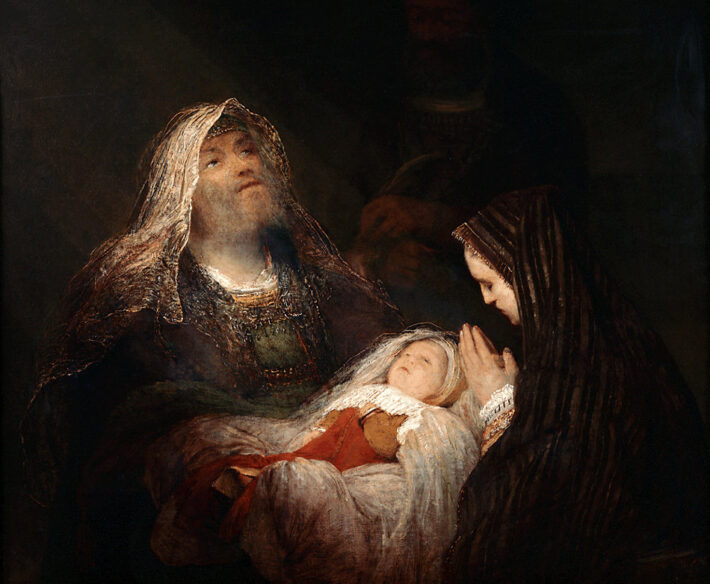
Nunc Dimittis | A Song Of Simeon

Luke 2:25-35 recounts the story of Simeon, a devout and righteous man who was promised by the Holy Spirit that he would not die until he had seen the Messiah. When Mary and Joseph brought the baby Jesus to the temple to present him to the Lord, Simeon recognized him as the Messiah and praised God for fulfilling his promise. Click to play:

Interpretations include:

  1. Simeon represents the faithful remnant of Israel who were waiting for the coming of the Messiah. His recognition of Jesus as the Messiah signifies that Jesus is the fulfillment of Israel’s hope and the culmination of God’s plan of salvation for his people.
  2. Simeon’s words to Mary, ‘A sword shall pierce through thy own soul also,’ are seen as a prophecy of Mary’s own suffering as the mother of Jesus, particularly at his crucifixion. This interpretation emphasizes Mary’s role as a co-sufferer with Jesus in the work of salvation.
  3. The presentation of Jesus in the temple is seen as a moment of revelation, both for Simeon and for all those who recognize Jesus as the Messiah. This revelation is not just about Jesus’ identity, but also about God’s plan of salvation for all people.
  4. Simeon’s recognition of Jesus as the Messiah demonstrates the continuity between the Old Testament and the New Testament. Jesus is the fulfillment of the prophecies and promises of the Old Testament, and his coming is the climax of God’s plan of salvation.
  5. Simeon’s statement that he can now ‘depart in peace’ is seen as a model of Christian hope and faith. Christians can also have the assurance of salvation and the hope of eternal life because of Jesus’ coming and his work on the cross.
  6. Simeon’s recognition of Jesus as the Messiah is also a challenge to all those who encounter Jesus in their own lives. Like Simeon, we are called to recognize Jesus’ true identity and respond with faith and devotion.
Jesus | Child | Prodigal Son | Parables | Audio Bible | KJV | King James Version

Meditations On The Love Of Jesus Christ | Word Aloud | Prayer And Reflection
  • Miracle | Jesus | Audio | Miracles | Audio KJV | Oliver

    In the Bible, a miracle is an event that is not explicable by natural or scientific laws and is therefore attributed to a divine agency. Miracles are often seen as a sign of the intervention of God in the affairs of human beings. In the Old Testament, the most famous miracles are the Ten Plagues of Egypt, in which God punished the Pharaoh for refusing to release the Israelites from slavery, and the parting of the Red Sea, in which God allowed the Israelites to escape from the pursuing Egyptians by opening a path through the sea. In the New Testament, the miracles of Jesus are a central part of his ministry and are seen as evidence of his divinity. These include healings, such as the restoration of sight to the blind and the raising of the dead, and acts of nature, such as turning water into wine and walking on water. Is There A Theological Significance To Jesus’ Miracles? In the Christian tradition, the miracles performed by Jesus are seen as a manifestation of his divinity and as proof of his authority to teach and heal. Many of these miracles are described in the Gospels of the New Testament, which are the primary source of information about the life and teachings of Jesus. The purpose of the miracles, according to the Gospels, was to demonstrate Jesus’ power over natural forces and to show that he had the authority to forgive sins and offer salvation to those who believed in him. Why Did Jesus Ask To Keep His Miracles Secret? ‘Tell No One Of This.’ In the Gospels, there are a few instances where Jesus tells people not to tell others about what he has done for them. For example, in the Gospel of Matthew, after Jesus healed a man who was possessed by demons, he told the man, ‘See that you tell no one anything, but go, show yourself to the priest and offer the gift that Moses commanded, as a proof to them’ (Matthew 8:4). In this case, it seems that Jesus was concerned that the man’s testimony might not be believed or might be misunderstood, and so he asked him to keep the experience to himself for the time being. It is difficult to say for sure why Jesus might have asked someone to keep quiet about a miracle without knowing the specific context in which the request was made. However, some possible reasons that come to mind include: To avoid drawing unnecessary attention to himself. In the Gospels, Jesus often tries to avoid drawing too much attention to himself, especially from the authorities who are hostile to him. Asking someone to keep quiet about a miracle might be one way of avoiding unwanted attention and allowing Jesus to continue his ministry without interference. To allow the person who was healed to experience the transformation for themselves. In some cases, the person who was healed might have been skeptical or unsure of what had happened to them. Asking them to keep quiet about the miracle might have given them time to reflect on the experience and come to their own understanding of it without being influenced by others. To test the person’s faith. In some cases, Jesus might have asked someone to keep quiet about a miracle as a test of their faith. If they were truly grateful for what Jesus had done for them, they would be willing to follow his instructions and trust that he had a good reason for asking them to keep quiet. These are just a few possible reasons why Jesus might have asked someone to keep quiet about a miracle. It is important to remember that the Gospels are ancient texts and that we must be careful not to impose our own interpretations on them without considering the historical and cultural context in which they were written. To avoid creating conflict or division. In the Gospels, Jesus often encounters people who are skeptical or hostile to his teachings, and he sometimes tries to avoid confrontations with them. Asking someone to keep quiet about a miracle might be one way of avoiding a confrontation or a heated debate that could disrupt his ministry. To avoid being misunderstood or misrepresented. In some cases, the person who was healed might not have understood the full significance of what Jesus had done for them, and they might have tried to explain it in a way that distorted or misrepresented the truth. Asking them to keep quiet might have given Jesus time to explain things to them more fully and help them to understand the true meaning of the miracle. To avoid becoming a spectacle. In the Gospels, there are many instances where people are amazed by the miracles that Jesus performs, and they often try to make him into a kind of celebrity or showman. Asking someone to keep quiet about a miracle might have been one way of avoiding this kind of attention and keeping the focus on the message that Jesus was trying to convey. What Is The Significance Of Miracle Of The Wedding At Cana? In the Christian tradition, the wedding at Cana is significant because it is the first of the miracles performed by Jesus that is recorded in the Gospels of the New Testament. This event is described in the Gospel of John, where it is said that Jesus, along with his mother Mary and his disciples, attended a wedding in the town of Cana. At the wedding, the host ran out of wine, and Mary asked Jesus to help. In response, Jesus turned water into wine, which is seen as a miraculous act that demonstrated his power and authority. In the Gospel of John, after Mary asks Jesus to help with the wine at the wedding in Cana, he replies, “Woman, what does this have to do with me? My hour has not yet come” (John 2:4). This statement is often seen as indicating that Jesus was aware […]

  • Audio Bible | Jesus Heals A Paralyzed Man Sick Of The Palsy | Sin And Redemption | Bible Verses

    For the Jewish people, the sickness of the paralyzed man was a symptom of underlying sin. It was a punishment, a consequence of one’s own moral evil or of one’s parents. We can imagine the social consequences for the paralyzed man, in the light of the various exclusions which were applied to disabled people [ … ]

  • Christian Art | Jesus, Mary, Martha

    Saint Augustine concludes his teaching on prayer by returning to its centre: the movement of the Holy Spirit within the believer. The true object of all prayer is the vision of God — the ‘life of happiness’ in which body and soul, made incorruptible, will behold the divine goodness for ever. Every other request is secondary and derives its meaning from this one desire. Without it, even good things lose their worth; with it, nothing is lacking [ … ]

Search Google Here | A Holy Land Jerusalem Pilgrimage? | A Safari? | An Escape..