

King James Audio Bible
The Ten Commandments | The Seventh Commandment: ‘You Shall Not Steal’
The seventh commandment of the Ten Commandments, as recorded in the Bible, states: ‘You shall not steal’ (Exodus 20:15). This commandment prohibits the taking of what belongs to another without just compensation or without the owner’s consent. It encompasses not only physical theft, but also fraud, embezzlement, and any other form of unjustly taking or keeping the goods or property of another.
The Catechism states that ‘the seventh commandment forbids theft, that is, usurping another’s property against the reasonable will of the owner.’ (CCC 2408). It also emphasizes that ‘the seventh commandment enjoins respect for the integrity of creation.’ (CCC 2409) This means that not only should one not steal from other people, but also, they must not take or use natural resources in a way that harms the environment or the rights of others.
The seventh commandment also requires us to respect the right to private property. ‘The use of another’s property entails the duty of paying a just price, of restoring it in case of need, and of not causing damage’. (CCC 2409) This is not only a moral duty but a legal one, as it is not just about respecting other people’s property rights, but also to pay fair prices and taxes, not to damage someone’s property without permission or without compensation.
As Christians, the Seventh Commandment calls us to not steal and to respect the rights of others, including their right to property. This commandment also requires us to be responsible and respectful in our use of the resources of the earth.
What Are The Broader Implications Of The Seventh Commandment In Contemporary Society?
In contemporary society, one can see how this commandment is relevant in various social and economic issues, such as fair wages, intellectual property rights, and environmental sustainability.
As Christians, we are called to be responsible citizens and to work towards a just society where the rights of all are respected and protected. For example, if a worker is being paid less than a living wage, that is theft. It is not right to take advantage of any worker and indirectly steal their wages. Similarly, it is important to recognize the rights of others to their ideas and creations, and not to plagiarize or use someone else’s work without proper attribution or permission.
One can see how the seventh commandment can be violated in everyday life, through actions such as shoplifting, tax evasion, and insider trading. Christians must take care to avoid such actions and to live out the seventh commandment by respecting the rights of others and acting justly in all their dealings.
The commandment calls us to be responsible and respectful in our use of resources, and to work towards a just society where the rights of all are respected.
Is Global Market Capitalism Consistent With Christianity?
The relationship between Christianity and global market capitalism is a complex and nuanced topic that has been the subject of much debate and discussion.
From one perspective, capitalism can be seen as compatible with Christian teachings, as it emphasizes the importance of work and economic growth. The Catechism of the Catholic Church states that ‘work is a good thing for man – a good thing for his humanity – because through work man not only transforms nature, adapting it to his own needs, but he also achieves fulfilment as a human being and indeed, in a sense, becomes more a human being.’ (2427) Additionally, the concept of private property is also recognized as a natural right in much Christian teaching.
However, there are also critiques of capitalism from a Christian perspective, particularly in regards to its emphasis on individualism and materialism. Pope Francis, in his apostolic exhortation ‘Evangelii Gaudium’, criticizes what he calls an ‘economy of exclusion’ and a ‘throwaway culture’, in which certain members of society are marginalized and left behind, while others amass wealth and resources. He states: ‘Just as the commandment “Thou shalt not kill” sets a clear limit in order to safeguard the value of human life, today we also have to say “thou shalt not” to an economy of exclusion and inequality. Such an economy kills.’
Some argue that capitalism can lead to an unjust distribution of wealth, with a few individuals accumulating a disproportionate share of resources, at the expense of the majority. This is in direct contrast with Christian teaching on the importance of caring for the poor and vulnerable, as stated in the Bible: ‘For the poor will never cease to be in the land; therefore I command you, saying, “You shall open your hand wide to your brother, to your poor and your needy, in your land.”’(Deuteronomy 15:11)
The emphasis on profit and material gain that is often present in capitalist societies can be at odds with Christian values of humility, simplicity, and detachment from material possessions.
How Does Capitalism Violate The Commandment Not To Kill?
The idea of the ‘common good’ is central to Christian social teaching. The Catechism of the Catholic Church states: ‘The common good consists of three essential elements: respect for the person, promotion of the general welfare, and the determination of the “just” and “right” principles of social organization.’ (CCC 1910)
In a capitalist system, the pursuit of individual profit can be at odds with the common good. For example, companies may prioritize their own financial gain over the well-being of their employees or the environment. This can be seen in instances of mistreatment of workers, or in the exploitation of natural resources for profit without regard for long-term sustainability.
Moreover, in a market economy where the profit is the ultimate goal, it can also neglect the right to live decently, as it can happen to promote practices like exploitation of worker, ignoring the environmental and social impacts, etc.
Christian social teaching often emphasizes the importance of subsidiarity, which holds that social and economic matters should be handled at the most local level possible. This principle is at odds with the globalized nature of capitalism, which often involves large, multinational corporations and centralized decision-making.
Overall, while capitalism can be seen as promoting hard work, initiative, and economic growth, it is important for Christians to consider its potential negative effects on the common good, the protection of the poor, and the principles of subsidiarity. In this sense, Christians have the duty to promote a ‘social market economy’, where the profit is not the ultimate goal, but rather the safeguard of the human dignity and the common good.
What More Has Pope Francis Said About This?
Pope Francis has spoken extensively about the issues related to global market capitalism and its impact on society. He has called for a ‘new global political authority’ to combat the ‘throwaway culture’ of consumerism and to address issues of poverty, inequality, and environmental degradation.
In his apostolic exhortation ‘Evangelii Gaudium’ Pope Francis states that ‘today’s economic mechanisms promote inordinate consumption, yet it is evident that unbridled consumerism combined with inequality proves doubly damaging to the social fabric.’ He goes on to say: ‘Just as the commandment “Thou shalt not kill” sets a clear limit in order to safeguard the value of human life, today we also have to say “thou shalt not” to an economy of exclusion and inequality. Such an economy kills.’
In his encyclical ‘Laudato Si’ Pope Francis addresses specifically the issue of the environment, and the link between social and environmental degradation, and an economic system centred on the profit at any costs. He says that the ‘technological paradigm’ and the ‘dominant technocratic paradigm’ have led to the ‘exploitation of nature’ and that as a consequence ‘the natural environment is so closely linked to human life that the degradation of the environment and of society affects the most vulnerable people’.
Pope Francis has called for an ‘integral ecology’ that takes into account not only the protection of the environment, but also the well-being of the poor and vulnerable members of society. In ‘Laudato Si’ Pope Francis stated that ‘care for ecology calls for an “integral ecology” which clearly respects its human and social dimensions.’
Pope Francis has called for a reform of the global financial system and a renewed emphasis on the preferential option for the poor. In the Post-Synodal Apostolic Exhortation ‘Christus vivit’, he states that ‘a financial reform open to such ethical considerations would require a vigorous change of approach on the part of political leaders’ and that ‘we need to see, with the eyes of faith, the infinite potential of human beings who can become an image of their Creator. We need to see that the growth of material goods is not enough’.
How Does The Commandment Relate To Our Use And Care Of The Environment?
The commandment ‘Thou shalt not kill’ is closely related to our relationship with the environment, as it applies to the sacredness of all life and the respect for the natural world.
There is a view that the use of animals is permissible:
‘God entrusted animals to the stewardship of those whom he created in his own image. Hence it is legitimate to use animals for food and clothing. They may be domesticated to help man in his work and leisure. Medical and scientific experimentation on animals is a morally acceptable practice if it remains within reasonable limits and contributes to caring for or saving human lives.’ (CCC 2417)
However: ‘Respect for physical life and for the environment is closely linked… Man’s dominion over inanimate and other living beings granted by the Creator is not absolute; it is limited by concern for the quality of life of his neighbour, including generations to come; it requires a religious respect for the integrity of creation.’(CCC 2258/2415)
This means that the commandment ‘Thou shalt not kill’ applies not only to human life but also to the life of all creatures and the integrity of the natural world.
The environmental degradation, pollution and climate change, are issues addressed by the Church. Pope Francis has been particularly vocal on the topic, in his encyclical ‘Laudato Si’ he states: ‘Each year sees the disappearance of thousands of plant and animal species which we will never know, which our children will never see, because they have been lost forever. The great majority become extinct for reasons related to human activity.’ He goes on to say: ‘The destruction of the human environment is extremely serious, not only because God has entrusted the world to us men and women, but because human life is itself a gift which must be defended from various forms of debasement.’
Pope Francis relates the commandment ‘Thou shalt not kill’ to the care of the environment. He states: ‘The Bible has no place for a tyrannical anthropocentrism blind to the cry of the earth and to the diagnostics of nature… The commandment “Thou shalt not kill” has absolute value and pertains to both the human person and the whole of creation.’
What Have Other Church Leaders And Religious Authorities Had To Say?
In the Jewish tradition, the principle of ‘bal tashchit’ which is derived from the Hebrew Bible is emphasized. It prohibits the wanton destruction of natural resources and requires human beings to use the earth’s resources responsibly, sustainably and compassionately. This principle of ‘bal tashchit’ is well-articulated in the Talmud (a central text in Rabbinic Judaism), which states: ‘You shall not destroy; he who destroys anything in the world is as if he destroyed the whole world.’ (Sanhedrin 74a) This concept is also related to the idea that the earth and its resources were given to human beings in trust, and that it is our responsibility to be stewards of the earth and its inhabitants.
In the Islamic tradition, the concept of ‘khalifa’ or ‘stewardship’ is central. Muslims believe that they are ‘vicegerents’ of God on Earth, and that they have a duty to protect and preserve the natural world, to ensure its well-being for future generations. The Quran states: ‘It is He (Allah) who has made you custodians of the earth. He has raised some of you by degrees above others, in order that He might try you in what He has bestowed on you.’ (Qur’an 6:165)
In Buddhism, the belief in the interdependence and interconnection of all things is central, and the concepts of ‘right livelihood’ and ‘right action’ are important aspects of Buddhist ethics. This includes avoiding harmful actions and being mindful of the impact of one’s actions on the environment and all living beings. In this sense, there is an understanding that our actions have an impact on all living beings and that not killing is not only about human life, but it also includes non-human life and the environment.
Many Protestant denominations have spoken out on the importance of environmental stewardship and the protection of creation. For instance, the United Methodist Church has adopted a number of statements and resolutions on environmental issues, and the Evangelical Lutheran Church in America has issued a statement on ‘Caring for Creation’ which states that ‘the commandment ‘Thou shalt not kill’ reminds us that God intends human life to be cherished and preserved, as is all of creation.’
In the Anglican tradition, the Anglican Communion has issued a statement on ‘The Integrity of Creation’ in which it affirms that ‘the Seventh Commandment (Thou shalt not kill) is a call to respect the integrity of God’s creation, which includes both human and non-human life.’ and that ‘all human beings are called to be stewards of creation and to respect the integrity of God’s creation, which includes the environment, the natural world and all forms of life.’
In addition, many local Anglican churches have taken a leadership role in promoting environmental stewardship, through initiatives such as installation of solar panels, energy-efficient buildings, and conservation of land.



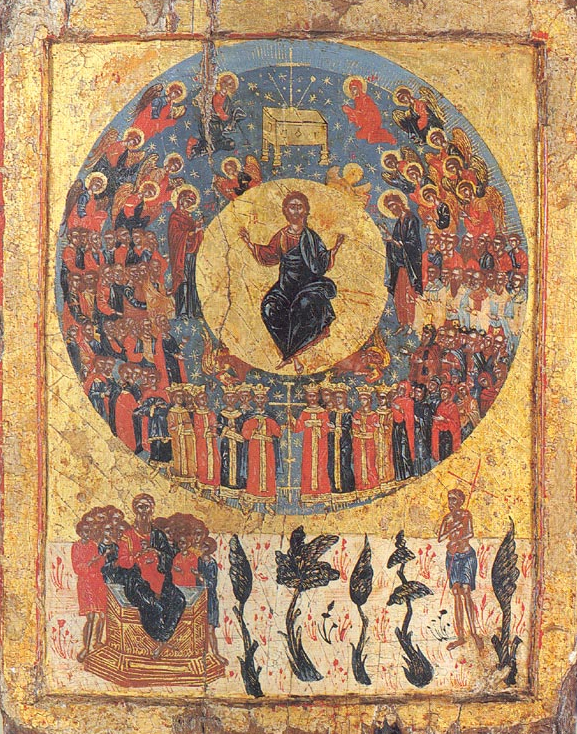
Most of the signs Christ describes to his listeners in the eschatological discourse had already been realized by the time Luke’s first audience would have heard his Gospel. There had been, and were, wars, persecutions, family conflict, and Jerusalem with the Temple had been destroyed. The Christians of Luke’s time listening to these Gospel verses, of today and since Tuesday, could then have been encouraged to know that they were very close to Christ’s full revelation, his apocalypse, and so have courage to bear persecutions and other great challenges of the early Church [ … ]
Saint Augustine brings his reflection on prayer to its culmination by turning to the Lord’s Prayer — the model and measure of all Christian supplication. For him, this brief prayer given by Christ contains the fullness of all holy desire. Every petition found in Scripture, every movement of the soul toward God, finds its echo and completion within its sevenfold structure [ … ]

In the light of Jesus, we understand that taking the name of the Lord in vain extends beyond the literal misuse of God’s name. It also includes misrepresenting God through our actions, attitudes, and behaviour as His followers. Jesus emphasized the importance of bearing fruit that aligns with the nature of God, saying, ‘By their fruits, you will know them’ (Matthew 7:20, KJV). As his disciples, we are called to embody the values and virtues associated with God’s name [ … ]
