
Christian Art | George Herbert | Sepulchre | The Church | Good Friday
George Herbert | The Temple | The Church | Sepulchre
O blessed bodie! Whither art thou thrown?
No lodging for thee, but a cold hard stone?
So many hearts on earth, and yet not one
Receive thee?
Sure there is room within our hearts good store;
For they can lodge transgressions by the score:
Thousands of toyes dwell there, yet out of doore
They leave thee.
But that which shews them large, shews them unfit.
What ever sinne did this pure rock commit,
Which holds thee now? Who hath indited it
Of murder?
Where our hard hearts have took up stones to brain thee,
And missing this, most falsly did arraigne thee;
Onely these stones in quiet entertain thee,
And order.
And as of old, the law by heav’nly art
Was writ in stone; so thou, which also art
The letter of the word, find’st no fit heart
To hold thee.
Yet do we still persist as we began,
And so should perish, but that nothing can,
Though it be cold, hard, foul, from loving man
Withold thee.


George Herbert | The Temple | The Church | Sepulchre
This poem addresses the burial and rejection of Christ’s body, using images of coldness, hardness, and stone to explore themes of human indifference, sin, and divine love. The poet begins by questioning where Christ’s body is placed, lamenting that it finds rest on ‘a cold hard stone’. Despite the existence of ‘so many hearts on earth’, none is receptive enough to ‘receive thee’, symbolizing the rejection and abandonment Christ endures even in death. The stone, a literal image of Christ’s tomb, also symbolizes the hardened state of human hearts unwilling to accept or contain him.
The poet observes that human hearts often house ‘transgressions by the score’ and ‘thousands of toys’ or distractions, which contrasts with their exclusion of Christ. This rejection implies that humanity’s preoccupation with sin and worldly concerns makes hearts unfit for Jesus’ presence. The line, ‘But that which shows them large, shows them unfit,’ reflects the paradox that, though the human heart has room for many things, its openness to sin renders it unsuitable for Christ’s purity. The poet questions what ‘sin’ this ‘pure rock’ committed to deserve holding Christ’s body, underscoring the innocence of Christ and the irony of his entombment.
In the third stanza, the poet compares human hearts to the stone in the tomb, noting that while people have metaphorically ‘took up stones to brain thee’, symbolizing their readiness to harm Christ through sin, only the literal stones of the tomb ‘in quiet entertain thee, / And order’. This line suggests that the physical stones are more suited to hold Christ than the metaphorically hard, sinful hearts of humanity. Here, the stone represents not only the tomb but the enduring rejection and mistreatment Christ experiences from humankind, juxtaposed against the peace and order Jesus finds in death.
The poet then draws a parallel between the stone tablets of the Old Testament law and the stone that now holds Christ’s body. As the law was once ‘writ in stone’ by divine command, so too does Christ, the ‘letter of the word’, encounter hardness and rejection from human hearts. This comparison underscores the continuity between God’s previous revelation through the law and the fulfillment of that revelation in Christ. The ‘letter of the word’ phrase emphasizes that Christ embodies divine truth, yet even so, finds ‘no fit heart / To hold thee’. In this light, Christ’s rejection by hardened hearts reflects humanity’s ongoing resistance to God’s message, both in its original form and its embodied form in Christ.
In the concluding stanza, the poet acknowledges humanity’s persistence in sin, admitting that without divine intervention, people would ‘perish’. However, despite human sinfulness—described as ‘cold, hard, foul’—nothing ‘can…withhold thee’ from ‘loving man’. This ending affirms Christ’s unconditional love, which persists in the face of humanity’s continued rejection and failings. Although human hearts are unworthy and resistant, divine love endures, illustrating a contrast between human weakness and divine constancy.
The poem uses imagery of stone and hardness to illustrate human indifference and moral inadequacy, contrasting it with Christ’s steadfast love and sacrifice. Through this contrast, the poem conveys the idea that divine love transcends human rejection and remains unwavering, even when it is met with indifference and sin.


Saint Ignatius, Bishop of Antioch, was being transported to Rome under guard to face execution in the Coliseum, likely in the early second century. His letters, written on the way, reflect both his apostolic zeal and a deep concern for the life of the Church in its earliest decades. His correspondent, Saint Polycarp, bishop of Smyrna, was himself a revered figure, a disciple of Saint John the Apostle, and later a martyr. Thus, this is a remarkable exchange: from one soon-to-be martyr to another, entrusted with the care of the flock in perilous times [ … ]

William Blake’s ‘Jerusalem’ is a visionary poem taken from Milton: A Poem, one of Blake’s prophetic works. Though often associated with patriotism, the poem is more complex than a simple celebration of England. It expresses a deep anxiety about the spiritual and moral state of the nation, contrasting an idealized past with the corrupted present. Blake imagines a divine England, once touched by the presence of Christ, now overshadowed by oppressive forces that must be resisted through a struggle of the mind and spirit. The poem follows a regular structure of four quatrains with an ABAB rhyme scheme, and its meter, largely iambic tetrameter, gives it the quality of a hymn or a rallying cry [ … ]
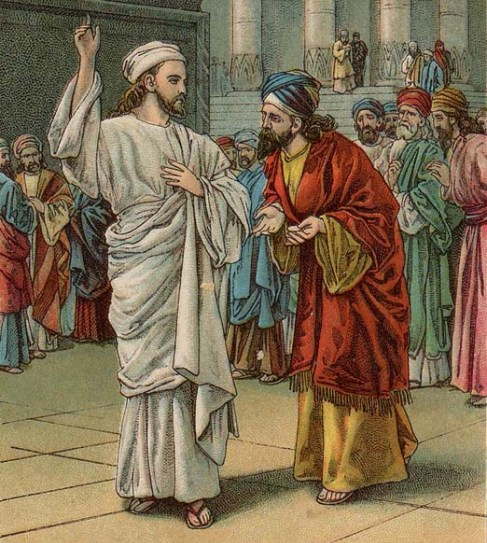
The Sadducees deny the resurrection, because they are rich and so proclaim the false belief that the Messianic Kingdom has already arrived, their riches being their reward for living according to the Law. In order to challenge Jesus, they present him with a fictional case of a widow passed from brother to brother, according to the Levirate Law, hoping to make the resurrection look ridiculous [ … ]