
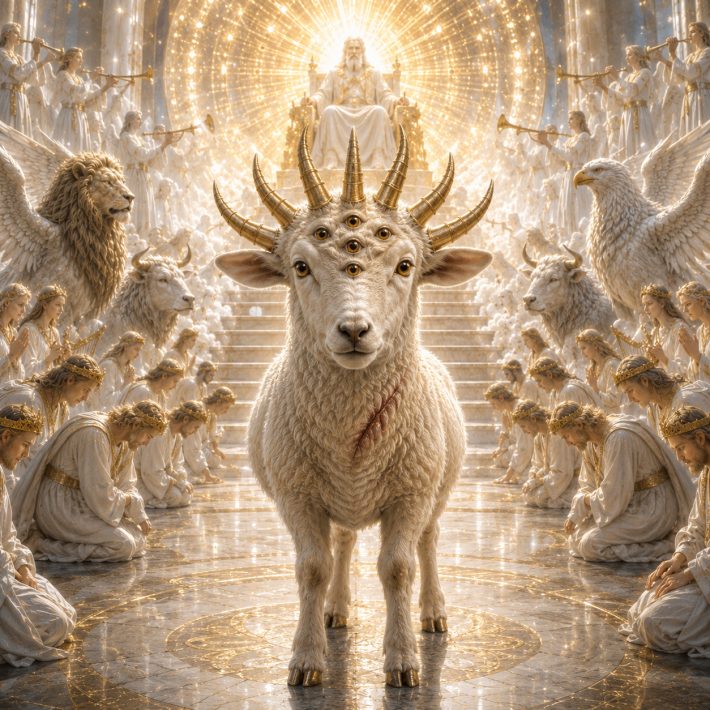
Christian Art | Lamb Of God
The Book Of Revelation/Apocalypse | Full Text Reading
‘Woe to the inhabiters of the earth and of the sea! for the devil is come down unto you, having great wrath,
because he knoweth that he hath but a short time.’
‘Here is wisdom. Let him that hath understanding count the number of the beast: for it is the number of a man;
and his number is Six hundred threescore and six.’
(Revelation 12: 12, 13: 18)
The Mission | Bring Yourself – Bring All You Are – To God
Behold the Lamb of God
The Book of Revelation begins by identifying both its subject and its source:
‘The Revelation of Jesus Christ, which God gave unto him, to shew unto his servants things which must shortly come to pass.’ (Revelation 1: 1)
The Greek word apokalypsis means an unveiling or disclosure – apo = from, since; kalypsis = cover, veiled, being hidden. The English title Revelation and the traditional title Apocalypse express the same idea: something which cannot ordinarily be seen is being made known. Revelation does not principally attempt to conceal information within a collection of puzzles; it unveils the true character of the world by showing earthly history from the standpoint of the throne of God and the slain Lamb.
The subject of that revelation is Jesus Christ. Revelation contains visions of war, persecution, beasts, plagues, judgement, death and the destruction of cities, but these do not constitute its centre. Christ stands at the centre: crucified, risen, enthroned and victorious. John first sees him among the churches; he then sees him as the Lamb before the throne, the one who alone is worthy to open the sealed scroll. Everything which follows takes place under the authority of God and the Lamb, and the final chapters disclose the consequence of that authority: the defeat of what opposes God, the resurrection of the dead, the renewal of creation and the dwelling of God with humanity.
Revelation belongs to several literary forms at once. It is an apocalypse, communicating extensively through visions and symbols; it is prophecy, since John explicitly calls it ‘the words of this prophecy’; and it is also a letter addressed to seven historical churches in the Roman province of Asia. These forms must be held together. John is shown realities extending to the completion of God’s purposes, but the visions are given to actual Christian communities facing questions of worship, compromise, persecution, prosperity and endurance within the Roman world.
The author identifies himself as John and describes himself as the Christians’ ‘brother, and companion in tribulation’. He is on Patmos ‘for the word of God, and for the testimony of Jesus Christ’. Christian tradition has associated him with Saint John the Apostle, though the authorship of Revelation and its precise literary relationship with the Fourth Gospel have been discussed since antiquity. Whatever conclusion is reached concerning those questions, the book consciously places itself within the Christian witness to Jesus Christ and addresses churches which John knows.
Its historical setting guides interpretation. The Christians of Ephesus, Smyrna, Pergamos, Thyatira, Sardis, Philadelphia and Laodicea lived within cities shaped by Roman political authority, civic religion, commerce, social hierarchy and pagan worship. Imperial power was not experienced merely as distant government; political, religious, social and economic life could overlap. The question of allegiance to Christ could thus become a question about participation in the ordinary structures of the city.
Revelation addresses that world directly, but it does so through the language of Scripture. Rome is never simply called Rome; the great city becomes ‘Babylon’. Political power becomes a beast; religious propaganda becomes a false prophet; persecution is disclosed as the earthly expression of a conflict involving the dragon. These symbols have historical referents, but their meaning is not exhausted by them. Rome can be Babylon because Babylon had already become within Scripture a name for organised human power set against God; the symbolism can therefore address John’s contemporaries while remaining capable of describing recurring forms of human rebellion.
The Old Testament supplies much of the language through which this unveiling takes place. Revelation rarely introduces an Old Testament passage as a formal quotation; instead, Genesis, Exodus, the Psalms, Isaiah, Ezekiel, Daniel, Zechariah and other books are woven throughout its visions. The plagues recall Egypt; the throne recalls Isaiah and Ezekiel; the beasts recall Daniel; the woman clothed with the sun evokes Israel; Babylon recalls the prophetic judgements upon imperial cities; the river and tree of life return the reader to Genesis while also recalling Ezekiel’s restored sanctuary.
Revelation presents the completion of a biblical history already under way. Creation, fall, covenant, Exodus, kingdom, exile, prophecy, incarnation, crucifixion and resurrection stand behind its imagery. The book cannot be separated from that history without distorting its symbols; the Apocalypse does not replace the rest of Scripture with a new symbolic system, but gathers the biblical story toward completion.
Numbers are used symbolically throughout Revelation. The number seven recurs throughout: seven churches, seven seals, seven trumpets and seven bowls. Twelve and its multiples are associated particularly with the people of God: twelve tribes, twelve apostles, twenty-four elders, 144,000 of the elect – the symbolic completeness of God’s redeemed people, viewed as the sealed covenant people of God, and too the innumerable multitude, the same redeemed people viewed in their universal extent, drawn from every nation. There are twelve gates and twelve foundations. The numbers contribute to the theological architecture of the visions; they are not normally a numerical code from which a chronology of future events can be calculated.
The structure of Revelation also resists reduction to a simple timetable. The seals, trumpets and bowls repeatedly approach judgement from different perspectives; scenes on earth are interrupted by scenes in heaven; events are shown and then interpreted through subsequent visions. The seventh trumpet can announce that ‘The kingdoms of this world are become the kingdoms of our Lord, and of his Christ’, yet the book then turns to the woman, dragon and beasts. The narrative has not simply moved backwards in time by mistake. John is being shown another dimension of the same conflict.
Earth and heaven provide two perspectives on the same events. The Church appears weak, persecuted and vulnerable; from the throne, it belongs to the Lamb. Imperial power appears permanent; from heaven, its authority has been ‘given’ and its time is limited. A martyr appears defeated by his killer; before God, he stands clothed in white. The old world appears permanent; John sees it pass away. The visions do not deny earthly experience but disclose its full meaning.
Revelation was given to churches required to endure. Its visions do not remove tribulation; they show that tribulation does not determine the end. The churches can remain faithful because they are shown that end. Their hope rests not on escape from suffering but on the sovereignty of God, the victory of the Lamb and the renewal of creation.
Revelation repeatedly distinguishes appearance from reality. John says, ‘I saw’, ‘I looked’, or ‘I beheld’ because ordinary observation cannot disclose what he is shown. An empire sees its magnificence; John sees a beast. Merchants see a wealthy city; John sees Babylon, drunk with the blood of the saints. The world sees Christians put to death; John sees those witnesses before God. The crucifixion appears a defeat; John sees a Lamb ‘as it had been slain’ standing in the midst of the throne.
The Lamb provides the interpretative centre of Revelation. In Chapter 5 John is told:
‘Behold, the Lion of the tribe of Juda, the Root of David, hath prevailed to open the book.’
He looks, however, and sees:
‘a Lamb as it had been slain’.
The Lion and Lamb are not two different figures. What John sees explains what he has heard: the victory of the Lion is accomplished through the sacrifice of the Lamb. Christ conquers not by abandoning the cross but through it; he stands because he was slain and has risen.
The dragon, beast and Babylon rely on domination, coercion, wealth, deception and death; the Lamb conquers through sacrifice, truth, testimony and resurrection. His followers overcome in the same way:
‘And they overcame him by the blood of the Lamb, and by the word of their testimony; and they loved not their lives unto the death.’
If victory meant simply remaining alive, the statement would be contradictory. The beast can kill the saints and appear to overcome them; they overcome because death does not make them abandon their testimony. Their victory depends upon Christ, whose own death was not final because he rose.
The final vision of Christ as the rider on the white horse does not abandon this principle. The sword proceeds from his mouth; his weapon is his word. His garment is already dipped in blood before the final confrontation has taken place. The victorious rider remains the crucified Word; Revelation does not transform the Lamb into another beast.
This distinction between the Lamb and the beast belongs to a larger set of contrasts that shapes Revelation. The book repeatedly places a true reality beside a counterfeit. There is the throne of God and the throne of the beast; the Lamb and the beast with lamb-like horns; the seal of God and the mark of the beast; prophetic witness and the false prophet; the name of God upon the foreheads of his servants and the number of the beast upon its followers. There is the woman clothed with the sun and Babylon clothed with purple and scarlet; Babylon the prostitute and Jerusalem the bride; Babylon’s intoxicating cup and the river of the water of life.
These contrasts focus the argument on worship. Revelation contains an extraordinary amount of worship because worship expresses allegiance to reality as it truly is. The living creatures and elders worship God because He created all things; heaven worships the Lamb because he was slain and redeemed a people. The beast demands worship because political power has made an ultimate claim for itself; the false prophet directs humanity toward that worship; Babylon seduces kings and nations into an order of desire which functions as an alternative to the order of God.
Political, economic, religious and moral questions converge. The mark of the beast affects buying and selling because economic participation can become an expression of allegiance; Babylon’s merchants mourn because the destruction of an idolatrous city also destroys the commercial system from which they became rich. Revelation does not condemn political organisation or commerce as such. The kings of the earth eventually bring their glory into the New Jerusalem, and the nations themselves are healed. The problem arises when created things claim or receive the allegiance belonging to the Creator.
Babylon most fully expresses this disordered allegiance. She is attractive rather than frightening: clothed in purple and scarlet, decorated with gold, precious stones and pearls, and connected with an immense network of commerce. Her attractiveness is essential to the vision. The beast can compel; Babylon can persuade. Revelation presents evil not only as obvious brutality but as an order which can appear desirable to those who benefit from it.
The catalogue of Babylon’s merchandise exposes the cost of that splendour. Gold, silver, precious stones, fine linen, spices, wine, wheat, cattle, horses and chariots culminate in ‘slaves, and souls of men’. Human beings have entered the catalogue of commodities. The beautiful city is also ‘drunken with the blood of the saints’. Revelation does not ask the reader to deny Babylon’s magnificence; it unveils what that magnificence contains.
The judgement of Babylon follows this disclosure. Judgement is indispensable to Revelation, but judgement is not its final subject. The dragon, beasts and Babylon cannot simply be left permanently alongside the New Jerusalem; death cannot remain within a creation in which God promises that there shall be no more death. Judgement removes what destroys God’s creation.
This is explicit at the seventh trumpet, when the time comes to ‘destroy them which destroy the earth’. Divine judgement is not presented as God’s rejection of creation; it is directed against what corrupts creation. The sequence reaches its theological explanation when the one seated upon the throne declares:
‘Behold, I make all things new.’
Revelation moves through judgement toward new creation. Babylon must fall because Jerusalem is to descend; the beast must be removed because the nations are to be healed; the dragon must be removed because deception is to end; death must be destroyed because humanity is to live in the presence of God.
Contrast between Babylon and Jerusalem structures the book. Both are women and both are cities; both gather nations and are associated with kings and wealth. The difference is not between civilisation and the absence of civilisation. The difference lies in the principle according to which human life is ordered. Babylon orders human life around idolatrous desire, domination and exploitation; Jerusalem orders it around the presence of God and the Lamb.
The difference appears even in their wealth. Babylon accumulates precious things through a commercial system which eventually includes human lives; Jerusalem itself is made of gold and precious stones, but its gifts are not purchased through exploitation. The water of life is given ‘freely’. Kings bring their glory into the city rather than using glory to dominate it; the nations are not enslaved but healed. The gates remain permanently open because there is no longer an enemy from whom the city must protect itself.
The New Jerusalem is not a replacement for a destroyed world. It is the fulfilment toward which the biblical history of divine presence has moved. Its dimensions form a cube, recalling the Holy of Holies in the Temple; yet John explicitly says that he sees no temple in the city:
‘for the Lord God Almighty and the Lamb are the temple of it.’
The apparent contradiction explains the symbolism. The city does not lack a sanctuary; the whole city has become what the Holy of Holies once represented. Divine presence is no longer concentrated within one restricted sacred chamber. God and the Lamb fill the city.
This brings Revelation back through the biblical history which supplied its symbols. God walked with humanity in Eden; appeared to Abraham; descended upon Sinai; dwelt among Israel in the tabernacle; filled the Temple; and came among humanity in Jesus Christ. Revelation brings this history to its stated end:
‘Behold, the tabernacle of God is with men, and he will dwell with them.’
The final Christian hope is not adequately described as going to heaven. The New Jerusalem comes down from God; the direction of the vision is toward renewed creation and the dwelling of God with humanity. The final state is communion.
The destruction of death belongs directly to that fulfilment. Death appears in Revelation as the apparent weapon of persecuting power. The martyrs die; the beast kills; Babylon contains the blood of the saints. Yet the authority of death has already been challenged in the first chapter, where the risen Christ declares:
‘I am he that liveth, and was dead; and, behold, I am alive for evermore, Amen; and have the keys of hell and of death.’
The claim reaches fulfilment when death and hell themselves are cast into the lake of fire. Revelation does not only promise that certain individuals will survive death; death itself ceases to possess a place within creation. Only then can the voice from the throne say:
‘there shall be no more death, neither sorrow, nor crying, neither shall there be any more pain.’
The tears which God wipes away should be understood within the same structure. Revelation has not forgotten suffering. The martyrs cry from beneath the altar; their blood is remembered. Babylon is judged partly because that blood was found within her. The new creation does not make suffering insignificant by pretending that it never occurred. Justice answers it; resurrection overturns its apparent finality; the presence of God removes the conditions which produced it.
The tree of life completes the return to Genesis. Humanity was excluded from it after the fall; in Revelation it stands beside the river of life and bears fruit continually. Yet Scripture does not finish where it began. Eden has become a city, and human history remains: the tribes of Israel are named upon its gates; the apostles upon its foundations; the nations enter it; kings bring their glory into it. The leaves are ‘for the healing of the nations’.
The final answer to the conflict of Revelation is not only the defeat of enemies; it is the healing of creation. The dragon deceived the nations; the beast dominated them; Babylon exploited them; the tree of life heals them.
At the centre of the city remains the Lamb. The wounds of history have not disappeared from the identity of the Redeemer; the one who reigns is still the one who was slain. The throne is described as ‘the throne of God and of the Lamb’, and from it proceeds the river of life. The servants of God see his face and bear his name upon their foreheads. The mark of the beast has disappeared; the name of God remains.
Revelation begins with seven churches trying to remain faithful where other powers claim their allegiance; it ends with the servants of God seeing his face. Between them, every rival claim to ultimate authority is exposed and removed. Contested worship gives way to undivided presence.
The Apocalypse begins, ‘The Revelation of Jesus Christ’. Its final hope is also concentrated in Jesus Christ. After the seals, trumpets, beasts, Babylon, bowls, judgement, resurrection and New Jerusalem, the book does not end with another symbol. It ends with a promise:
‘Surely I come quickly.’
John answers:
‘Amen. Even so, come, Lord Jesus.’
The prayer gathers the whole Apocalypse into a few words. To ask Christ to come is to ask for the fulfilment of what John has seen: for false worship to end; for the victims of violence to be vindicated; for death to lose its power; for creation to be made new; for the nations to be healed; and for God to dwell with humanity.
Revelation begins by unveiling Jesus Christ; it ends by teaching the Church to desire his coming.
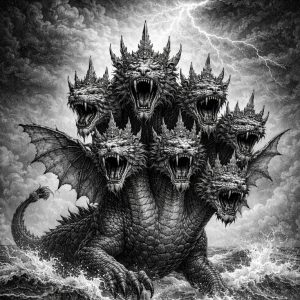
The Dragon | Identified As Satan.
I. The Revelation Of Jesus Christ
Revelation 1
After its opening identification, Revelation immediately establishes a chain of communication: God gives the revelation to Jesus Christ; Christ sends it through his angel; the angel communicates it to John; John bears witness to the churches. The book presents itself as testimony received rather than speculation devised by its author. John writes of ‘things which must shortly come to pass’, and the reader is told that ‘the time is at hand’. Whatever later fulfilments the visions may contain, these statements establish that Revelation was intended to speak meaningfully to the churches which first received it.
A blessing is pronounced upon ‘he that readeth, and they that hear the words of this prophecy, and keep those things which are written therein’. The singular reader and plural hearers reflect the public reading of the text within the gathered Church. More importantly, the blessing is attached not only to understanding but to keeping. Revelation is given to shape Christian conduct. Its purpose is practical from the beginning: the visions call the churches to faithfulness.
John addresses ‘the seven churches which are in Asia’ and greets them with grace and peace. The greeting comes from ‘him which is, and which was, and which is to come’, from the seven Spirits before the throne, and from Jesus Christ. Christ is described as ‘the faithful witness, and the first begotten of the dead, and the prince of the kings of the earth’. These titles anticipate the whole book. Jesus has borne faithful testimony unto death; he has risen; and he already possesses authority over the rulers who appear to dominate the political world.
The response is praise: ‘Unto him that loved us, and washed us from our sins in his own blood.’ The KJV’s ‘washed’ expresses the cleansing accomplished through Christ’s sacrificial death. He has made his people ‘kings and priests unto God and his Father’. The language recalls Israel’s vocation as a kingdom of priests; Revelation applies it to the redeemed community. The promise will reappear later when the saints reign with Christ and serve God within the New Jerusalem.
The announcement ‘Behold, he cometh with clouds’ draws upon Daniel’s vision of the Son of Man and the prophetic language of Zechariah: ‘every eye shall see him, and they also which pierced him’. Revelation begins with the coming of Christ before describing the events which lead toward its final fulfilment. The book’s last prayer, ‘Even so, come, Lord Jesus’, will answer this opening announcement.
God declares: ‘I am Alpha and Omega, the beginning and the ending.’ History is enclosed within divine sovereignty before John is shown any of its conflicts. The beasts, Babylon, persecution and death will appear formidable, but none exists outside the beginning and end established by God.
John On Patmos
John describes himself not by ecclesiastical rank but as ‘your brother, and companion in tribulation, and in the kingdom and patience of Jesus Christ’. Tribulation, kingdom and endurance are placed together. Participation in Christ’s kingdom does not mean the absence of suffering; it requires patience within it.
John is ‘in the Spirit on the Lord’s day’ when he hears behind him ‘a great voice, as of a trumpet’. He is commanded to write what he sees and send it to the seven churches. Turning toward the voice, he first sees seven golden candlesticks, or lampstands, and then one ‘like unto the Son of man’ standing among them.
The order is significant. Christ is revealed in the midst of the churches. They may be small communities within powerful Roman cities, but the first vision does not show them abandoned; the risen Christ walks among their lampstands.
His appearance combines imagery from Daniel and other prophetic visions. He wears a garment reaching to the feet and a golden girdle; his head and hair are white like wool and snow; his eyes are ‘as a flame of fire’; his feet resemble fine brass glowing in a furnace; his voice is ‘as the sound of many waters’. He holds seven stars in his right hand; from his mouth proceeds a sharp two-edged sword; his countenance shines like the sun.
These features are not components of a literal physical portrait. They communicate identity and authority. The white hair recalls the Ancient of Days in Daniel; the fiery eyes express penetrating judgement; the voice like waters conveys power; the sword proceeding from the mouth signifies the judging word of Christ. The vision places Jesus within imagery associated with divine authority.
John falls at his feet ‘as dead’. Christ lays his right hand upon him and says:
‘Fear not; I am the first and the last: I am he that liveth, and was dead; and, behold, I am alive for evermore.’
The centre of the vision is not terror but the identity of the risen Christ. He was dead and now lives permanently; because of this he possesses ‘the keys of hell and of death’. Death, which will appear repeatedly as the weapon of persecutors and beasts, is already shown to be under his authority.
Christ then interprets two of the symbols himself. The seven stars are the angels of the seven churches, and the seven candlesticks are the seven churches. Revelation thus begins its symbolic language by providing an interpretation: visible images disclose spiritual realities.
The first chapter establishes the standpoint from which everything else must be read. Christ is alive; he stands among his churches; he holds their stars; his word judges; and he possesses the keys of death. The churches will shortly be confronted with their failures, dangers and compromises, but they are addressed by one whose authority precedes and exceeds the powers which threaten them.
The Seven Storey Mountain.
II. The Seven Churches
Revelation 2-3
The messages to the seven churches are not a preliminary section which can be left behind when the visions begin. They establish the practical questions which the rest of Revelation will address: faithfulness, compromise, false worship, endurance, spiritual complacency and the meaning of overcoming. Each message concerns a particular historical church, but each ends with a command addressed more widely: ‘He that hath an ear, let him hear what the Spirit saith unto the churches.’
The seven messages follow a broadly recognisable form. Christ identifies himself using language drawn from the opening vision; he states what he knows about the church; he commends or rebukes as appropriate; he calls for repentance or endurance; and he gives a promise to the one who overcomes. The promises anticipate the final chapters of Revelation. The tree of life, the second death, authority over the nations, white garments, the name of God, the New Jerusalem and the sharing of Christ’s throne all appear first as promises to churches struggling within the present world and later as realities of the completed kingdom.
Ephesus
Christ addresses Ephesus as the one who ‘holdeth the seven stars in his right hand, who walketh in the midst of the seven golden candlesticks’. He knows their works, labour and patience. The church has tested false apostles and endured for Christ’s name without fainting. Its doctrinal vigilance and perseverance are acknowledged.
Yet Christ says: ‘Nevertheless I have somewhat against thee, because thou hast left thy first love.’ Correct judgement and endurance have not removed the need for love. The church is commanded to remember, repent and do the first works. If it refuses, Christ will remove its candlestick.
The warning is significant because the lampstand represents the church itself. A congregation may defend truth and yet cease to fulfil its vocation as a church if love disappears. Revelation begins its judgement not with Rome or Babylon but with the household of faith.
The promise is: ‘To him that overcometh will I give to eat of the tree of life, which is in the midst of the paradise of God.’ The tree lost in Genesis already appears as the destination of Christian perseverance; it will return beside the river of life in Revelation 22.
Smyrna
Smyrna receives no rebuke. Christ identifies himself as ‘the first and the last, which was dead, and is alive’. The title is directly relevant to a church facing death.
He knows their tribulation and poverty, but adds: ‘but thou art rich’. The contrast between appearance and reality is already explicit. By ordinary economic measures the church is poor; from Christ’s standpoint it is rich.
Further persecution is coming. Some will be cast into prison and tested; the tribulation will have a limited duration. Christ does not promise that they will avoid suffering. He commands:
‘be thou faithful unto death, and I will give thee a crown of life.’
The words establish the pattern later embodied by the martyrs. Faithfulness may lead to physical death, yet death is not the final judgement. The promise follows: ‘He that overcometh shall not be hurt of the second death.’ Revelation 20 will eventually explain the second death; Smyrna is told in advance that the greater death has no authority over those who remain faithful to Christ.
Pergamos
Pergamos is described as the place ‘where Satan’s seat is’. The exact local reference has been variously identified with the city’s temples, imperial cult, political authority or its general concentration of pagan worship. Revelation does not explain the phrase further; its principal effect is to disclose the spiritual character of the pressure surrounding the church.
The Christians have held fast Christ’s name even when Antipas, ‘my faithful martyr’, was killed. The word translated ‘martyr’ means witness; Revelation shows the development by which faithful witness and death become closely associated.
Yet the church has tolerated teachings compared with Balaam, who caused Israel to fall into idolatry and sexual immorality, and with the Nicolaitans. The danger is not only external persecution but internal accommodation. A church may resist direct coercion while gradually accepting the practices of the surrounding religious order.
Christ calls for repentance and warns that he will fight against the unrepentant ‘with the sword of my mouth’. Again the weapon is his word.
The conqueror receives ‘hidden manna’ and ‘a white stone, and in the stone a new name written’. The precise social background of the white stone is uncertain, and proposed explanations range from acquittal to admission tokens and other ancient practices. The central symbolism is clearer: Christ gives sustenance and an identity known in relation to him. Later the servants of God will bear his name upon their foreheads.
Thyatira
Christ addresses Thyatira as ‘the Son of God, who hath his eyes like unto a flame of fire, and his feet are like fine brass’. He knows their works, charity, service, faith and patience; their later works exceed their first.
The rebuke concerns the toleration of a figure symbolically called Jezebel, who teaches and seduces Christ’s servants into sexual immorality and participation in idolatrous food. The name invokes the Old Testament queen associated with the promotion of Baal worship. As with Balaam, an Old Testament figure becomes a type through which the spiritual character of compromise is exposed.
Christ says that he gave her space to repent. Judgement follows persistent refusal of repentance; it is not presented as the absence of an opportunity to turn.
The faithful who have not accepted this teaching are not given another burden: ‘But that which ye have already hold fast till I come.’ Endurance again means retaining what has been received.
The conqueror is promised ‘power over the nations’ and ‘the morning star’. The promise of authority will later be understood through the reign of Christ and his saints; at Revelation’s end Jesus identifies himself as ‘the bright and morning star’. The final gift is Christ himself.
Sardis
Sardis has ‘a name that thou livest, and art dead’. Here the contrast between appearance and reality is applied directly to a church. Reputation says life; Christ’s judgement says death.
The command is: ‘Be watchful, and strengthen the things which remain, that are ready to die.’ Their works have not been found perfect before God. They must remember what they received, hold fast and repent. If they do not watch, Christ will come ‘as a thief’.
Yet some in Sardis have not defiled their garments. They will walk with Christ in white. The conqueror will be clothed in white raiment, his name will not be blotted from the book of life, and Christ will confess his name before the Father and the angels.
The images anticipate the multitude in white robes and the final book of life. Again Revelation places its eschatological promises within the immediate moral life of a local church.
Philadelphia
Philadelphia, like Smyrna, receives no rebuke. Christ is ‘he that is holy, he that is true, he that hath the key of David’. What he opens no one can shut; what he shuts no one can open. The imagery of the key continues the theme of authority established in Chapter 1.
Christ has placed before the church ‘an open door, and no man can shut it’. They have ‘a little strength’, yet have kept his word and not denied his name. The importance of the phrase lies precisely in the contrast: little strength is not an obstacle to faithfulness. Revelation does not require the Church to possess the world’s forms of power to overcome.
Christ promises to keep them ‘from the hour of temptation’ coming upon the world and tells them: ‘Behold, I come quickly: hold that fast which thou hast, that no man take thy crown.’
The conqueror will become ‘a pillar in the temple of my God’ and will go out no more. Christ will write upon him the name of God, ‘the name of the city of my God, which is new Jerusalem’, and his own new name. The New Jerusalem is introduced long before John sees it descending. The final city is already the promised identity and home of the faithful Church.
Laodicea
The final message is addressed by ‘the Amen, the faithful and true witness, the beginning of the creation of God’. Laodicea is neither cold nor hot but lukewarm, and Christ says he will spew it out of his mouth.
The church’s own assessment is:
‘I am rich, and increased with goods, and have need of nothing.’
Christ’s assessment is the opposite: ‘thou art wretched, and miserable, and poor, and blind, and naked’. The distinction between appearance and reality reaches a particularly sharp form. Laodicea’s material prosperity has become the basis of spiritual misjudgement.
Christ counsels the church to buy from him gold tried in the fire, white raiment and eyesalve. The imagery engages with the city’s wealth and perhaps with features of its local economy, but the theological contrast is straightforward: what the city can supply does not remedy its spiritual poverty.
The rebuke is grounded in love: ‘As many as I love, I rebuke and chasten: be zealous therefore, and repent.’ Then follows the familiar image:
‘Behold, I stand at the door, and knock.’
In context, these words are addressed to a church from which Christ is outside. The promise is restoration of communion: ‘if any man hear my voice, and open the door, I will come in to him, and will sup with him, and he with me.’
The final promise is the most expansive of the seven:
‘To him that overcometh will I grant to sit with me in my throne, even as I also overcame, and am set down with my Father in his throne.’
The pattern of Christian victory is stated before the heavenly throne itself is shown. Christ overcame and now sits with the Father; those who overcome will participate in his reign. Revelation 4 does not introduce an unrelated heavenly spectacle. It shows the throne which has already been promised to the faithful.
Taken together, the seven messages establish the human setting of the Apocalypse. The churches face persecution, poverty, false teaching, idolatrous compromise, loss of love, complacency and wealth. Their circumstances differ, but the command is consistent: hear what the Spirit says, repent where necessary, hold fast, and overcome.
The rest of Revelation will show why such endurance is reasonable. Behind the visible pressures upon these churches stands a larger conflict; above that conflict stands the throne of God; and in the midst of the throne stands the Lamb.
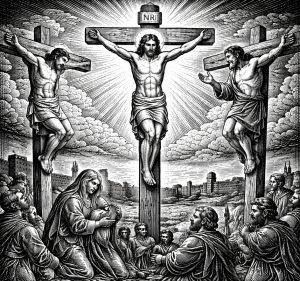
‘And he said unto Jesus, Lord, remember me when thou comest into thy kingdom.’
III. The Throne In Heaven
Revelation 4
After the messages to the seven churches, John sees ‘a door was opened in heaven’, and the voice which had spoken to him like a trumpet says: ‘Come up hither, and I will shew thee things which must be hereafter.’ The passage from the churches on earth to the throne in heaven is fundamental to the structure of Revelation. John is not leaving the concerns of the churches behind; he is being shown the reality within which their circumstances must be understood.
John is immediately ‘in the spirit’ and sees a throne set in heaven, ‘and one sat on the throne’. The first object is not a beast, an army or a persecuting emperor, but a throne already occupied. Revelation establishes divine sovereignty before introducing the forces which appear to challenge it.
John does not attempt a physical description of God. The one seated upon the throne is described through the appearance of precious stones: jasper and sardine stone, with a rainbow around the throne ‘in sight like unto an emerald’. The image conveys brilliance and glory while avoiding a bodily representation. The rainbow also recalls the covenant with Noah, placing the throne within the biblical history of God’s relation to creation.
Around the throne are twenty-four seats, upon which sit twenty-four elders clothed in white and wearing golden crowns. Their number has commonly been connected with the twelve tribes of Israel and the twelve apostles, though Revelation does not explicitly provide that interpretation here. What is clear is that they belong to the heavenly court, participate in worship and possess a derivative authority symbolised by their crowns.
From the throne proceed ‘lightnings and thunderings and voices’. The imagery recalls Sinai, where thunder and lightning accompany the manifestation of God. Before the throne burn seven lamps of fire, identified as ‘the seven Spirits of God’, and there is ‘a sea of glass like unto crystal’. The threatening instability associated elsewhere with the sea is here transformed into something still and transparent before the throne.
The Four Living Creatures
Around and within the throne are four living creatures, full of eyes. One resembles a lion, another a calf or ox, another has a face like a man, and the fourth resembles a flying eagle. Each has six wings and continually declares:
‘Holy, holy, holy, Lord God Almighty, which was, and is, and is to come.’
The imagery combines elements from Isaiah’s seraphim and Ezekiel’s living creatures. Revelation does not explain the four creatures as representing four particular earthly beings, though Christian interpretation has often connected them with the four Evangelists. Within the vision itself their function is clearer: they stand near the throne as representatives of created life and lead creation’s worship of God.
Their cry of ‘Holy, holy, holy’ recalls Isaiah 6, while ‘which was, and is, and is to come’ returns to the divine title in Revelation 1. God is worshipped not because He has recently defeated a rival and acquired sovereignty, but because holiness and eternal being belong to who He is.
Whenever the living creatures give glory, honour and thanks, the twenty-four elders fall before God, cast their crowns before the throne and say:
‘Thou art worthy, O Lord, to receive glory and honour and power: for thou hast created all things, and for thy pleasure they are and were created.’
The reason for worship is creation. God’s authority rests upon the fact that everything which exists owes its existence to Him. This matters when later figures demand worship. The beast may exercise authority, but the beast is not Creator; Babylon may possess the wealth of nations, but Babylon did not create them. Revelation establishes the proper object of worship before showing its counterfeits.
The elders cast their crowns before the throne. Their authority is acknowledged as received rather than autonomous. This anticipates one of the book’s repeated distinctions between legitimate and illegitimate power. Created authority remains rightly ordered when it recognises its dependence upon God; it becomes beastly when it claims ultimacy for itself.
Revelation 4 contains no direct description of the suffering churches, yet it answers their situation. Smyrna may face prison and death; Philadelphia may possess little strength; Laodicea may mistake wealth for security. Above all of them stands the same throne. The chapter establishes the perspective from which the seals, trumpets, beasts and judgements must be seen: history is not moving through an empty heaven.
IV. The Lamb And The Sealed Book
Revelation 5
The throne vision continues. John sees in the right hand of the one seated upon the throne ‘a book written within and on the backside, sealed with seven seals’. The scroll is completely written and completely sealed. A strong angel asks:
‘Who is worthy to open the book, and to loose the seals thereof?’
No one in heaven, earth or under the earth is found able to open the book or even to look upon it. John weeps. Whatever precise contents are assigned to the scroll, its opening is connected with the execution and disclosure of God’s purposes in history. If the scroll remains sealed, those purposes remain inaccessible.
One of the elders tells John:
‘Weep not: behold, the Lion of the tribe of Juda, the Root of David, hath prevailed to open the book, and to loose the seven seals thereof.’
The titles evoke the messianic promises of Genesis and Isaiah. John is told to expect the victorious Davidic Messiah, the Lion who has conquered.
He looks and sees:
‘a Lamb as it had been slain.’
This is the decisive interpretative reversal of Revelation. John does not see a different figure from the Lion he has been promised; he sees what the Lion’s victory means. The Messiah has prevailed as the sacrificed Lamb.
The Lamb stands ‘in the midst of the throne’, surrounded by the living creatures and elders. He bears the marks of slaughter but is alive and standing. His death has not been erased from his identity by resurrection; the one who reigns remains the one who was slain.
The Lamb has seven horns and seven eyes, ‘which are the seven Spirits of God sent forth into all the earth’. Horns signify power within biblical imagery; seven indicates completeness. The seven eyes signify complete perception and are explicitly connected with the seven Spirits. The imagery conveys the fullness of the Lamb’s power and knowledge rather than providing a naturalistic portrait.
The Lamb comes and takes the scroll from the right hand of the one seated upon the throne. This action provokes worship throughout heaven.
‘Thou Art Worthy’
The four living creatures and twenty-four elders fall before the Lamb. They possess harps and golden bowls full of incense, ‘which are the prayers of saints’. The prayers of the Church appear within the heavenly throne room. The suffering churches are not absent from the government of God; their prayers are present before Him and will later become connected with the unfolding of judgement.
The heavenly court sings a new song:
‘Thou art worthy to take the book, and to open the seals thereof: for thou wast slain, and hast redeemed us to God by thy blood.’
The worthiness of the Lamb is explained through his sacrificial death. He does not seize the scroll through superior force; he is worthy because he was slain and redeemed a people.
Those redeemed come ‘out of every kindred, and tongue, and people, and nation’. The scope is universal. The beast will later claim authority over the same categories of humanity, but the contrast is already prepared: the Lamb gathers the nations through redemption; the beast seeks to rule them through domination.
The song continues that the redeemed have been made ‘kings and priests’ and ‘shall reign on the earth’. The promise from Revelation 1 is repeated. Redemption leads not to the abandonment of creation but to a restored human vocation within it.
John then hears an innumerable multitude of angels around the throne:
‘Worthy is the Lamb that was slain to receive power, and riches, and wisdom, and strength, and honour, and glory, and blessing.’
The worship expands again until ‘every creature which is in heaven, and on the earth, and under the earth, and such as are in the sea’ joins the praise:
‘Blessing, and honour, and glory, and power, be unto him that sitteth upon the throne, and unto the Lamb for ever and ever.’
The Lamb is included within the worship offered to the one upon the throne. This is one of Revelation’s clearest expressions of its Christology. The book which repeatedly forbids worship of angels places the Lamb beside God as the recipient of universal worship.
The four living creatures answer, ‘Amen’, and the elders worship.
Revelation 5 establishes theological meaning of what follows. The seals are not opened by an arbitrary destroyer; they are opened by the Lamb who gave his blood for the world. The judgements which emerge must be read within the purpose of the God who created all things and the Lamb who redeemed people from every nation.
V. The Seven Seals
Revelation 6-8: 1
The Lamb now begins to open the seals. In the transition, the same Lamb worshipped because he was slain is the one through whom the hidden scroll is opened. The violence which appears in the seal visions belongs within a world already described as fallen, contested and awaiting the completion of God’s purposes.
The First Four Seals
When the first seal is opened, one of the living creatures says, ‘Come and see.’ John sees a white horse. Its rider carries a bow, receives a crown and goes forth ‘conquering, and to conquer’. The identity of this rider has been disputed. Some have interpreted him positively, even as Christ or the victorious Gospel, partly because Christ later rides a white horse in Revelation 19. Within the immediate sequence, however, the rider belongs with war, famine and death. Conquest is the more natural emphasis. The crown is ‘given’ to him, again indicating limited and derivative authority.
The second seal brings a red horse. Its rider is given power ‘to take peace from the earth, and that they should kill one another’. He receives a great sword. The language does not describe God creating human hatred; peace is removed and human beings kill one another. War exposes the violence already present within human political life.
The third seal brings a black horse whose rider carries balances. A voice announces severely inflated prices for wheat and barley while saying, ‘see thou hurt not the oil and the wine’. The image is famine and economic scarcity, but not absolute absence of food. Basic grain becomes prohibitively expensive while other goods remain. War and conquest are followed by unequal economic suffering.
The fourth horse is pale, and its rider is named explicitly: ‘Death, and Hell followed with him.’ Authority is given over a fourth part of the earth to kill through sword, hunger, death and wild beasts. The sequence draws upon the traditional covenantal and prophetic imagery of judgement.
The four horsemen should not be detached from one another as isolated predictions. Together they portray recurring structures of a disordered world: conquest produces war; war contributes to scarcity; violence, hunger and disease culminate in death. Their authority is terrible but limited. They do not possess the whole earth, and what authority they have is repeatedly described as given.
The Fifth Seal: The Martyrs
With the fifth seal the perspective changes. John sees beneath the altar ‘the souls of them that were slain for the word of God, and for the testimony which they held’. The victims of earthly violence appear within the heavenly sanctuary.
They cry:
‘How long, O Lord, holy and true, dost thou not judge and avenge our blood on them that dwell on the earth?’
Revelation does not suppress the demand for justice. The martyrs do not pretend that their deaths are morally insignificant; they ask God to judge. Their prayer will echo through the later judgements upon Babylon, where the blood of saints and prophets is found.
Each martyr is given a white robe and told to rest ‘yet for a little season’ until the number of their fellow servants who will also be killed is fulfilled. The answer does not deny further suffering. Vindication is certain, but the period of witness has not yet ended.
The white robe already anticipates Revelation 7. Those apparently stripped of life by persecutors are clothed by God.
The Sixth Seal
The sixth seal produces a great earthquake. The sun becomes black, the moon like blood, stars fall, the heaven departs like a scroll, and mountains and islands are moved. The language draws upon prophetic descriptions of the Day of the Lord. Cosmic imagery communicates a collapse of the apparently stable order before divine judgement.
Kings, great men, rich men, military commanders, slaves and free people hide themselves and call upon the mountains:
‘Fall on us, and hide us from the face of him that sitteth on the throne, and from the wrath of the Lamb.’
The phrase ‘wrath of the Lamb’ is striking. The Lamb is the one who was slain, yet rejection of his rule has consequences. The imagery prevents a division between Christ the Redeemer and Christ the Judge; the one who gives himself for redemption is also the one before whom injustice is judged.
The chapter ends with a question:
‘For the great day of his wrath is come; and who shall be able to stand?’
Revelation 7 answers that question before the seventh seal is opened.
VI. The Sealed People And The Great Multitude
Revelation 7
The judgement sequence pauses. Four angels hold back the winds of the earth while another angel ascends from the east carrying ‘the seal of the living God’. The earth is not to be harmed until the servants of God have been sealed ‘in their foreheads’.
The seal signifies ownership, identity and protection. It does not necessarily mean exemption from physical suffering, since Revelation repeatedly shows God’s servants undergoing persecution and death. The protection is deeper: the powers of the world cannot erase their belonging to God. The mark of the beast will later function as a deliberate counterfeit of this seal.
John hears the number sealed: 144,000 from the tribes of Israel, twelve thousand from each listed tribe. The list itself differs from ordinary Old Testament tribal lists: Judah appears first; Dan is omitted; Joseph and Manasseh are both included; Levi appears among the tribes. These features caution against assuming that John is providing a census.
The number is twelve multiplied by twelve and then by one thousand, combining numbers associated with the people of God and completeness. Interpretations differ over whether the group should be understood as ethnic Israel, a particular eschatological remnant, or symbolically as the whole people of God. The literary course which follows is significant: John hears the numbered company and then sees an innumerable multitude from all nations. This resembles the Lion/Lamb pattern in Chapter 5, where what John sees discloses the meaning of what he has heard. On this reading, the 144,000 and the great multitude provide two perspectives upon the redeemed people of God: numbered as the covenant army and seen as an innumerable international multitude.
The text has generated other interpretations, and the distinction should not be made more certain than the passage permits. What is beyond dispute is that the sealed belong to God and that the vision immediately expands toward people from every nation.
The Great Multitude
John sees:
‘a great multitude, which no man could number, of all nations, and kindreds, and people, and tongues’.
They stand ‘before the throne, and before the Lamb’, clothed in white robes and carrying palms. Their cry is:
‘Salvation to our God which sitteth upon the throne, and unto the Lamb.’
The question at the end of Chapter 6 was who could stand before the great day of judgement. Revelation now shows a multitude standing before the throne. They stand not because they possess sufficient earthly power but because salvation belongs to God and the Lamb.
The angels, elders and living creatures join their worship. One of the elders asks John who the people in white are. John returns the question, and the elder explains:
‘These are they which came out of great tribulation, and have washed their robes, and made them white in the blood of the Lamb.’
The paradox is characteristic of Revelation: robes become white by being washed in blood. The imagery cannot be understood naturalistically; the blood of the Lamb cleanses because his sacrificial death redeems.
The multitude serves God ‘day and night in his temple’, and God dwells among them. They will hunger and thirst no more; the sun will not strike them; the Lamb ‘which is in the midst of the throne shall feed them, and shall lead them unto living fountains of waters’.
The Lamb becomes shepherd. The apparent contradiction again expresses the identity of Christ: the sacrificed Lamb is the shepherd of the redeemed.
The final promise is:
‘and God shall wipe away all tears from their eyes.’
The words return in Revelation 21, after the New Jerusalem descends. Here they are promised to those emerging from tribulation; there they become a feature of the new creation itself. Revelation thus begins to connect the endurance of the suffering Church with the final state toward which the book moves.
VII. The Seventh Seal And The Trumpets
Revelation 8-9
When the Lamb opens the seventh seal, ‘there was silence in heaven about the space of half an hour’. After the thunder, worship and cries which have filled the heavenly visions, the silence is striking. It marks a solemn pause before the next sequence of judgement.
Seven angels receive seven trumpets. Before they sound, another angel stands at the altar with a golden censer. He is given incense to offer ‘with the prayers of all saints upon the golden altar which was before the throne’. The smoke of the incense ascends with the prayers before God.
The angel then fills the censer with fire from the altar and casts it upon the earth; voices, thunder, lightning and an earthquake follow.
The sequence connects the prayers of the saints with what follows. The martyrs asked, ‘How long?’; the prayers of God’s people now stand immediately before the trumpet judgements. Revelation presents divine judgement partly as the answer to the demand that violence and persecution should not continue without end.
The First Four Trumpets
The first trumpet brings hail and fire mingled with blood. A third of the trees are burnt and all green grass is affected. The imagery recalls the plagues of Egypt, but the repeated fraction ‘a third’ marks limitation. The trumpets are severe but not yet final.
The second trumpet casts something ‘as it were a great mountain burning with fire’ into the sea. A third of the sea becomes blood, a third of its creatures die and a third of the ships are destroyed. The expression combines plague imagery with prophetic images of collapsing powers.
The third trumpet brings a great star called Wormwood, which falls upon rivers and fountains. The waters become bitter and many die from them. Wormwood is associated in the Old Testament with bitterness and judgement.
The fourth trumpet darkens a third of the sun, moon and stars. The creation affected in the first four trumpets corresponds broadly to earth, sea, fresh water and heavenly lights. The order recalls the created world itself; judgement touches the structures upon which human life depends.
An angel then flies through heaven crying:
‘Woe, woe, woe, to the inhabiters of the earth.’
The final three trumpets will be more directly concerned with human beings.
The Fifth Trumpet
A star fallen from heaven receives the key to the bottomless pit. When the pit is opened, smoke darkens the air and locust-like creatures emerge. They are commanded not to harm vegetation but those people who do not have the seal of God.
The contrast with Revelation 7 is direct. The seal distinguishes those who belong to God within the judgement.
The locusts are described through an unnatural combination of features: horses prepared for battle, crowns, human faces, women’s hair, lions’ teeth, iron breastplates and scorpion tails. Their king is the angel of the bottomless pit, named Abaddon in Hebrew and Apollyon in Greek, both names associated with destruction.
Imagery recalls the locust plague of Exodus and the invading locust army of Joel, but it has become demonic. The creatures torment rather than kill, and their period of activity is limited to five months. People seek death but cannot find it. The vision depicts an order in which destructive spiritual powers are permitted to expose the torment inherent in rebellion, yet even these powers remain subject to limits.
The Sixth Trumpet
The sixth trumpet releases four angels bound at the Euphrates. They have been prepared for a particular hour, day, month and year. Again the language stresses limitation and appointment; the destructive forces do not determine their own moment.
An immense cavalry appears. Fire, smoke and brimstone proceed from the horses, and a third of humanity is killed. This figurative imagery is not intended as a straightforward description of ordinary military equipment; like the preceding locust vision, it transforms language of warfare into apocalyptic symbolism.
After the destruction comes the chapter’s key point. The survivors ‘repented not of the works of their hands’. They continue to worship devils and idols of gold, silver, brass, stone and wood; neither do they repent of murders, sorceries, sexual immorality or thefts.
The trumpets have a purpose beyond punishment: they expose the need for repentance. Their partial character leaves room for repentance, yet humanity refuses it. The problem is not lack of warning. Judgement reveals the persistence of idolatry.
This refusal prepares the reader for the later bowls, where the judgements become complete and the same refusal to repent is repeated. Before the seventh trumpet sounds, however, the narrative again pauses. John must receive a little book, and the prophetic witness of the Church must be shown.
VIII. The Little Book And The Prophetic Witness
Revelation 10-11
John sees a mighty angel descending from heaven, clothed with a cloud, with a rainbow upon his head, a face like the sun and feet like pillars of fire. He holds ‘a little book open’. One foot stands upon the sea and the other upon the earth, expressing the scope of the message and authority represented in the vision.
The angel cries like a lion, and seven thunders answer. John is about to write what they say but is commanded:
‘Seal up those things which the seven thunders uttered, and write them not.’
This is an important restraint within a book devoted to revelation. John is not shown everything, and not everything he hears may be communicated. Revelation does not claim to abolish mystery. There remain things known to God which are not given to the Church.
The angel raises his hand to heaven and swears by the Creator that ‘there should be time no longer’, or, that there will be no further delay. In the days of the seventh angel ‘the mystery of God should be finished’.
John is then told to take the open book and eat it. It is sweet in his mouth but bitter in his belly. The action recalls Ezekiel, who ate a scroll before being sent to prophesy. God’s word is sweet because it is His word; its contents are bitter because prophecy includes judgement and suffering.
John is told:
‘Thou must prophesy again before many peoples, and nations, and tongues, and kings.’
The prophetic vocation continues. Revelation itself belongs to that witness.
Measuring The Temple
John receives a reed and is told to measure ‘the temple of God, and the altar, and them that worship therein’. The outer court is excluded because it is given to the Gentiles, who will tread the holy city under foot for forty-two months.
This draws upon Ezekiel and Zechariah, where measuring can signify divine ownership and protection. As with the seal in Revelation 7, protection does not mean exemption from earthly assault; the holy city is trampled. The people of God can be preserved as God’s possession while suffering persecution.
The period of forty-two months corresponds to 1,260 days and to three and a half years. These equivalent periods recur in the following chapters. Three and a half is half of seven; it represents a broken, limited period rather than completion. The time of oppression is real but bounded.
The Two Witnesses
God gives power to ‘my two witnesses’, who prophesy for 1,260 days clothed in sackcloth. They are called ‘the two olive trees, and the two candlesticks standing before the God of the earth’, drawing upon Zechariah 4.
Their actions also recall Moses and Elijah. They have power to shut heaven so that it does not rain, like Elijah; they turn water to blood and strike the earth with plagues, like Moses. The witnesses embody the prophetic testimony of Scripture.
When they have finished their testimony, ‘the beast that ascendeth out of the bottomless pit’ makes war against them, overcomes them and kills them. This is the first explicit appearance of the beast who will dominate Revelation 13.
Crucially, the beast overcomes the witnesses by killing them. Their bodies lie in the street of ‘the great city, which spiritually is called Sodom and Egypt, where also our Lord was crucified’. Several biblical places of rebellion and oppression are combined. The ‘great city’ cannot be reduced here to one geographical name; Jerusalem, Sodom and Egypt are drawn together to describe a world which rejects prophetic witness.
People from the nations look upon the bodies and celebrate their deaths. They exchange gifts because the prophets had tormented those who dwell on earth. From the standpoint of the world, the witnesses have been defeated.
After three and a half days, however, ‘the Spirit of life from God entered into them’. They stand upon their feet and ascend to heaven in a cloud while their enemies watch. The pattern is death, resurrection and vindication. The witnesses overcome according to the pattern of the Lamb.
The contrast between the beast’s definition of victory and God’s definition is now explicit. The beast can kill; it cannot make death final.
The Seventh Trumpet
The seventh angel sounds, and great voices in heaven declare:
‘The kingdoms of this world are become the kingdoms of our Lord, and of his Christ; and he shall reign for ever and ever.’
The twenty-four elders fall before God and worship. They give thanks because God has taken his great power and reigned. The nations were angry; now the time has come for judgement, reward and the destruction of ‘them which destroy the earth’.
God’s purpose is not the destruction of creation but the judgement of those who destroy it. The kingdom belongs finally to God and Christ.
The temple in heaven opens, and the ark of the covenant is seen within it. Lightning, voices, thunder, earthquake and hail follow.
The seventh trumpet sounds like a conclusion, yet Revelation continues for eleven more chapters. This confirms that the book is not proceeding through one simple chronological sequence. The kingdom has been announced from the heavenly perspective; the visions which follow disclose the conflict which leads to that consummation in greater depth.
The first of those visions is the woman, her child and the dragon. What the churches have experienced as persecution, compromise and political pressure will now be shown within the larger conflict between the purposes of God and the ancient serpent.
IX. The Woman, the Child and the Dragon
Revelation 12
Revelation 12 begins a new visionary sequence:
‘And there appeared a great wonder in heaven; a woman clothed with the sun, and the moon under her feet, and upon her head a crown of twelve stars.’
The woman is pregnant and cries out in labour. This expression draws together several biblical traditions. The sun, moon and twelve stars recall Joseph’s dream in Genesis 37, where the family of Israel is represented by heavenly bodies; the woman represents, at the least, the people of God from whom the Messiah comes. Christian tradition has also seen a Marian dimension in the vision, since Mary personally gives birth to Christ and stands within faithful Israel. These interpretations need not be treated as mutually exclusive. Apocalyptic symbolism can gather a personal figure and a corporate reality into one image.
The woman gives birth to ‘a man child, who was to rule all nations with a rod of iron’. This comes from Psalm 2 and identifies the child as the Messiah. Before the birth, however, another sign appears: a great red dragon with seven heads, ten horns and seven crowns. Revelation later identifies him explicitly as ‘that old serpent, called the Devil, and Satan’. The phrase ‘old serpent’ carries the vision back to Genesis 3; the conflict now being shown is not only between the Church and Rome, or between believers and persecutors, but between the purposes of God and the adversary who has opposed them from the beginning.
The dragon stands before the woman ‘for to devour her child as soon as it was born’. The image compresses the hostility directed against Christ into one scene. Herod’s attempt to kill the infant Jesus belongs naturally within the pattern, but the symbolism is larger than one episode. The dragon opposes the Messiah’s coming and mission; yet the child is ‘caught up unto God, and to his throne’. The earthly ministry, death, resurrection and ascension of Christ are compressed into this course. Revelation is not retelling the Gospel chronologically; it is showing the outcome of the dragon’s assault. The Messiah reaches the throne.
The woman then flees into the wilderness, where God has prepared a place for her for 1,260 days. The wilderness is both a place of danger and a place of preservation. Israel was sustained there after the Exodus; Revelation applies the same pattern to the people of God during persecution. The period is the same limited three-and-a-half-year symbolism already encountered in the trampling of the holy city and the ministry of the two witnesses.
War In Heaven
The scene shifts to heaven, where Michael and his angels fight against the dragon and his angels. The dragon is defeated and cast down. A heavenly voice declares:
‘Now is come salvation, and strength, and the kingdom of our God, and the power of his Christ.’
The dragon is described as ‘the accuser of our brethren’, recalling the adversarial role seen in Job and Zechariah. His defeat means that accusation no longer holds the position it once possessed.
The faithful overcome him:
‘by the blood of the Lamb, and by the word of their testimony; and they loved not their lives unto the death.’
This is one of Revelation’s clearest statements of Christian victory. The victory belongs first to the Lamb; the saints participate through testimony and faithfulness. Their willingness to die rather than abandon that testimony exposes the difference between the dragon’s definition of victory and God’s. The dragon can kill; he cannot compel faithful witnesses to renounce the Lamb.
The heavens rejoice, but the earth is warned:
‘Woe to the inhabiters of the earth and of the sea! for the devil is come down unto you, having great wrath, because he knoweth that he hath but a short time.’
The dragon’s violence is intensified by the knowledge that his time is limited. This remains characteristic of evil in Revelation: its power is real but bounded; its apparent strength does not indicate final sovereignty.
The dragon persecutes the woman. She is given two wings of a great eagle and carried into the wilderness, echoing Exodus 19: ‘I bare you on eagles’ wings, and brought you unto myself.’ The serpent casts water from his mouth like a flood, but the earth swallows it. Again Exodus imagery appears: threatening waters fail to destroy the people God preserves.
Unable to destroy the woman, the dragon turns against ‘the remnant of her seed, which keep the commandments of God, and have the testimony of Jesus Christ’. This description defines the Church in relation to obedience and witness. Revelation 12 discloses a deeper spiritual structure behind persecution: hostility experienced by believers participates in the dragon’s opposition to the Messiah.
Yet the dragon is not presented as a rival god. He fails to destroy the child; he loses the heavenly conflict; he cannot destroy the woman; his time is short. His remaining weapon is persecution.
X. The Beast from the Sea
Revelation 13: 1-10
John now sees ‘a beast rise up out of the sea’. The sea has already carried associations of chaos, but Daniel 7 provides the most direct background. Daniel sees four beasts rising from the sea, each representing a kingdom. Revelation combines features of those beasts into one.
The beast has seven heads and ten horns, resembles a leopard, has feet like a bear and a mouth like a lion. The dragon gives it ‘his power, and his seat, and great authority’. The political character of the beast is explicit. It represents imperial power animated by the dragon.
For John’s first readers, Rome is the most immediate historical embodiment of this image. Rome exercised military, political and economic power across the Mediterranean world, and imperial authority increasingly carried religious claims. Yet the beast is not a coded name which becomes irrelevant after Rome. The symbolism identifies a recurring form of political power: authority becomes beastly when it presents itself as absolute, demands idolatrous allegiance and persecutes those who refuse.
The Wounded Head
One of the beast’s heads appears wounded to death, but the wound is healed. The world marvels after the beast. The parody is of Christ’s death and resurrection. The Lamb was slain and lives; the beast suffers a mortal wound and appears restored.
Evil in Revelation often imitates rather than opposes. Such is the parody. The dragon imitates divine sovereignty; the beast imitates Christ; the second beast will imitate prophetic or spiritual power by directing worship toward the first. The resulting order is a counterfeit of divine rule.
The world worships the dragon because he gives authority to the beast, and then worships the beast itself:
‘Who is like unto the beast? who is able to make war with him?’
The words echo biblical declarations about the incomparability of God. Military power has become the basis of worship. The beast’s apparent invincibility persuades humanity that it deserves ultimate allegiance.
Blasphemous Authority
The beast is given a mouth speaking ‘great things and blasphemies’ and authority for forty-two months. Again the period is limited. It blasphemes God, His name, His dwelling and those who dwell in heaven.
It is also permitted:
‘to make war with the saints, and to overcome them.’
The words recall the beast’s victory over the two witnesses. From an earthly standpoint, persecution and execution look like victory; yet Revelation has already shown that the saints overcome the dragon precisely through faithfulness unto death. Two definitions of conquest stand in opposition.
The beast receives authority over ‘all kindreds, and tongues, and nations’. This parallels the universal language applied to the Lamb’s redeemed people. The Lamb gathers from every nation through sacrifice; the beast seeks to dominate every nation through coercion.
Those who worship the beast are contrasted with those whose names are written in ‘the book of life of the Lamb slain from the foundation of the world’. Whatever grammatical interpretation is given to the final phrase, the essential point is that the identity of the faithful is determined by the Lamb, not by the beast.
The section ends:
‘If any man have an ear, let him hear.’
The words recall the messages to the seven churches. Revelation 13 is not only information about a terrifying future figure; it is a call to Christian endurance:
‘Here is the patience and the faith of the saints.’
Proper response to beastly power is not imitation of its methods but perseverance in allegiance to Christ.
XI. The Beast From The Earth And The Mark
Revelation 13: 11-18
A second beast rises ‘out of the earth’. It has ‘two horns like a lamb, and he spake as a dragon’. The contradiction between appearance and voice defines the figure. It resembles the Lamb but communicates the dragon’s purposes.
This second beast later is called the false prophet. Its role is religious and ideological. It exercises the authority of the first beast and causes humanity to worship it. Political power is supported by a system which legitimises and sacralises it.
The second beast performs signs, even making fire descend from heaven. The imagery recalls Elijah, but prophetic power is now imitated in the service of deception. Revelation does not assume that miraculous appearance proves divine authority; signs must be judged by the worship and allegiance toward which they direct people.
The beast commands the inhabitants of the earth to make an image of the first beast. It is permitted to give breath to the image so that it appears to speak, and those who refuse worship are threatened with death. For John’s contemporaries, this would resonate with images, ceremonies and cultic expectations surrounding imperial authority.
The point extends beyond the first-century setting. Political power becomes beastly when it demands what belongs to God, and religious structures become false when they provide sacred justification for that demand.
The Mark Of The Beast
The beast causes ‘all, both small and great, rich and poor, free and bond’ to receive a mark in the right hand or forehead. Without the mark, no one may buy or sell.
The mark is both religious and economic. It represents belonging to the beast’s order and has consequences for participation in its commercial system. This corresponds directly to the seal of God placed on the foreheads of his servants in Revelation 7. The issue is not first technological; it is allegiance.
The right hand and forehead also evoke biblical language in which God’s law is bound upon hand and mind. The beast’s mark functions as a counterfeit sign of covenantal belonging. Revelation portrays humanity as bearing an identity which becomes visible through worship and conduct.
The economic restriction is important because Revelation does not isolate worship from ordinary life. Allegiance to the beast may be enforced not only through overt religious ceremonies but through access to trade and social participation. This prepares for Babylon, where commerce and idolatry become inseparable.
The Number 666 | Number Of The Beast
The chapter concludes:
‘Here is wisdom. Let him that hath understanding count the number of the beast: for it is the number of a man; and his number is Six hundred threescore and six.’
Ancient alphabets commonly assigned numerical values to letters, so the number invites calculation. The strongest historical interpretation connects 666 with ‘Nero Caesar’ when the name is rendered in Hebrew letters. This fits the Roman setting of Revelation and the memory of Nero as a persecuting emperor. The manuscript variant 616 can also be explained by an alternative spelling of Nero’s name.
The symbolism need not be exhausted by the historical connection. Six falls short of seven, the number repeatedly associated with fullness; three sixes also suit the beast’s character as a counterfeit which approaches divine pretension but cannot attain divine completeness.
The text itself says that the number is ‘the number of a man’. The empire presents itself as transcendent and irresistible; Revelation reduces its number to human measure. The beast claims what belongs to God but remains creaturely.
XII. The Lamb On Mount Sion
Revelation 14: 1-5
After the oppressive vision of the beasts, John immediately sees another scene:
‘And I looked, and, lo, a Lamb stood on the mount Sion.’
The beast has appeared to dominate the earth; the Lamb stands. He has not been displaced.
With him are 144,000, having the Father’s name written in their foreheads. Revelation presents two communities bearing two identities: one belongs to the beast; the other to God and to the Lamb.
The 144,000 reappear from Revelation 7. Whatever precise interpretation is given to their number, their presence with the Lamb shows that the seal of God has preserved their identity. The beast can exclude from commerce and even kill; it cannot erase the name of God.
A voice from heaven sounds like many waters and thunder, yet also like harpers playing their harps. The 144,000 sing ‘as it were a new song before the throne’. No one else can learn it. The song belongs to those whose identity has been formed through redemption.
They are described as those ‘which follow the Lamb whithersoever he goeth’. This is one of Revelation’s simplest definitions of discipleship. Their allegiance is determined by the path of the Lamb rather than the claims of the beast.
They are ‘redeemed from among men, being the firstfruits unto God and to the Lamb’. Firstfruits belong to God and anticipate a larger harvest. The imagery points both to consecration and to fulfilment.
The text also says that they were not defiled with women and are virgins. This language has received literal, ascetical and symbolic interpretations. Within Revelation’s wider use of sexual immorality as an image of idolatrous compromise, a symbolic dimension is difficult to avoid. Babylon will later seduce the nations through fornication; the 144,000 are presented as those who remain faithful to the Lamb.
This does not require marriage or sexual relations within marriage to be treated as defilement. The contrast concerns spiritual fidelity. The description concludes that ‘in their mouth was found no guile’. Truthfulness stands against the dragon’s deception and the false prophet’s signs. Those who follow the faithful and true witness are themselves marked by truthful testimony.
XIII. The Three Angels And The Harvest
Revelation 14: 6-020
John sees an angel carrying ‘the everlasting gospel’ to proclaim to ‘every nation, and kindred, and tongue, and people’. The universal scope corresponds both to the beast’s claims and to the Lamb’s redemption. The conflict is not confined to one city or people.
The first angel calls humanity to:
‘Fear God, and give glory to him; for the hour of his judgment is come.’
The command is then made explicit: ‘worship him that made heaven, and earth, and the sea, and the fountains of waters.’ The words return to Revelation 4. The answer to false worship is worship of the Creator.
A second angel announces:
‘Babylon is fallen, is fallen, that great city.’
Babylon has not yet been fully described, but her fall is announced before the detailed vision. The wording comes from Isaiah and transfers the name of the ancient imperial city into the symbolic world of Revelation. For John’s readers, Rome is the obvious immediate referent; the name ‘Babylon’ also places Rome within a larger scriptural pattern of idolatrous empire.
A third angel warns against worshipping the beast and receiving its mark. Consequences are described in severe language of wine, fire and brimstone. Revelation treats idolatry as a question of ultimate allegiance because worship determines participation in one of two opposing orders.
The warning concludes:
‘Here is the patience of the saints: here are they that keep the commandments of God, and the faith of Jesus.’
The description echoes Revelation 12. The saints are defined by obedience, faith and endurance rather than by political power.
A voice then says:
‘Blessed are the dead which die in the Lord from henceforth.’
The beast threatens death; heaven calls those who die in the Lord blessed. Their works follow them. Death cannot function as the beast’s final instrument of control.
The Harvest
John next sees ‘one like unto the Son of man’ seated upon a white cloud, wearing a golden crown and holding a sharp sickle. The imagery again recalls Daniel 7 and the Gospel language of the Son of Man.
An angel announces that the harvest is ripe, and the earth is reaped. A second harvest follows, this time of grapes, which are cast ‘into the great winepress of the wrath of God’. The image comes from prophetic judgement language, especially Isaiah.
The two harvests have been interpreted either as distinct harvests of the righteous and wicked or as complementary images of judgement; the second is explicitly punitive. Blood flows from the winepress on a vast scale. What we see is overwhelming, communicating the seriousness of judgement upon organised violence and rebellion.
The sequence now stands ready for the seven bowls. The dragon has been identified; the beasts have been shown; the faithful have been seen with the Lamb; Babylon’s fall has been announced. Revelation will next show the judgement of that system moving to completion.
Opposing orders are now fully visible. The dragon, beast and false prophet operate through deception, coercion and death; the Lamb through truth, sacrifice and resurrection. The remaining visions will disclose which order endures.
XIV. The Seven Last Plagues
Revelation 15-16
Revelation 15 introduces the final sequence of seven judgements:
‘And I saw another sign in heaven, great and marvellous, seven angels having the seven last plagues; for in them is filled up the wrath of God.’
The word ‘last’ distinguishes these plagues from earlier seals and trumpets. The bowls bring the judgement to completion.
Before they are poured out, however, Revelation again places worship before judgement. John sees ‘as it were a sea of glass mingled with fire’. Beside it stand those who ‘had gotten the victory over the beast, and over his image, and over his mark, and over the number of his name’. They hold harps and sing.
The location recalls the glassy sea before the throne in Revelation 4, but the Exodus imagery now is explicit.
The Song Of Moses And The Lamb
The victors sing ‘the song of Moses the servant of God, and the song of the Lamb’. Revelation joins Exodus and Gospel. After Israel crossed the sea and Pharaoh’s army was destroyed, Moses and the children of Israel sang to God; here the victory over the beast is presented as a new Exodus. The persecuting power occupies the place of Pharaoh; the faithful are the people delivered; the Lamb is the agent of the greater redemption.
Their song declares:
‘Great and marvellous are thy works, Lord God Almighty; just and true are thy ways, thou King of saints.’
The justice of God becomes a repeated theme in the bowl sequence. The judgements are severe. Revelation repeatedly places declarations of divine justice within the visions so that judgement is interpreted as a response to evil rather than arbitrary destruction.
The song continues:
‘for all nations shall come and worship before thee; for thy judgments are made manifest.’
The final goal remains worship. Nations which have been deceived by the beast are destined for the worship of God.
The Heavenly Sanctuary
The temple of ‘the tabernacle of the testimony in heaven’ is opened. The phrase again evokes Exodus. Seven angels emerge from the temple wearing pure garments and golden girdles, and one of the four living creatures gives them seven golden bowls ‘full of the wrath of God, who liveth for ever and ever’. The temple fills with smoke from God’s glory and power, and no one can enter until the seven plagues are completed.
The vision recalls the dedication of the tabernacle and temple, when the glory of God filled the sanctuary. Judgement proceeds from the same holy presence which Israel encountered in worship. Revelation does not divide God into a deity of salvation and another deity of judgement; the God who delivers is the God who judges what enslaves and destroys.
XV. The Seven Bowls
Revelation 16
A great voice from the temple commands:
‘Go your ways, and pour out the vials of the wrath of God upon the earth.’
The KJV’s ‘vials’ are shallow bowls. The first four correspond broadly to the first four trumpets, but the limitation to one third disappears. The course is to completion.
The First Bowl
The first bowl is poured upon the earth. A grievous sore afflicts those ‘which had the mark of the beast, and upon them which worshipped his image’. The judgement is specifically connected with allegiance to the beast, and the plague recalls the boils of Egypt.
The Second Bowl
The second bowl is poured upon the sea. It becomes ‘as the blood of a dead man’, and every living thing in the sea dies. Under the second trumpet only one third was affected; here the judgement is comprehensive. The world of the beast is approaching its end.
The Third Bowl
The third bowl strikes rivers and fountains, and they become blood. An angel interprets the judgement:
‘Thou art righteous, O Lord, which art, and wast, and shalt be, because thou hast judged thus.’
The reason follows:
‘For they have shed the blood of saints and prophets, and thou hast given them blood to drink.’
There is expressed correspondence between sin and judgement. Those who shed blood encounter blood. The altar itself answers: ‘Even so, Lord God Almighty, true and righteous are thy judgments.’ The altar is the place beneath which the martyrs cried: ‘How long?’ Their prayer and the bowl judgement are connected.
The Fourth Bowl
The fourth bowl is poured upon the sun, which scorches humanity with great heat. The response is not repentance. People ‘blasphemed the name of God, which hath power over these plagues: and they repented not to give him glory.’
This recalls the end of Revelation 9. Judgement exposes rather than automatically changes the human heart; a repeated refusal to repent explains why the judgements progress.
The Fifth Bowl
The fifth bowl is poured ‘upon the seat of the beast’. Its kingdom fills with darkness. Imagery again recalls Egypt, but the location is significant: judgement now falls directly upon the beast’s authority.
Those within its kingdom gnaw their tongues in pain but continue to blaspheme God. The darkness of the beast’s kingdom contrasts with the light which will fill the New Jerusalem. The beast’s world ends in darkness; the city of the Lamb requires no night.
The Sixth Bowl And Armageddon
The sixth bowl dries the Euphrates ‘that the way of the kings of the east might be prepared’. John then sees three unclean spirits like frogs emerging from the mouths of the dragon, beast and false prophet. The frog imagery recalls Egypt. They are ‘spirits of devils, working miracles’ and gather the kings of the world ‘to the battle of that great day of God Almighty’.
The means by which the nations are gathered is deception. The battle is not only military; it is the culmination of the dragon’s ability to deceive political power into opposition to God.
In the middle of this preparation Christ speaks:
‘Behold, I come as a thief. Blessed is he that watcheth, and keepeth his garments.’
The words return to the messages to the churches and the teaching of Jesus. Even at the point of global conflict, Revelation’s practical demand remains vigilance and faithfulness.
The armies gather ‘into a place called in the Hebrew tongue Armageddon’. The name is usually understood as Mount Megiddo. Megiddo was associated with important battles in Israel’s history, though there is no prominent literal mountain of Megiddo corresponding neatly to the expression. This itself suggests symbolic geography. Armageddon represents the place of final gathering for opposition to God.
Revelation does not yet narrate the battle. It will return to the defeat of the assembled kings in Chapter 19.
The Seventh Bowl
The seventh bowl is poured into the air. A voice from the heavenly temple declares: ‘It is done.’ There are voices, thunder, lightning and the greatest earthquake yet described. The great city is divided, the cities of the nations fall, then John says, ‘and great Babylon came in remembrance before God.’
Babylon now becomes the focus. Every island flees and mountains disappear; enormous hail falls; still humanity blasphemes God. The bowl sequence ends not with universal repentance but with the collapse of the world order which has refused it.
The name Babylon provides the transition to the next vision. Revelation has announced Babylon’s fall since Chapter 14. Now John will be shown what Babylon is, why she is judged, and why the world mourns when she falls.
XVI. Babylon the Great
Revelation 17
One of the angels who carried the bowls says to John:
‘Come hither; I will shew unto thee the judgment of the great whore that sitteth upon many waters.’
The imagery changes from beasts and plagues to a woman and a city. Babylon is personified as a prostitute. The image belongs to the prophetic tradition: Isaiah, Jeremiah, Ezekiel, Hosea and Nahum use sexual infidelity to describe idolatry, political alliances and corrupt cities. The image concerns faithlessness and seduction.
Babylon does not rule only by force. She attracts. This is essential to the vision. The beast coerces; Babylon seduces. Together they show two ways by which an idolatrous order gains allegiance.
The Woman On The Beast
John is carried into the wilderness and sees ‘a woman sit upon a scarlet coloured beast, full of names of blasphemy, having seven heads and ten horns’. The beast is recognisable from Revelation 13. Babylon rides upon political power. The relationship between woman and beast represents the interdependence of wealth, culture, religion and imperial authority.
The woman is ‘arrayed in purple and scarlet colour, and decked with gold and precious stones and pearls’. She carries a golden cup, and everything about her appearance communicates wealth. Yet the cup is ‘full of abominations and filthiness of her fornication’. External splendour conceals corruption.
Upon her forehead is written:
‘MYSTERY, BABYLON THE GREAT, THE MOTHER OF HARLOTS AND ABOMINATIONS OF THE EARTH.’
She is ‘drunken with the blood of the saints, and with the blood of the martyrs of Jesus’. The beautiful city is sustained by violence; this is the central contradiction of Babylon. Its luxury conceals blood.
John wonders at the vision, and the angel explains it.
Seven Heads And Seven Mountains
The beast ‘was, and is not; and shall ascend out of the bottomless pit, and go into perdition’. Again there is parody of divine language. God is the one ‘which is, and which was, and which is to come’; the beast ‘was, and is not, and yet is’. The imitation is unstable. The beast appears to return but goes to destruction.
The seven heads are interpreted:
‘The seven heads are seven mountains, on which the woman sitteth.’
For an ancient reader, a city associated with seven hills would strongly suggest Rome. The identification is reinforced by the conclusion of the chapter: ‘the woman which thou sawest is that great city, which reigneth over the kings of the earth.’ In John’s historical world, Rome provides the obvious referent.
Yet Revelation deliberately calls the city Babylon, not Rome. The renaming places Rome within a biblical pattern extending beyond one empire. Babylon is what a city becomes when political power, economic splendour, idolatry and persecution combine into an order opposed to God. Rome can be Babylon; other cities and systems can participate in the same pattern.
The Beast Turns Upon Babylon
The angel also explains the horns as kings who receive authority with the beast. They make war against the Lamb ‘and the Lamb shall overcome them: for he is Lord of lords, and King of kings’. The identity of the true ruler is restated before Babylon’s fall.
Then comes a striking reversal. The horns and beast ‘shall hate the whore, and shall make her desolate and naked’. Political power which supported Babylon eventually destroys her. Evil turns upon itself; the alliance between coercive power and seductive wealth is unstable because it is not grounded in love or truth. The beast uses Babylon and then consumes her.
Revelation shows judgement operating partly through the internal contradictions of rebellion. Yet even this remains within divine sovereignty: ‘For God hath put in their hearts to fulfil his will.’ The statement does not absolve the kings of responsibility; it declares that even their destructive purposes cannot finally escape God’s judgement.
Babylon’s identity is now established. Chapter 18 will show her fall from the perspective of those whose wealth depended upon her.
XVII. The Fall Of Babylon
Revelation 18
John sees another angel descending from heaven with great authority; the earth is illuminated by his glory. He cries:
‘Babylon the great is fallen, is fallen.’
The words repeat Isaiah’s oracle against ancient Babylon. The city has become ‘the habitation of devils, and the hold of every foul spirit’. The splendour of Revelation 17 is now shown from another perspective: what appeared luxurious is spiritually desolate.
The nations have participated in Babylon’s fornication, kings have joined her, and ‘the merchants of the earth are waxed rich through the abundance of her delicacies’. The economic dimension now is explicit. Babylon is not only a political capital; it is an entire commercial order.
‘Come Out Of Her, My People’
A voice from heaven says:
‘Come out of her, my people, that ye be not partakers of her sins.’
The command echoes the prophets’ calls to flee historical Babylon. For Christians within the Roman world, literal geographical departure was not always possible or intended; the deeper command concerns non-participation in Babylon’s sins. Revelation asks how God’s people live within an economic and political order without sharing its idolatry.
This question has already appeared in the mark of the beast, where buying and selling became connected with allegiance. The command to leave Babylon concerns moral separation within an interconnected world.
Her sins ‘have reached unto heaven’, and her judgement corresponds to her conduct. She says:
‘I sit a queen, and am no widow, and shall see no sorrow.’
The claim expresses the self-confidence of imperial permanence. Babylon imagines that her present position guarantees her future; Revelation answers: ‘Therefore shall her plagues come in one day.’ The city which presents itself as permanent falls suddenly.
The Lament Of The Kings
The kings who participated in Babylon’s luxury stand at a distance when they see her burning. They cry:
‘Alas, alas, that great city Babylon, that mighty city! for in one hour is thy judgment come.’
Their grief is revealing. They do not lament Babylon’s injustice; they lament the loss of the system from which they benefited. The repeated phrase ‘one hour’ emphasises the fragility of apparently permanent power.
The Lament Of The Merchants
The merchants also weep ‘for no man buyeth their merchandise any more’. John then provides an extraordinary catalogue of goods: gold, silver, precious stones, pearls, fine linen, purple, silk, scarlet, scented woods, ivory, expensive timber, brass, iron, marble, spices, wine, oil, flour, wheat, cattle, sheep, horses and chariots.
The list presents the material abundance of imperial trade. Then, at its end, comes ‘slaves, and souls of men’. Human beings appear as commodities. Its placement is deliberate. Revelation does not condemn commerce because goods are exchanged; it exposes an economic system whose appetite for luxury finally includes human life within its catalogue.
The merchants say: ‘The fruits that thy soul lusted after are departed from thee.’ Babylon is driven by desire; its economy depends upon continual acquisition. When the city falls, the merchants lose not only a market but the structure through which their wealth was generated.
They stand far away and cry:
‘Alas, alas, that great city, that was clothed in fine linen, and purple, and scarlet.’
Again they remember her appearance. The gold and jewels which made Babylon attractive become part of the lament.
The Lament Of The Sea
A third group mourns: shipmasters, sailors and all whose trade depends upon the sea. They cry: ‘What city is like unto this great city!’ The question echoes the worshippers of the beast: ‘Who is like unto the beast?’ Both political and economic idolatry imitate language properly directed toward God.
The sailors throw dust upon their heads and lament because ‘in one hour is she made desolate’. The three laments come from kings, merchants and maritime traders: political power, commercial wealth and international trade. Together they reveal Babylon as an interconnected world system.
Heaven Rejoices
The response of heaven is entirely different:
‘Rejoice over her, thou heaven, and ye holy apostles and prophets; for God hath avenged you on her.’
Earth mourns the loss of a profitable system; heaven rejoices at the judgement of a murderous one.
A mighty angel throws a millstone into the sea:
‘Thus with violence shall that great city Babylon be thrown down, and shall be found no more at all.’
Then follows a series of absences. Music will no longer be heard; craftsmen will no longer work; the millstone will cease; the light of a candle will disappear; the voice of bridegroom and bride will no longer be heard. The city which appeared full of life becomes silent.
The reason is stated: ‘for thy merchants were the great men of the earth; for by thy sorceries were all nations deceived.’ Finally: ‘And in her was found the blood of prophets, and of saints, and of all that were slain upon the earth.’
The final accusation returns to blood. Babylon’s judgement is not ultimately because she possessed beautiful objects; it is because her splendour was bound to idolatry, deception, exploitation and violence. Her beauty concealed victims; the city falls because the blood has been remembered.
XVIII. The Marriage Supper And The Rider On The White Horse
Revelation 19
After Babylon’s lament comes the sound of heaven. John hears ‘a great voice of much people in heaven, saying, Alleluia.’ The reason for praise is stated:
‘for true and righteous are his judgments: for he hath judged the great whore.’
The heavenly multitude interprets Babylon’s fall as justice. The twenty-four elders and four living creatures join the worship, and a voice calls all God’s servants to praise him. The response sounds ‘as the voice of many waters, and as the voice of mighty thunderings’:
‘Alleluia: for the Lord God omnipotent reigneth.’
Babylon’s fall reveals a kingship which Babylon had attempted to imitate.
The Marriage Of The Lamb
The imagery changes abruptly from prostitution to marriage:
‘the marriage of the Lamb is come, and his wife hath made herself ready.’
Such is the contrast. Revelation presents two women and ultimately two cities: Babylon is the prostitute; the New Jerusalem is the bride. Babylon seduces the nations through luxury and idolatry; the bride belongs faithfully to the Lamb.
She is clothed in ‘fine linen, clean and white’, and John is told: ‘the fine linen is the righteousness of saints.’ The clothing is given to her, yet it also represents the faithful acts of God’s people. Grace and faithful response are held together.
The angel pronounces a blessing:
‘Blessed are they which are called unto the marriage supper of the Lamb.’
Salvation appears as communion and celebration. The goal of judgement is not destruction for its own sake; it is the removal of what prevents the marriage and the city.
John falls before the angel to worship him. The angel immediately refuses: ‘See thou do it not.’ He is a fellow servant. ‘Worship God.’ This briefly reinforces a central question of the whole book. Even a glorious angel must not receive worship; worship belongs to God.
Heaven Opened
John now sees heaven opened:
‘and behold a white horse; and he that sat upon him was called Faithful and True.’
The rider is Christ. The title recalls Revelation 1, where Jesus is ‘the faithful witness’, and Revelation 3, where he is ‘the faithful and true witness’. His judgement is ‘in righteousness’. His eyes are like fire; he wears many crowns. The beast wore crowns as a claim to rule; Christ wears many crowns because the authority falsely claimed by the beast belongs to him.
He has a name which no one knows but himself. The unknown name marks the limit of human comprehension. He is then given another name: ‘The Word of God.’ The title connects the vision closely with Johannine Christology; Christ does not only speak God’s word but is identified as the Word.
The Garment Dipped In Blood
Christ wears ‘a vesture dipped in blood’. An important question is whose blood this is. The battle has not yet occurred; the most natural theological connection is with Christ’s own blood. The conquering rider remains the slain Lamb.
Even when Revelation presents Christ as warrior and judge, it does not abandon the cross. The armies of heaven follow him on white horses, clothed in clean white linen; yet the text does not describe them fighting. The decisive weapon belongs to Christ: ‘out of his mouth goeth a sharp sword.’ The image returns directly to Revelation 1. The sword proceeds from the mouth because Christ judges through his word; it should not be turned into an ordinary sword held in his hand.
He rules the nations with a rod of iron, fulfilling Psalm 2, and bears the title:
‘KING OF KINGS, AND LORD OF LORDS.’
The beast’s claim to universal political authority is answered by the true sovereignty of Christ.
The Defeat Of The Beast
An angel summons the birds to ‘the supper of the great God’. The grotesque feast contrasts with the marriage supper of the Lamb; again there are two meals. One is communion with Christ; the other is the aftermath of judgement.
The beast and kings of the earth gather their armies against the rider, yet no extended battle follows. The beast is simply taken, and the false prophet is taken with him. Both are cast alive into the lake of fire.
The remainder are slain by ‘the sword of him that sat upon the horse, which sword proceeded out of his mouth’. The apparent great battle ends almost before it begins. Revelation does not portray God and evil as equal forces engaged in uncertain combat; once Christ appears, the beast’s defeat is immediate.
The dragon remains, and Chapter 20 will deal with him directly. The sequence which began with the dragon, beast and false prophet is now being reversed. Babylon has fallen; the beast is destroyed; the false prophet is destroyed. The ancient serpent is next.
XIX. The Thousand Years And The Defeat Of Satan
Revelation 20: 1-10
Revelation 20 opens with an angel descending from heaven, ‘having the key of the bottomless pit and a great chain in his hand’. The dragon is seized and identified through a succession of names: ‘that old serpent, which is the Devil, and Satan’. The identification links the dragon of Revelation 12 directly with the serpent of Genesis 3; the adversary who appeared near the beginning of the biblical story is now approaching his end.
The dragon is bound for ‘a thousand years’. Interpretation varies. Some Christian traditions understand the passage as describing a future earthly reign of Christ following his return; others interpret the thousand years symbolically as the present reign of Christ and his saints during the age of the Church. Variations of both positions have appeared throughout Christian history. The symbolism of Revelation cautions against treating the number automatically as a literal chronological measurement; one thousand is ten cubed and readily conveys magnitude and completeness. The chronology is disputed, but the theological point is clear: Satan’s power is limited, his ability to deceive is restrained, and his final release is temporary.
He is shut in the abyss ‘that he should deceive the nations no more, till the thousand years should be fulfilled’. The phrase focuses upon deception. Satan has repeatedly operated as deceiver throughout the Apocalypse: the dragon deceives the world; the false prophet deceives through signs; Babylon deceives the nations. The binding restricts this capacity, and the subsequent release will be described principally in terms of its temporary restoration.
Thrones And The Reign Of The Saints
John then sees thrones: ‘and they sat upon them, and judgment was given unto them.’ He also sees ‘the souls of them that were beheaded for the witness of Jesus, and for the word of God’. These are the martyrs already encountered under the altar and before the throne; they had refused worship of the beast and his image and had not received his mark. John says that ‘they lived and reigned with Christ a thousand years’.
The vision completes the reversal begun earlier. The beast appeared to overcome the saints by killing them; now the saints reign. The means by which the beast seemed victorious is exposed as temporary. The martyrs did not lose their participation in the kingdom through death; they entered more fully into the reign of Christ.
The text calls this ‘the first resurrection’. Its precise interpretation depends partly upon the wider millennial interpretation. Some understand it as bodily resurrection before the millennium; others understand it as the heavenly life and reign of those who have died in Christ, or as participation in Christ’s resurrection through baptism and faith. Whatever detailed scheme is adopted, the passage again distinguishes physical death from final destruction. John declares: ‘Blessed and holy is he that hath part in the first resurrection: on such the second death hath no power.’
The ‘second death’ will shortly be identified with the lake of fire. The promise to Smyrna in Revelation 2 is now fulfilled: ‘He that overcometh shall not be hurt of the second death.’ The faithful are ‘priests of God and of Christ, and shall reign with him’. This also fulfils the vocation announced at the book’s beginning. Christ has made his people kings and priests; Revelation binds its beginning and ending together through the fulfilment of its earlier promises.
Satan Released
When the thousand years are completed, Satan is released ‘for a little season’. He again deceives the nations, described as ‘Gog and Magog’. The names come from Ezekiel 38 – 39, where Gog leads hostile nations against the people of God; Revelation does not simply reproduce Ezekiel’s historical geography, but turns Gog and Magog into symbolic names for the final concentration of rebellion.
The many nations gather in enormous numbers, ‘as the sand of the sea’, and surround ‘the camp of the saints about, and the beloved city’. Again there is no extended battle. Fire descends from God and consumes them; the pattern repeats Revelation 19. The apparent scale of opposition does not imply uncertainty in the outcome.
Satan is then cast into ‘the lake of fire and brimstone, where the beast and the false prophet are’. The counterfeit trinity is now completely defeated: dragon, beast and false prophet are all removed from creation. They are said to be tormented ‘day and night for ever and ever’. This marks finality.
The adversary who entered the biblical story in Genesis 3 is gone before the new creation appears. Revelation is moving backwards through the consequences of the fall: false political power is removed; false religion is removed; Satan is removed. Death itself remains to be judged.
XX. The Great White Throne
Revelation 20: 11-15
John now sees ‘a great white throne, and him that sat on it’. The vision is deliberately austere. Earlier throne scenes were surrounded by living creatures, elders, rainbows, lamps, thunder and worship; here the emphasis is judgement.
From the face of the one seated upon the throne ‘the earth and the heaven fled away; and there was found no place for them’. The old creation cannot remain unchanged before final judgement. John sees ‘the dead, small and great, stand before God’. The social distinctions which governed earthly life no longer matter; kings and slaves, rich and poor, powerful and powerless stand under the same judgement.
Books are opened; then ‘another book was opened, which is the book of life’. The dead are judged ‘according to their works’. Revelation holds together two forms of language. There is the book of life, which signifies belonging to God and the Lamb; there are also the books of works, which signify the moral reality of human life. Final judgement is neither arbitrary nor detached from conduct; what people have done matters.
The Sea Gives Up The Dead
John says:
‘And the sea gave up the dead which were in it; and death and hell delivered up the dead which were in them.’
Nothing retains the dead against the authority of God. The sea gives them up; death gives them up; Hades gives them up. The claim of Revelation 1 is fulfilled: Christ holds ‘the keys of hell and of death’. Death is not a realm beyond divine authority.
Then comes a reversal:
‘And death and hell were cast into the lake of fire.’
Death itself is judged. The final enemy is not only human wickedness or political oppression; it is death. This recalls Saint Paul’s declaration: ‘The last enemy that shall be destroyed is death.’ Revelation shows that destruction symbolically.
The lake of fire is called ‘the second death’. Those not found written in the book of life are also cast into it. The judgement is final because Revelation must remove everything belonging to the old order before the new creation appears. The dragon has gone; the beasts have gone; Babylon has gone; death has gone. The next words are possible: ‘And I saw a new heaven and a new earth.’
XXI. A New Heaven And A New Earth
Revelation 21: 1-8
Revelation 21 opens not with humanity ascending to heaven but with creation renewed:
‘And I saw a new heaven and a new earth: for the first heaven and the first earth were passed away.’
The words echo Isaiah, where God promises new heavens and a new earth. The biblical course reaches fulfilment not through the abandonment of creation but through its transformation. The Greek word translated ‘new’ can carry the sense of new in quality rather than recent in time; Revelation does not provide a technical account of the physical relation between the old creation and the new, but its theological claim is clear. The order subject to death, corruption and rebellion has passed.
John adds: ‘and there was no more sea.’ Within Revelation, the sea has repeatedly carried negative associations: the beast rises from the sea; the sea represents instability and separation; in biblical imagery it can represent chaos restrained by God. Its absence marks the end of that chaos. This need not mean that the new creation has no bodies of water; Revelation 22 immediately presents a river. The threatening sea has gone.
The Holy City Descends
John sees ‘the holy city, new Jerusalem, coming down from God out of heaven’. The city descends. Humanity does not construct the city and climb toward God; God gives the city, and the course is from heaven to earth. This contrasts with Babel, where humanity attempted to build a city and tower reaching heaven by its own power; the New Jerusalem comes from God.
It is ‘prepared as a bride adorned for her husband’. The city and the bride are the same reality viewed through two images, confirming the contrast already established with Babylon. Babylon was both woman and city; the New Jerusalem is both woman and city. The two cities represent two forms of human community: one is organised around idolatry, exploitation and violence; the other around communion with God and the Lamb.
The Tabernacle Of God
A great voice from heaven declares:
‘Behold, the tabernacle of God is with men, and he will dwell with them.’
This is central to Apocalypse. The purpose of biblical history reaches completion in divine presence. God walked with humanity in Eden; the tabernacle represented God’s presence among Israel; the temple became the place of his name and glory; the incarnation brought the Word to dwell among humanity. Now the distinction between sanctuary and world disappears: God dwells with his people without separation.
The voice continues: ‘and they shall be his people, and God himself shall be with them, and be their God.’ The covenant formula repeated throughout Scripture reaches its final form. The promise given to Abraham and Israel, renewed by the prophets and fulfilled in Christ, becomes universal and permanent.
No More Death
John then describes the consequences:
‘And God shall wipe away all tears from their eyes; and there shall be no more death.’
This promise already appeared in Revelation 7. The multitude coming from great tribulation was promised that God would wipe away every tear; now the promise is fulfilled in the new creation.
John continues: ‘neither sorrow, nor crying, neither shall there be any more pain.’ The reason is ‘for the former things are passed away’. Revelation does not present eternal life merely as endless continuation; the structures which make present existence painful are removed. Death is gone because death has been judged; sorrow and pain disappear because the order which produced them has passed.
The one seated on the throne declares:
‘Behold, I make all things new.’
He does not say merely, ‘I make new things’; the object is ‘all things’. God restores and transforms His creation.
John is told: ‘Write: for these words are true and faithful.’ The language recalls Christ as ‘Faithful and True’; the promise of new creation rests upon the character of God.
‘It Is Done’
The one on the throne says:
‘It is done. I am Alpha and Omega, the beginning and the end.’
The title returns from Revelation 1. The book has travelled from beginning to end under the sovereignty of the same God. He gives ‘unto him that is athirst of the fountain of the water of life freely’. The promise recalls Isaiah’s invitation to the thirsty and the words of Jesus in John’s Gospel.
Life is gift; it is not bought from Babylon’s merchants. The contrast with Revelation 18 is striking. Babylon sells everything, finally even human beings; the water of life is given freely.
The conqueror ‘shall inherit all things; and I will be his God, and he shall be my son’. Such talk of inheritance fulfils covenantal promises. Yet Revelation retains judgement: those identified with cowardice, unbelief, murder, sexual immorality, sorcery, idolatry and falsehood have their part in the second death.
The placement of the warning in the new creation is significant. The New Jerusalem is not created by ignoring evil; it exists because evil has been judged and excluded. Grace does not mean that violence, falsehood and idolatry are simply incorporated into the city unchanged. The city is holy because the old order has passed.
XXII. The New Jerusalem
Revelation 21: 9-27
One of the seven angels who carried the bowls now speaks to John:
‘Come hither, I will shew thee the bride, the Lamb’s wife.’
The parallel with Revelation 17 is exact. There an angel said: ‘Come hither; I will shew unto thee the judgment of the great whore.’ Now John is shown the bride. The literary structure deliberately places Babylon and Jerusalem against one another: two women, two cities, two systems of worship and two destinies.
John is carried ‘to a great and high mountain’. From there he sees ‘that great city, the holy Jerusalem, descending out of heaven from God’. The mountain recalls prophetic visions, especially Ezekiel’s vision of the restored temple and Isaiah’s vision of the mountain of the Lord.
The city has ‘the glory of God’. Its light resembles a precious stone, clear as crystal. This is the fundamental reason for the city’s splendour; it does not shine because gold and jewels possess autonomous value, but because God’s glory is present. The materials of the city communicate that glory.
Twelve Gates And Twelve Foundations
The city has a great high wall with twelve gates. At the gates are twelve angels, and the names of the twelve tribes of Israel are written upon them. The wall has twelve foundations bearing ‘the names of the twelve apostles of the Lamb’.
Israel and the apostles belong within one city. Revelation does not present the New Jerusalem as a rejection of the history of Israel; the tribes form its gates and the apostles form its foundations. The whole biblical covenantal history reaches fulfilment in the city.
The number twelve again signifies the people of God in completeness. There are three gates in each direction: east, north, south and west. The arrangement communicates universality and accessibility. People enter from every direction.
The Measuring Of The City
The angel carries a golden reed to measure the city. This recalls the measuring of the temple in Revelation 11 and Ezekiel’s measured sanctuary.
The city is ‘foursquare’. Its length, breadth and height are equal, and it measures twelve thousand furlongs. The proportions form a cube. This is one of the most important symbolic features of the New Jerusalem because, within the Old Testament sanctuary, the Holy of Holies was cubic. The innermost space of the temple, where the divine presence was especially associated with the ark, had equal length, breadth and height; the entire New Jerusalem now possesses that form.
The implication is that the whole city has become the Holy of Holies. There is no longer one sacred chamber within a larger profane world; the whole dwelling of humanity is filled with the presence of God. This helps explain a later statement: ‘I saw no temple therein.’ The city does not lack holiness because it lacks a temple; it lacks a temple because the whole city has become the place of immediate divine presence.
The size of the city is accordingly immense. Twelve thousand furlongs in every dimension cannot plausibly be ordinary urban planning; the dimensions are theological. The city is vast enough for the redeemed and shaped according to the symbolism of divine presence.
Jasper, Gold And Precious Stones
The wall is jasper; the city is ‘pure gold, like unto clear glass’. The foundations are decorated with precious stones; the gates are pearls; the street is ‘pure gold, as it were transparent glass’. Such description deliberately strains the properties of physical materials. Gold is not normally transparent; the vision should not be reduced to a mineralogical description of heaven!
John uses the most precious materials available to his symbolic vocabulary and then transforms them. What humanity regards as opaque becomes transparent; the city is characterised by light, and nothing conceals the presence of God. The list of foundation stones may evoke the stones associated with the high priest’s breastplate, reinforcing priestly symbolism. The people who were called priests at Revelation’s beginning now inhabit a city whose very foundations recall priestly holiness.
No Temple
John says:
‘And I saw no temple therein: for the Lord God Almighty and the Lamb are the temple of it.’
The temple was the meeting place of heaven and earth, the location of sacrifice and the symbol of divine presence; in the New Jerusalem, mediation through a building is no longer necessary. God and the Lamb themselves are the temple, and the presence once associated with a particular sanctuary fills the city.
The verse also places God and the Lamb together in a striking way: they form one temple. The Christology of Revelation reaches its natural conclusion; the Lamb shares the divine presence.
No Need Of Sun Or Moon
The city ‘had no need of the sun, neither of the moon, to shine in it’. John does not necessarily say that sun and moon cease to exist; he says they are not needed as the city’s source of light, ‘for the glory of God did lighten it, and the Lamb is the light thereof’.
This echoes Isaiah 60, where restored Zion no longer needs sun or moon because the Lord is its everlasting light. Revelation identifies the Lamb within the fulfilment of that promise; the light of the city is personal, coming from God and the Lamb. This reverses the darkness of the beast’s kingdom. The beast’s world ends in darkness; the city of the Lamb requires no night.
The Nations And Their Glory
John says: ‘And the nations of them which are saved shall walk in the light of it.’ The kings of the earth ‘do bring their glory and honour into it’. This is an important development. Earlier in Revelation, kings of the earth were often associated with the beast and Babylon; here kings and nations appear within the holy city.
The nations are not abolished; their glory is purified and brought into the presence of God. The new creation contains fulfilment rather than simple erasure of human cultural life. What is good within the nations is not destroyed merely because Babylon corrupted wealth and power; it is brought into proper relation to God.
The gates are never shut, ‘for there shall be no night there’. Ancient city gates were shut at night for protection; the permanent openness of the gates means there is no threat. The wall exists, but fear does not. The nations bring ‘their glory and honour into it’; the city is both holy and open. These qualities are not opposed because evil has already been judged.
Nothing That Defiles
John concludes:
‘And there shall in no wise enter into it any thing that defileth.’
Falsehood and abomination are excluded; only those written ‘in the Lamb’s book of life’ enter. The holiness of the city must be understood together with its open gates. The gates are never shut because no enemy remains outside waiting to invade. The exclusion has already been accomplished through judgement.
The New Jerusalem is not an anxious fortress. Its security is complete. The city has moved beyond the political logic of Babylon: while Babylon protects itself through power and domination, Jerusalem is secure because the sources of violence have disappeared.
XXIII. The River Of The Water Of Life
Revelation 22: 1-5
The final vision moves from architecture to a garden. John is shown ‘a pure river of water of life, clear as crystal, proceeding out of the throne of God and of the Lamb’. The source of life is the throne; again God and the Lamb are joined within one divine source.
The river recalls several biblical traditions. In Genesis, a river flows from Eden; in Ezekiel 47, water flows from the restored temple and gives life wherever it goes; in Zechariah, living waters flow from Jerusalem; in the Gospel of John, Jesus speaks of living water. Revelation brings these streams together. The temple has disappeared because God and the Lamb are the temple; the life-giving river flows directly from their throne.
Eden Restored And Transformed
On either side of the river stands ‘the tree of life’. The tree of Genesis returns. After the fall, humanity was excluded from the tree of life; at the end of Scripture, access is restored.
The tree bears twelve kinds of fruit and yields fruit every month. Again the number twelve marks completeness; life is continuous and abundant. The leaves of the tree are ‘for the healing of the nations’. This is striking because the final judgement has already occurred. The language of healing does not imply that disease or conflict remain in the city; rather, it presents the nations as fully restored from the wounds of the old creation. The nations deceived by the dragon, exploited by Babylon and ruled by the beast are now healed within the life of God. The final answer to the violence of history is not only the destruction of enemies; it is the healing of nations.
No More Curse
John says:
‘And there shall be no more curse.’
The curse entered after human rebellion; Revelation now explicitly removes it.
The Bible thus runs from one garden to another. Genesis has a garden, river and tree of life, followed by sin, curse and expulsion; Revelation has a city-garden, river and tree of life, with the curse removed and humanity admitted permanently into God’s presence.
The end is not a return to the beginning. The garden has become a city; human history has not been erased. The tribes of Israel and apostles remain named in its structure; the nations bring their glory into it; creation has passed through redemption and reached fulfilment.
They Shall See His Face
The throne of God and the Lamb is in the city, ‘and his servants shall serve him’. Then comes the promise:
‘And they shall see his face.’
Throughout Scripture, direct vision of God is treated as the highest and most dangerous form of divine encounter. Moses is told that man cannot see God’s face and live; priestly access to the Holy of Holies is restricted. Revelation ends with the restriction removed: the servants of God see His face.
The goal of salvation is not only immortality or residence in an ideal city; it is communion with God.
His name is ‘in their foreheads’. The seal introduced in Revelation 7 is now permanently fulfilled. The mark of the beast has vanished; the servants of God bear His name. Identity and worship have reached their proper end.
No Night
John repeats: ‘And there shall be no night there.’ They need neither candle nor sunlight, ‘for the Lord God giveth them light’. The servants ‘shall reign forever and ever’.
This fulfils the promise first given at Revelation’s beginning. Christ made his people kings and priests; the martyrs reigned with him; now the servants of God reign eternally. The reign is not described in terms of domination over victims. The beast’s model of rule has been abolished; reigning means participation in the life and order of God.
The river, tree, light, worship and face of God form Revelation’s final substantive vision of creation.
XXIV. ‘Behold, I Come Quickly’
Revelation 22: 6-21
The visions are complete, but the book is not yet finished. Concluding verses return the reader from the New Jerusalem to the prophetic situation in which John writes.
The angel says: ‘These sayings are faithful and true.’ God has sent his angel ‘to shew unto his servants the things which must shortly be done’. The words echo the opening verse of Revelation; in change and transformation, the beginning is recalled in the end.
Christ says:
‘Behold, I come quickly: blessed is he that keepeth the sayings of the prophecy of this book.’
Again the emphasis falls upon keeping. Revelation aims at practical faithfulness; the visions have not been given simply to satisfy curiosity about future events. The reader must live differently because Christ comes.
Worship God
John again falls before the angel; again the angel refuses worship: ‘See thou do it not.’ He identifies himself as a fellow servant and commands: ‘worship God.’
The whole Apocalypse has concerned true and false worship. The beast demands worship; Babylon seduces people into idolatrous allegiance; the saints worship God and the Lamb; even angels reject worship. The final ethical question of Revelation remains the simplest: whom do you worship?
Do Not Seal The Book
The angel tells John:
‘Seal not the sayings of the prophecy of this book: for the time is at hand.’
This contrasts with Daniel, who is instructed to seal his visions for a later time. Revelation’s prophecy is open; its message is relevant to the churches receiving it. This is another reason to resist interpretations which make Revelation almost entirely meaningless to its first-century readers. The book speaks to their situation while also extending beyond it; the coming judgement and consummation give urgency to present conduct.
Alpha And Omega
Christ says:
‘And, behold, I come quickly; and my reward is with me, to give every man according as his work shall be.’
Then:
‘I am Alpha and Omega, the beginning and the end, the first and the last.’
Titles associated with God at Revelation’s beginning are now spoken by Christ. The identification is unmistakable: Jesus belongs within the divine identity. He is not only God’s final messenger; he is the beginning and end. The book which began as ‘The Revelation of Jesus Christ’ ends with Jesus speaking in the language of God.
Access To The Tree Of Life
A final blessing is pronounced upon those who ‘do his commandments’. They have ‘right to the tree of life’ and may enter the city through its gates. The promise to Ephesus in Revelation 2 has reached fulfilment; the tree of life is no longer inaccessible.
The warning against those outside the city repeats the moral categories associated with the second death: falsehood, murder, idolatry and sexual immorality. The dragon lied and deceived; the beast blasphemed; the false prophet deceived; Babylon intoxicated the nations. The city of God admits no lie.
The Root And Offspring Of David
Jesus declares:
‘I am the root and the offspring of David, and the bright and morning star.’
The titles bring together divine priority and human descent. Christ is both root and offspring of David; he is David’s source and descendant. The messianic promise has reached fulfilment in one who exceeds it.
The morning star also fulfils the promise made to Thyatira. Christ promised the conqueror, ‘I will give him the morning star’; now he identifies himself as that star. The gift is Christ.
The Final Invitation
Then comes one of Scripture’s final invitations:
‘And the Spirit and the bride say, Come.’
The Holy Spirit and the Church speak together. The hearer is invited to join the cry: ‘And let him that heareth say, Come.’ Then the direction changes. The thirsty person is invited: ‘And let him that is athirst come.’ The one who desires may ‘take the water of life freely’.
The word ‘come’ operates in two directions. The Church calls for Christ to come; the thirsty are called to come to Christ. Eschatological hope and invitation meet in the same word.
The water is freely given. Again the final economy of God stands opposite Babylon: Babylon traded in luxury and human lives; God gives life without price.
The Warning Concerning The Prophecy
John gives a solemn warning against adding to or subtracting from ‘the words of the book of this prophecy’. The warning directly concerns Revelation itself, though it naturally resonates with similar warnings concerning God’s law in Deuteronomy. The purpose is to protect the integrity of the prophetic witness; the book is not material to be reshaped according to the reader’s preference. Its promises and judgements stand together.
‘Even So, Come, Lord Jesus’
Christ says for the final time:
‘Surely I come quickly.’
John answers:
‘Amen. Even so, come, Lord Jesus.’
This is Revelation’s final prayer. This completes our understanding in the book. The prayer asks for the coming of the one whose arrival means judgement of Babylon, defeat of the beast, destruction of death, resurrection of the dead, vindication of the martyrs, renewal of creation and dwelling of God with humanity. To pray for Christ to come is to desire the completion of everything Revelation has shown.
The book ends:
‘The grace of our Lord Jesus Christ be with you all. Amen.’
After all such challenging images of judgement, the final word is grace.




The first two chapters of the Gospel of Luke are more than history, as we now understand the term. The narrative captures core truths of the events which took place upon the birth of Jesus. They serve as a mirror in which we discover the meaning of the birth of Jesus and recognize that Jesus came to fulfil the promise of the Old Testament. They reflect the longing of the human heart as we find out about Jesus. To the Christians of Luke’s time, the infancy narrative of Luke’s Gospel offered a lesson in how to persevere in adversity as the Old Law gave way to the New. The attitude of Mary is a model to us all, as we welcome Jesus into our own lives. We marvel just as Joseph and Mary marvelled. Mary’s obedience teaches the way [ … ]
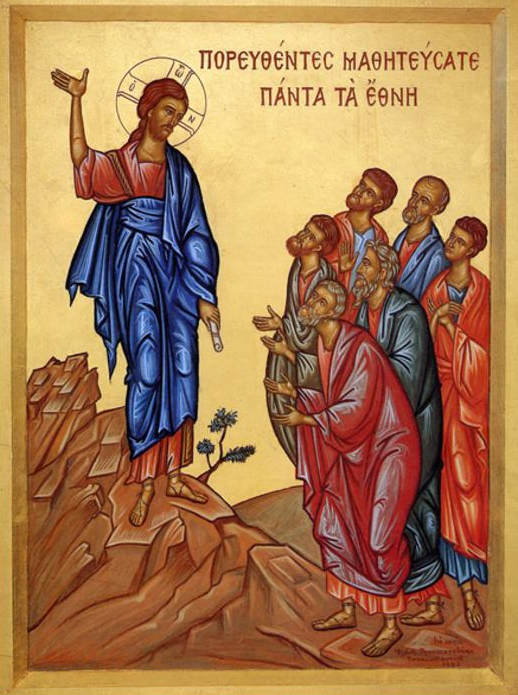
Matthew’s account of the Sermon on the Mount has been related through the whole of chapters five, six and seven of his Gospel. Jesus concludes his teachings with today’s Bible verses, which carry both a promise and a warning. Commencing with the Beatitudes, Jesus’ Sermon on the Mount has presented to the people, toward the start of his ministry, a most beautiful, transformative understanding of God’s call to us to be with Him and to live according to the real, inner truth of the law [ … ]
Jesus speaks in parables when he has something important to communicate. The meaning of a parable may seem obscure or in need of explanation. Jesus does give interpretations of the parables to his disciples. We are encouraged through the parables to see our world in new and perhaps unexpected ways. The parables encourage us to think more deeply about Jesus’ teaching. They are, above all, a challenge – even an anarchic challenge – to everything we think we know [ … ]
