
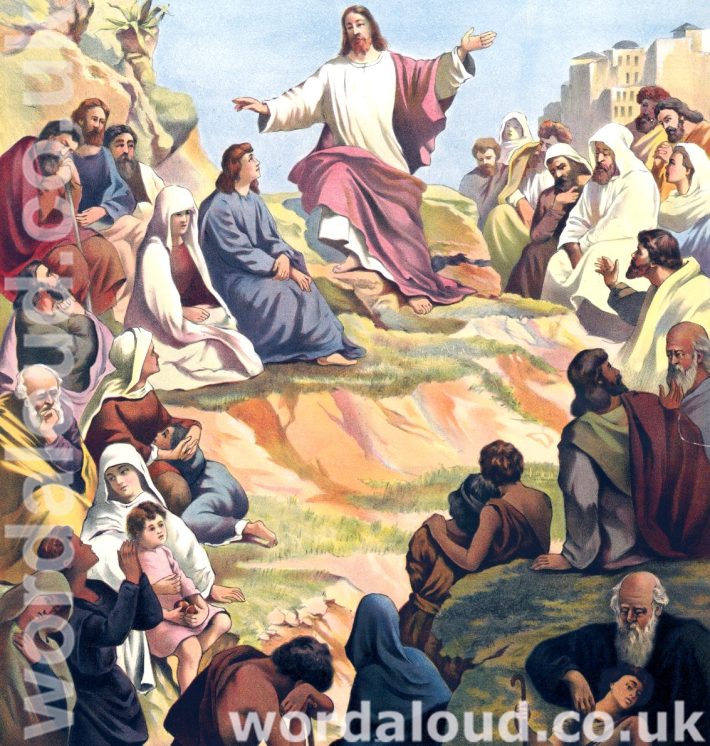
Christian Art | Jesus Preaches The Sermon On The Mount
Office Of Readings | Week 22, Friday, Ordinary Time | A Reading From The Sermon Of Pope Saint Leo The Great On The Beatitudes | Blessed Are The Poor In Spirit
‘Blessed are the poor in spirit.’
Pope Saint Leo the Great’s exposition of the first Beatitude, ‘Blessed are the poor in spirit, for theirs is the kingdom of heaven,’ (Matthew 5:3) sets poverty of spirit in relation to both material poverty and spiritual detachment. His reflection is situated within the wider Christian tradition that viewed the Beatitudes as the programme of the Christian life, and particularly as an introduction to the Sermon on the Mount.
Poverty and Humility
Leo begins by recognising the natural link between material poverty and humility. Those without wealth are less bound to the structures of pride that riches often enable. Yet he is careful to distinguish poverty of spirit from mere lack of possessions. For him, it is possible for the wealthy to live with poverty of spirit if they do not cling to their abundance and use their means for works of mercy. Conversely, it is possible for the materially poor to lack poverty of spirit if they are attached to wealth in desire.
This interpretation corresponds to earlier Christian readings. Origen had stressed that ‘poor in spirit’ refers to those who know their dependence on God rather than those who are simply destitute. Augustine, in his commentary on the Sermon on the Mount, likewise interpreted this Beatitude as humility, the foundation of Christian virtue. Leo aligns with this tradition, presenting poverty of spirit as detachment from temporal goods and orientation towards heavenly goods.
Apostolic Example
Leo turns to the apostles as a model of this Beatitude. He recalls their response to the call of Christ, leaving behind their livelihoods and possessions to become ‘fishers of men’. The unity of heart and soul in the early Church, described in Acts 4:32, is presented as the fruit of such poverty of spirit. Their poverty was not only the abandonment of property but the embrace of common life in Christ.
The example of Peter in Acts 3 is then brought forward. When confronted with a beggar at the temple gate, Peter declares that he has neither silver nor gold, but gives healing in the name of Christ. For Leo, this demonstrates the true wealth of the apostolic mission. Peter’s poverty of material means is contrasted with his possession of divine power, which not only restores physical health but brings many to faith. The incident shows how poverty of spirit makes possible a different kind of generosity: giving what is received from Christ rather than what is possessed materially.
Theological Themes
- Christological foundation: The poverty of the apostles imitates the poverty of Christ, who, according to 2 Corinthians 8:9, ‘though he was rich, became poor for your sake.’ Apostolic poverty is thus rooted in the pattern of Christ himself.
- Ecclesial dimension: Poverty of spirit is not an individual achievement but a communal reality. The early Christian community shared goods and life together, showing that detachment from possessions creates space for unity in Christ.
- Sacramental transformation: Peter’s healing of the lame man illustrates the shift from material to spiritual economy. The apostle gives not money stamped with Caesar’s image but restoration that reflects the image of Christ. Poverty of spirit redirects value from imperial coinage to divine grace.
Historical Context
Leo preached in fifth-century Rome, a society where wealth and social status were closely linked. His emphasis on poverty of spirit rather than mere deprivation reflects the pastoral need to address both the wealthy elite and the poor within the Church. For the wealthy, he offered a path of detachment and charity; for the poor, he pointed beyond material lack to spiritual disposition.
A Reading From The Sermon Of Pope Saint Leo The Great On The Beatitudes | Blessed Are The Poor In Spirit
It cannot be doubted that the poor can more easily attain the blessing of humility than those who are rich. In the case of the poor, the lack of worldly goods is often accompanied by a quiet gentleness, whereas the rich are more prone to arrogance. Nevertheless, many wealthy people are disposed to use their abundance not to swell their own pride but to perform works of benevolence. They consider their greatest gain what they spend to alleviate the distress of others.
This virtue is open to all men, no matter what their class or condition because all can be equal in their willingness to give, however unequal they may be in earthly fortune. Indeed, their inequality in regard to worldly means is unimportant, provided they are found equal in spiritual possessions. Blessed, therefore, is that poverty which is not trapped by the love of temporal things and does not seek to be enriched by worldly wealth, but desires rather to grow rich in heavenly goods.
The apostles were the first after the Lord himself to provide us with an example of this generous poverty, when they all equally left their belongings at the call of the heavenly master. By an immediate conversion they were turned from the catching of fish to become fishers of men, and by their own example they won many others to the imitation of their own faith. In these first sons of the Church there was but one heart and one soul among all who believed. Abandoning all their worldly property and possessions in their dedicated poverty, they were enriched with eternal goods, and in accordance with the apostolic preaching, they rejoiced to have nothing of this world and to possess all things with Christ.
Therefore, when the apostle Peter was on his way up to the temple and was asked for alms by the lame man, he replied: Silver and gold I have not; but what I have I give you. In the name of Jesus Christ of Nazareth, arise and walk. What is more sublime than this humility? And what could be richer than this poverty? Though Peter cannot assist with money, he can confer gifts of nature. With a word Peter brought healing to the man who had been lame from birth; he who did not give a coin with the emperor’s image refashioned the image of Jesus in this man.
And by the riches of this treasure, not only did he help the man who recovered the power to walk, but also five thousand others who believed the preaching of the apostle because of this miraculous cure. Thus Peter, who in his poverty had no money to give to the beggar, bestowed such a bounty of divine grace that in restoring to health the feet of one man, he healed the hearts of many thousands of believers. He had found all of them lame; but he made them leap for joy in Christ.
Christian Prayer With Jesus
Lord Jesus Christ,
you taught your disciples that the poor in spirit
are blessed in your kingdom.
Grant us freedom from the love of possessions,
so that we may seek first the riches of your grace.
Make us generous in sharing what we have,
and faithful in giving what you alone can give.
Through you, who live and reign with the Father
in the unity of the Holy Spirit,
God, forever and ever.
Amen.
Glossary Of Christian Terms
Beatitudes – The blessings spoken by Jesus at the beginning of the Sermon on the Mount (Matthew 5:1–12), setting out the character of those who belong to the kingdom of heaven.
Poverty of spirit – Inner detachment from material goods, marked by humility and trust in God, whether one is rich or poor.
Apostles – The first disciples chosen and sent by Jesus to preach the Gospel and establish the Church.
Acts 3 – A passage in the New Testament describing the healing of a lame man at the temple gate by Peter and John.
Grace – The free and unearned gift of God’s life and help, enabling human beings to live in relationship with him.
Image of Christ – In Christian teaching, humanity is created in the image of God (Genesis 1:27). Through faith and grace, believers are renewed to reflect Christ more fully.




In today’s Bible verses, the confrontation continues between Jesus and the Jewish authorities, who now send Pharisees and Herodians, themselves mutually hostile, to seek to provoke and condemn Jesus [ … ]

In this verse, Jesus shares the parable of the lost sheep, emphasizing Jesus’ care and concern for those who have gone astray. Jesus shows us that every individual is precious and worth seeking out, no matter how far they have wandered. This passage invites us to reflect on Jesus’ relentless pursuit of the lost sheep and Jesus’ deep desire to bring the lost sheep back into his fold [ … ]
We learn in Mark’s Gospel that Jesus’ friends are concerned about Jesus, thinking that he is beside himself, and intending to restrain him (Mark 3: 21). Shortly afterwards, in Mark’s Gospel, Mary and others of Jesus’ family make the journey recounted in today’s Gospel verses to try to see Jesus [ … ]