

Christian Art | A Boy At Prayer In Baptism | Love Revealed By Jesus Christ
Office Of Readings | Eastertide Week 2, Sunday | Divine Mercy | A Reading From The Sermons Of Saint Augustine | A New Creation In Jesus Christ
‘A new creation in Jesus Christ.’
A New Creation In Christ | Saint Augustine
In this Easter sermon, Saint Augustine speaks tenderly and passionately to the newly baptized, those who have recently passed through the saving waters of baptism at the Easter Vigil. His words are full of warmth, joy, and hope, as he invites these ‘little children in Christ’ to recognize the extraordinary gift they have received and to live according to the new life that has been planted within them.
At the heart of Augustine’s message is the idea of a new creation. Baptism is not merely the washing away of past sins; it is a real participation in the death and resurrection of Jesus Christ. The old life, dominated by sin and mortality, has been buried, and a new life, shining with the light of Christ, has begun. Augustine describes the baptized as the ‘holy seed’, the ‘flower of our ministry’, and ‘the proof of Mother Church’s fruitfulness’. These images speak of vitality, growth, and promise. The Church, through the power of the Holy Spirit, gives birth to new sons and daughters who are called to live no longer according to the flesh but according to the Spirit.
He urges the neophytes to ‘put on the Lord Jesus Christ’, to be clothed in Christ as in a new garment. This beautiful metaphor captures the intimacy of the union between Christ and the Christian. To be baptized is to be enveloped by Christ’s life, to have one’s identity reshaped by his presence. Augustine stresses that in Christ, all the divisions that once separated humanity—Jew and Greek, slave and free, male and female—are overcome. Baptism ushers in a new unity, a communion that reflects the unity of the Body of Christ itself.
Augustine reminds his listeners that the power of baptism is not confined to the moment it is received. It initiates a journey that leads ultimately to the resurrection of the dead. The baptized are still pilgrims, still living by faith and not yet by sight. They walk the road of life directed toward their heavenly homeland, with Jesus himself as their Way. Baptism has given them a new beginning, but the fullness of what they have received will only be revealed at the end of time when Christ appears in glory.
A striking and important theme in this sermon is Augustine’s meditation on the eighth day, the day of new creation. In the Old Covenant, circumcision—the sign of belonging to God—was performed on the eighth day after birth. Now, in the New Covenant, baptism has become the true circumcision, the mark of belonging to Christ. Augustine points out that the day of Christ’s Resurrection, Easter Sunday, is both the first day of the new week and the eighth day beyond the Sabbath. It signals not only the beginning of a new week but the dawn of a new creation. By linking baptism to the eighth day, Augustine shows that those who are baptized share already in the Resurrection life of Christ, even though they await its full manifestation.
Thus, the newly baptized, though still living in mortal bodies, have been given the pledge of the Spirit, the guarantee of their future glory. Their lives are now ‘hidden with Christ in God’, as Augustine beautifully puts it. Though they continue to face the struggles and sufferings of earthly life, their true identity is anchored beyond the visible world, held safely in the life of the risen Christ.
This hidden life is a call to hope and transformation. The baptized must now seek ‘the things that are above’, setting their hearts not on earthly ambitions but on heavenly realities. Augustine’s exhortation is filled with urgency and love: the Christian life is a serious calling, but it is also a life of profound joy, because it is already rooted in the life of God himself.
In his usual style, Augustine moves effortlessly from doctrinal teaching to heartfelt encouragement. He wants his listeners to grasp both the immense dignity they have received in Christ and the serious responsibility it entails. Baptism is not the end but the beginning—a call to live according to the Spirit, a call to holiness, a call to journey forward with eyes fixed on the promise of eternal life.
In the end, Augustine’s sermon is a song of praise to the mercy and greatness of God. Through baptism, the small and fragile lives of men and women have been drawn into the eternal life of the Trinity. They have become, even now, participants in the Resurrection, citizens of a new creation, heirs of a glory that will never fade.
Thus, he leaves the neophytes—and us—with a lasting invitation: to live what we have become. To walk by faith, strengthened by hope, and burning with the love that has been poured into our hearts by the Holy Spirit.

A Reading From The Sermons Of Saint Augustine | A New Creation In Jesus Christ
I speak to you who have just been reborn in baptism, my little children in Christ, you who are the new offspring of the Church, gift of the Father, proof of Mother Church’s fruitfulness. All of you who stand fast in the Lord are a holy seed, a new colony of bees, the very flower of our ministry and fruit of our toil, my joy and my crown. It is the words of the Apostle that I address to you: Put on the Lord Jesus Christ, and make no provision for the flesh and its desires, so that you may be clothed with the life of him whom you have put on in this sacrament. You have all been clothed with Christ by your baptism in him. There is neither Jew nor Greek; there is neither slave nor freeman; there is neither male nor female; you are all one in Christ Jesus.
Such is the power of this sacrament: it is a sacrament of new life which begins here and now with the forgiveness of all past sins, and will be brought to completion in the resurrection of the dead. You have been buried with Christ by baptism into death in order that, as Christ has risen from the dead, you also may walk in newness of life.
You are walking now by faith, still on pilgrimage in a mortal body away from the Lord; but he to whom your steps are directed is himself the sure and certain way for you: Jesus Christ, who for our sake became man. For all who fear him he has stored up abundant happiness, which he will reveal to those who hope in him, bringing it to completion when we have attained the reality which even now we possess in hope.
This is the octave day of your new birth. Today is fulfilled in you the sign of faith that was prefigured in the Old Testament by the circumcision of the flesh on the eighth day after birth. When the Lord rose from the dead, he put off the mortality of the flesh; his risen body was still the same body, but it was no longer subject to death. By his resurrection he consecrated Sunday, or the Lord’s day. Though the third after his passion, this day is the eighth after the Sabbath, and thus also the first day of the week.
And so your own hope of resurrection, though not yet realised, is sure and certain, because you have received the sacrament or sign of this reality, and have been given the pledge of the Spirit. If, then, you have risen with Christ, seek the things that are above, where Christ is seated at the right hand of God. Set your hearts on heavenly things, not the things that are on earth. For you have died and your life is hidden with Christ in God. When Christ, your life, appears, then you too will appear with him in glory.



The poem is an address to the Holy Spirit, symbolized as fire or a spark, exploring themes of divine transformation, purification, and ultimate union with God. Herbert opens with an acknowledgment of the Spirit’s divinity, emanating from the presence of the Saviour’s face. The Spirit is seen as belonging naturally to this celestial realm, yet the poet invites the Spirit to ‘take a bad lodging’ in his heart, reflecting humility and recognition of his own imperfections [ … ]
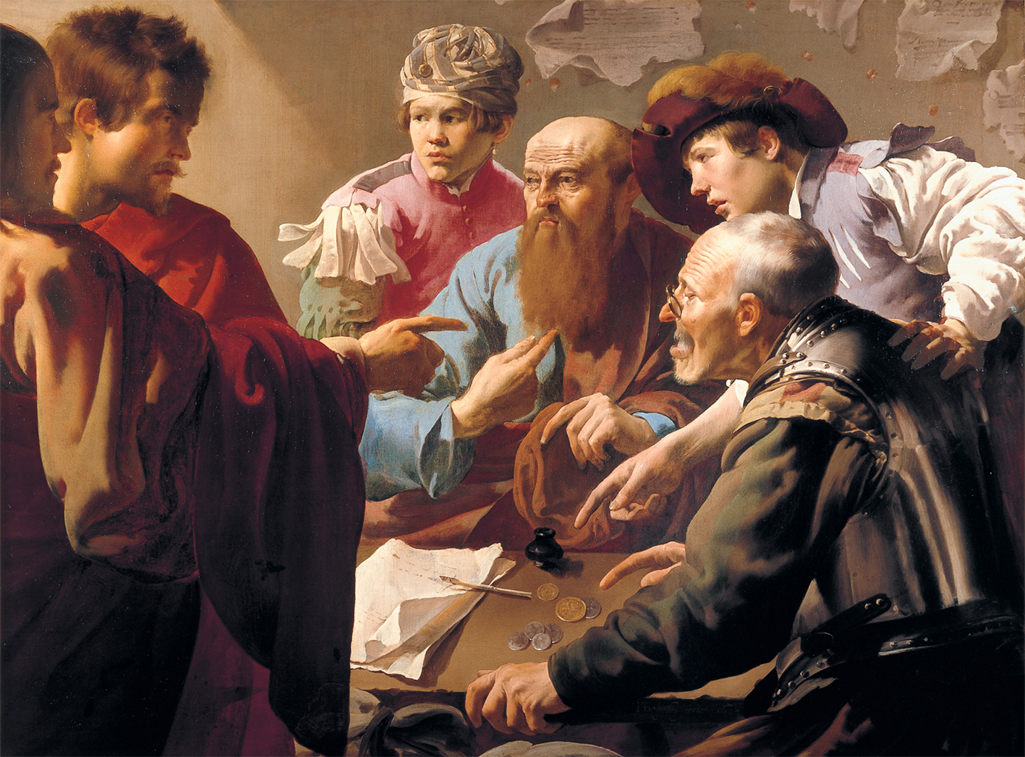
In the Sermon on the Mount, Jesus preached a message of love and acceptance. He called everyone to a new way of being, which would be true to God’s will. As the narrative account continues from chapter eight through nine, we see Jesus putting into practice the lessons he has taught. Jesus accepts lepers, foreigners, women, the sick, the possessed, paralytics, the unclean, and now a tax collector [ … ]
The reading, presented as the voice of Christ addressing the disciple, reflects the central themes of The Imitation of Christ — listening to God’s word with humility, preferring eternal truth over temporal vanities, and persevering in faith through both trials and consolations [ … ]
