
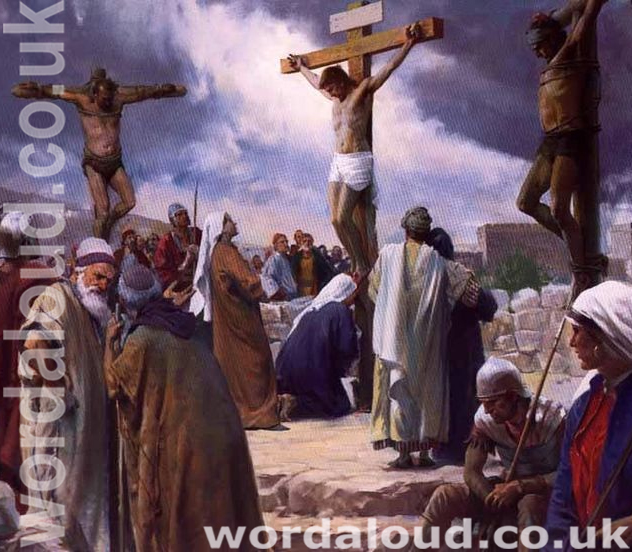
Christian Art | Jesus Christ Is Crucified | The Triumph Of The Cross
Office Of Readings | Week 4, Thursday, Ordinary Time | A Reading From The Catecheses By Saint Cyril Of Jerusalem | Let The Cross Be A Joy To You Even In Times Of Persecution
‘Even in time of persecution let the cross be your joy.’
In this catechetical instruction, Saint Cyril of Jerusalem places the cross at the centre of Christian faith and identity. His purpose is to form believers who not only understand the meaning of Christ’s death but are prepared to confess it publicly, even under pressure.
Cyril begins by stating that the Church’s greatest glory is the cross. While Christ’s miracles revealed his power, they were limited in scope: a single blind man healed, one person raised, a crowd fed. By contrast, the cross has universal effect. Through it, ignorance is overcome, sin is forgiven, and humanity as a whole is redeemed. The comparison is intended to show that the crucifixion, though outwardly a sign of weakness, is in fact the decisive act of salvation.
Cyril then addresses the apparent contradiction in how the cross is perceived. For some, it is an offence or foolishness; for believers, it is the power of God. This difference rests on the identity of the one who suffered. The crucified is not merely a human victim but the Son of God made man. Because of this, the cross is not a defeat but a victory.
Cyril links Christ’s sacrifice with earlier biblical imagery. The lamb in the Mosaic law protected Israel from destruction, but Christ, the Lamb of God, removes sin itself. The comparison highlights continuity between the old covenant and its fulfilment in Christ, while emphasising that Christ’s sacrifice is complete and effective for all.
A further theme is Christ’s willing participation in his passion. Jesus did not suffer by accident or coercion but accepted the cross knowingly and freely. His endurance is presented as a form of triumph, a ‘crown of victory’ achieved through obedience.
The reading turns to practical instruction. Believers are urged not to honour the cross only in peaceful circumstances but to remain faithful when facing opposition. Cyril frames discipleship as participation in Christ’s suffering. Since Christ, who was without sin, endured the cross for humanity, Christians are called to respond with courage if they must endure hardship for his sake. The cross thus becomes both the source of forgiveness and the pattern of Christian witness.

A Reading From The Catecheses By Saint Cyril Of Jerusalem | Let The Cross Be A Joy To You Even In Times Of Persecution
The Catholic Church glories in every deed of Christ. Her supreme glory, however, is the cross. Well aware of this, Paul says: God forbid that I glory in anything but the cross of our Lord Jesus Christ!
At Siloam, there was a sense of wonder, and rightly so. A man born blind recovered his sight. But of what importance is this, when there are so many blind people in the world? Lazarus rose from the dead, but even this only affected Lazarus. What of those countless numbers who have died because of their sins? Those five miraculous loaves fed five thousand people. Yet this is a small number compared to those all over the world who were starved by ignorance. After eighteen years a woman was freed from the bondage of Satan. But are we not all shackled by the chains of our own sins?
For us all, however, the cross is the crown of victory! It has brought light to those blinded by ignorance. It has released those enslaved by sin. Indeed, it has redeemed the whole of mankind! Do not, then, be ashamed of the cross of Christ; rather, glory in it. Although it is a stumbling block to the Jews and folly to the Gentiles, the message of the cross is our salvation. Of course it is folly to those who are perishing, but to us who are being saved it is the power of God. For it was not a mere man who died for us, but the Son of God, God made man.
In the Mosaic law a sacrificial lamb banished the destroyer. But now it is the Lamb of God who takes away the sin of the world. Will he not free us from our sins even more? The blood of an animal, a sheep, brought salvation. Will not the blood of the only-begotten Son bring us greater salvation?
I have the power to lay down my life and to take it up again. Yes, he willingly submitted to his own passion. He took joy in his achievement; in his crown of victory he was glad and in the salvation of man he rejoiced. He did not blush at the cross for by it he was to save the world. No, it was not a lowly man who suffered but God incarnate. He entered the contest for the reward he should win by his patient endurance.
Certainly in times of tranquility the cross should give you joy. But maintain the same faith in times of persecution. Otherwise you will be a friend of Jesus in times of peace and his enemy during war. Now you receive the forgiveness of your sins and the generous gift of grace from your King. When war comes, fight courageously for him.
Jesus never sinned; yet he was crucified for you. Will you refuse to be crucified for him, who for your sake was nailed to the cross? You are not the one who gives the favor; you have received one first. For your sake he was crucified on Golgotha. Now you are returning his favor; you are fulfilling your debt to him.
Christian Prayer With Jesus Christ
Lord Jesus Christ,
you accepted the cross willingly
for the salvation of the world.
Grant us the grace
never to be ashamed of your cross,
but to glory in the love it reveals.
Strengthen our faith in times of peace
and give us courage in times of trial.
Forgive our sins through your sacrifice,
and teach us to follow you
with steadfast hearts.
May your victory over sin and death
shape our lives and our witness.
You who live and reign for ever and ever.
Amen
Glossary Of Christian Terms
Cross | The instrument of Christ’s crucifixion and the sign of salvation
Catholic Church | The universal community of believers
Stumbling block | Something that causes rejection or offence
Power of God | God’s saving action revealed in Christ
Incarnate | God made human in Jesus Christ
Lamb of God | Title for Christ as the one who takes away sin
Passion | The suffering and death of Jesus
Redemption | Deliverance from sin through Christ’s sacrifice
Grace | God’s free gift of forgiveness and new life
Persecution | Opposition or suffering endured for faith
Golgotha | The place where Jesus was crucified
Crown of victory | The triumph achieved through Jesus Christ’s obedience



Psalm 96 opens with an impassioned exhortation: ‘O sing unto the Lord a new song: sing unto the Lord, all the earth.’ This vibrant call to sing a new song is not mere repetition of familiar tunes; it is invitation to explore fresh melodies of praise that resonate with ever-renewing wonders of God’s salvation. Scope of this call is universal—reaching to each corner of the earth, summoning all nations and peoples to join in celestial chorus [ … ]

The infancy narratives of Jesus are more than mere history. Luke’s accounts of Jesus’ infancy constitute a theological and Christological prologue to his Gospel. Many great truths of the Gospels are here prefigured. We may think of the Jesus’ infancy narratives given to us in Luke as a beautiful gateway, through which we enter to encounter the Gospels as a whole. This would certainly be appropriate to the spirit of our celebrations of Christmas, when we rejoice that God has answered our calls to be with us, as we celebrate the great mystery of the Incarnation [ … ]
Capernaum was a small city on the crossroad of two important routes, one from Asia Minor, leading to Petra on the south of the Transjordan, the other from the region of the two rivers, the Tigris and Euphrates, descending toward Egypt. Jesus’ move to Capernaum helped his contact with the people, and so the spreading of the Good News [ … ]