
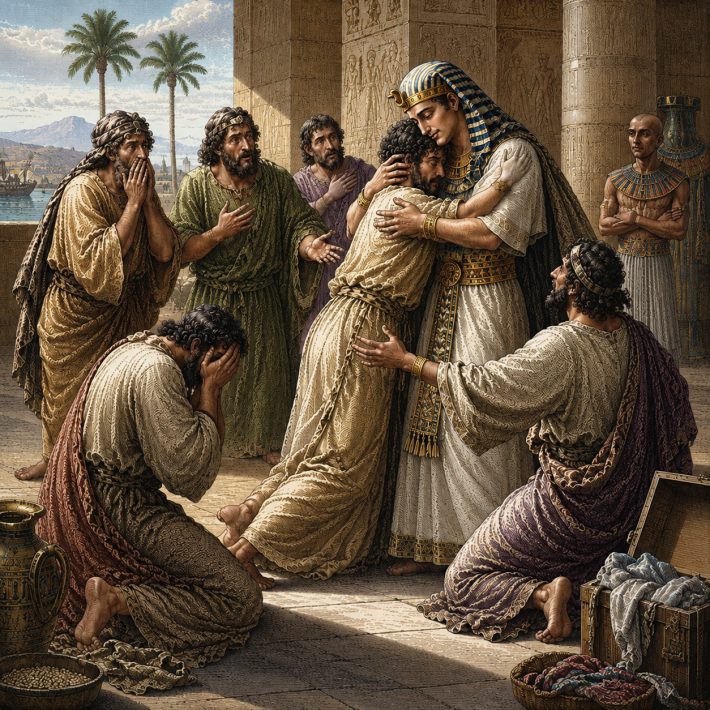
Christian Art | Joseph Reveals Himself To His Brothers
A Reading From The Book Of Genesis | The Story Of Joseph
The Mission | Bring Yourself – Bring All You Are – To God
1 And Jacob dwelt in the land wherein his father was a stranger, in the land of Canaan.
2 These are the generations of Jacob. Joseph, being seventeen years old, was feeding the flock with his brethren; and the lad was with the sons of Bilhah, and with the sons of Zilpah, his father’s wives: and Joseph brought unto his father their evil report.
3 Now Israel loved Joseph more than all his children, because he was the son of his old age: and he made him a coat of many colours.
4 And when his brethren saw that their father loved him more than all his brethren, they hated him, and could not speak peaceably unto him.
5 And Joseph dreamed a dream, and he told it his brethren: and they hated him yet the more.
6 And he said unto them, Hear, I pray you, this dream which I have dreamed:
7 For, behold, we were binding sheaves in the field, and, lo, my sheaf arose, and also stood upright; and, behold, your sheaves stood round about, and made obeisance to my sheaf.
8 And his brethren said to him, Shalt thou indeed reign over us? or shalt thou indeed have dominion over us? And they hated him yet the more for his dreams, and for his words.
9 And he dreamed yet another dream, and told it his brethren, and said, Behold, I have dreamed a dream more; and, behold, the sun and the moon and the eleven stars made obeisance to me.
10 And he told it to his father, and to his brethren: and his father rebuked him, and said unto him, What is this dream that thou hast dreamed? Shall I and thy mother and thy brethren indeed come to bow down ourselves to thee to the earth?
11 And his brethren envied him; but his father observed the saying.
*
The story of Joseph begins within a family already marked by division. Genesis has traced generations shaped by rivalry, favouritism, deception and estrangement. The conflict between Cain and Abel established early the destructive force of jealousy between brothers. Later narratives repeat similar patterns in different forms: Isaac and Ishmael, Jacob and Esau, Leah and Rachel. By the time Joseph appears, the family of Jacob already carries deep instability within itself.
Joseph becomes the focus of that instability almost immediately. Jacob’s preference for him is visible and public. The favour shown toward Joseph separates him from the other sons and intensifies tensions already present within the household. The problem is not simply that Joseph is loved, but that love appears unequally distributed. The brothers experience Joseph less as companion than as reminder of exclusion.
Dreams deepen this division. Joseph dreams repeatedly of future exaltation and of the submission of others before him. Yet the narrative presents him at this stage with little understanding of what such dreams will require. Joseph speaks his dreams openly and directly, but he does not yet comprehend the suffering through which their fulfilment must pass.
This tension between revelation and understanding becomes one of the controlling patterns of the narrative. Dreams disclose something true, yet the truth remains incomplete and difficult to interpret. Meaning unfolds gradually through time rather than appearing immediately in clarity.
The brothers respond first with resentment and then with violence. Their hostility develops slowly before finally reaching the decision to remove Joseph altogether. The scene at Dothan is the decisive break. Joseph approaches his brothers expecting ordinary familial encounter, but instead enters betrayal.
Joseph begins a long descent: into the pit; into slavery; into Egypt; into imprisonment; into obscurity. Again and again the narrative places humiliation before exaltation.
The brothers sell Joseph into Egypt rather than killing him directly. Yet the distinction offers little comfort. Joseph is treated as object of exchange rather than brother. At the same time, Jacob is deceived through the bloodied garment returned to him as evidence of death. The family becomes organised around concealment, grief and silence.
A striking feature of the Joseph narrative is the absence of overt divine intervention at these moments of suffering. God does not interrupt events visibly. There is no miraculous rescue from the pit, no angelic appearance overturning catastrophe, no direct explanation offered to Joseph regarding the meaning of his suffering.
This silence is central to the theology of the narrative. The Joseph story is shaped not by dramatic revelation, but by hidden providence. God remains active throughout, yet rarely in explicit or miraculous form. Meaning emerges indirectly through events, memory, dreams, famine, delay and reversal.
This distinguishes the Joseph narrative sharply from Exodus. In Exodus, God acts openly within history through plagues, covenant speech, fire and deliverance. In Joseph, providence remains largely concealed within ordinary historical processes. The narrative resembles ordinary human experience more closely. Characters act without possessing full understanding of what their actions will ultimately mean.
Joseph arrives in Egypt stripped of family, status and certainty. This transition into Egypt is not presented romantically. It is exile. Joseph enters a foreign land as slave and must learn to survive within structures entirely outside his control.
Yet even within exile the narrative begins slowly to suggest underlying preservation. Joseph rises within the household of Potiphar because he proves trustworthy, disciplined and perceptive. Genesis increasingly presents him not as heroic conqueror, but as a figure marked by attentiveness and restraint.
This becomes especially visible in the episode with Potiphar’s wife. Joseph refuses adultery not simply from caution or social calculation, but because he understands human action ultimately in relation to God. Conduct cannot be separated from moral accountability.
Yet integrity does not protect him from suffering. Joseph is falsely accused and imprisoned despite innocence. Genesis repeatedly refuses any simple relationship between righteousness and immediate reward. Goodness does not guarantee security. Faithfulness may instead lead deeper into obscurity.
Prison scenes intensify themes of waiting and hiddenness. Joseph passes from favoured son to slave and from slave to prisoner. At each stage his circumstances narrow further. Yet the narrative continues quietly to suggest that abandonment is not the final truth of his condition.
Dreams return in prison, though now belonging to others rather than to Joseph himself. The cupbearer and baker each dream symbolic dreams requiring interpretation. Joseph’s role increasingly becomes interpretive rather than controlling. He does not shape events directly. Instead, he discerns patterns and meanings within them.
This distinction matters. Joseph’s wisdom never appears self-generated. Again and again the narrative prevents him from becoming a figure of autonomous brilliance or ambition. His understanding remains receptive. He interprets rather than originates.
Even after correctly interpreting the dreams of Pharaoh’s servants, Joseph remains forgotten. The cupbearer returns to favour and leaves Joseph behind in prison. Forgetting is a recurring experience of the narrative. Joseph is forgotten politically, separated from his family, concealed from memory, and apparently lost within history itself. Yet the narrative quietly resists the idea that forgetting by human beings means abandonment by God.
Time is increasingly important. Genesis slows the story repeatedly through delay and waiting. Joseph cannot force fulfilment of the dreams he received earlier. He must endure years in which meaning remains hidden and the future uncertain.
This patient unfolding of providence gives the Joseph narrative much of its theological depth. Events do not reveal their significance immediately. Understanding emerges retrospectively and often painfully. While suffering unfolds, coherence remains concealed.
When Pharaoh dreams, the hidden movement of the narrative begins to emerge more clearly. Pharaoh’s dreams concern abundance and famine, fertility and devastation, years of plenty followed by years of scarcity. Joseph interprets them not merely as private symbols, but as revelations concerning history itself.
Again the narrative stresses Joseph’s restraint. Joseph refuses to claim independent power or wisdom for himself. His understanding remains dependent upon God rather than personal genius.
This posture distinguishes Joseph from many figures of political ascent in ancient literature. He rises to extraordinary authority within Egypt, yet Genesis repeatedly undercuts triumphalism. Joseph’s authority emerges through suffering, waiting and dependence rather than conquest or self-assertion.
Joseph’s Rise To Political Authority
Joseph’s rise within Egypt marks a turning point in the narrative, yet Genesis continues to present that rise with restraint. Pharaoh elevates Joseph because the coming famine requires discernment and administrative wisdom. Joseph moves suddenly from imprisonment into political authority, but the narrative does not present this transformation as simple triumph. The memory of descent remains close to everything that follows.
The Joseph story continually resists straightforward success narrative. Joseph gains authority, wealth and position, yet these do not erase the years of abandonment and uncertainty preceding them. Genesis preserves continuity between suffering and exaltation rather than allowing one simply to cancel the other.
At the same time, Joseph’s new position introduces ambiguity into the narrative. During the famine he centralises increasing power within Pharaoh’s system. Land, livestock, labour and wealth gradually come under royal control through Joseph’s administration. The same Joseph who preserves life also strengthens imperial authority.
Genesis never entirely resolves this tension. Egypt becomes simultaneously place of salvation and place of future bondage. Joseph preserves the covenant family through Egypt, yet later generations will require deliverance from Egypt. The ending of Genesis therefore already contains the beginnings of Exodus within itself.
Famine eventually forces Joseph’s brothers to descend into Egypt seeking food. Here the narrative slows considerably and becomes psychologically more complex. Joseph recognises his brothers immediately, while they fail to recognise him. This asymmetry shapes what follows.
Recognition in Genesis is rarely simple. Again and again throughout the book, identity is obscured or misunderstood: Jacob disguises himself before Isaac; Joseph is hidden beneath Egyptian authority; the brothers stand before the very person they believe lost forever; Joseph now occupies the position of power once held over him by others. The narrative could easily move toward revenge at this point, yet Genesis chooses a more difficult path. Joseph conceals his identity and begins testing the brothers repeatedly.
These tests are not merely punitive. Joseph forces the brothers to confront memory and responsibility. The past cannot simply be ignored. Before reconciliation becomes possible, the brothers must face what they once did. Benjamin becomes central to this process because he now occupies the place Joseph himself once held within the family. He is the younger son of Rachel, the child especially beloved by Jacob. Joseph watches carefully to see whether the brothers will sacrifice Benjamin as they once sacrificed him.
The narrative reveals gradual moral change within them. Earlier they protected themselves at Joseph’s expense. Now they become increasingly willing to bear suffering for one another. Judah especially undergoes transformation. The same Judah who once proposed selling Joseph later offers himself in Benjamin’s place.
This change matters profoundly. Genesis does not present reconciliation as emotional impulse alone. The brothers must become different men from those who stood at Dothan years earlier. Time, guilt, suffering and memory slowly alter them.
Joseph himself remains emotionally divided throughout these scenes. Again and again he withdraws privately in order to weep before returning to confront his brothers once more. These repeated withdrawals are important. Joseph has achieved authority within Egypt, yet the unresolved wound of betrayal remains active within him.
The narrative handles this with remarkable restraint. Joseph neither immediately forgives nor fully hardens himself against his brothers. Instead, he inhabits a difficult space between remembered suffering and the possibility of reconciliation. In part, this complexity gives the Joseph story its unusual and particular psychological depth. The narrative understands that betrayal alters relationships permanently. Reconciliation does not erase history or undo suffering. The brothers remain marked by guilt, and Joseph remains marked by loss.
When Joseph finally reveals himself, the moment carries extraordinary tension. Concealment maintained throughout the Egypt scenes suddenly collapses. Yet even here the narrative avoids simple resolution. Joseph names the truth directly: he is the brother whom they sold into Egypt. This acknowledgement matters because Genesis refuses reconciliation built upon denial. Evil must first be recognised as evil. The brothers truly betrayed Joseph. The suffering which followed was real.
Yet Joseph immediately begins interpreting that suffering through another framework. Looking backwards, he perceives providence working through events which once appeared only tragic and meaningless. The famine, the dreams, the imprisonment, the rise to authority, and even the betrayal itself now appear gathered within a larger frame preserving life. This becomes one of the central theological claims of the entire narrative. Human beings act freely and often wickedly, yet divine purpose continues to work through and beyond human intention.
What matters is that Genesis never collapses providence into determinism. Joseph does not claim that the brothers acted rightly or that suffering itself was good. The evil remains evil. Years of loss remain irreversible. What changes is the recognition that destruction did not finally possess the last word over history. This providential vision emerges only retrospectively. Joseph could not see its shape while suffering unfolded. During imprisonment and abandonment there was no visible assurance that events possessed meaning. Understanding comes afterwards and only partially.
In this respect the Joseph narrative speaks powerfully to conditions of uncertainty and obscurity. Providence in Genesis is rarely obvious while events are being lived. Human beings act within limited understanding, unable to perceive fully how present suffering may eventually be gathered into larger purposes beyond immediate comprehension.
Joseph And His Brothers Reconciled
Reconciliation between Joseph and his brothers does not remove uncertainty entirely. Even after reunion, fear continues to shape the family. This becomes especially clear after the death of Jacob. The brothers immediately suspect that Joseph may finally seek revenge now that their father no longer stands between them.
Their fear reveals something important about guilt. The past is not easily escaped. The brothers continue to interpret Joseph through the memory of their own wrongdoing. Even years of peace cannot entirely erase the anxiety created by betrayal.
Joseph’s response returns once more to the question of providence. He refuses to place himself in the position of ultimate judgement. The famous statement that the brothers intended evil while God intended good does not deny human responsibility. Rather, it expresses Joseph’s conviction that destruction does not finally control history.
This theological vision remains careful and restrained. Genesis does not claim that suffering becomes unreal once meaning is later perceived within it. Joseph’s years of slavery and imprisonment remain lost years in one sense. Nor does the narrative suggest that providence excuses evil actions. The brothers are transformed precisely because they must confront the truth of what they did.
Instead, the Joseph story suggests that divine purpose may continue to work even within situations shaped by betrayal, injustice and human failure. Providence appears not as interruption of history from outside, but as hidden trajectory within history itself.
This hiddenness gives the narrative much of its enduring force. Many biblical stories depend upon visible miracle or direct revelation. The Joseph story unfolds differently. Characters live largely without certainty. They make decisions within confusion, grief, delay and partial understanding. Meaning emerges slowly, often only in retrospect.
The narrative does indeed pay close attention to time. Joseph waits repeatedly: in slavery; in prison; in obscurity; and later within concealment before his brothers.
The book refuses immediacy. Fulfilment of the dreams received in youth passes through many years before becoming visible at all. Even then fulfilment appears differently from what Joseph likely imagined at the beginning. The dreams come true, yet through exile, suffering and separation rather than direct ascent.
This long process changes Joseph. The young Joseph at the beginning of the narrative differs greatly from the Joseph who finally speaks with his brothers in Egypt. Earlier he appears direct, exposed, and perhaps lacking awareness of how others perceive him. Later he becomes marked by restraint, patience and emotional discipline.
Egypt forms Joseph through suffering and waiting. Prison teaches endurance. Concealment teaches caution. Responsibility teaches discernment. At the close, Joseph possesses authority, yet he remains less dominating ruler than interpreter of events and preserver of life.
This preserving role becomes increasingly important toward the close of Genesis. Joseph saves not only Egypt from famine, but also the covenant family itself. Without Joseph, Jacob’s household would likely perish during years of scarcity. The promises given earlier to Abraham continue historically through Joseph’s preservation of the family line.
Genesis deliberately complicates this preservation by locating it within Egypt. The family survives, but in exile. Refuge and danger become intertwined. Egypt protects Israel and will later enslave Israel. Joseph stands at the threshold between Genesis and Exodus. Through him the covenant line survives, but through that same movement Israel enters the land from which later deliverance will become necessary.
The close of Genesis is shaped by incompletion. Joseph dies outside the promised land. The covenant promises remain only partially fulfilled. Israel has become larger as family, yet not yet nation. The descendants of Abraham remain dependent upon foreign power and foreign land.
Joseph’s final words therefore look beyond the immediate circumstances of the narrative. He speaks of future visitation and asks that his bones eventually be carried out of Egypt. The request reveals continuing orientation toward promise even in death.
Genesis ends not with fulfilment, but with expectation. This unfinished quality is essential to the theology of the book. Promises move forward through history without reaching completion within the lifetime of the actors themselves.
Joseph embodies this condition. His life is shaped by transition: from son to slave; from prisoner to ruler; from exile to reconciliation; from suffering toward preservation.
Yet no stage finally resolves all tension. Joseph is a figure living between worlds: between Canaan and Egypt; between betrayal and forgiveness; between suffering and authority; between memory and hope. Perhaps this is why the narrative continues to possess such theological depth. The Joseph story addresses a problem of meaning within ordinary historical experience. God does not overwhelm events visibly. Human beings often live without immediate clarity regarding suffering or delay. Providence remains concealed within an unfolding of time itself.
The narrative therefore invites a particular kind of faithfulness: not certainty grounded in visible control, but endurance within partial understanding. Joseph repeatedly acts without possessing full knowledge of what his suffering will eventually mean. Only later can he begin to perceive coherence within events which once appeared fragmented and destructive.
By the close of Genesis, the future remains unresolved. Israel still dwells in Egypt. The promises remain unfinished. Yet the covenant line has survived, reconciliation has become possible, and the narrative continues forward in expectation of what God will yet do beyond the limits of Joseph’s own lifetime.
Conclusions | A Life In Expectation Of God
The story of Joseph is shaped from beginning to end by things hidden from sight. Hiddenness governs the movement of the narrative long before Joseph himself disappears into Egypt. The family of Jacob already lives within concealed tensions, unspoken resentments, remembered injuries, and unequal affections. What eventually erupts into violence has existed silently for some time beforehand.
Joseph enters this atmosphere without fully understanding it. The dreams he receives suggest future authority and exaltation, yet at the beginning he possesses little awareness of how others perceive him. He speaks openly because he has not yet learned concealment. The Joseph at the opening of Genesis still lives close to immediacy. He sees revelation but not yet complexity. The movement into Egypt changes this profoundly.
Once Joseph is sold by his brothers, almost everything significant in the narrative becomes concealed. Jacob believes Joseph dead while Joseph remains alive. The brothers carry hidden guilt beneath outward normality. Joseph himself disappears beneath slavery, imprisonment, and foreign identity. Even providence becomes hidden within ordinary historical events rather than revealed openly through miracle.
This hiddenness gives the narrative much of its spiritual depth. Genesis presents a world in which truth often exists invisibly long before it becomes recognisable. Human beings act within partial understanding. Meaning unfolds slowly through time rather than appearing immediately.
Joseph himself must learn this gradually. The dreams of Joseph’s youth contain truth, yet the truth remains unintelligible apart from suffering. The young Joseph imagines elevation; he does not yet understand descent. He sees authority but not exile, recognition but not concealment, reconciliation but not betrayal. The years in Egypt form him through waiting.
Genesis repeatedly slows the narrative through delay: years in slavery; years in prison; years forgotten; years separated from family. This waiting is not incidental. Providence in the Joseph story unfolds patiently rather than suddenly. Joseph cannot force fulfilment according to his own timing. Again and again he must endure uncertainty without visible explanation.
This experience changes him inwardly. The Joseph who eventually stands before his brothers differs greatly from the exposed and perhaps somewhat naïve figure at the beginning of the story. Egypt teaches him restraint. Imprisonment teaches him patience. Concealment teaches him discipline.
One sees this especially in the recognition scenes. Joseph immediately recognises his brothers, yet chooses not to reveal himself at once. The earlier Joseph spoke too quickly. The later Joseph waits. He tests, observes, conceals emotion, and allows truth to emerge gradually.
This transformation matters because Genesis presents suffering not merely as obstacle, but as condition through which discernment develops. Joseph becomes capable of interpreting events precisely because he has endured uncertainty himself.
Interpretation lies near the centre of the narrative. Characters struggle to understand what is happening: dreams require interpretation; suffering requires interpretation; history requires interpretation.
Joseph increasingly becomes interpreter not simply of dreams, but of providence. Yet even this understanding remains partial and retrospective. While suffering unfolds, Joseph possesses no clear explanation for it. Only later can he begin to perceive coherence within events that once appeared fragmented and destructive.
This is why the narrative remains so restrained in speaking directly about God. Genesis rarely interrupts the story with overt divine explanation. Instead, providence emerges indirectly through the shape of events themselves: through famine; through memory; through delay; through political circumstance; through reunion.
The hiddenness of God within the Joseph story therefore resembles ordinary historical experience more closely than many biblical narratives. Human beings often live without immediate certainty regarding suffering or purpose. Meaning appears slowly and incompletely. Joseph’s wisdom develops within precisely this condition.
As the narrative progresses, Joseph becomes increasingly figurative of wisdom: interpreter of dreams; reader of circumstances; administrator during crisis; discerner of hidden patterns within events. Yet Genesis carefully prevents wisdom from becoming mastery. Joseph repeatedly refuses to present himself as autonomous source of understanding. Interpretation belongs finally to God rather than to human cleverness.
This distinction preserves humility as the core of Joseph’s character. Joseph rises to extraordinary authority within Egypt, yet never fully controls the circumstances surrounding him. Even at the height of power he remains dependent upon realities beyond himself: famine; memory; family history; and providence.
A political dimension of the narrative deepens this ambiguity. Joseph preserves life during famine, yet he does so through increasing centralisation of Pharaoh’s authority. Land, wealth, labour and economic control gather progressively into the hands of the Egyptian state.
Genesis does not resolve the tension created by this development. Joseph acts wisely and preserves countless lives, yet such structures strengthened during his administration will later become those very structures within which Israel suffers oppression.
This unresolved tension matters greatly. Egypt in Genesis is both refuge and danger. Joseph saves the covenant family through Egypt, yet Exodus will later narrate liberation from Egypt. Preservation and bondage stand closer together than they first appear.
This same complexity shapes the reconciliation scenes. Genesis refuses sentimental resolution. Joseph does not simply embrace his brothers immediately and erase the past. The brothers themselves remain uncertain and fearful long after reunion occurs. Their fear after Jacob’s death reveals how deeply guilt continues to shape them. They cannot easily believe that forgiveness is possible because they remain conscious of the enormity of what they once did.
Joseph likewise does not forget the past. Reconciliation does not depend upon denial. The betrayal remains real. Years of suffering remain real. What changes is not memory itself, but the possibility that memory no longer needs to govern the future absolutely. This gives the Joseph story psychological maturity. Forgiveness emerges not through forgetting, but through truthful recognition of evil combined with refusal to allow evil final authority.
Joseph’s understanding of providence becomes central. He believes that God has brought preservation out of destruction without thereby making destruction good. Human beings remain responsible for what they have done. Yet providence continues to work through and beyond human failure. This conviction allows Joseph to move beyond revenge without pretending that suffering never occurred.
At the end, Genesis preserves this same unfinished complexity. Joseph dies in Egypt rather than in the promised land. Israel survives, yet remains in exile. The promises continue, but without fulfilment. Joseph’s final request concerning his bones expresses faith directed beyond his own lifetime. He believes that God will one day bring the people forth again. This is why we say that Genesis closes in expectation rather than completion.
This unfinished ending is essential to the theological movement of the book. Covenant history extends beyond any single generation. Joseph preserves the family, but does not complete the promise. The future remains open, uncertain, and dependent upon what God will yet do within history.
Joseph himself stands permanently within that condition of transition: between Canaan and Egypt; between betrayal and reconciliation; between suffering and authority; between hiddenness and revelation; between promise and fulfilment.
Through this we reflect upon difficulty of discerning meaning within ordinary human experience. Providence remains real, yet often concealed. Human beings must continue within uncertainty, memory, waiting, and partial understanding.
The narrative offers neither simple optimism nor by any means despair. Suffering remains genuine. Evil remains destructive. Yet the book insists that betrayal, delay, exile and loss do not finally possess authority over history.




George Herbert’s poem explores humanity’s relentless pursuit of knowledge and mastery over the natural world, juxtaposing these achievements with the failure to recognize and embrace God’s immediate presence. The poem is structured around vivid images of human ingenuity, drawing on the astronomer, diver, and chemist (or ‘chymick’) as archetypes of humanity’s intellectual and physical endeavors. Yet, beneath these triumphs lies a critique: the neglect of the divine, who resides ‘at hand’ rather than in the distant realms humanity seeks to conquer [ … ]

In this reading of Saint Cyril of Jerusalem, we encounter a vision of the Church both radiant and robust—at once the Bride of Christ, the mother of believers, the spiritual city of Jerusalem, and the instrument of eternal life. This rich ecclesial portrait, drawn from the fourth century, is relevant today, offering insights not only into the Church’s theological foundations but also into the spiritual identity of her members [ … ]

Saint John Chrysostom, preaching in the late fourth century, sets out a contrast between external honour given to Christ in the liturgy and the practical demands of charity. His central argument is that Christ’s body is not only present in the Eucharist but also in the poor, the hungry, the imprisoned, and the stranger. To neglect the afflicted while adorning the sanctuary is to dishonour Christ himself [ … ]
