
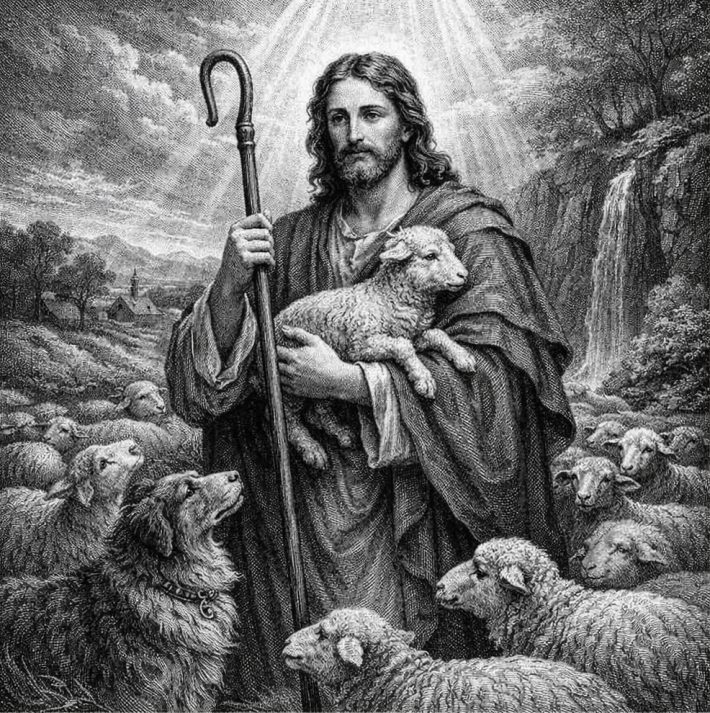
Christian Art | Jesus The Good Shepherd
Office Of Readings | Tuesday, Week 7, Ordinary Time | A Reading From The Homilies On Ecclesiastes Of Saint Gregory Of Nyssa | There Is A Time To Be Born, And A Time To Die
‘There is a time to be born, and a time to die.’
In this reading, Gregory of Nyssa returns to the text of Ecclesiastes but reads it through a distinctly spiritual and moral lens. The apparent inevitability of birth and death—presented in Scripture as part of the natural order—is reinterpreted as referring not merely to biological events but to the inner life of the soul.
Gregory begins by acknowledging the literal meaning: birth leads to death, and both lie beyond human control. In this sense, neither can be considered virtuous or blameworthy. This clarification is important, for it prevents a simplistic moral reading. Instead, Gregory shifts the discussion to what he calls a ‘timely’ birth and death—terms that require interpretation beyond the natural level.
The ‘birth’ in question is understood as salvation. Drawing implicitly on prophetic imagery, Gregory describes this birth as a process: conceived through the ‘fear of God’, brought to term through inner struggle, and finally manifested in a transformed life. The metaphor of childbirth is sustained with care. The soul undergoes labour, and the outcome depends on whether this process reaches completion. The striking claim that ‘we are in a sense our own parents’ underscores the role of human freedom. While grace initiates and sustains, the individual must cooperate through deliberate choice. Spiritual birth is thus neither automatic nor external; it is an interior act of becoming.
This leads to a further distinction: the possibility of failure. Gregory introduces the image of ‘aborting’ oneself if the ‘form of Christ’ is not realised within. The language is severe, but it serves to emphasise that incomplete formation results in a loss of what might have been. The goal is maturity—the full emergence of Christ’s likeness in the believer. Here Gregory aligns with a broader patristic theme: salvation as growth into conformity with Jesus Christ.
The second half of the passage turns to the notion of a ‘timely death’. Again, Gregory departs from the literal sense. Death is interpreted as a daily, voluntary turning away from sin. The example of Paul the Apostle is central. Paul’s assertion that he ‘dies daily’ is taken as evidence of a disciplined life in which the impulses of the body are brought under control and subordinated to a higher purpose. This is not a denial of life but a transformation of it.
The paradox of this ‘death’ is that it leads to life. Gregory emphasises that Paul’s identity is no longer centred on himself but on Christ: ‘it was not his own life he lived’. The language reflects a theology of participation, in which the believer shares in the death and life of Christ. To ‘carry death’ is to share in Christ’s self-offering; to be ‘crucified with Christ’ is to be freed from the dominance of sin. Thus, death becomes the condition for true life.
The concluding scriptural reference—’I put to death and I shall give life’—grounds this transformation in divine action. While human effort is required, the ultimate agency belongs to God. Death to sin and life in the Spirit are not self-generated achievements but gifts. The sequence is essential: what God brings to an end, he also renews. Destruction and restoration are not opposed but ordered towards redemption.
In sum, Gregory offers a reinterpretation of birth and death that relocates them within the moral and spiritual sphere. Birth signifies the emergence of a life shaped by God; death signifies the renunciation of sin. Both are ongoing processes rather than singular events. The passage presents a vision of Christian existence marked by continual becoming—dying and rising, until the fullness of life in Christ is attained.

A Reading From The Homilies On Ecclesiastes Of Saint Gregory Of Nyssa | There Is A Time To Be Born, And A Time To Die
There is a time to be born and a time to die. The fact that there is a natural link between birth and death is expressed very clearly in this text of Scripture. Death invariably follows birth and everyone who is born comes at last to the grave.
There is a time to be born and a time to die. God grant that mine may be a timely birth and a timely death! Of course no one imagines that the Speaker regards as acts of virtue our natural birth and death, in neither of which our own will plays any part. A woman does not give birth because she chooses to do so; neither does anyone die as a result of his own decision. Obviously, there is neither virtue nor vice in anything that lies beyond our control. So we must consider what is meant by a timely birth and a timely death.
It seems to me that the birth referred to here is our salvation, as is suggested by the prophet Isaiah. This reaches its full term and is not stillborn when, having been conceived by the fear of God, the soul’s own birth pangs bring it to the light of day. We are in a sense our own parents, and we give birth to ourselves by our own free choice of what is good. Such a choice becomes possible for us when we have received God into ourselves and have become children of God, children of the Most High. On the other hand, if what the Apostle calls the form of Christ has not been produced in us, we abort ourselves. The man of God must reach maturity.
Now if the meaning of a timely birth is clear, so also is the meaning of a timely death. For Saint Paul every moment was a time to die, as he proclaims in his letters: I swear by the pride I take in you that I face death every day. Elsewhere he says: For your sake we are put to death daily and we felt like men condemned to death. How Paul died daily is perfectly obvious. He never gave himself up to a sinful life but kept his body under constant control. He carried death with him, Christ’s death, wherever he went. He was always being crucified with Christ. It was not his own life he lived; it was Christ who lived in him. This surely was a timely death – a death whose end was true life.
I put to death and I shall give life, God says, teaching us that death to sin and life in the Spirit is his gift, and promising that whatever he puts to death he will restore to life again.
Christian Art With Jesus Christ
O God,
author of life and giver of new birth,
grant that we may be born in you
through the power of your grace.
Bring to fulfilment what you have begun in us,
that the form of your Son, Jesus Christ,
may be fully realised in our lives.
Teach us to die daily to sin,
to renounce all that is unworthy of you,
and to live in the freedom of your Spirit.
Strengthen us in this continual turning,
that through death we may come to life,
and through discipline to true joy.
Through Christ our Lord.
Amen
Glossary Of Christian Terms
Spiritual Birth (New Birth)
The beginning of a new life in God, often associated with conversion and salvation.
Salvation
The process by which a person is brought into right relationship with God and shares in divine life.
Fear of God
A reverent awareness of God’s majesty that leads to obedience and wisdom.
Free Will
The human capacity to choose, enabling cooperation with God’s grace.
Form of Christ
The likeness of Christ formed within the believer through grace and spiritual growth.
Maturity (Spiritual Maturity)
The state of full development in faith and virtue, reflecting the life of Christ.
Death to Sin
The renunciation of sinful ways of living, often described as a daily spiritual discipline.
Life in the Spirit
A life guided and sustained by the Holy Spirit, characterised by holiness and freedom.
Crucified with Christ
Participation in Christ’s death through self-denial and union with him (cf. Paul the Apostle).
Ascetic Discipline
Practices of self-control aimed at overcoming sin and growing in virtue.
Grace
The divine gift that enables transformation and participation in God’s life.
Conversion
The continual turning of the heart towards God and away from sin.
Resurrection (Spiritual Sense)
The new life that follows death to sin, anticipating eternal life with God.
Participation in Christ
Sharing in the life, death, and resurrection of Christ through faith and grace.
Divine Action
The work of God in bringing about transformation, beyond human effort alone.



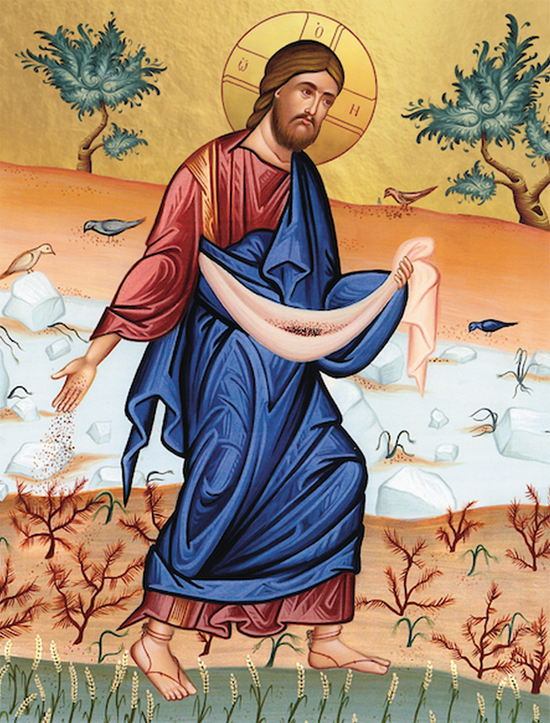
With Chapter 13 of Matthew’s Gospel begins the Discourse of the Parables, which concerns the Christian mystery of the Kingdom Of God present in life now. The parables draw us to Jesus, whose divinity is the central fact of the parables. Christ is the veiled truth of each parable. As we uncover the meaning of each of the parables we discover Jesus [ … ]
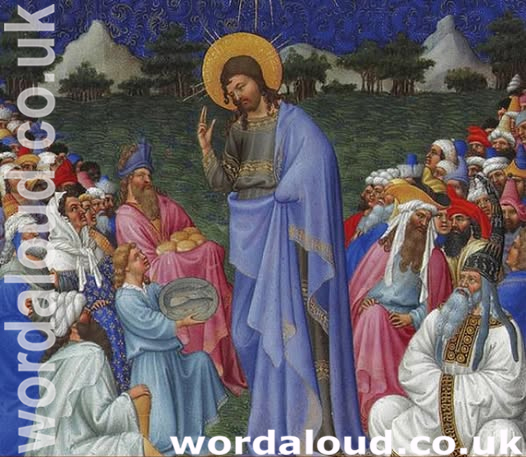
Saint Thomas Aquinas meditates on Christ’s self-revelation as the Good Shepherd (John 10:11). This image, deeply rooted in Scripture, conveys both pastoral care and sacrificial love. It recalls the Old Testament tradition of God as shepherd of Israel (e.g. Ps 23:1; Ez 34:11–16) and the prophetic promise that God would raise up faithful shepherds after His own heart (Jer 3:15) [ … ]
Psalm 121 is of the series of Psalms known as the ‘Songs of Ascents’ (Psalms 120-134). Traditionally, these psalms were sung by pilgrims ascending to Jerusalem for religious festivals. Psalm 121, in particular, has been a source of comfort, revered for its focus on God’s protection and providence [ … ]
