

Christian Art | Jesus Christ The King
Office Of Readings | Week 5, Ordinary Time, Saturday | A Reading From A Sermon Of Blessed Saint
Isaac Of Stella | The Supremacy Of Love
‘The preeminence of charity.’
This sermon by Isaac of Stella offers a sustained meditation on charity as the governing principle of Christian life. Its argument is both moral and theological, moving from practical exhortation to a more fundamental claim: that charity is not one virtue among others, but the form and fulfilment of all virtue.
The opening question sets the tone. Isaac does not begin with abstraction, but with a perceived failure within the community: a lack of concern for the well-being of others. His appeal is grounded in the teaching of Paul the Apostle, particularly the injunction to ‘bear one another’s burdens’. This scriptural reference is not incidental; it establishes charity as participation in what Paul calls ‘the law of Christ’. Isaac’s reasoning is direct: to neglect the burdens of others is not merely a moral lapse, but a failure to live according to the defining law of Christian existence.
A notable feature of the passage is its attention to weakness—physical, moral, and circumstantial. Isaac does not idealise the Christian community as one of perfected individuals. Rather, it is constituted by mutual limitation. The question he poses—why one cannot patiently endure the frailty of another—reveals a tension between expectation and reality. His answer is equally direct: the absence of charity. Charity, in this account, is not sentiment but a disciplined capacity to ‘suffer all things’ and to remain steadfast in love. The language echoes the well-known description of love in the First Epistle to the Corinthians, suggesting continuity with Pauline teaching while adapting it to a monastic and communal context.
Isaac strengthens his argument by reference to Jesus Christ. Christ’s bearing of human weakness—particularly in the Passion—is presented as the definitive model. The formulation is precise: Christ both ‘loved those he carried’ and ‘carried those he loved’. Charity is thus shown to be both affective and active. It does not remain at the level of disposition but expresses itself in concrete endurance and self-giving. In contrast, the one who exploits or attacks the weakness of another is said to follow not the law of Christ but its opposite. The starkness of this contrast serves a rhetorical purpose: it clarifies that charity is not optional but decisive.
The latter part of the sermon broadens the scope of the argument. Isaac moves from interpersonal conduct to a general principle governing all forms of Christian life. Whether one’s way of life is marked by particular observances or disciplines is secondary; what determines its value is the presence of charity. This introduces a criterion that relativises external forms without dismissing them. Practices are neither rejected nor absolutised; they are to be judged according to whether they express and sustain love of God and neighbour.
The most significant claim follows: charity is both the ‘initial principle’ and the ‘end’ of all action. This formulation places charity at the origin and goal of moral life. It is that from which actions proceed and that towards which they are directed. Such a view aligns with a broader theological tradition in which love is understood as the fulfilment of the law. The corollary is equally important: actions done ‘out of love and in accordance with love’ are, by that very fact, rightly ordered. Isaac does not deny the need for discernment, but he grounds it in a single, comprehensive measure.
The conclusion returns to dependence on God. Charity, though demanded, is not presumed to be self-generated. Without divine gift, it cannot be attained; without God, nothing can be done. This final note guards against any interpretation of the sermon as merely ethical instruction. The primacy of charity is inseparable from the primacy of grace.
In sum, Isaac presents a coherent and demanding vision. Charity is at once the law of Christ, the pattern of Christ’s own action, and the criterion by which all Christian practices are to be judged. His emphasis lies not in elaborating particular duties, but in identifying the principle that gives them coherence and meaning.

A Reading From A Sermon Of Blessed Saint Isaac Of Stella | The Supremacy Of Love
Why, brothers, are we so little concerned to seek one another’s well-being, so that where we see a greater need, we might show a greater readiness to help and carry one another’s burdens? For this is what the blessed apostle Paul urges us to do in the words: Bear one another’s burdens, and so fulfill the law of Christ; and also: Support each other in charity. For this surely is the law of Christ.
Why can I not patiently bear the weakness I see in my brother which, either out of necessity or because of physical or moral weakness, cannot be corrected? And why can I not instead generously offer him consolation, as it is written: Their children shall be carried on their shoulders and consoled upon their knees? Is it because I lack that virtue which suffers all things, is patient enough to bear all, and generous enough to love?
This is indeed the law of Christ, who truly bore our weaknesses in his passion and carried our sorrows out of pity, loving those he carried and carrying those he loved. Whoever attacks a brother in need, or plots against him in his weakness of whatever sort, surely fulfills the devil’s law and subjects himself to it. Let us then be compassionate toward one another, loving all our brothers, bearing one another’s weaknesses, yet ridding ourselves of our sins.
The more any way of life sincerely strives for the love of God and the love of our neighbor for God’s sake, the more acceptable it is to God, no matter what be its observances or external form. For charity is the reason why anything should be done or left undone, changed or left unchanged; it is the initial principle and the end to which all things should be directed. Whatever is honestly done out of love and in accordance with love can never be blameworthy. May he then deign to grant us this love, for without it we cannot please him, and without him we can do absolutely nothing, God, who lives and reigns for ever. Amen.
Christian Prayer With Jesus Christ
O God,
whose Son Jesus Christ
bore our weaknesses and carried our sorrows,
grant us the grace of true charity.
Teach us to bear one another’s burdens with patience,
to console rather than condemn,
and to seek not our own good, but the good of our neighbour.
Remove from us all hardness of heart,
and give us that love which endures all things
and fails in nothing that is pleasing to you.
May all that we do begin in love,
be guided by love,
and find its fulfilment in love.
For without you we can do nothing,
and without charity we cannot please you.
Through Christ our Lord.
Amen
Glossary Of Christian Terms
Charity (Caritas)
The theological virtue of love, by which God is loved above all things and one’s neighbour is loved for God’s sake; the highest and unifying virtue.
Law of Christ
The command to love as Christ loves, especially expressed in bearing one another’s burdens (cf. Paul the Apostle).
Grace
The free gift of God that enables human beings to live in accordance with his will and to grow in holiness.
Virtue
A stable disposition to do what is good; in Christian theology, virtues are perfected by grace and ordered towards God.
Sin
Any thought, word, or action contrary to God’s will, which damages the relationship between humanity and God.
Passion (of Christ)
The suffering and death of Jesus Christ, understood as the supreme expression of divine love.
Neighbour
Any other person, without distinction, whom one is called to love for God’s sake.
Communion
The fellowship and unity shared among believers, grounded in their common participation in Christ.
Moral Life
The lived response of a believer to God’s grace, expressed in actions shaped by faith and charity.
Commandment
A divine directive; in this context, especially the command to love God and neighbour.
Humility
The recognition of one’s dependence on God, opposed to pride and self-sufficiency.
Consolation
Spiritual or moral support offered to another, especially in times of weakness or suffering.
End (Telos)
The ultimate purpose or goal of human life, which in Christian theology is union with God in love.
Theological Virtues
Faith, hope, and charity—virtues given by God that orient the believer directly towards him.
Sanctification
The process by which a person is made holy through the work of grace, especially through growth in charity.




It may seem strange to the modern Christian that Christ should have so earnestly told his disciples to remain on high alert for his coming. Jesus does not speak of a repeat Nativity, of his coming once again being in the form of a vulnerable infant, humbled by the obscurity of the place of his birth. Nor does it seem that those of the elect who live to witness his coming might be easily deceived by the false claims of others to be the Messiah. Rather Jesus’ return is to be unmistakeable. He will come in ‘clouds of glory’. This will be an apocalypse. No one knows when this will be, but we feel it is imminent [ … ]
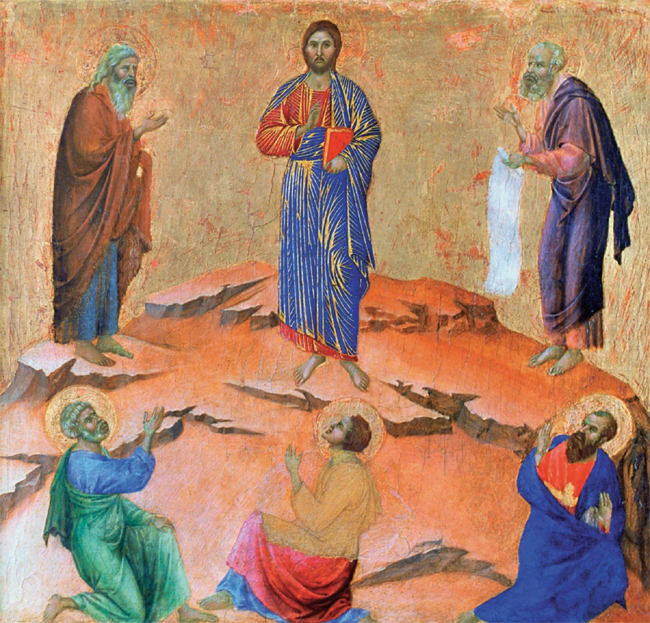
As they travel on the way to Jerusalem, Jesus throws his disciples into confusion by telling them about the suffering and death he must undergo. The disciples simply do not understand. For centuries, the Jews have awaited the coming of the Messiah, whom they envisaged as a glorious warrior king, not as one who would suffer and die the most ignominious of deaths, on a cross, of all things. A person condemned to die on a cross could not be the Messiah; rather, according to the Old Law, he had to be “cursed by God” (Deuteronomy 21: 22-23). The disciples cannot see the divine plan for our salvation, while the command for all who would be saved to ‘take up his cross and follow me’ must have seemed both strange and terrifying. To reassure his disciples, Jesus allows them to witness his glorious body through the transfiguration [ … ]

Jesus continues to preach the Sermon on the Mount with a further lesson in love and humility. Once more, Jesus teaches us about our proper relationships with God and with other people. This is a lesson against conceit and anger. It is a call to peace, such as can heal the divisions between people [ … ]
