
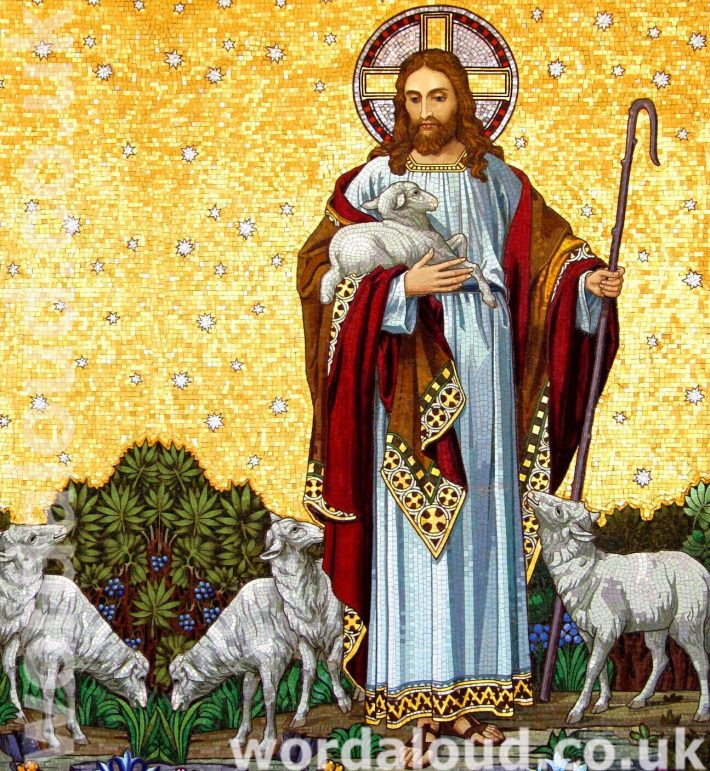
Christian Art | Jesus Christ The Good Shepherd
Office Of Readings | Week 24, Monday, Ordinary Time | From The Sermon Of Saint Augustine On The Shepherds | Shepherds Feeding Themselves
‘The shepherds who feed themselves.’
Saint Augustine reflects on Ezekiel 34, where God condemns unfaithful shepherds who exploit the flock for their own benefit while neglecting their pastoral duties. The text distinguishes between the shepherds’ concern for themselves and their neglect of the sheep. The imagery of consuming milk and wearing wool symbolises the material benefits that leaders receive from their communities. These are not illegitimate in themselves, as Paul’s writings indicate, but they become corrupt when they are detached from genuine pastoral care.
Augustine draws attention to Paul’s discussion in 1 Corinthians 9:7–14. The apostle affirms that those who preach the Gospel have the right to live from it, just as shepherds rightly drink the milk of their flock. Yet Paul chooses not to exercise this right, supporting himself through manual labour. Augustine interprets this as an expression of generosity and mercy, a decision that goes beyond obligation. Paul’s example reflects a concern for the fruitfulness of the flock: he is less interested in receiving material support than in ensuring that the people remain spiritually active and generous.
The comparison with the Good Samaritan reinforces this point. The Samaritan not only provides immediate aid but also promises to cover any additional expense. In Augustine’s reading, Paul’s ministry mirrors this readiness to go beyond what is required. The apostle sacrifices his own comfort for the sake of the Church, exemplifying the kind of pastoral care that contrasts with the neglect condemned in Ezekiel.
At the same time, Augustine is careful not to condemn those who accept the material support of the faithful. He maintains that such provision is lawful and even divinely instituted. The issue is not the reception of support, but the failure to provide care in return. True shepherds, whether or not they take the milk of the flock, are distinguished by their dedication to strengthening the weak, healing the sick, and seeking the lost.
This reflection highlights Augustine’s concern with the responsibilities of Christian leadership. Material benefits may accompany pastoral ministry, but they cannot be its purpose. The shepherd’s first duty is to nurture the flock, and his legitimacy depends on the service he renders to those entrusted to him.

From The Sermon Of Saint Augustine On The Shepherds | Shepherds Feeding Themselves
Let us consider the unflattering words of God which Scripture addresses to shepherds who feed themselves and not the sheep. You consume their milk and cover yourselves with their wool; you kill the fatlings, but my sheep you do not pasture. You have failed to strengthen what was weak, to heal what was sick, and to bind up what was injured. You did not call back what went astray, nor seek out what was lost. What was strong you have destroyed, and my sheep have been scattered because there is no shepherd.
This is spoken to the shepherds who feed themselves and not the sheep; it speaks of their concern and their neglect. What is their concern? You consume their mild and cover yourselves with their wool. And so the Apostle asks: Who plants a vineyard and does not eat from its fruit? Who pastures a flock and does not drink from the mild of the flock? Thus we learn that the milk of the flock is whatever temporal support and sustenance God’s people give to those who are placed over them. It is of this that the Apostle was speaking in the passage just quoted.
Although he chose to support himself by the labor of his own hands and not to ask for milk from the sheep, the Apostle did say that he had the right to receive the milk, for the Lord had established that they who preach the Gospel should live from the Gospel. Paul also says that other of his fellow apostles made use of this right, a right granted them, and not unlawfully usurped. But Paul went further by not taking what was rightfully his. He forgave the debt, whereas the others did not demand what was not due them. Therefore Paul went further. Perhaps his action was foreshadowed by the Good Samaritan who, when he brought the sick man to the inn, said: If you spend any more, I will repay you on my way back.
What more can I say concerning those shepherds who do not need the milk of the flock? They are more merciful; or rather, they carry out a more abundant ministry of mercy. They are able to do so, and they do it. Let them receive praise, but do not condemn the others. The Apostle himself did not seek what was given. However, he wanted the sheep to be fruitful, not sterile and unable to give milk.
Christian Prayer With Jesus
Lord Jesus, the Good Shepherd,
you came not to be served but to serve.
Strengthen all who are entrusted with the care of your flock.
Guard them from self-interest,
and give them hearts ready to heal the wounded,
to seek the lost,
and to feed your people with the bread of life.
Grant that your Church may be led by those
who follow your example of humble service,
so that all may grow strong in faith,
and rejoice in your salvation.
Amen.
Glossary Of Christian Terms
Shepherds – Biblical image for leaders of God’s people, especially priests, bishops, and pastors.
Flock – The community of believers, the people of God.
Milk of the flock – A metaphor for the material support provided by the faithful to their ministers.
Wool of the flock – Symbol of comfort or benefit drawn from the community.
Fatlings – The well-fed animals of the flock, here representing the strong or prosperous members of the community.
Good Samaritan – Parable told by Jesus (Luke 10:29–37), illustrating mercy and care for the wounded.
Inn – In Augustine’s interpretation, the Church, where the wounded are brought for healing.
Pasture – Image of spiritual nourishment and teaching given by faithful shepherds.



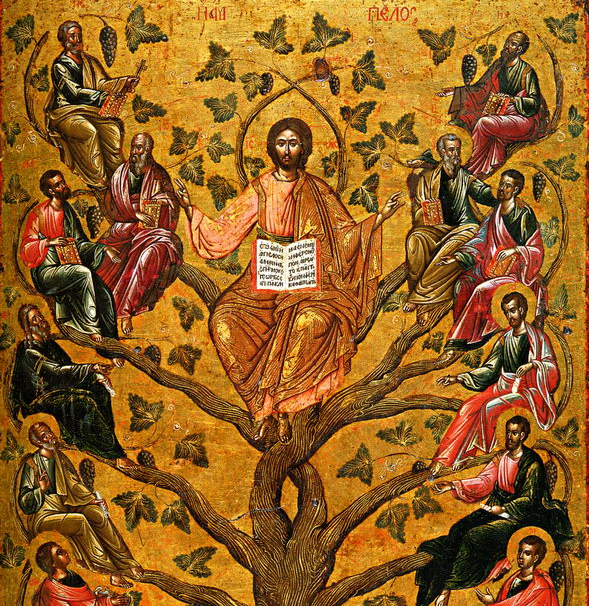
In the Old Testament, the chosen people of Israel have been compared to a vine. We may think, for example, of Isaiah’s Song of the Vineyard (Isaiah 5:1-7 – Audio Bible Verses Spoken Word), in which God complains that, despite the care he has lavished upon it, his vineyard has only produced wild grapes [ … ]

There is a beautiful lesson in love, which is to test ourselves when we are offering gifts of love to our beloved/s, and this is by imagining that we actually don’t know the person or people to whom we are giving. This way, we can make sure that what we are doing is giving, rather than making an investment and expecting something in return [ … ]
In the Bible, a miracle is an event that is not explicable by natural or scientific laws and is therefore attributed to a divine agency. Miracles are often seen as a sign of the intervention of God in the affairs of human beings. In the Old Testament, the most famous miracles are the Ten Plagues of Egypt, in which God punished the Pharaoh for refusing to release the Israelites from slavery, and the parting of the Red Sea, in which God allowed the Israelites to escape from the pursuing Egyptians by opening a path through the sea. In the New Testament, the miracles of Jesus are a central part of his ministry and are seen as evidence of his divinity. These include healings, such as the restoration of sight to the blind and the raising of the dead, and acts of nature, such as turning water into wine and walking on water. Is There A Theological Significance To Jesus’ Miracles? In the Christian tradition, the miracles performed by Jesus are seen as a manifestation of his divinity and as proof of his authority to teach and heal. Many of these miracles are described in the Gospels of the New Testament, which are the primary source of information about the life and teachings of Jesus. The purpose of the miracles, according to the Gospels, was to demonstrate Jesus’ power over natural forces and to show that he had the authority to forgive sins and offer salvation to those who believed in him. Why Did Jesus Ask To Keep His Miracles Secret? ‘Tell No One Of This.’ In the Gospels, there are a few instances where Jesus tells people not to tell others about what he has done for them. For example, in the Gospel of Matthew, after Jesus healed a man who was possessed by demons, he told the man, ‘See that you tell no one anything, but go, show yourself to the priest and offer the gift that Moses commanded, as a proof to them’ (Matthew 8:4). In this case, it seems that Jesus was concerned that the man’s testimony might not be believed or might be misunderstood, and so he asked him to keep the experience to himself for the time being. It is difficult to say for sure why Jesus might have asked someone to keep quiet about a miracle without knowing the specific context in which the request was made. However, some possible reasons that come to mind include: To avoid drawing unnecessary attention to himself. In the Gospels, Jesus often tries to avoid drawing too much attention to himself, especially from the authorities who are hostile to him. Asking someone to keep quiet about a miracle might be one way of avoiding unwanted attention and allowing Jesus to continue his ministry without interference. To allow the person who was healed to experience the transformation for themselves. In some cases, the person who was healed might have been skeptical or unsure of what had happened to them. Asking them to keep quiet about the miracle might have given them time to reflect on the experience and come to their own understanding of it without being influenced by others. To test the person’s faith. In some cases, Jesus might have asked someone to keep quiet about a miracle as a test of their faith. If they were truly grateful for what Jesus had done for them, they would be willing to follow his instructions and trust that he had a good reason for asking them to keep quiet. These are just a few possible reasons why Jesus might have asked someone to keep quiet about a miracle. It is important to remember that the Gospels are ancient texts and that we must be careful not to impose our own interpretations on them without considering the historical and cultural context in which they were written. To avoid creating conflict or division. In the Gospels, Jesus often encounters people who are skeptical or hostile to his teachings, and he sometimes tries to avoid confrontations with them. Asking someone to keep quiet about a miracle might be one way of avoiding a confrontation or a heated debate that could disrupt his ministry. To avoid being misunderstood or misrepresented. In some cases, the person who was healed might not have understood the full significance of what Jesus had done for them, and they might have tried to explain it in a way that distorted or misrepresented the truth. Asking them to keep quiet might have given Jesus time to explain things to them more fully and help them to understand the true meaning of the miracle. To avoid becoming a spectacle. In the Gospels, there are many instances where people are amazed by the miracles that Jesus performs, and they often try to make him into a kind of celebrity or showman. Asking someone to keep quiet about a miracle might have been one way of avoiding this kind of attention and keeping the focus on the message that Jesus was trying to convey. What Is The Significance Of Miracle Of The Wedding At Cana? In the Christian tradition, the wedding at Cana is significant because it is the first of the miracles performed by Jesus that is recorded in the Gospels of the New Testament. This event is described in the Gospel of John, where it is said that Jesus, along with his mother Mary and his disciples, attended a wedding in the town of Cana. At the wedding, the host ran out of wine, and Mary asked Jesus to help. In response, Jesus turned water into wine, which is seen as a miraculous act that demonstrated his power and authority. In the Gospel of John, after Mary asks Jesus to help with the wine at the wedding in Cana, he replies, “Woman, what does this have to do with me? My hour has not yet come” (John 2:4). This statement is often seen as indicating that Jesus was aware […]
