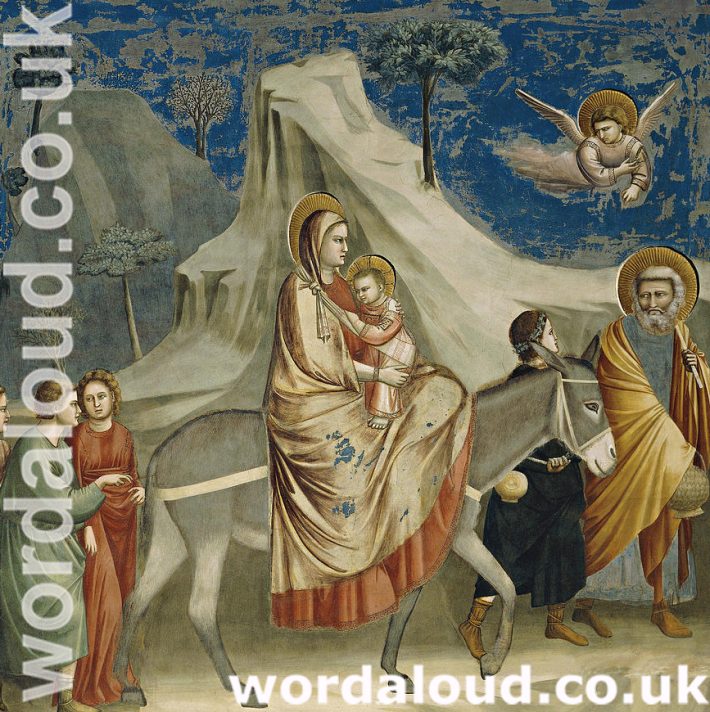
Christian Art | Jesus And Mary | The Holy Family | The Flight To Egypt
Office Of Readings | Week 28, Sunday, Ordinary Time | A Reading From The Commentary Of Saint Cyril Of Alexandria On The Book Of Haggai | My Name Is Great Among The Nations
‘My name is great among the nations.’
Saint Cyril of Alexandria interprets the prophecy of Haggai as a vision of the Church’s universal fulfilment in Christ. When he writes that ‘our Saviour came and appeared as a divine temple’, he identifies Jesus Christ himself as the true dwelling-place of God among men — the reality of which the old Jerusalem temple was only a shadow. The worship of the old covenant, confined to one people and one sanctuary, is surpassed by the worship of the new covenant, offered everywhere in spirit and in truth.
In Christ, God’s presence is no longer bound to a single building or nation. The incarnate Son is the living temple, and through him the whole world becomes a place of worship. The prophecy of Malachi — ‘My name is great among the nations, and in every place a pure offering is made to my name’ — is thus fulfilled in the Church. Everywhere the faithful now offer ‘spiritual sacrifices’ (Romans 12:1; 1 Peter 2:5): lives shaped by faith, holiness, and thanksgiving rather than by ritual blood offerings.
Cyril calls the Church ‘the final temple’, more glorious than the first, because its foundation is Christ himself, the cornerstone rejected by men but chosen by God. Those who labour for its building — whether bishops, teachers, or the faithful who live as ‘living stones’ in the household of God — receive the gift that Haggai foretold: Christ himself, the peace of all peoples. ‘Through him,’ Cyril reminds us, ‘we have access in one Spirit to the Father.’
Peace, for Cyril, is not merely the absence of conflict but the fruit of divine reconciliation. It is the inward stability that enables the soul to grow in virtue and to carry out God’s will. Drawing on Christ’s words, ‘My peace I give you,’ and on Paul’s assurance that ‘the peace of Christ, which surpasses all understanding, will guard your hearts and minds’, Cyril teaches that this peace is both the gift and the sign of the Church’s true life.
To ‘build the Church’ is therefore not only the task of pastors but of every believer. Each Christian contributes to the structure of the spiritual temple through obedience, prayer, and charity. In doing so, one’s own salvation is advanced: for the builder of the Church is himself being built up into Christ.
Cyril’s commentary presents a theology at once ecclesial and personal. The glory of the new temple lies not in stone but in souls — in a worship that is universal, intelligent, and interior; in a peace that unites all nations under Christ, the true Temple and the Prince of Peace.
A Reading From The Commentary Of Saint Cyril Of Alexandria On The Book Of Haggai | My Name Is Great Among The Nations
When our Saviour came, he appeared as a divine temple, glorious beyond any comparison, far more splendid and excellent than the older temple. He exceeded the old as much as worship in Christ and the gospels exceeds the cult of the laws, as much as truth exceeds its shadows.
Furthermore, I might point out that originally there was just one temple at Jerusalem, in which one people, the Israelites, offered their sacrifices. Since the only-begotten Son became like us, and as Scripture says, though he was Lord and God, he has shone upon us, the rest of the world has been filled with places of worship.
Now there are countless worshipers who honor the universal God with spiritual offerings and fragrant sacrifices. This surely, is what Malachi foretold, speaking, as if in the person of God: I am a great king, says the Lord; my name is honored among the nations, and everywhere there is offered to my name the fragrance of a pure sacrifice.
With justice, therefore, do we say that the final temple, the Church, will be more glorious. To those who are so solicitous for the Church and labor for its construction, Haggai declares that a gift will be made, a gift from heaven given by the Savior. That gift is Christ himself, the peace of all men: through him we have access in the one Spirit to the Father. The prophet goes on to say: I will give peace to this place and peace of soul to save all who lay the foundation to rebuild the temple. Christ too says somewhere: My peace I give you. Paul will teach how profitable this is for those who love: The peace of Christ, he says, which surpasses all understanding will keep your minds and hearts. Isaiah, the seer, made the same prayer: O Lord our God, give us peace, for you have given us everything. Once a man has been found worthy of Christ’s peace, he can easily save his soul and guide his mind to carry out exactingly the demands of virtue.
Haggai, therefore, declares that peace will be given to all who build. One builds the Church either as a teacher of the sacred mysteries, as one set over the house of God, or as one who works for his own good by setting himself forth as a living and spiritual stone in the holy temple, God’s dwelling place in the Spirit. The results of these efforts will profit such men so that each will be able to gain his own salvation without difficulty.
Christian Prayer With Jesus
Lord Jesus Christ,
true Temple of the living God,
you have made your Church the dwelling-place of the Holy Spirit
and called all nations to offer you a pure sacrifice of praise.
Grant that we, as living stones, may take our place in that holy house,
building one another up in faith and charity.
Give us the peace that you promised to your disciples —
a peace beyond understanding,
which steadies the heart and sanctifies the soul.
May your name be great among the nations,
and your glory fill the whole earth.
Amen.
Glossary Of Christian Terms
Cyril of Alexandria (c. 376–444) – Patriarch of Alexandria and one of the great Doctors of the Church. A central figure at the Council of Ephesus (431), he defended the doctrine that Mary is Theotokos (‘God-bearer’) and wrote extensively on Scripture and the incarnation.
Haggai – A prophet of the post-exilic period (6th century BC) who urged the people of Jerusalem to rebuild the temple after their return from Babylon. His message is taken by Christian writers as a figure of the Church’s spiritual renewal in Christ.
Temple – In Christian theology, the temple of Jerusalem prefigures Christ, the incarnate Word, and the Church, his mystical body. God’s presence now dwells not in a building but in Christ and in those united to him by faith and the Spirit.
Spiritual sacrifice – The offering of one’s life, praise, and good works to God in place of ritual sacrifices. See Romans 12:1 and 1 Peter 2:5.
Malachi 1:11 – A prophecy of universal worship fulfilled in the Eucharist and the worldwide Church: ‘From the rising of the sun to its setting my name is great among the nations.’
Peace of Christ – The state of reconciliation and divine harmony granted to believers through Christ’s passion, guarding both mind and heart (Philippians 4:7).
Living stones – An image from 1 Peter 2:5 describing Christians as elements of a spiritual temple built upon Christ, the cornerstone.




Psalm 146 declares importance of lifelong praise to God. The psalm opens with a compelling invitation to praise, ‘Praise ye the LORD. Praise the LORD, O my soul,’ setting a tone of devotion that is meant to last throughout one’s life. This directive is a fundamental declaration, essence of the psalmist’s message: that praise to God is an eternal commitment, deeply personal and unwavering [ … ]

Saint Gaudentius, a 4th–5th century bishop and contemporary of Saint Ambrose, offers in this homily a profound reflection on the Eucharist as the enduring inheritance Christ has left his Church. Rooted deeply in the language and symbolism of Scripture and the early Church, his words provide a moving theology of presence, sacrifice, and transformation that remains strikingly relevant to Christian thought today [ … ]
The psalm begins with a declaration, ‘Behold, how good and how pleasant it is for brethren to dwell together in unity!’ This opening line serves as a thesis statement, asserting the intrinsic value and pleasantness of communal harmony. The emphasis here is on the collective experience of togetherness, highlighting the inherent goodness found in unity among God’s people [ … ]