

Christian Art | Jesus Christ | The Holy Cross
Office Of Readings | Week 3, Wednesday, Ordinary Time | A Reading From The Sermons Of Saint Bernard On The Song Of Songs | Where Sin Abounded, Grace Superabounded
‘Where sin abounded grace has overflowed.’
In this reading concerning The Song of Songs, Saint Bernard of Clairvaux explores the relationship between human weakness and the mercy of Christ. His language is personal and contemplative, yet it expresses a clear theological conviction: the wounds of Christ are the place where fear, guilt, and insecurity are overcome.
Bernard begins by asking where a fragile and sinful person can find stability. His answer is direct: in the wounds of the Saviour. These wounds are not only signs of suffering but sources of refuge and healing. Against the pressures of the world, the weakness of the flesh, and the temptations of evil, Bernard sees Christ’s wounded body as firm ground. Even when conscience is troubled by serious sin, the memory of Christ’s sacrifice restores peace.
Bernard then addresses the despair that claims sin is beyond forgiveness. Bernard rejects this as a misunderstanding of what it means to belong to Christ. A Christian is a member of Christ’s body and therefore shares in Christ’s merits. What belongs to the head belongs, in some measure, to the members. Since Christ’s heart is rich in mercy, the believer can draw from it without fear of depletion.
Bernard develops this point through vivid imagery. The wounds in Christ’s hands, feet, and side are described as openings through which grace flows. Using biblical language, he speaks of tasting ‘honey from the rock and oil from the hardest stone’, meaning the sweetness and strength of God’s mercy found even in suffering. These wounds are not closed marks of pain but open signs of God’s goodwill.
Bernard then reflects on Christ’s inner life. The piercing of Christ’s body reveals the intentions of Christ’s heart. Through the wounds, the believer can see that God was at work in Christ, reconciling the world to himself. Christ’s suffering is not distant or mechanical; it is filled with compassion, because he has entered fully into human weakness.
The theological centre of the reading is in Bernard’s understanding of merit. He does not deny the reality of sin, but he places it within a larger reality: the abundance of God’s mercy. A person’s true worth before God does not rest on personal achievement but on God’s compassion. Because Christ is righteous and merciful, and because the believer belongs to him, that righteousness becomes the believer’s own.
The reading ends with Bernard turning praise away from himself and towards God. He will not sing of his own righteousness, but of God’s justice and mercy revealed in Christ. In this way, the reading returns to its starting point: confidence, peace, and hope are found not in the self, but in the wounded and merciful Lord.

A Reading From The Sermons Of Saint Bernard On The Song Of Songs | Where Sin Abounded, Grace Superabounded
Where can the weak find a place of firm security and peace, except in the wounds of the Saviour? Indeed, the more secure is my place there the more he can do to help me. The world rages, the flesh is heavy, and the devil lays his snares, but I do not fall, for my feet are planted on firm rock. I may have sinned gravely. My conscience would be distressed, but it would not be in turmoil, for I would recall the wounds of the Lord: he was wounded for our iniquities. What sin is there so deadly that it cannot be pardoned by the death of Christ? And so if I bear in mind this strong, effective remedy, I can never again be terrified by the malignancy of sin.
Surely the man who said: My sin is too great to merit pardon, was wrong. He was speaking as though he were not a member of Christ and had no share in his merits, so that he could claim them as his own, as a member of the body can claim what belongs to the head. As for me, what can I appropriate that I lack from the heart of the Lord who abounds in mercy? They pierced his hands and feet and opened his side with a spear. Through the openings of these wounds I may drink honey from the rock and oil from the hardest stone: that is, I may taste and see that the Lord is sweet.
He was thinking thoughts of peace, and I did not know it, for who knows the mind of the Lord, or who has been his counsellor? But the piercing nail has become a key to unlock the door, that I may see the good will of the Lord. And what can I see as I look through the hole? Both the nail and the wound cry out that God was in Christ reconciling the world to himself. The sword pierced his soul and came close to his heart, so that he might be able to feel compassion for me in my weaknesses.
Through these sacred wounds we can see the secret of his heart, the great mystery of love, the sincerity of his mercy with which he visited us from on high.
Where have your love, your mercy, your compassion shone out more luminously that in your wounds, sweet, gentle Lord of mercy? More mercy than this no one has than that he lay down his life for those who are doomed to death.
My merit comes from his mercy; for I do not lack merit so long as he does not lack pity. And if the Lord’s mercies are many, then I am rich in merits. For even if I am aware of many sins, what does it matter? Where sin abounded grace has overflowed. And if the Lord’s mercies are from all ages for ever, I too will sing of the mercies of the Lord forever. Will I not sing of my own righteousness? No, Lord, I shall be mindful only of your justice. Yet that too is my own; for God has made you my righteousness.
Christian Prayer With Jesus Christ
Lord Jesus Christ,
in your wounded body
you have made a refuge for the weak
and a healing for the broken.
When our conscience is troubled,
bring us back to the memory of your mercy.
When we fear our sins are too great,
remind us of the love
that led you to lay down your life.
Open to us the secret of your heart,
that we may see your compassion
and trust in your forgiveness.
Let your grace be stronger than our failings
and your mercy greater than our fear.
May we never rely on ourselves,
but always rest in what you have done for us,
who live and reign for ever.
Amen
Glossary Of Christian Terms
Wounds of the Saviour | The injuries Christ received in his passion and crucifixion
Mercy | God’s compassionate forgiveness and care
Conscience | The inner awareness of right and wrong
Merit | What counts before God in judgement
Member of Christ | One who belongs to Christ as part of his body, the Church
Reconciliation | The restoration of the relationship between God and humanity
Grace | God’s free and active help given to sinners
Compassion | Christ’s sharing in human suffering
Righteousness | Right standing before God
Justice of God | God’s faithful and saving action
Body of Christ | The Church united to Christ
Song of Songs | A book of Scripture interpreted here as describing the love between Christ and the soul



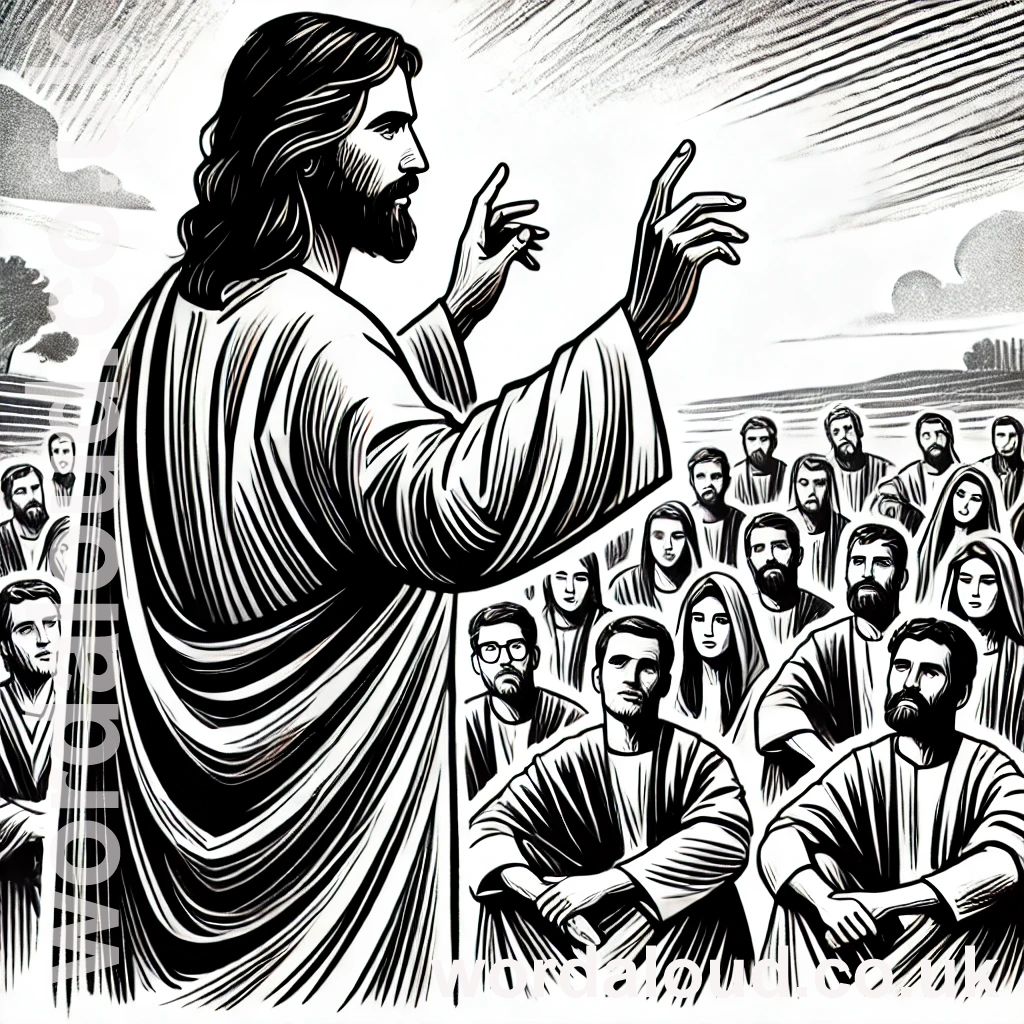
The world into which Jesus was born was not just one of imperial power—it was a world of cruelty, excess, and moral depravity beyond modern comprehension. The Caesars were not merely rulers; they were demigods in their own eyes, demanding worship, reveling in debauchery, and enforcing their will through brutality. Rome was a world where the strong crushed the weak, where spectacles of torture and death entertained the masses, and where mercy was seen as weakness [ … ]

Mark’s Gospel tells us that, astonishingly quickly, Jesus has become the focus of a vast popular movement. He is preaching in Galilee, and his listeners have come all the way from Judea, from Jerusalem, and from Jordan, Tyre and Sidon. It is an international crowd, and these really are great distances. Jerusalem is over 100 kilometres from Lake Galilee, at its nearest point and as the crow flies. That’s a good few days on foot, and no package tour pilgrimage [ … ]

Saint Augustine’s reflection presents a profound theological anthropology: that the human soul, redeemed and graced, is called to live out two complementary forms of life—the active and the contemplative. These are not merely individual spiritual preferences but dimensions of the Church’s total life and mission [ … ]