
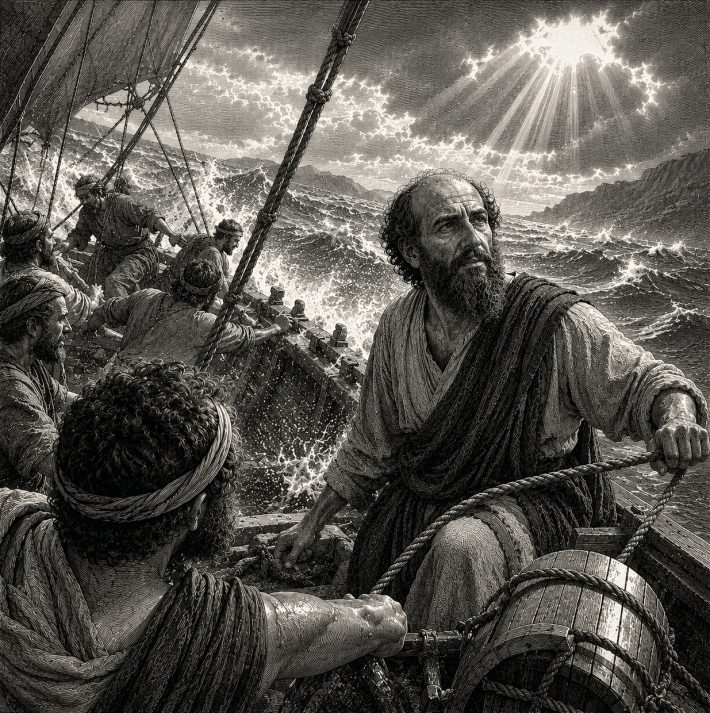
Christian Art | Saint Paul
Saint Paul’s Epistle To The Romans | Audio | Full Text
14 For we know that the law is spiritual: but I am carnal, sold under sin.
15 For that which I do I allow not: for what I would, that do I not; but what I hate, that do I.
16 If then I do that which I would not, I consent unto the law that it is good.
17 Now then it is no more I that do it, but sin that dwelleth in me.
18 For I know that in me (that is, in my flesh,) dwelleth no good thing: for to will is present with me; but how to perform that which is good I find not.
19 For the good that I would I do not: but the evil which I would not, that I do.
20 Now if I do that I would not, it is no more I that do it, but sin that dwelleth in me.
21 I find then a law, that, when I would do good, evil is present with me.
22 For I delight in the law of God after the inward man:
23 But I see another law in my members, warring against the law of my mind, and bringing me into captivity to the law of sin which is in my members.
24 O wretched man that I am! who shall deliver me from the body of this death?
25 I thank God through Jesus Christ our Lord. So then with the mind I myself serve the law of God; but with the flesh the law of sin.
*
The Epistle To The Romans combines the occasional character of an early Christian letter with extended theological argument concerning law, the Law, covenant, sin, salvation, and the relation between Jews and Gentiles. Written probably in the late 50s AD, and during Paul’s stay in Corinth, the letter was addressed to Christian communities in Rome which Paul had not himself founded. Unlike several of his other letters, Romans was not written primarily in response to a specific local crisis already familiar to him. Instead, it functions partly as an introduction to his teaching and partly as an attempt to address tensions emerging within mixed Jewish / Gentile communities in the imperial capital.
The historical setting of the letter helps toward understanding both its argument and its tone. Rome in the mid-first century AD was the political centre of the Mediterranean world – symbolic centre of imperial authority. Christian communities appear to have consisted of both Jewish and Gentile believers, and relations between these groups had likely been affected by the expulsion of Jews from Rome under the emperor Claudius during the late 40s AD and their subsequent return after Claudius’ death. Questions concerning a continuing significance of Jewish law and identity carried immediate practical implications. Paul’s argument throughout Romans is shaped by the problem of how Gentiles may participate in the promises associated with Israel without erasing theological significance of Israel itself.
The letter emerges from a wider intellectual environment shaped by Hellenistic culture and Roman imperial order. Paul was a diaspora Jew writing in Greek within cities formed by Greek education, rhetoric, and patterns of urban life. His arguments employ forms of reasoning familiar within the eastern Mediterranean world, including rhetorical questioning, scriptural interpretation, and forms of moral argument resembling aspects of Hellenistic philosophical discourse. At the same time, Paul’s conceptual framework remains deeply rooted in Jewish scripture and Jewish expectations concerning covenant, law, and divine redemption. Romans should not be understood as a rejection of Judaism in favour of a new religious system. Rather, it reflects an internal dispute concerning the meaning of Israel’s covenant and the status of Gentiles within unfolding purposes of God.
A central problem underlying the letter concerns universality. Paul attempts to explain how the God of Israel can also be understood as the God of Gentiles without dissolving the particular historical significance of Israel’s covenantal identity. This problem shapes the structure of the letter from beginning to end. Paul develops an account of universal human sinfulness, argues that both Jews and Gentiles stand equally under divine judgement, and presents faith rather than ethnic distinction or observance of the Mosaic Law as basis for inclusion within the covenantal community. Yet he simultaneously insists upon the continuing significance of Israel within salvation history and rejects the conclusion that Israel has simply been replaced by a Gentile church.
Conceptual tensions run throughout Romans. Paul argues that the Law is holy while also insisting that the Law cannot liberate humanity from sin. He presents salvation as universally available while maintaining an historical framework grounded in Israel’s covenant. He emphasises divine grace while also demanding ethical transformation. He speaks of freedom while describing humanity as enslaved to powers such as sin and death. These tensions are not incidental to the letter but help to form its argumentative structure.
Romans develops a distinctive account of human existence. Paul describes humanity collectively as existing within conditions of alienation, corruption and mortality that cannot be resolved through legal obedience alone. Sin increasingly appears not simply as individual wrongdoing but as a condition or power shaping human life at both personal and collective levels. The language Paul employs concerning flesh, law, desire and inward division can be compared with themes found within Hellenistic moral philosophy, though Paul’s argument remains fundamentally shaped by Jewish apocalyptic and covenantal traditions. Humanity, in Paul’s account, exists within a fractured condition requiring transformation rather than mere moral instruction.
Romans should not be reduced to abstract theological speculation. The letter addresses the practical formation of communities composed of socially and ethnically diverse groups within the Roman Empire. Paul’s theological arguments ultimately serve communal purposes. Questions concerning food laws, ritual observance, ethnic identity and mutual obligation recur throughout the letter because theology and social life remain inseparable within Paul’s thought. The universal scope of salvation requires the construction of forms of communal life capable of accommodating both Jewish and Gentile believers without eliminating difference entirely.
Paul Within Judaism, Hellenism, And Empire
An interpretation of the letter rests in part upon how Paul is situated historically. Earlier Christian interpretation often presented Paul as a figure who rejected Judaism in favour of a new religion centred upon faith rather than law. Paul identified himself as a Jew and understood his arguments concerning Christ within the context of Israel’s scriptures, covenantal history, and apocalyptic expectations. Romans emerges not from a rejection of Judaism but from a dispute concerning an interpretation of Jewish covenantal theology under new historical conditions.
Paul belonged to the world of diaspora Judaism. Jewish communities had existed throughout the eastern Mediterranean since the Hellenistic period, particularly in cities shaped by Greek language and administration. These communities varied considerably in practice and outlook, yet many participated extensively in Greek-speaking urban culture while maintaining distinctive forms of religious identity organised around scripture, synagogue life, dietary practice, and covenantal tradition. Paul himself wrote in Greek, travelled through Hellenistic cities, and addressed communities composed partly or largely of Gentiles. His letters assume familiarity with forms of urban association characteristic of the Roman East.
Paul’s conceptual framework remains deeply shaped by Jewish thought. He interprets history through categories derived from Jewish apocalyptic expectation: creation, covenant, sin, judgement, redemption, and the coming transformation of the world. Scripture functions throughout Romans as authoritative evidence. Paul repeatedly cites the Law, the Prophets and the Psalms in order to construct his arguments. Figures such as Abraham and Adam are treated not merely as historical individuals but as representatives within a wider theological narrative concerning humanity and God’s purposes in history.
Paul’s understanding of the Law ought to be situated within this Jewish context. The Mosaic Law was not simply a legal code but determinant of Israel’s covenantal identity. Circumcision, dietary practice and ritual observance distinguished Jews from surrounding populations and marked participation within the covenant. The question confronting Paul was therefore not whether morality mattered, but whether Gentiles could belong to the covenantal community without adopting full obligations of Jewish law. Romans repeatedly returns to this issue because it had direct implications for the composition of early Christian communities and for the interpretation of God’s promises to Israel.
There is diversity of Jewish thought through the Second Temple period. Judaism in the first century was not intellectually uniform. Pharisees, Sadducees, apocalyptic groups, diaspora intellectuals and other identities disagreed concerning law, resurrection, purity, temple practice, and divine intervention in history. Paul’s arguments can be understood as emerging from disputes internal to Judaism rather than from a simple opposition between ‘Judaism’ and ‘Christianity’. His insistence that Gentiles may enter the covenant through faith in Christ without full Torah observance represents one position within broader first-century debates concerning the future of Israel and inclusion of the nations.
Although Paul’s theology remains rooted in Jewish traditions, Romans also reflects the intellectual environment of the Hellenistic world. As said, Paul writes in Greek and employs argumentative techniques associated with Greco-Roman rhetoric. Romans frequently adopts a dialogical style resembling diatribe, in which an imagined interlocutor raises objections that Paul then answers. Questions such as ‘What then shall we say?’ and the corollary ‘By no means’ structure the argument of the letter and suggest familiarity with forms of philosophical and rhetorical debate common within the eastern Mediterranean.
Key themes in Romans parallel concerns found within Hellenistic moral philosophy. Discussions of conscience, inward conflict, desire, self-mastery, and the relation between reason and conduct appear throughout Greek philosophical traditions, perhaps most notably Stoicism, a philosophy that teaches that the good life is found not in wealth, pleasure or success, but in the cultivation of wisdom and virtue. Paul’s description in Romans 7 of divided intention – ‘I do not do what I want’ – resembles wider Mediterranean discussions concerning moral incapacity and the failure of rational knowledge to produce ethical transformation. Yet these similarities should not be overstated. Paul does not simply reproduce Stoic or Platonic moral psychology. His account of sin remains connected to Jewish apocalyptic conceptions of cosmic disorder and divine redemption.
A Hellenistic environment shapes the conceptual and linguistic world within which Paul operated. Greek was the common language of administration, trade and intellectual exchange across much of the eastern Roman Empire. Jewish scripture circulated widely in Greek translation through the Septuagint. Paul therefore addressed audiences already accustomed to cultural and intellectual mixture. His arguments concerning universal humanity, moral accountability, and the relation between divine law and human conduct emerged within cities where Jews and Gentiles lived in sustained proximity under Roman rule.
The imperial context of Romans is equally significant. As said, the letter was addressed to communities living in the capital of the Roman Empire, a political system that presented itself as universal in scope and authority. Roman rule claimed to establish peace, order and legal stability across diverse peoples and territories. Imperial ideology frequently employed religious language, associating the emperor and the empire with divine favour and universal harmony.
Paul’s language in Romans operates on a universal scale. He speaks of all humanity under sin, of one God governing Jews and Gentiles alike, and of salvation extending beyond ethnic distinctions. Although Romans does not contain direct political attacks upon Rome, the imperial setting remains visible throughout the letter. Paul’s proclamation of one Lord and one universal community exists within a world already ordered by imperial claims concerning sovereignty and universality.
This political context may help explain some of those tensions within the letter. Romans 13, for example, instructs believers to submit to governing authorities because authority derives from God. Yet elsewhere Paul describes believers as belonging to a different order shaped by the Spirit rather than by the power-structures of the present age. The relationship between divine sovereignty and imperial power therefore remains unresolved and complex. Paul neither advocates political revolt nor simply collapses Christian identity into Roman civic order.
The mixed composition of the Roman Christian communities intensified these tensions. Jewish and Gentile believers brought different assumptions concerning Law, food practices, ritual observance, and communal identity. Paul’s theological arguments in Romans cannot be separated from the practical challenge of maintaining unity within socially and ethnically diverse assemblies. Theology and communal organisation remain closely connected throughout the letter.
Romans lives at an intersection of overlapping worlds. It is a Jewish text shaped by scriptural interpretation and covenantal reasoning. It is also a Hellenistic text written in Greek and employing forms of argument familiar within the eastern Mediterranean. At the same time, it is a Roman text addressed to communities living under imperial authority at the centre of the empire. Paul’s account of law, sin, salvation and humanity emerges from the interaction of these contexts rather than from any one of them in isolation.
Universal Sin And The Human Condition | Romans 1–3
‘For the wrath of God is revealed from heaven against all ungodliness and unrighteousness of men, who hold the truth in unrighteousness;’ (Romans 1: 18)
The opening argument of the letter establishes anthropological and theological foundations upon which the remainder depends. Before discussing covenant, law, salvation, or the relation between Jews and Gentiles, Paul develops an account of humanity as universally subject to sin and therefore universally in need of redemption. This argument unfolds across Romans 1–3. Paul begins with Gentile humanity, turns toward Jews who rely upon the Law, and concludes that no group possesses moral or covenantal exemption from divine judgement.
Paul’s aim is not merely to condemn particular forms of behaviour but to establish a universal condition affecting humanity collectively. Distinction between Jew and Gentile remains historically and theologically significant throughout, yet Romans 1–3 insists that both stand under the same condition of alienation from God. This argument creates the basis for Paul’s later claim that salvation may also extend universally.
Romans 1 begins with consideration of Gentile idolatry. Paul argues that knowledge of God is available through creation itself:
‘For the invisible things of him from the creation of the world are clearly seen, being understood by the things that are made, even his eternal power and Godhead; so that they are without excuse.’ (Romans 1: 20)
Humanity possesses access to a form of natural revelation. The created order reflects divine reality sufficiently to make ignorance inexcusable. Paul’s argument resembles themes found within Hellenistic Jewish thought and, to some extent, Stoic conceptions of rational order within nature. The world bears evidence of intelligibility and structure, yet humanity has failed to recognise its proper relation to the creator.
A central problem in Romans 1 is not atheism but idolatry. Humanity has ‘exchanged the glory of the immortal God’ for created things. Paul describes this exchange as a distortion of proper order: worship directed toward creation rather than creator produces corresponding disorder within human conduct. The catalogue of behaviours that follows should therefore be understood within a wider theological framework. Moral disintegration results from metaphysical disorientation.
This argument reflects traditional Jewish critiques of paganism, particularly those found in wisdom literature and Hellenistic Jewish apologetic writing. Idolatry appears not simply as religious error but as a failure of perception and judgement. Human beings misunderstand reality itself, and this misunderstanding shapes social and moral life collectively.
Paul’s language increasingly moves beyond isolated acts toward something more structural. Humanity is described as having been ‘given over’ to distorted desire and futile thinking. Sin appears not merely as individual wrongdoing but as a condition affecting human existence more broadly. The problem is not simply that human beings commit sins, but that humanity exists within a state of alienation from the proper relation between creator and creation.
The argumentative force of Romans 1 depends partly upon the expectations of Paul’s audience. Jewish listeners would likely recognise familiar criticisms of Gentile society and idolatrous culture. Yet Romans 2 introduces a decisive reversal. Paul turns toward those who judge others while committing similar offences themselves:
‘Therefore thou art inexcusable, O man, whosoever thou art that judgest: for wherein thou judgest another, thou condemnest thyself; for thou that judgest doest the same things.’ (Romans 2:1)
The target becomes Jews who rely upon possession of the Law as a basis for confidence before God. Paul does not deny the value of the Law. On the contrary, he repeatedly affirms its holiness and divine origin. The problem lies instead in the assumption that possession of Torah guarantees righteousness independently of conduct.
This thought is central to the structure of Romans. Paul dismantles any claim to covenantal privilege understood as exemption from judgement. Gentiles cannot claim ignorance, yet Jews cannot claim immunity through possession of the Law alone. Divine judgement applies universally because moral accountability applies universally.
Paul therefore introduces a distinction between possessing the Law and fulfilling it. Circumcision and covenantal identity retain significance, yet external observance without obedience becomes insufficient. Romans 2 repeatedly emphasises inward reality over outward status:
‘But he is a Jew, which is one inwardly; and circumcision is that of the heart, in the spirit, and not in the letter; whose praise is not of men, but of God.’ (Romans 2:29)
This argument should not be interpreted as a rejection of Judaism or Jewish law in general. Paul remains engaged in internal Jewish debates concerning covenant and obedience. Prophetic and apocalyptic Jewish traditions had long critiqued purely external observance detached from inward transformation. Paul radicalises this critique by extending it universally and by relating it directly to inclusion of Gentiles within the covenantal framework.
Romans 3 brings this aspect of an overall argument to its conclusion. Paul assembles a sequence of scriptural quotations in order to demonstrate universality of sin:
‘As it is written, There is none righteous, no, not one.’ (Romans 3:10)
The cumulative effect is to remove all grounds for moral distinction before God. Jews and Gentiles alike stand under the power of sin. The Law reveals sin but does not free humanity from it:
‘Therefore by the deeds of the law there shall no flesh be justified in his sight: for by the law is the knowledge of sin.’ (Romans 3:20)
This marks change in Paul’s understanding of the Law. The Law remains good and authoritative, yet its function becomes diagnostic rather than transformative. It reveals human failure without overcoming the underlying condition producing that failure.
The concept of the ‘righteousness of God’ becomes central at this point in the argument. The phrase carries layers of meaning simultaneously: God’s righteousness; God’s covenantal faithfulness; and the means through which human beings are brought into right relation with God.
Paul argues that righteousness has now been disclosed apart from the Law, though still ‘attested by the law and the prophets’. Continuity with Jewish scripture remains important. Paul does not present the gospel as a rejection of Israel’s traditions but as fulfilment or unveiling of purposes already present within them.
Faith becomes basis for justification because faith allows the inclusion of Gentiles without requiring full incorporation into Jewish legal identity. This point is theological and communal simultaneously. If righteousness depended exclusively upon Torah observance, Gentiles would remain outside the covenant unless they became Jews fully. Paul instead argues for a form of inclusion grounded in faith rather than ethnic distinction.
Later history of interpretation has treated Romans 3 through categories of the Protestant Reformation, particularly debates concerning justification by faith versus works. While these debates remain historically important, they can obscure the first-century context of Paul’s argument. Paul is not addressing late medieval questions concerning merit or individual salvation. He is attempting to explain how Jews and Gentiles may stand together within a single covenantal framework under one God.
This universalism of Romans 1–3 emerges from Paul’s account of universal human failure. Humanity collectively exists under the power of sin, and neither possession of the Law nor Gentile ignorance provides exemption. This argument establishes the conceptual basis for the remainder of the letter. Once all humanity stands equally under judgement, salvation may also become universally available.
Abraham, Covenant, And Universal Inclusion | Romans 4–5
Having argued in Romans 1–3 that both Jews and Gentiles stand under the power of sin, Paul turns in Romans 4–5 toward the question of covenantal inclusion. If righteousness is not secured through possession of the Mosaic Law alone, how are the promises associated with Israel to be understood? Paul addresses this problem through the figure of Abraham, whose significance lies partly in his chronological position within the biblical narrative. Abraham precedes both Sinai and the giving of the Law. For Paul, this allows the covenant to be interpreted in ways not limited exclusively to Torah observance or ethnic descent.
Romans 4 therefore functions as a scriptural argument concerning the basis of belonging within the covenantal community. Paul cites Genesis 15: 6:
‘For what saith the scripture? Abraham believed God, and it was counted unto him for righteousness.’ (Romans 4:3)
The emphasis falls upon belief or trust prior to circumcision and prior to Mosaic Law. Abraham becomes significant not because he represents legal observance, but because he demonstrates a form of covenantal relationship grounded in faith.
Paul’s argument depends upon chronology. Circumcision occurs after Abraham has already been reckoned righteous. This sequence allows Paul to claim that Abraham functions as the ancestor not only of circumcised Jews but also of Gentiles who share the same form of faith:
‘And he received the sign of circumcision, a seal of the righteousness of the faith which he had yet being uncircumcised: that he might be the father of all them that believe, though they be not circumcised; that righteousness might be imputed unto them also.’ (Romans 4:11)
The covenant may therefore be extended beyond ethnic Israel without being detached from Israel’s scriptural history. Paul does not reject Abrahamic covenant; rather, he reinterprets its scope. Gentile inclusion becomes possible because Abraham precedes the distinctions later associated with Torah observance.
This argument addresses practical communal problems within early Christianity. Mixed Jewish / Gentile communities required some account of shared identity that did not depend entirely upon full adoption of Jewish law. Paul’s interpretation of Abraham provides such a framework. Faith becomes a principle of inclusion because it allows continuity with Israel’s covenant while opening participation to non-Jews.
Paul insists that the promise to Abraham possesses universal dimensions already implicit within scripture itself. Abraham is associated not merely with one people but with ‘many nations’. Paul reads the patriarchal narratives through a wider theological lens in which inclusion of Gentiles forms part of the unfolding purposes of God rather than a later departure from them.
The argument also reflects Paul’s understanding of divine initiative. Abraham’s faith concerns trust in God’s capacity to bring life where life appears impossible. Themes of barrenness, old age and promise become central because they anticipate Paul’s later discussion of resurrection and new creation. Faith is directed toward divine action rather than human achievement.
Romans 5 extends the thought through covenantal history to universal anthropology. This progression in thought from Abraham to Adam broadens the scope considerably. Whereas Abraham concerns the inclusion of nations within covenant, Adam concerns humanity as a whole.
Paul constructs a typological comparison between Adam and Christ. Adam is associated with sin, death and condemnation; Christ with righteousness, life and reconciliation. The comparison depends upon collective representation. Adam is not treated merely as an individual but as a figure through which a condition affecting humanity universally has entered the world:
‘Wherefore, as by one man sin entered into the world, and death by sin; and so death passed upon all men, for that all have sinned.’ (Romans 5:12)
Humanity shares collectively in conditions of mortality and alienation associated with Adam. Death reigns universally because sin affects humanity universally.
Paul’s comparison of Adam and Christ establishes a parallel structure: Adam with sin and death; Christ with righteousness and life.
The logic is representative and participatory rather than merely individual. Human beings exist within broader conditions or solidarities shaping their relation to God and to one another.
This intensifies Paul’s apocalyptic framework. Humanity appears divided between opposing dominions or powers: sin and death on one side; grace and life on the other.
Such discourse increasingly moves beyond legal categories. Sin becomes active within history rather than simply a record of individual offences. Death appears almost as a ruling force exercising dominion over humanity.
This relation between law and sin is complex in Romans 5. Paul states that ‘law came in’ so that trespass might increase. This does not mean that the Law is evil. Rather, the Law exposes and intensifies awareness of transgression within a world already marked by sin. A paradox emerges repeatedly throughout Romans: the Law is holy, yet incapable of overcoming the conditions it reveals.
Grace exceeds the reach of sin:
‘Moreover the law entered, that the offence might abound. But where sin abounded, grace did much more abound.’ (Romans 5:20)
Universalism established earlier in relation to sin now becomes the basis for a universal possibility of reconciliation. Paul’s argument consistently proceeds through parallelism: all stand under sin; therefore salvation may extend to all.
Yet this universalism remains historically structured. Salvation still emerges through Israel’s covenantal history, through Abraham, and through the figure of Christ understood within Jewish messianic expectation. Paul does not replace Israel’s history with abstract philosophy or detached spirituality. Instead, he universalises covenantal categories rooted in Jewish scripture.
Romans 4–5 perform several related functions within the structure of the letter: they explain how Gentiles may belong within the covenantal community without full Torah observance; they reinterpret Abraham as the ancestor of a trans-ethnic people defined through faith; they expand Paul’s account of sin and redemption from covenantal history to universal humanity; and they establish the representative parallel between Adam and Christ that shapes the remainder of Paul’s anthropology.
Such progressing from Abraham to Adam widens the scale of Paul’s thought. The argument no longer concerns Jews and Gentiles per se. Humanity itself becomes the subject of redemption history. Questions concerning covenant, law, and inclusion now lead directly into Paul’s broader account of human division, moral incapacity, and liberation in Romans 6–8.
Law, Flesh, And Human Division | Romans 6–8
Romans 6–8 might be understood as the conceptual centre of the letter. Earlier chapters established universality of sin and extension of covenantal inclusion beyond ethnic Israel. Paul now turns to the problem of human transformation. If humanity exists under the power of sin, how is liberation possible? What is a relation between divine grace, moral action, and the Mosaic Law? Why does knowledge of what is good fail to produce obedience?
The chapters develop Paul’s sustained account of human division and moral incapacity. Sin increasingly appears not as individual wrongdoing but as a power operating within human existence. The language Paul employs concerning flesh, law, death, desire and Spirit suggests conditions shaping human life collectively rather than isolated moral failures alone.
Romans 6 addresses an objection: if grace increases where sin increases, does this imply that sin itself becomes irrelevant?
‘What shall we say then? Shall we continue in sin, that grace may abound?’ (Romans 6:1)
Paul rejects this conclusion immediately. Participation in Christ means participation in death and resurrection symbolically enacted through baptism. Believers have died to sin and entered a new form of existence. The thought here is participatory rather than merely juridical. Salvation does not consist solely in acquittal from guilt but in transition from one condition of existence to another.
Paul describes humanity in terms of opposing forms of servitude: slavery to sin; or slavery to righteousness.
We may find this language of slavery unsettling, yet within Paul’s argument it expresses absence of autonomous moral neutrality. Human beings always exist under some determining power or orientation. Freedom is not conceived primarily as unrestricted individual choice but as liberation from one form of domination into another mode of life ordered toward God.
Sin in Romans 6 possesses an active and quasi-political character. It ‘reigns’, ‘rules’, and enslaves. Death similarly appears as an operative power rather than merely biological fact. Paul’s anthropology therefore becomes increasingly apocalyptic in structure. Humanity exists within competing dominions: sin and death; or Spirit and life.
The Mosaic Law enters this framework ambiguously. Paul insists repeatedly that the Law itself is good, holy and spiritual. Yet the Law does not liberate humanity from sin. On the contrary, sin appears to exploit the Law itself:
‘But sin, taking occasion by the commandment, wrought in me all manner of concupiscence. For without the law sin was dead.’ (Romans 7:8)
This paradox is a problem in Romans. Why does good law fail to produce righteousness?
Paul’s answer depends partly upon his understanding of flesh. The term ‘flesh’ in Romans does not simply mean physical embodiment. Nor does it correspond precisely to later philosophical distinctions between body and soul. Flesh refers more broadly to humanity considered within its present mortal and corrupted condition – humanity subject to weakness, desire, and death.
The Law confronts flesh with divine command, yet command alone cannot transform underlying condition of human existence. Indeed, prohibition may intensify the very desires it forbids. Paul therefore presents sin and law in a complex relation: the Law reveals sin; defines transgression; exposes human incapacity; yet cannot overcome the power of sin itself.
This argument reflects discussion concerning moral weakness and divided intention. Greek philosophical traditions had long considered why human beings fail to act according to rational knowledge. Stoic philosophers emphasised a need to align reason and conduct through disciplined self-mastery. Paul shares some of this concern with inward division, yet his explanation differs significantly. The problem is not merely inadequate rational discipline but humanity’s subjection to powers exceeding ordinary moral effort.
Romans 7 develops this theme:
‘For the good that I would I do not: but the evil which I would not, that I do.’ (Romans 7:19)
Interpretation of this passage might vary considerably. Some have read it autobiographically as Paul’s account of personal moral struggle. Others have read a representative speech describing humanity under the Law more generally. The latter interpretation may fit more closely with the structure of Romans as a whole. Paul is describing divided human existence under conditions where moral knowledge exists without corresponding liberation from sin.
The passage is marked by fragmentation: desire opposed to action; mind opposed to flesh; intention opposed to conduct.
The self appears internally divided. Human beings recognise what is good yet remain unable consistently to realise it. The Law therefore produces awareness of moral obligation without supplying power required for fulfilment.
This analysis moves Romans beyond simple legal categories toward a broader anthropology of incapacity and inward conflict. Sin operates not only externally but internally, shaping desire and conduct at the level of self itself.
Romans 8 responds to this condition through the language of Spirit. The chapter marks a shift from diagnosis toward transformation. Opposition between flesh and Spirit now structures Paul’s understanding of human existence. Life ‘according to the flesh’ remains subject to death and incapacity; life ‘according to the Spirit’ participates in liberation and renewal.
The Spirit functions in several ways simultaneously within the chapter: as the presence of divine life; as liberation from condemnation; as adoption into a new communal identity; and as anticipation of future redemption.
Paul’s language concerning adoption is particularly significant because it redefines covenantal belonging in trans-ethnic terms. Believers become ‘children of God’ not through ethnic descent but through participation in the Spirit. Yet this universalism does not erase Israel’s historical role; rather, it extends covenantal talk into a broader framework.
Romans 8 also expands salvation beyond individual transformation toward cosmic renewal. Creation itself is described as awaiting liberation:
‘For we know that the whole creation groaneth and travaileth in pain together until now.’ (Romans 8:22)
Effects of sin extend beyond humanity. Mortality, corruption and disorder affect creation collectively. Redemption correspondingly acquires cosmic dimensions. Paul’s theology in this chapter is not concerned solely with private spiritual experience but with restoration of creation.
This apocalyptic horizon situates moral and spiritual transformation within history and cosmos rather than within inward psychology alone. Human beings await redemption together with creation itself. Present existence remains marked by suffering, weakness, and incompletion, yet oriented toward future transformation.
Romans 8 concludes with a sequence of rhetorical affirmations concerning divine faithfulness and persistence of God’s purposes despite suffering and opposition. The emphasis falls not upon human achievement but upon divine initiative. Salvation remains grounded in God’s action rather than human capacity for legal or moral perfection.
Across Romans 6–8, Paul develops an account of humanity marked by interconnected themes: participation in broader powers or conditions; incapacity of Law alone to transform human conduct; inward division and moral fragmentation; liberation through Spirit; and future renewal extending to creation in entirety.
The chapters deepen tensions present elsewhere in the letter. Paul affirms the Law while insisting upon its insufficiency. He emphasises moral transformation while denying such transformation originates in human effort. He describes freedom in terms of participation within new forms of belonging and obligation rather than autonomous self-determination.
The argument now leads toward a further problem. If God’s purposes remain faithful and universal, what then is the status of Israel? Romans 9–11 addresses this question directly by turning from anthropology and transformation toward history, election, and covenantal continuity.
Israel, Election, And The Problem Of History | Romans 9–11
Romans 9–11 addresses a central historical and theological problem. If God’s covenant with Israel remains valid, how should the existence of Jewish non-belief in Christ be understood? Earlier chapters of the letter argued that Gentiles may participate in the covenant through faith and that salvation extends beyond ethnic Israel. Yet this raises an unavoidable question: has Israel itself been displaced within the unfolding purposes of God?
The chapters are structurally important because they prevent Paul’s universalism from becoming detached entirely from Israel’s historical role. The argument repeatedly returns to covenant, election, mercy and continuity. Paul rejects the conclusion that God has abandoned Israel, even while insisting that Gentile inclusion forms part of divine purpose. The resulting discussion is complex because it attempts to hold together several claims simultaneously: God remains faithful to Israel; Gentiles are now included within the covenantal framework; many Jews have not accepted Paul’s message concerning Christ; yet Israel retains continuing theological significance.
Romans 9 begins not with abstract doctrine but with lament. Paul describes ‘great sorrow and unceasing anguish’ concerning his fellow Jews. This opening is important because it situates the discussion within a continuing sense of Jewish collective identity. Paul does not speak as an outsider criticising Judaism from beyond. He speaks as a Jew wrestling with an apparent contradiction between Israel’s covenantal election and widespread Jewish non-acceptance of the gospel.
Paul lists Israel’s privileges in emphatic terms: adoption; covenants; law; worship; promises; patriarchs.
Historical significance of Israel is reaffirmed. The problem is not whether Israel matters, but how God’s purposes are to be understood given present circumstances.
Paul responds initially through the concept of election. Not all physical descendants belong equally to the covenantal line. He cites figures such as Isaac and Jacob in order to argue that divine purpose has through time involved differentiation within Israel itself:
‘So then it is not of him that willeth, nor of him that runneth, but of God that sheweth mercy.’ (Romans 9:16)
There are theological debates concerning predestination. Yet within Romans the issue concerns continuity of God’s historical purposes despite apparent contradiction. Once more, Paul argues that divine election has never depended solely upon biological descent or human achievement.
Romans 9 is severe at points, particularly in relation to Pharaoh and the hardening of hearts. Paul employs scriptural examples to emphasise divine sovereignty over history. Yet the chapter should not be isolated from what follows. Romans 9–11 forms a continuous argument moving toward possibility of restoration and inclusion rather than final exclusion.
The relation between Jews and Gentiles remains central. Paul argues that Gentiles who did not pursue righteousness have attained righteousness through faith, while Israel, pursuing the Law, has not achieved righteousness because it sought it ‘as if it were based on works’. This distinction should again be interpreted carefully. Paul does not oppose morality to faith in simplistic terms. The issue concerns the basis upon which covenantal belonging and righteousness are understood.
Romans 10 continues this argument while emphasising Paul’s concern for Israel’s salvation. Israel possesses zeal for God but lacks proper understanding because righteousness is being pursued through the Law rather than through faith in Christ. Paul’s citation of Deuteronomy and Isaiah throughout the chapter demonstrates that scriptural interpretation remains central to his reasoning.
Paul insists that the gospel now extends universally:
‘For there is no difference between the Jew and the Greek: for the same Lord over all is rich unto all that call upon him.’ (Romans 10:12)
Universalism developed earlier in the letter reappears here explicitly. Yet Paul does not conclude from this universality that Jewish identity has become irrelevant. Instead, Romans 11 attempts to explain how Israel’s present condition relates to the wider inclusion of Gentiles.
Romans 11 opens with a direct question:
‘I say then, Hath God cast away his people? God forbid. For I also am an Israelite, of the seed of Abraham, of the tribe of Benjamin.’ (Romans 11:1)
Paul answers immediately:
‘God forbid.’
This response is fundamental to the structure of Romans. Whatever tensions exist within Paul’s argument, he rejects a conclusion that Israel has been abandoned or superseded entirely.
Paul again presents himself as evidence of continuing Jewish inclusion: ‘I myself am an Israelite.’ He employs the example of Elijah and the remnant to argue that divine faithfulness persists even when the majority appears unresponsive.
The concept of the ‘remnant’ allows Paul to maintain continuity between Israel’s covenantal election and the emergence of Gentile believers. Yet the chapter moves beyond remnant theology toward a more expansive account of Israel’s future.
The olive tree metaphor is central. Gentiles are described as wild branches grafted into an existing cultivated tree. The image preserves Israel’s priority within salvation history. Gentiles do not replace Israel; they are incorporated into a covenantal structure already rooted in Israel’s history.
Paul therefore warns Gentile believers against arrogance:
‘Boast not against the branches. But if thou boast, thou bearest not the root, but the root thee.’ (Romans 11:18)
This warning is historically significant because later Christian interpretation often moved in precisely the direction Paul cautions against. Romans 11 explicitly resists triumphalist conclusions concerning Gentile superiority.
The chapter also introduces a temporal dimension to Paul’s thought. Israel’s ‘hardening’ is described as partial and temporary, associated with the inclusion of Gentiles. Paul anticipates a future restoration: ‘All Israel will be saved.’
Interpretations may well vary concerning whether Paul refers to: ethnic Israel collectively; the faithful remnant; or the totality of Jews and Gentiles together.
What is clear is that Paul affirms enduring significance of Israel within divine purpose. God’s covenantal promises have not been revoked.
Romans 9–11 complicates any straightforward account of Christian universalism detached from Jewish history. Paul insists simultaneously upon: universal access to salvation; continuity with Israel’s covenant; and the continuing theological significance of the Jewish people.
The chapters also reveal historical pressures shaping the letter. The emergence of predominantly Gentile Christian communities created the possibility that Jewish identity would become marginalised within the progress of thought originating from Israel’s scriptures and messianic expectations. Paul attempts to prevent this outcome while still defending Gentile inclusion.
Theologically, Romans 9–11 extends themes already present elsewhere in the letter: divine mercy rather than human entitlement; the insufficiency of ethnic privilege alone; and the persistence of God’s purposes through historical contradiction.
Yet emphasis now falls upon history itself. Paul interprets the present situation of Jews and Gentiles within an unfolding narrative governed by divine faithfulness despite apparent discontinuity.
This section concludes not with systematic resolution but with doxology:
‘O the depth of the riches both of the wisdom and knowledge of God! how unsearchable are his judgments, and his ways past finding out!’ (Romans 11:33)
Limits to rational explanation are acknowledged. Paul develops an extensive theological argument concerning covenant and history, yet ultimately presents divine purpose as exceeding full human comprehension.
Romans 9–11 are significant in that without, Paul’s universalism might appear detached from Israel’s covenantal history; with, Romans remains anchored within Jewish theological concerns even while extending salvation beyond ethnic Israel. The argument also prepares for the final major set of thoughts of the letter, in which theology turns toward ethics, communal life, and the practical organisation of mixed Jewish–Gentile communities within the Roman world.
Ethics, Community, And Political Order | Romans 12–15
Having developed his arguments concerning sin, law, salvation, and the relationship between Jews and Gentiles, Paul turns in Romans 12–15 toward ethical and communal questions. This is not away from theology into practical instruction alone. Ethical conduct follows from theological and anthropological claims developed earlier. If humanity has entered a new mode of existence through participation in Christ and the Spirit, communal and social life must also be reordered accordingly.
Romans 12 begins with transformation:
‘And be not conformed to this world: but be ye transformed by the renewing of your mind, that ye may prove what is that good, and acceptable, and perfect, will of God.’ (Romans 12:2)
Emphasis upon inward renewal returns to themes already present in Romans 6–8. Ethical life does not arise through external conformity to rules but through reorientation of perception, judgement and conduct. Paul describes this transformation using sacrificial language: believers are to present themselves as ‘living sacrifices’.
This imagery relocates sacrifice from temple ritual toward ethical existence. Worship becomes inseparable from communal conduct and moral practice.
Paul then develops a model of community organised through mutual dependence rather than hierarchy. The metaphor of the body appears prominently: many members; one body; differing functions; shared belonging.
The image addresses practical tensions within mixed Christian communities. Jews and Gentiles, individuals of differing status, and believers possessing different forms of authority or responsibility must coexist within a common framework. Unity therefore does not require uniformity. Diversity of function becomes compatible with communal integration.
Ethical instructions throughout Romans 12 emphasise: mutual obligation; humility; hospitality; restraint; and non-retaliation.
Particularly striking is Paul’s rejection of vengeance:
‘Recompense to no man evil for evil. Provide things honest in the sight of all men.’ (Romans 12:17)
This reflects a broader transformation of power relations within the letter. Humanity no longer lives under the dominion of sin and violence but within a different order shaped by reconciliation and mercy.
The command to ‘overcome evil with good’ reflects tension between present conduct and future expectation. Believers inhabit existing structures of Roman society while simultaneously orienting themselves toward a different conception of communal life. Paul does not advocate political revolution, yet neither does he reduce Christian existence to ordinary civic conformity.
This tension is visible in Romans 13. Paul instructs believers to submit to governing authorities:
‘Let every soul be subject unto the higher powers. For there is no power but of God: the powers that be are ordained of God.’ (Romans 13:1)
At first sight, this appears to endorse political obedience straightforwardly. Yet the passage must be interpreted within wider context of Romans and within realities of Roman imperial rule.
Paul’s argument appears partly pragmatic. Christian communities constituted small and potentially vulnerable groups within the empire. Open political resistance would likely have invited suppression. Emphasis upon taxation, order and public conduct suggests concern with communal stability and survival within the empire.
Paul does not identify the empire with the kingdom of God. Earlier chapters of Romans describe humanity as awaiting future redemption and liberation. Ultimate sovereignty belongs to God rather than to imperial authority. The command to submit therefore exists within limits and tensions not fully resolved within the text itself.
The imperial context sharpens these ambiguities. Rome claimed universal authority and frequently associated imperial rule with divine sanction and cosmic order. Paul’s proclamation of one Lord governing Jews and Gentiles alike exists alongside imperial claims concerning sovereignty and peace. Romans does not openly oppose Rome, yet it constructs a universal community whose primary allegiance ultimately lies elsewhere.
The ethical framework of Romans 12–13 remains deeply communal. Paul repeatedly returns to love as the fulfilment of the Law:
‘Love worketh no ill to his neighbour: therefore love is the fulfilling of the law.’ (Romans 13:10)
This saying clarifies Paul’s earlier criticisms of legal observance. Paul does not reject ethical obligation itself. Rather, he argues that the Law reaches fulfilment through transformed relations between persons rather than through external observance alone.
Closing passages of Romans focus increasingly upon coexistence between Jewish and Gentile believers. Questions concerning food, ritual practice, and sacred days emerge directly: some eat all foods; others abstain; some observe particular days; others do not.
These disputes were not minor matters. Dietary practice and ritual observance were central markers of Jewish communal identity within the ancient world. Shared meals in mixed communities therefore carried substantial social and theological significance.
Paul’s response is neither strict uniformity nor unrestricted individualism. Instead, he advocates mutual accommodation: the ‘strong’ should not despise the ‘weak’; the ‘weak’ should not judge the ‘strong’.
Such language of strength and weakness may refer partly to differing attitudes toward Jewish food laws and ritual observance. Paul himself appears closer to the position of the ‘strong’, yet he insists that freedom must remain subordinate to communal responsibility.
This approach reflects the wider structure of Romans. Theology serves the formation of communities capable of containing difference without fragmentation. Gentile inclusion does not justify contempt for Jewish practice, while Jewish observance must not become a basis for excluding Gentiles.
The figure of Christ functions as the model for this communal ethic. Christ ‘did not please himself’ but acted for others. Paul therefore interprets ethical life through participation and mutual obligation rather than autonomous self-assertion.
Romans 15 returns explicitly to the relation between Jews and Gentiles. Paul presents Christ as: servant to the circumcised; and means through which Gentiles glorify God.
He supports this claim through a sequence of scriptural citations drawn from the Law, Psalms, and Prophets. Once again, Gentile inclusion is presented not as a break from Israel’s scriptures but as their extension or fulfilment.
*
The letter closes in personal and practical terms: travel plans; greetings; recommendations; networks of association.
Such verses remind the reader that Romans is not an abstract theological treatise detached from lived social realities. Paul writes to actual communities dispersed across the imperium, composed of individuals negotiating questions of identity, practice and belonging within everyday life.
Romans 12–15 completes the progress of the letter from theology toward communal existence. Arguments concerning sin, law, Spirit, covenant and salvation ultimately lead toward the practical problem of how Jews and Gentiles may live together within a shared community under Roman rule.
A variety of themes converges in these chapters: transformation rather than mere legal conformity; communal interdependence; restraint in the exercise of freedom; ethical fulfilment of the Law through love; and coexistence within diversity.
Tensions remain unresolved. Paul advocates submission to governing authority while proclaiming allegiance to a higher sovereignty. He relativises aspects of Jewish law while insisting upon Israel’s continuing significance. He constructs universal inclusion while preserving historical continuity with Israel’s covenantal traditions.
These tensions are not signs of incoherence. They reflect the historical situation in which Paul wrote: a theology emerging from Judaism, expanding among Gentiles, and attempting to organise communal life within the structures of the Roman Empire without fully belonging to them.
Conclusions | Universalism, Covenant | Our Human Condition In Romans
We see that the letter develops an extended set of ideas concerning humanity, covenant, the Law and salvation within historical conditions of the first-century Roman world. Written by Paul to Christian communities in Rome composed of both Jews and Gentiles, the letter addresses practical communal tensions while also constructing a broader theological account of universal human existence. Paul’s argument develops upon interactions of Jewish covenantal theology, Hellenistic intellectual culture, and Roman imperial society, rather than from any one of these contexts in isolation.
The letter develops from particular history toward universal scope. Paul begins from Israel’s scriptures and covenantal traditions, yet increasingly describes humanity collectively as subject to sin, death and moral incapacity. Neither Gentile ignorance nor Jewish possession of the Law provides exemption from divine judgement. Distinction between Jew and Gentile remains historically significant, yet both stand within the same human condition.
This universal anthropology is a basis for Paul’s account of salvation. Faith becomes the principle through which Gentiles may participate in the promises associated with Israel without full incorporation into Jewish legal identity. The figure of Abraham allows Paul to reinterpret covenant in trans-ethnic terms because Abraham precedes the Mosaic Law and functions as ancestor of ‘many nations’. At the same time, Paul repeatedly insists upon continuity with Israel’s covenantal history. Salvation remains rooted in the promises, scriptures and traditions associated with Israel rather than replacing them with an entirely new religious framework.
The Law occupies a complex position within the letter. Paul affirms its holiness and divine origin while arguing that it cannot liberate humanity from sin. The Law reveals transgression and exposes moral failure, yet command alone does not transform human existence. This tension leads Paul toward a broader account of divided humanity in Romans 6–8, where sin appears less as isolated wrongdoing than as a power shaping desire, conduct and mortality itself. Human beings recognise the good yet remain unable consistently to realise it. Redemption therefore requires transformation at the level of existence rather than legal instruction alone.
Romans expands salvation beyond the individual. Paul describes creation as subject to corruption and awaiting liberation. The argument acquires cosmic dimensions extending beyond questions of private morality or personal salvation. Humanity and creation stand within a condition of incompletion oriented toward future renewal.
The problem of Israel remains central throughout. Romans 9–11 prevents Paul’s universalism from becoming detached from Jewish history. Paul rejects the conclusion that Israel has been abandoned and insists upon continuing significance of covenantal election even while defending Gentile inclusion. The olive tree metaphor in Romans 11 is particularly important because it preserves continuity between Gentile believers and Israel’s historical covenant. Gentiles are incorporated into an existing covenantal structure rather than replacing it.
Final chapters of the letter return theology to the level of communal life. Questions concerning food, ritual observance, mutual obligation and political authority demonstrate that Paul’s arguments were intended to shape the practical organisation of mixed communities within the Roman Empire. Ethical transformation follows from participation in a new mode of existence structured by the Spirit rather than by sin and death. Yet Paul does not advocate withdrawal from society altogether. Christian communities continue to exist within imperial structures even while orienting themselves toward a different understanding of authority, obligation and belonging.
There are tensions which remain unresolved: divine sovereignty and human responsibility; Law and grace; Jewish continuity and Gentile inclusion; political accommodation and higher allegiance; present suffering and future redemption.
Such tensions are integral to the letter rather than accidental inconsistencies. Romans was written within an historical moment in which inherited Jewish theological categories were in process of being reformulated under conditions of Hellenistic urban life and Roman imperial expansion. Paul attempts to explain how the God associated historically with Israel may be understood as God of Jews and Gentiles alike without dissolving theological significance of Israel.
Later interpretative history of Romans has often focused on particular themes in isolation: justification by faith; predestination; individual salvation; or political obedience. Yet the letter operates on several levels simultaneously: theological; anthropological; communal; historical; and political.
Romans is not reducible to a single doctrinal system. It combines scriptural interpretation, apocalyptic expectation, moral reflection, and communal instruction within sustained argument concerning the relation between humanity and divine righteousness.



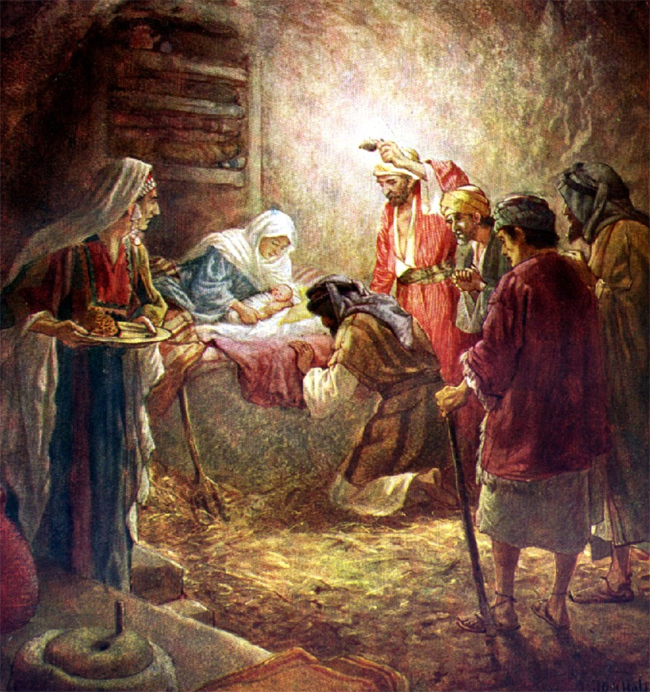
Our Advent prayers recall Jesus and Mary and Joseph in Bethlehem, the birth of Jesus, the story of the Nativity as handed down to us especially through the Gospels of Matthew and Luke. It is such a wonderful, intimate story, of Mary and Joseph, two people whose lives would have been otherwise utterly obscure, lived out in a remote province of the Roman Empire, far from the centre of things, to whom something extraordinary is happening [ … ]
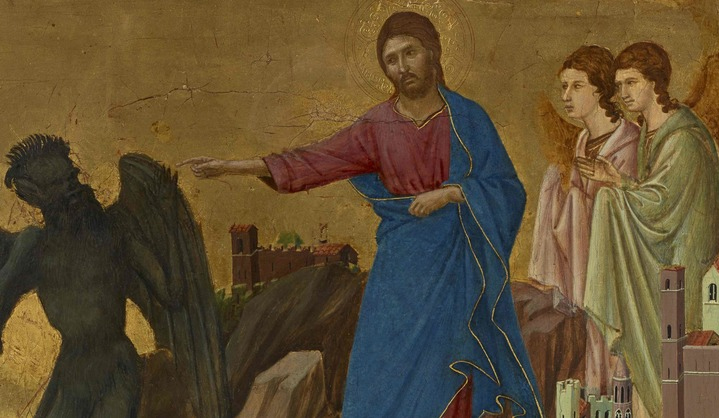
Jesus has performed miracles and his redeeming power over the devils which possess people is clearly apparent; Jesus’ power over evil is manifest. The people marvel, and yet their hearts are hardened to the truth of Jesus. Rather than see with their eyes and understand, they reject the truth of Christ. They retreat to within the evil that holds them captive, which prevents them from seeing the truth of Jesus. They mutter and grumble and gossip, actively seeking to suggest the worst possible and false interpretation of what they have witnessed. They have seen the work of absolute good. They choose to accuse this good of being evil. They do not rise to the message of Christ [ .. ]

In this verse of Matthew’s Gospel, Jesus emphasizes the value and importance of children in the eyes of God. Jesus welcomes children with open arms and assures us that the kingdom of heaven belongs to such as these. This message highlights the need to care for and protect children, especially those who are most vulnerable. Jesus’ compassion for children is a powerful reminder of our responsibility to ensure children’s well-being and to provide them with the love and support they need [ … ]
