
Christian Art | Prayer With Jesus | Psalms | Folly Of Trust In Riches | King David As A Boy
Psalm 49 | King James Audio Bible
YouTube: Psalm 49 | KJV | King James Audio Bible | Word Aloud
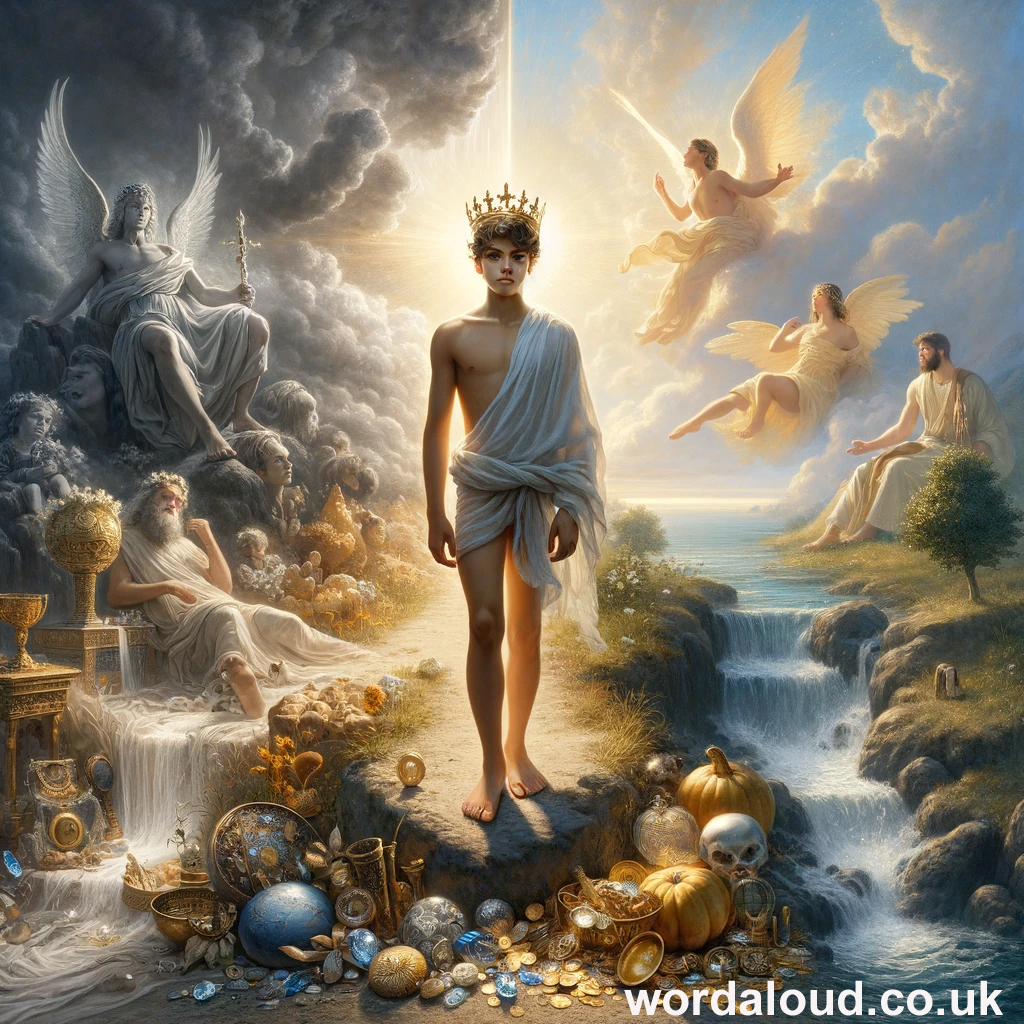
Psalm 49 is a psalm of balance, expressing an engagement with life’s realities while maintaining a perspective beyond the material. The psalm examines pursuit of prosperity and calls for humility in recognizing ultimate limitations of material wealth. The psalm invites solace in redemption offered by the Divine, affirming such vanity of riches and that worth transcends wealth – money.
Psalm 49 calls for reflection—an opportunity to contemplate life’s fleeting nature. The psalm invites listeners to consider brevity of human existence. The psalm begins with a universal call: ‘Hear this, all people; give ear, all inhabitants of the world.’ This invitation extends to every soul, irrespective of circumstances, to heed God’s message.
The psalmist, with wisdom, enters into questions of human existence: pursuit of wealth, an illusion of invincibility such money can create, and ultimate limitations of earthly riches. ‘Both low and high, rich and poor, together,’ declares the psalmist, acknowledging that these reflections apply to all.
The psalmist channels divine wisdom to convey a fundamental understanding: the constraints of wealth. ‘Their inward thought is that their houses shall continue forever, and their dwelling places to all generations; they call their lands after their own names.’ Here, the psalmist highlights universal desire for a lasting legacy, often sought through accumulation of wealth, property, and influence. Such is an aspiration as old as civilization itself, and yet, as the psalmist reminds, even the most opulent estates eventually change hands, their grandeur fading.
Central to this psalm is the idea that, despite efforts to secure futures through wealth, humans are ultimately powerless in the face of mortality. ‘Nevertheless, man being in honour abides not; he is like the beasts that perish.’ The psalmist draws a parallel between humanity and the animal kingdom, emphasizing our shared fate—inevitable death.
This reflection on human mortality, though sombre, serves a profound purpose: redirecting focus from the transient to the eternal. The psalmist underscores a gift more precious than material wealth—the redemption of one’s soul. ‘But God will redeem my soul from the power of the grave; for He shall receive me.’ Here, the psalmist offers hope, reminding that while earthly treasures may fade, the soul’s destiny is not determined by possessions but by a relationship with God.
Psalm 49 | King James Audio Bible KJV | Love Revealed By Jesus Christ
Hear this, all ye people; give ear, all ye inhabitants of the world: Both low and high, rich and poor, together.
My mouth shall speak of wisdom; and the meditation of my heart shall be of understanding. I will incline mine ear to a parable: I will open my dark saying upon the harp.
Wherefore should I fear in the days of evil, when the iniquity of my heels shall compass me about?
They that trust in their wealth, and boast themselves in the multitude of their riches;
None of them can by any means redeem his brother, nor give to God a ransom for him: (For the redemption of their soul is precious, and it ceaseth forever:)
That he should still live forever, and not see corruption.
For he seeth that wise men die, likewise the fool and the brutish person perish, and leave their wealth to others.
Their inward thought is, that their houses shall continue forever, and their dwelling places to all generations; they call their lands after their own names.
Nevertheless man being in honour abideth not: he is like the beasts that perish. This their way is their folly: yet their posterity approve their sayings. Selah.
Like sheep they are laid in the grave; death shall feed on them; and the upright shall have dominion over them in the morning; and their beauty shall consume in the grave from their dwelling.
But God will redeem my soul from the power of the grave: for he shall receive me. Selah. Be not thou afraid when one is made rich, when the glory of his house is increased;
For when he dieth he shall carry nothing away: his glory shall not descend after him.
Though while he lived he blessed his soul: and men will praise thee, when thou doest well to thyself.
He shall go to the generation of his fathers; they shall never see light.
Man that is in honour, and understandeth not, is like the beasts that perish.
Key Themes Of The Psalm For Reflection | Love Revealed By Jesus Christ
- Meditation On Transience: The primary theme of Psalm 49 is a deep meditation on the transient nature of human existence. The psalmist calls upon people from all walks of life to listen and ponder this universal truth. This meditation urges individuals to consider the brevity of life, prompting reflection on the purpose and meaning of one’s time on Earth.
- Wealth And Its Illusions: A prominent theme of the psalm is the reflection on wealth and its illusory nature. The psalmist observes that people, regardless of their social or economic status, often become enamoured with the pursuit of wealth. They may believe that their riches will secure their futures and create a lasting legacy. This theme invites contemplation on the pursuit of material success and the false sense of security it can provide.
- Limitations Of Material Wealth: The psalmist emphasizes that material wealth has its limitations. Houses, lands, and possessions are acquired and passed down through generations, yet they do not endure forever. This theme encourages humility and a recognition of the ultimate limitations of earthly treasures, challenging the notion that wealth guarantees lasting significance.
- Human Mortality: Psalm 49 draws a striking parallel between humanity and the animal kingdom concerning mortality. It highlights the sobering truth that all living beings, regardless of their accomplishments or possessions, share a common fate—death. This theme serves as a reminder of the fragility of human life and the equalizing force of mortality.
- Redemption Of The Soul: Amid reflections on the fleeting nature of life and the limitations of wealth, the psalmist introduces a message of hope. The psalm points to the idea that true worth is not measured in material riches but in the redemption of the soul by God. This theme invites individuals to look beyond earthly pursuits and consider the eternal destiny of the soul as the ultimate treasure.




The New Testament account of Saint Peter provides us with a rich and detailed portrait of Saint Peter’s character and of his relationship with Jesus and the other apostles. In our contemporary context, Saint Peter’s teachings and example remain relevant and vital, providing us with a powerful reminder of the transformative potential of the Gospel. Whether through his emphasis on love, forgiveness, and hospitality, or his example of repentance and humility, Saint Peter’s legacy invites us to deepen our understanding of the Christian faith and to live out its principles in our own lives [ … ]
In the Bible, a miracle is an event that is not explicable by natural or scientific laws and is therefore attributed to a divine agency. Miracles are often seen as a sign of the intervention of God in the affairs of human beings. In the Old Testament, the most famous miracles are the Ten Plagues of Egypt, in which God punished the Pharaoh for refusing to release the Israelites from slavery, and the parting of the Red Sea, in which God allowed the Israelites to escape from the pursuing Egyptians by opening a path through the sea. In the New Testament, the miracles of Jesus are a central part of his ministry and are seen as evidence of his divinity. These include healings, such as the restoration of sight to the blind and the raising of the dead, and acts of nature, such as turning water into wine and walking on water. Is There A Theological Significance To Jesus’ Miracles? In the Christian tradition, the miracles performed by Jesus are seen as a manifestation of his divinity and as proof of his authority to teach and heal. Many of these miracles are described in the Gospels of the New Testament, which are the primary source of information about the life and teachings of Jesus. The purpose of the miracles, according to the Gospels, was to demonstrate Jesus’ power over natural forces and to show that he had the authority to forgive sins and offer salvation to those who believed in him. Why Did Jesus Ask To Keep His Miracles Secret? ‘Tell No One Of This.’ In the Gospels, there are a few instances where Jesus tells people not to tell others about what he has done for them. For example, in the Gospel of Matthew, after Jesus healed a man who was possessed by demons, he told the man, ‘See that you tell no one anything, but go, show yourself to the priest and offer the gift that Moses commanded, as a proof to them’ (Matthew 8:4). In this case, it seems that Jesus was concerned that the man’s testimony might not be believed or might be misunderstood, and so he asked him to keep the experience to himself for the time being. It is difficult to say for sure why Jesus might have asked someone to keep quiet about a miracle without knowing the specific context in which the request was made. However, some possible reasons that come to mind include: To avoid drawing unnecessary attention to himself. In the Gospels, Jesus often tries to avoid drawing too much attention to himself, especially from the authorities who are hostile to him. Asking someone to keep quiet about a miracle might be one way of avoiding unwanted attention and allowing Jesus to continue his ministry without interference. To allow the person who was healed to experience the transformation for themselves. In some cases, the person who was healed might have been skeptical or unsure of what had happened to them. Asking them to keep quiet about the miracle might have given them time to reflect on the experience and come to their own understanding of it without being influenced by others. To test the person’s faith. In some cases, Jesus might have asked someone to keep quiet about a miracle as a test of their faith. If they were truly grateful for what Jesus had done for them, they would be willing to follow his instructions and trust that he had a good reason for asking them to keep quiet. These are just a few possible reasons why Jesus might have asked someone to keep quiet about a miracle. It is important to remember that the Gospels are ancient texts and that we must be careful not to impose our own interpretations on them without considering the historical and cultural context in which they were written. To avoid creating conflict or division. In the Gospels, Jesus often encounters people who are skeptical or hostile to his teachings, and he sometimes tries to avoid confrontations with them. Asking someone to keep quiet about a miracle might be one way of avoiding a confrontation or a heated debate that could disrupt his ministry. To avoid being misunderstood or misrepresented. In some cases, the person who was healed might not have understood the full significance of what Jesus had done for them, and they might have tried to explain it in a way that distorted or misrepresented the truth. Asking them to keep quiet might have given Jesus time to explain things to them more fully and help them to understand the true meaning of the miracle. To avoid becoming a spectacle. In the Gospels, there are many instances where people are amazed by the miracles that Jesus performs, and they often try to make him into a kind of celebrity or showman. Asking someone to keep quiet about a miracle might have been one way of avoiding this kind of attention and keeping the focus on the message that Jesus was trying to convey. What Is The Significance Of Miracle Of The Wedding At Cana? In the Christian tradition, the wedding at Cana is significant because it is the first of the miracles performed by Jesus that is recorded in the Gospels of the New Testament. This event is described in the Gospel of John, where it is said that Jesus, along with his mother Mary and his disciples, attended a wedding in the town of Cana. At the wedding, the host ran out of wine, and Mary asked Jesus to help. In response, Jesus turned water into wine, which is seen as a miraculous act that demonstrated his power and authority. In the Gospel of John, after Mary asks Jesus to help with the wine at the wedding in Cana, he replies, “Woman, what does this have to do with me? My hour has not yet come” (John 2:4). This statement is often seen as indicating that Jesus was aware […]

Heavenly Father, I come before you seeking renewal. My heart longs for a deeper connection with you and a refreshed commitment to living out your will. Transform my mind and spirit, that I may be conformed to your purposes rather than the patterns of this world. Fill me with your Holy Spirit, and guide me in your truth. Renew my passion for your Word and my dedication to following Jesus. Thank you for your unending grace and mercy. In Jesus’ name, I pray. Amen [ … ]