
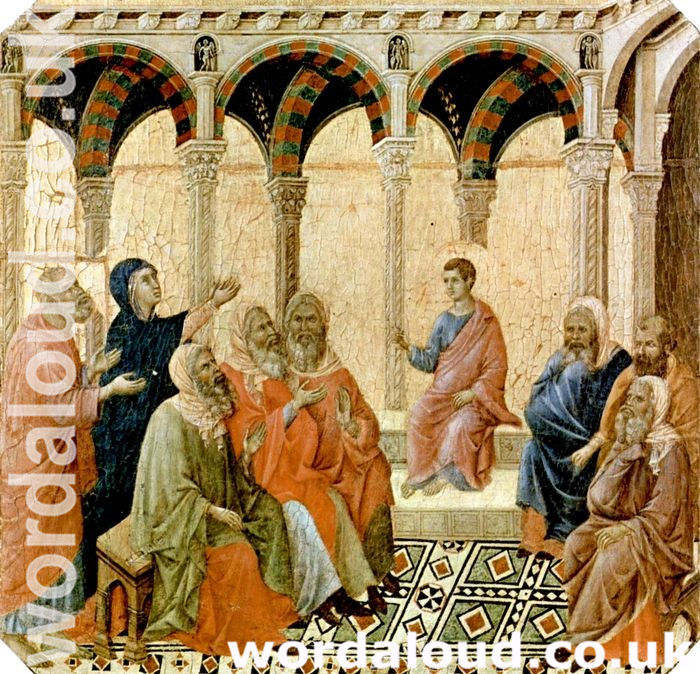
Christian Art | Jesus As A Boy Disputes In The Temple
Office Of Readings | Week 20, Saturday, Ordinary Time | A Reading From The Discourses Of Saint Ambrose On The Psalms | Through His Blood, Jesus Christ Reconciled The World To God
‘Through his blood, Jesus Christ reconciled the world to God.’
Saint Ambrose of Milan continues his exposition of the psalms by dwelling on the theme of Jesus Christ as the universal reconciler. His reflection builds on two interconnected truths: the sinlessness of Christ and the all-sufficiency of his sacrifice.
The argument begins with the episode of the temple tax (Mt 17:24–27). Ambrose interprets this incident as an enacted parable of Christ’s freedom from sin. The temple tax, associated with offerings of atonement (cf. Ex 30:11–16), symbolised humanity’s indebtedness before God. Jesus, however, declares himself exempt, since he is the true Son, not a servant under bondage. Yet, for the sake of others, he consents to pay, not out of necessity but out of humility and to avoid scandal. The miracle of the coin in the fish’s mouth underscores the gratuitous character of this payment: Christ gives not what is required of him but what is given for the sake of others.
Ambrose then expands this principle into a theology of redemption. Since Christ has no sin, he owes no ransom for himself. His sacrifice, therefore, is offered wholly for others. Moreover, the price of his blood is not limited to one person or one offering, but is sufficient for the redemption of the entire world. Ambrose contrasts this universality with the limitations of human sacrifice: no individual’s blood, however precious, could redeem even themselves, still less others. Only Christ, sinless and divine, can make satisfaction for all.
Ambrose then draws a pastoral implication: since Christ has once and for all made propitiation, no other atoning sacrifice is necessary. There is no need for each individual to offer their own blood, because Christ has already accomplished redemption universally and definitively. This emphasises both the singularity and the finality of the cross.
Ambrose concludes by returning to the words of Christ: ‘Come to me, all you who labour and are overburdened, and I will give you rest.’ (Mt 11:28) Reconciliation is not merely a transaction but a sharing of burdens. Christ not only cancels humanity’s debt but takes its weight upon himself. The commentary thus ties together theological reflection with a note of consolation: the universal redeemer is also the one who invites the weary into rest.
This passage exemplifies Ambrose’s theological clarity: Christ’s sinlessness grounds his capacity to redeem; his blood is sufficient for all; reconciliation is universal, final, and pastoral in its effect.
A Reading From The Discourses Of Saint Ambrose On The Psalms | Through His Blood, Jesus Christ Reconciled The World To God
When Christ reconciled the world to God he himself was certainly not in need of reconciliation. What sin could he do penance for, when he had no sin in him? Moreover, when the Jews were asking for the half-shekel, the offering given for sin according to the Law, he said to Peter: ’Simon, what is your opinion? From whom do the kings of the earth take toll or tribute? From their sons or from foreigners?’ And when Peter replied, ‘From foreigners’, Jesus said, ‘Well then, the sons are exempt. However, so as not to offend these people, go to the lake and cast a hook; take the first fish that bites, open its mouth and there you will find a shekel; take it and give it to them for me and for you.’
He showed that he does not owe an offering for any sin of his own, for he was not a slave of sin: the Son of God was free from all fault. For the son gives freedom; it is the slave who is guilty. So Jesus is completely free, and he does not make payment to redeem his soul. The price of his blood was more than enough to redeem all the sins of the entire world. It is right that he who owes nothing for himself should be able to give freedom to others.
Let me say more. Christ owes nothing for his own redemption and owes nothing as propitiation for sin. But more than that, if you consider any one of us then you will see that none of us owes anything as a propitiatory offering, because Christ himself is that offering, the offering for all and the redemption of all.
What man’s blood now has the power to redeem him, when Christ has shed his own blood for the redemption of all? Is there anyone whose blood could be compared to Christ’s? Or what man is so powerful that he could make an offering of propitiation greater than the offering that Christ made of himself when he alone reconciled the world to God by his blood? What greater sacrificial victim can there be, what superior sacrifice, what better advocate could there be than Christ, who became the atonement for the sins of all, who gave his life for our redemption?
Individual propitiation, individual redemption is not needed, because the blood of Christ is the price of all. By that blood the Lord Jesus redeemed us, and he alone has reconciled us to the Father. He laboured at this to the end, for he took our own burdens on himself when he said, Come to me, all you who labour and are overburdened, and I will give you rest.
Christian Prayer With Jesus Christ
O Christ our Redeemer,
sinless Son of the Father,
whose blood reconciled the world to God,
you owed nothing, yet you paid the debt of all.
Take upon yourself our burdens,
give rest to the weary,
and grant that we may live in the freedom of your redemption,
until we are brought into the fullness of your peace,
who live and reign with the Father in the unity of the Spirit,
one God, forever and ever.
Amen.
Glossary Of Christian Terms
Reconciliation: The restoration of right relationship between God and humanity, achieved through Christ’s sacrifice.
Temple tax (half-shekel): A levy in the Law of Moses associated with offerings of atonement (Ex 30:11–16). Ambrose reads it as symbolic of sin’s debt.
Sinlessness of Christ: The belief that Jesus was without sin (Heb 4:15), enabling him to be a perfect sacrifice.
Propitiation: An offering that turns aside wrath or satisfies the demands of justice; Christ is the final propitiatory sacrifice (Rom 3:25).
Redemption: The act of buying back or liberating from slavery; in Christian theology, the liberation of humanity from sin and death by Christ’s sacrifice.
Sacrificial victim: In biblical religion, the offering presented to God in atonement; Christ is seen as the perfect and final sacrificial victim.
Advocate: One who intercedes on behalf of another; Christ is the supreme advocate before the Father (1 Jn 2:1).



This deeply moving letter from Saint Ignatius of Antioch, composed on his journey to martyrdom in Rome around AD 107, is one of the earliest and most passionate testimonies to Christian witness through suffering. Ignatius, the bishop of Antioch and a disciple of the Apostle John, wrote this letter to the Christian community in Rome to plead that they not intervene in preventing his execution. Far from fearing death, he embraces it as the culmination of his discipleship in Christ. The letter is both a theological reflection and a spiritual testament on martyrdom, discipleship, and union with Christ [ … ]

Second Temple Judaism refers to the religious and cultural practices of the Jewish people during the Second Temple period, which lasted from the construction of the Second Temple in Jerusalem in 516 BCE until its destruction by the Romans in 70 CE. During this time, Judaism was marked by the development of various religious movements and the emergence of important religious figures such as the Pharisees, Sadducees, and Essenes [ … ]
In his discourse, Saint Athanasius explores how divine Wisdom—identified with the eternal Word, the Son—imprints itself within creation. Saint Athanasius’s argument responds to Arian claims that the Son was a created being. For Athanasius, the phrase ‘The Lord created me in his works’ cannot mean that the eternal Wisdom itself was made; rather, it refers to the reflection or imprint of Wisdom in the created order [ … ]
