
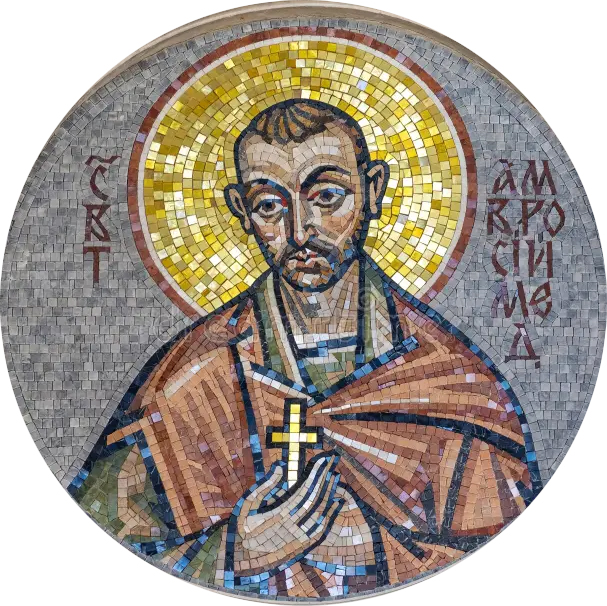
Saint Ambrose Of Milan | A Holy Life Of Authority, Faith, And Song
Here are readings in the Office Of Readings of Saint Ambrose..
- Office Of Readings | Week 15, Sunday, Ordinary Time | A Reading From The Treatise Of Saint Ambrose On The Mysteries | Instruction On The Ceremonies Preceding Baptism
- Office Of Readings | Week 15, Monday, Ordinary Time | A Reading From The Treatise Of Saint Ambrose On The Mysteries | We Are Born Again Of Water And The Holy Spirit
- Office Of Readings | Week 15, Tuesday, Ordinary Time | A Reading From The Treatise Of Saint Ambrose On The Mysteries | Everything That Happened To Them Was A Figure
- Office Of Readings | Week 15, Wednesday, Ordinary Time | A Reading From The Treatise Of Saint Ambrose On The Mysteries | Water Does Not Sanctify Without The Holy Spirit
- Office Of Readings | Week 15, Thursday, Ordinary Time | A Reading From The Treatise Of Saint Ambrose On The Mysteries | Instruction On Ceremonies After Baptism
As bishop, theologian, and composer, Saint Ambrose of Milan shaped the doctrine, liturgy, and moral character of Latin Christianity. Born into the elite of the Roman Empire and trained in classical rhetoric, Saint Ambrose rose from civil office to ecclesiastical leadership under unusual circumstances. His life exemplifies the intersection of Roman civic tradition with the emerging authority of the Christian Church. His writings, hymns, and pastoral actions continue to influence both theological scholarship and devotional practice.
Saint Ambrose was born around 340 AD in the city of Trier, then a Roman imperial residence in the province of Gaul. His father served as praetorian prefect, one of the highest administrative offices in the Western Empire. Following his father’s death, Ambrose was raised in Rome and educated in law, rhetoric, and Greek philosophy. His classical education prepared him for public service, and he was appointed governor of Aemilia-Liguria, based in Milan, around 370.
Milan at the time was a key imperial and ecclesiastical centre. The city was divided by theological conflict between supporters of Nicene orthodoxy and adherents of Arianism. When the Arian bishop Auxentius died in 374, the election of a new bishop became contentious. Ambrose, then governor, attended the assembly to maintain order. According to tradition, a child’s voice cried out, ‘Ambrose for bishop,’ and the crowd echoed the call. Despite being unbaptized and lacking clerical experience, he was unanimously chosen. Ambrose initially resisted, but after eight days, he was baptized and consecrated as bishop.
Ambrose’s episcopacy lasted over two decades. From the outset, he aligned himself with Nicene orthodoxy. He opposed Arian attempts to seize churches in Milan and resisted imperial interference in theological matters. His confrontation with the Empress Justina, an Arian sympathiser, over the control of basilicas in 385–386 became a defining moment. Ambrose refused to yield churches to imperial authority, asserting the independence of the Church in spiritual matters. This stance established a precedent for the moral authority of bishops over emperors.
Saint Ambrose’s most famous conflict with imperial power came in 390, after the massacre of thousands in Thessalonica ordered by Emperor Theodosius I. Ambrose responded by barring the emperor from receiving the Eucharist until he publicly repented. This act signalled a turning point in the relationship between Church and state. It demonstrated the capacity of ecclesiastical leaders to hold rulers accountable to Christian moral standards.
Ambrose’s intellectual contributions were equally significant. He composed numerous theological treatises, many aimed at instructing catechumens and clergy. His style blended Roman rhetorical techniques with Christian doctrine. In De officiis ministrorum, he adapted Cicero’s ethical writings to guide Christian clergy, emphasising humility, service, and integrity. His treatises on virginity, widowhood, and the duties of bishops provided early frameworks for Christian moral theology.
Saint Ambrose’s exegesis was shaped by Origen and Philo of Alexandria, and he often employed allegorical interpretation. In his commentary on Genesis, Hexaemeron, he described the six days of creation not only as cosmological events but also as moral and spiritual stages. In ‘De bono mortis’, he offered a Christian philosophy of death, portraying it as liberation for the soul rather than a cause for fear. These works, while theologically dense, were designed to support the spiritual formation of his readers.
Ambrose was also a key figure in the development of Western liturgical practice. He introduced antiphonal chanting to the Latin Church, drawing on Eastern traditions. His hymns became models for subsequent Latin hymnody. Among those widely attributed to him are ‘Aeterne rerum conditor’, ‘Deus Creator omnium’, and ‘Veni redemptor gentium’. These hymns were composed in classical metre, structured for congregational singing, and rich in theological content. They helped embed doctrinal truths within the rhythm of daily worship.
Ambrose’s pastoral theology was grounded in Scripture and sacrament. His treatises De Mysteriis and De Sacramentis expound on the rites of baptism and Eucharist, emphasising their spiritual power and connection to Christ’s death and resurrection. His instruction was not abstract but oriented toward the transformation of the believer through liturgical participation.
Ambrose also played a formative role in the life of Augustine of Hippo. When Augustine arrived in Milan, he was a sceptic influenced by Manichaean thought. Ambrose’s preaching, intellectual depth, and scriptural interpretation impressed him. Ambrose’s influence prepared Augustine for conversion and baptism in 387. In his Confessions, Augustine describes Ambrose with deep respect, not only as a bishop but as a spiritual father.
Ambrose died in 397. His remains are preserved in the Basilica of Saint Ambrogio in Milan, a church he helped build. He was declared a Doctor of the Church in later centuries and is venerated in both Western and Eastern Christian traditions. His feast day is celebrated on December 7, the anniversary of his episcopal consecration.
Devotional traditions surrounding Saint Ambrose reflect both his doctrinal clarity and his pastoral care. He is often invoked by preachers, bishops, and hymn-writers seeking guidance. In Christian iconography, he is depicted with a beehive or bees, recalling the legend that a swarm of bees settled on his face as an infant, foretelling his eloquence. This image emphasises his gift for sacred speech and his role as a teacher of divine truths.
Modern devotional materials, such as the Saint Ambrose Prayer Book, preserve his legacy in contemporary worship. His hymns continue to be sung in the liturgy, and his theological reflections are studied for their spiritual insight. His insistence on the Church’s moral voice, even in the face of imperial opposition, remains a model for Christian leadership.
Saint Ambrose exemplifies the bishop as theologian, liturgist, and pastor. He brought classical learning into the service of Christian doctrine. He defended the integrity of the Church while guiding souls through word and sacrament. His writings and hymns continue to shape both scholarship and devotion. In him, the early Church found a voice capable of uniting faith with reason, liturgy with life, and authority with humility.



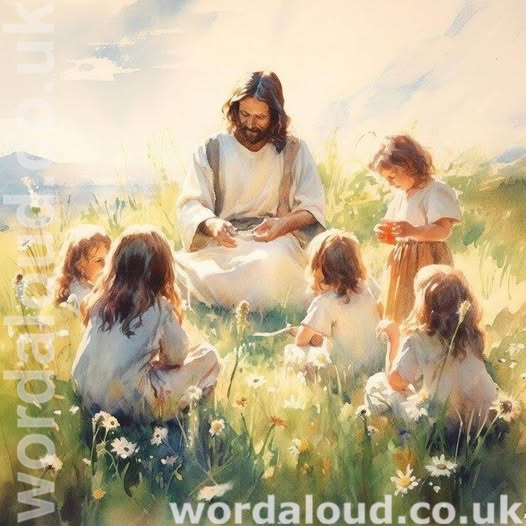
In this passage from his Treatise on Cain and Abel, Saint Ambrose reflects on the nature of Christian prayer as both personal and communal, inner and active. His interpretation moves beyond external forms and focuses on the transformation of the heart, the renewal of love, and the unity of the Church as the Body of Christ [ … ]

Scripture: John 14:27 ‘Peace I leave with you; my peace I give you. I do not give to you as the world gives. Do not let your hearts be troubled and do not be afraid.’ In this verse, Jesus offers his peace to his disciples, a peace that is different from what the world provides. This divine peace is deep, abiding, and capable of calming troubled hearts and dispelling fear. It is a peace that surpasses all understanding and is rooted in the presence and promises of Christ. Prayer Dear Jesus, I come before you, seeking your peace in my life. The world around me is filled with chaos and uncertainty, but I know that your peace can calm the storm within my heart. Help me to trust in you more deeply, to rest in your promises, and to feel your presence in every moment. Fill me with your peace that surpasses all understanding, and help me to be a vessel of your peace to those around me. Amen. Personal Reflection What areas of your life are causing you anxiety or fear? How can you invite Jesus’ peace into these areas? Reflect on a time when you experienced Christ’s peace amidst turmoil. Meditation On Prayer And Gospel John 14:27 reveals a profound truth about the nature of Jesus’ peace. Unlike the fleeting and often superficial peace offered by the world, Jesus’ peace is enduring and deeply transformative. This peace is not dependent on external circumstances but is anchored in the character and promises of Christ. As we navigate through life’s challenges, it’s crucial to understand and embrace this divine peace. Jesus’ peace is rooted in his presence. When he says, ‘Peace I leave with you; my peace I give you,’ Jesus is assuring us of his continual presence. This peace is a gift that flows from his abiding presence in our lives. It is a reminder that we are never alone, no matter what we face. his presence brings comfort and security, allowing us to rest even in the midst of life’s storms. Furthermore, Jesus contrasts his peace with the peace that the world gives. The world’s peace is often conditional and temporary, based on circumstances that can change in an instant. In contrast, Jesus’ peace is steadfast and eternal. It is a peace that reassures us in our deepest fears and anxieties, reminding us that he is in control. This peace transcends our understanding, as it is grounded in the eternal and unchanging nature of God. To experience Jesus’ peace, we must cultivate a relationship with him. This involves spending time in prayer, meditating on his word, and seeking his presence in our daily lives. It also means surrendering our worries and fears to Jesus, trusting that Jesus will provide and protect. As we draw closer to Jesus, his peace fills our hearts and minds, transforming our outlook and calming our spirits. One practical way to embrace Jesus’ peace is through prayer and meditation. By setting aside time each day to be still before the Lord, we create space for his peace to fill us. Reflecting on scriptures like John 14:27 can remind us of his promises and help us focus on his presence. Additionally, practicing gratitude can shift our focus from our worries to the many blessings in our lives, further opening our hearts to his peace. Another aspect of embracing Jesus’ peace is learning to let go of control. Often, our anxiety stems from a desire to control our circumstances. Jesus invites us to trust in his sovereign plan, even when we do not understand it. By surrendering our need for control and placing our trust in Him, we open ourselves to the peace that comes from knowing that He holds all things in his hands. Living in Jesus’ peace also means becoming peacemakers in our relationships and communities. As we experience his peace, we are called to extend that peace to others. This involves forgiving those who have wronged us, seeking reconciliation, and promoting harmony wherever we go. By being agents of his peace, we reflect his love and grace to a world in desperate need of his presence. Prayer Lord Jesus, Your peace is a precious gift that the world cannot give. In times of turmoil and distress, remind me to turn to you. Let your peace guard my heart and mind, dispelling all fear and anxiety. Teach me to trust in your unfailing love and to rest in your promises. Help me to be a peacemaker, sharing your peace with those around me. May your peace reign in my heart, my home, and my relationships. Thank you for your constant presence and the gift of your peace. Amen. Scripture: Matthew 5:9 ‘Blessed are the peacemakers, for they will be called children of God.’ Blessing May the peace of our Lord Jesus Christ fill your heart and mind, guiding you through every challenge and bringing you comfort and joy. May you rest in his unending peace and share it generously with those around you. Amen.
Psalm 75 is a hymn of praise and reflection on the righteous judgment and sovereignty of God. It opens with an acknowledgment of gratitude and thanksgiving to God, whose name is near, and whose wondrous works are declared. This psalm contains themes of divine judgment, the importance of humility, and the contrast between the wicked and the righteous [ … ]
