
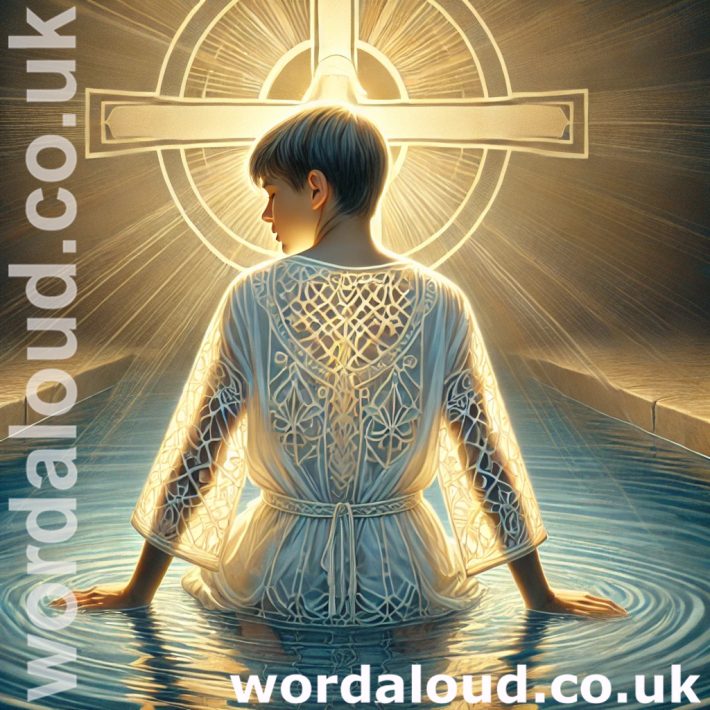
Christian Art | The Mystery Of Baptism | The Newly Baptized
Office Of Readings | Week 15, Tuesday, Ordinary Time | A Reading From The Treatise Of Saint Ambrose On The Mysteries | Everything That Happened To Them Was A Figure
‘Everything that happened to them was a figure.’
Historical And Liturgical Setting
Saint Ambrose’s On the Mysteries was addressed to newly baptized Christians in fourth-century Milan, many of whom received baptism at the Easter Vigil. This period was marked by a heightened catechetical emphasis on post-baptismal mystagogy — instructing the newly initiated in the mysteries they had just experienced. The baptistery in Milan itself, where many of these catechumens would have been baptized, is octagonal, symbolising new creation and eternal life.
Ambrose compares the deacons and bishop to Old Testament figures: deacons as Levites ministering in the temple and the bishop as the high priest presiding over sacred rites. This analogy roots Christian baptism in continuity with the worship of ancient Israel, yet proclaims its fulfilment in Christ.
Scriptural Imagery And Typology
Ambrose’s exposition draws on rich biblical typology to reveal baptism as the fulfilment of God’s saving work in history:
- Creation and the Spirit hovering over the waters (Genesis 1:2): Ambrose sees the Spirit’s presence at creation as the archetype of the Spirit’s action in baptism. Just as the Spirit brought order and life to the primal waters, so the Spirit now recreates the baptized person into a new creation.
- The flood and Noah’s ark (Genesis 6–9): The flood is presented as a purifying deluge, prefiguring the waters of baptism that wash away sin. Noah’s ark becomes a type of the Church, the vessel of salvation in a sinful world. The dove returning with an olive branch symbolises the Spirit bringing peace and reconciliation after judgment.
- The wood of the cross: For Ambrose, the wood on which Christ was crucified is intimately linked to the wood of the ark, signalling that it is through Christ’s Passion that salvation is accomplished.
This typological reading was common in patristic thought, where the Old Testament was seen not as a separate narrative but as a preparation for and prophecy of Christ and the sacraments.
The Theology Of Baptism And The Holy Spirit
Ambrose insists that what appears as water is not simply natural water but a vehicle for divine grace, because the Spirit is present and active. He warns against a superficial, merely visible understanding of the rite: ‘Look not at what is visible but at what is invisible.’ This sacramental realism affirms that God is truly present and acting — it is not the bishop or deacons who effect the transformation but the Spirit working through them.
The dove, as Ambrose notes, is a symbol of the Spirit’s peaceful and renewing presence. In patristic thought, the dove also recalls Christ’s baptism in the Jordan (Matthew 3:16), where the Spirit descended in the form of a dove, inaugurating Christ’s public ministry and manifesting the Trinity.
Ambrose also stresses the moral dimension of baptism: sin corrupts and turns away the Spirit’s grace, as indicated by the passage from Genesis where God declares, ‘My Spirit shall not remain among men, because they are flesh.’ Therefore, baptism is both a gift and a summons to live according to the Spirit.

A Reading From The Treatise Of Saint Ambrose On The Mysteries | Everything That Happened To Them Was A Figure
The Apostle teaches you that our fathers were all covered by the cloud, all passed through the sea, all were baptized into Moses in the cloud and in the sea. Further, Moses in his canticle says: You sent your spirit, and the sea overwhelmed them. You observed that in this crossing by the Hebrews there was already a symbol of holy baptism. The Egyptian perished; the Hebrew escaped. What else is the daily lesson of this sacrament than that guilt is drowned, and error destroyed, while goodness and innocence pass over unharmed?
You are taught that our fathers were covered by the cloud, a cloud of blessing that cooled the fire of bodily passions. A cloud of blessing: it is with a cloud of blessing that the Holy Spirit overshadows those whom he comes to visit. The Holy Spirit came at last upon the Virgin Mary, and the power of the most High overshadowed her, when she conceived for all mankind him who is redemption. This great miracle was prefigured through Moses. If then the Spirit was prefigured, is he not now present in truth, for Scripture tells you that the law was given through Moses, but grace and truth came through Jesus Christ?
Marah was a spring of bitter water. When Moses threw wood into it, its water became sweet. Water, you see, is of no avail for future salvation without the proclamation of the Lord’s cross. But when it has been consecrated through the saving mystery of the cross, it is then ready for use in the laver of the Spirit and in the cup of salvation. Therefore, as Moses in his role of prophet threw wood into the spring of Marah, so also the priest sends out into the fountain of baptism the proclamation of the Lord’s cross, and the water becomes sweet, ready for the giving of grace.
Do not then believe only what the eyes of your body tell you. What is not seen is here more truly seen, for what is seen belongs to time but what is not seen belongs to eternity. What is not comprehended by the eyes but is seen by the mind and the soul is seen in a truer and deeper sense.
Finally, learn from the readings we have gone through from the books of the Kings. Naaman was a Syrian; he was a leper, and could not be healed by anyone. Then a girl from among the captives said that there was a prophet in Israel who could cleanse him from the disease of leprosy. Taking gold and silver, we are told, he went to see the king of Israel. The king, on learning the reason for his coming, rent his garments, saying that it was really to find an excuse against him, for what he was being asked was beyond the power of a king.
Elisha, however, told the king to send the Syrian to him, and he would learn that there was a God in Israel. When he came, Elisha ordered him to bathe seven times in the river Jordan. Then Naaman began to reflect that the rivers of his own country had better waters, and that he had often bathed in them, and never been cleansed of his leprosy. This gave him pause, and he refused to obey the prophet’s instructions. But on the advice and persuasion of his servants he yielded and bathed, and was instantly made clean. He realized then that it is not waters that make clean but grace.
Here was a man who doubted before being made whole. You are already made whole, and so ought not to have any doubt.
Prayer With Jesus
God of creation and redemption,
You have made us anew by water and the Holy Spirit.
Grant that we, who have been baptized into Christ,
May live as faithful members of His body,
Free from sin and full of peace.
Let Your Spirit hover over the waters of our hearts,
Bringing order where there is chaos and light where there is darkness.
Through Christ our Lord. Amen.
Glossary Of Christian Terms
Catechesis: Religious instruction given to catechumens preparing for baptism.
Mystagogy: Instruction given after baptism to explain the sacraments newly received.
Typology: A method of interpreting Scripture where events, persons, or institutions in the Old Testament prefigure those in the New.
Pneumatology: The branch of theology dealing with the Holy Spirit.
Sacramental realism: The belief that the sacraments effect what they signify; they are not mere symbols but convey divine grace.




This poem centres on themes of spiritual nourishment and intimate connection between the divine and the individual soul. The poem begins by contrasting superficial wealth, symbolized by ‘rich furniture’ and ‘a wedge of gold’, with the poet’s experience of spiritual fulfilment. Here, material objects hold no power to convey the divine presence. Instead, the poet emphasizes a more personal and humble approach: sustenance provided by Christ in the Eucharist, which enters into the poet ‘by the way of nourishment and strength’. This nourishment implies a steady, almost unseen influence that fills the body and soul, offering rest and inner strength while combating the forces of sin [ … ]
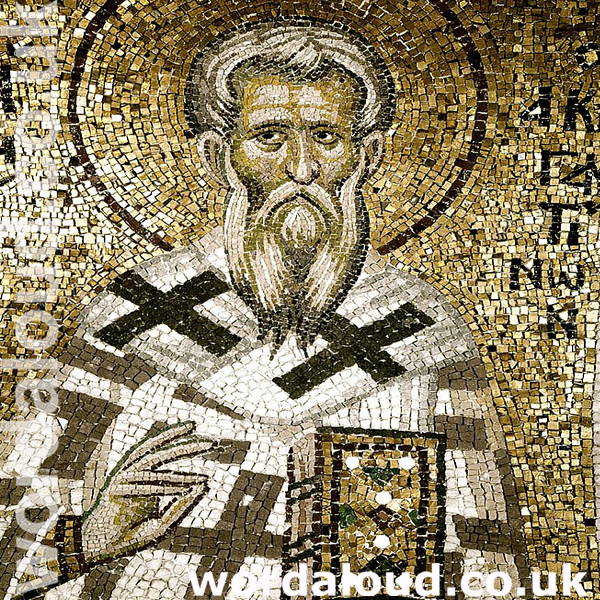
Come, eat your bread in gladness and drink your wine with a cheerful heart, for your works have been pleasing to God. If we would interpret this text in its obvious and ordinary sense, it would be correct to call it a righteous exhortation, in which Ecclesiastes counsels us to embrace a simple way of life and to be led by doctrines which involve a genuine faith in God. Then we may eat our bread in gladness and drink our wine with a cheerful heart. We will not fall into slanderous speech nor be involved in anything devious; rather we should think that which is right, and, insofar as we can, we should help the poor and destitute with mercy and generosity, truly dedicated to those pursuits and good deeds which please God [ … ]
Psalm 53 reflects on faith and consequences of disbelief. The psalm echoes themes found in Psalm 14, offering a compelling exploration of the nature of human folly and the importance of seeking God [ … ]
