
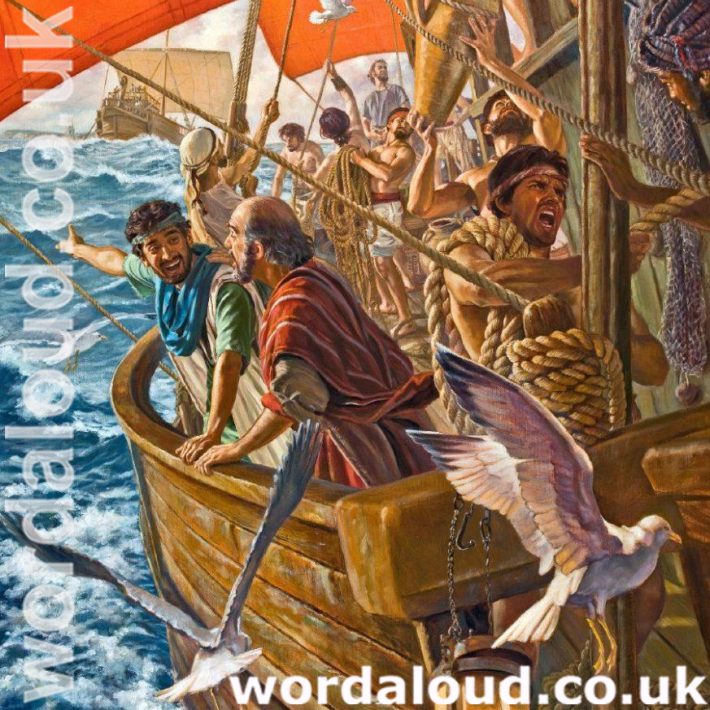
Christian Art | Saint Paul At Sea
‘I Have Not Shunned To Declare Unto You All The Counsel Of God’ | Saint Paul | Acts 20
Acts chapter 20 records the latter stages of Paul’s missionary journeys and contains his farewell address to the elders of the church at Ephesus. The chapter combines travel narrative, ecclesial instruction, pastoral exhortation, and preparation for suffering. Luke presents Paul as a missionary, teacher, pastor, and witness whose ministry is shaped by service, endurance, and obedience to the calling of God.
The chapter begins after the uproar at Ephesus:
‘And after the uproar was ceased, Paul called unto him the disciples, and embraced them, and departed for to go into Macedonia.’
—Acts 20:1 (KJV)
Luke’s account places Paul within a network of churches extending through Macedonia and Greece. The movement of the Gospel is now firmly connected to Gentile regions outside Judaea. Paul’s journeys are not random acts of travel but forms of pastoral oversight. He strengthens congregations already founded and maintains unity between dispersed Christian communities.
The text states:
‘And when he had gone over those parts, and had given them much exhortation, he came into Greece.’
—Acts 20:2 (KJV)
The phrase ‘much exhortation’ summarises an extended ministry of teaching and encouragement. Luke does not reproduce the content of these addresses, but the epistles suggest the themes likely involved: perseverance, unity, holiness, endurance under persecution, and fidelity to apostolic doctrine.
Paul remains in Greece for three months before altering his route because of a plot against him:
‘And there abode three months. And when the Jews laid wait for him, as he was about to sail into Syria, he purposed to return through Macedonia.’
—Acts 20:3 (KJV)
Throughout Acts, opposition accompanies the spread of the Gospel. The pattern reflects earlier sections of the book in which proclamation produces both belief and resistance. Luke presents such opposition not as evidence of failure but as part of apostolic ministry itself.
The following verses list several companions travelling with Paul:
‘And there accompanied him into Asia Sopater of Berea… Aristarchus and Secundus… Gaius… Timotheus… Tychicus and Trophimus.’
—Acts 20:4 (KJV)
The catalogue of names illustrates the international and communal character of the early Church. Jews and Gentiles, Greeks and Asians, participate together in missionary labour. The Church described in Acts is not centred upon one locality or ethnicity but extends across regions connected by teaching, worship, and common faith in Christ.
Luke then records Paul’s arrival at Troas:
‘And upon the first day of the week, when the disciples came together to break bread, Paul preached unto them.’
—Acts 20:7 (KJV)
This verse has significance for the history of Christian worship. The gathering takes place ‘upon the first day of the week’, associated with the resurrection of Christ and later established as the principal day of Christian assembly. The phrase ‘to break bread’ carries eucharistic associations within Acts, indicating communal worship centred upon teaching and sacramental fellowship.
Paul continues speaking until midnight:
‘And there were many lights in the upper chamber, where they were gathered together.’
—Acts 20:8 (KJV)
The detail concerning the lamps contributes to Luke’s eyewitness style, but it also situates the gathering within an ordinary domestic setting. Early Christian worship frequently took place in houses rather than public religious buildings. The Church exists as an assembly gathered around apostolic teaching and the breaking of bread rather than around sacred architecture.
Luke then recounts the incident involving Eutychus:
‘And there sat in a window a certain young man named Eutychus, being fallen into a deep sleep.’
—Acts 20:9 (KJV)
As Paul continues preaching, Eutychus falls from the third loft and is taken up as dead. Paul descends, embraces him, and declares:
‘Trouble not yourselves; for his life is in him.’
—Acts 20:10 (KJV)
The episode recalls prophetic narratives from the Old Testament, particularly Elijah and Elisha restoring life to the dead. It also recalls episodes from the ministry of Christ. Luke therefore situates apostolic ministry within continuity with both prophetic and Gospel traditions.
The restoration of Eutychus is not presented as spectacle. The narrative quickly returns to teaching and fellowship:
‘When he therefore was come up again, and had broken bread, and eaten, and talked a long while, even till break of day, so he departed.’
—Acts 20:11 (KJV)
Teaching, Eucharist, fellowship, and perseverance remain central to the life of the Church.
The narrative then shifts towards Jerusalem. Paul travels through several coastal locations before arriving at Miletus, where he summons the elders of Ephesus:
‘And from Miletus he sent to Ephesus, and called the elders of the church.’
—Acts 20:17 (KJV)
The speech which follows is the only extended address in Acts directed specifically to Christian leaders rather than to Jews, Gentiles, or civic authorities. It therefore provides insight into apostolic understanding of ministry and ecclesial responsibility.
Paul begins by reminding the elders of his conduct among them:
‘Ye know, from the first day that I came into Asia, after what manner I have been with you at all seasons.’
—Acts 20:18 (KJV)
The emphasis falls not only upon doctrine but upon visible conduct. Apostolic authority is connected to manner of life. Paul’s ministry includes humility, endurance, and public witness:
‘Serving the Lord with all humility of mind, and with many tears, and temptations.’
—Acts 20:19 (KJV)
The reference to tears recurs several times within the chapter. Ministry is not portrayed in administrative or institutional terms alone but as involving personal sacrifice and emotional burden.
Paul continues:
‘And how I kept back nothing that was profitable unto you, but have shewed you, and have taught you publickly, and from house to house.’
—Acts 20:20 (KJV)
The phrase ‘publickly, and from house to house’ describes a ministry extending across formal and domestic settings. Christian instruction occurs within the gathered assembly and within ordinary daily life.
The content of Paul’s proclamation is summarised as:
‘Repentance toward God, and faith toward our Lord Jesus Christ.’
—Acts 20:21 (KJV)
Repentance and faith remain inseparable. Conversion involves both turning away from sin and turning towards Christ.
Paul then introduces the subject of his approaching imprisonment:
‘And now, behold, I go bound in the spirit unto Jerusalem, not knowing the things that shall befall me there.’
—Acts 20:22 (KJV)
The phrase ‘bound in the spirit’ suggests inward compulsion or obedience to divine direction. Paul does not claim detailed knowledge of future events, but he expects suffering:
‘Save that the Holy Ghost witnesseth in every city, saying that bonds and afflictions abide me.’
—Acts 20:23 (KJV)
Throughout Acts, the Holy Ghost directs missionary activity whilst also warning of opposition. Divine guidance does not exempt the apostolic ministry from suffering.
Paul responds:
‘But none of these things move me, neither count I my life dear unto myself.’
—Acts 20:24 (KJV)
The statement reflects a theology in which life is interpreted through vocation rather than self-preservation. Paul’s purpose is defined as:
‘To finish my course with joy, and the ministry, which I have received of the Lord Jesus.’
—Acts 20:24 (KJV)
The image of a ‘course’ or race appears elsewhere in Pauline writing and suggests disciplined perseverance towards completion of a divinely appointed task.
Paul then declares:
‘I am pure from the blood of all men.’
—Acts 20:26 (KJV)
The phrase derives from prophetic language, especially Ezekiel’s description of the watchman responsible for warning the people. Paul understands his ministry in similar terms. Responsibility lies in faithful proclamation:
‘For I have not shunned to declare unto you all the counsel of God.’
—Acts 20:27 (KJV)
The ‘counsel of God’ refers not to isolated teachings but to the whole divine purpose revealed through Christ. Paul presents Christian doctrine as coherent, comprehensive, and entrusted to the Church through apostolic witness.
The speech then turns directly towards the responsibilities of the elders:
‘Take heed therefore unto yourselves, and to all the flock.’
—Acts 20:28 (KJV)
The pastoral image of the flock derives from Old Testament language concerning Israel and from Christ’s own description of Himself as the Good Shepherd. Church leaders are described as overseers appointed by the Holy Ghost:
‘Over the which the Holy Ghost hath made you overseers, to feed the church of God.’
—Acts 20:28 (KJV)
The ministry of oversight is therefore neither merely administrative nor political. It concerns care, teaching, protection, and spiritual responsibility.
The Church itself is defined through the language of redemption:
‘Which he hath purchased with his own blood.’
—Acts 20:28 (KJV)
The phrase connects ecclesiology directly to the cross. The Church belongs to God because it has been redeemed through the death of Christ.
Paul warns that threats will arise from outside and within the Church:
‘For I know this, that after my departing shall grievous wolves enter in among you, not sparing the flock.’
—Acts 20:29 (KJV)
and:
‘Also of your own selves shall men arise, speaking perverse things.’
—Acts 20:30 (KJV)
The danger is doctrinal as well as moral. False teaching threatens the unity and integrity of the Church. Paul therefore instructs the elders to remain vigilant:
‘Therefore watch, and remember, that by the space of three years I ceased not to warn every one night and day with tears.’
—Acts 20:31 (KJV)
Again the language of tears appears. Pastoral ministry involves sustained concern for the spiritual condition of others.
Paul then commends the elders to God:
‘And now, brethren, I commend you to God, and to the word of his grace.’
—Acts 20:32 (KJV)
The phrase ‘word of his grace’ indicates the Gospel understood as both proclamation and divine action. God remains the source of the Church’s preservation and growth.
Paul next refers to his own conduct regarding material support:
‘I have coveted no man’s silver, or gold, or apparel.’
—Acts 20:33 (KJV)
and:
‘These hands have ministered unto my necessities.’
—Acts 20:34 (KJV)
Manual labour formed part of Paul’s missionary practice. He presents this not simply as personal preference but as an example intended to avoid burdening the churches and to demonstrate generosity towards others.
He concludes:
‘It is more blessed to give than to receive.’
—Acts 20:35 (KJV)
The saying is not recorded in the Gospels and is preserved only here in Acts. It summarises Paul’s understanding of Christian service as self-giving rather than acquisition or status.
The chapter closes with prayer and farewell:
‘And when he had thus spoken, he kneeled down, and prayed with them all.’
—Acts 20:36 (KJV)
Luke records the response of the elders:
‘And they all wept sore, and fell on Paul’s neck, and kissed him.’
—Acts 20:37 (KJV)
Their grief arises especially from Paul’s statement:
‘That they should see his face no more.’
—Acts 20:38 (KJV)
The conclusion emphasises the personal bonds created through shared ministry, teaching, suffering, and worship. The Church in Acts is presented not as an abstract institution but as a community sustained through fellowship in Christ.
Acts 20 therefore brings together several themes developed throughout the book: missionary expansion, apostolic suffering, pastoral responsibility, Eucharistic worship, doctrinal fidelity, and preparation for persecution. Paul’s farewell speech presents ministry as service directed towards the building up and protection of the Church. The chapter also prepares for the final stages of Acts, in which Paul’s journey increasingly resembles a movement towards trial, imprisonment, and witness under opposition.
Luke’s portrayal of Paul in this chapter reflects continuity with the pattern established earlier in Acts and in the Gospel narratives. The apostolic ministry includes proclamation, endurance, teaching, warning, prayer, and readiness for suffering. The Church is sustained through the word of grace, the guidance of the Holy Ghost, and fidelity to the Gospel entrusted to the apostles.




Saint Ignatius, bishop of Antioch in Syria, was one of the Apostolic Fathers—Church leaders who lived in the generation following the apostles. His letters were written on route to Rome under Roman guard, and they reflect the mind of a man facing imminent death with confidence and clarity. His impending martyrdom adds a striking authenticity to his call to steadfast faith, humility, and obedience [ … ]

We were at Lourdes before we crossed the Pyrenees. This lies back in the days when I wanted a clean faith, a vertical faith, where I could just be me, and nothing to do with home. Later, I have come to know, and quite to like, that modern Catholicism’s splashed all over the blessed place, a more womany religion, and perhaps that is its secret heart. Fundamentally vulgar, squalid, domestic, this, necessarily, was an attempt to share. All manner of things. All manner of stuff and business. Normally, the rule is, Mum and I talk through the dog: Samson’s very happy to see you. Samson was missing you. Oh look, Samson’s giving you his paw. That’s how we share most directly. That’s how we confer such mutual feeling and human emotion. I had wanted to share a lot, but we never did – not directly. Now this delicate matter of Catholic faith [ … ]

In this poem, often titled Whitsunday or The Feast of Pentecost, Herbert reflects on the power and presence of the Holy Spirit as he calls for divine inspiration and renewal. The poem begins with a personal appeal, where the poet speaks directly to the ‘sweet Dove’, a metaphor for the Holy Spirit, asking the Spirit to listen and take residence within him. This opening conveys a desire for a profound inner transformation, as Herbert hopes the Spirit will ‘hatch’ his heart, suggesting a period of nurturing and growth that will ultimately enable him to ‘fly away’ spiritually [ … ]
