
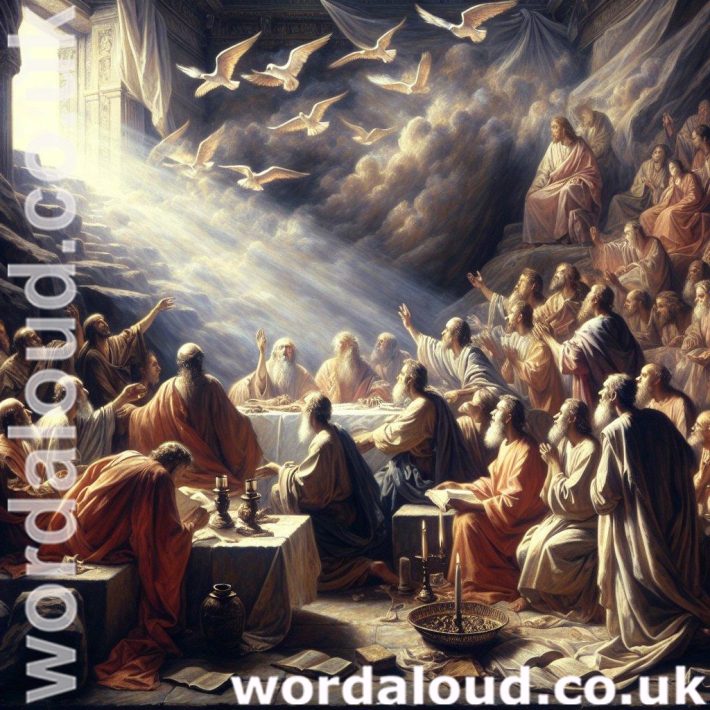
Christian Art | Pentecost | Descent Of The Holy Spirit
‘They Were All Filled With The Holy Ghost’ | Pentecost | Acts 2
Acts 2 records the descent of the Holy Spirit at Pentecost, Peter’s address to the people gathered in Jerusalem, and the emergence of the Church as a visible community. The chapter continues themes established in the Gospel of Saint Luke: fulfilment of Scripture, the action of the Holy Spirit, witness concerning Jesus Christ, repentance, and the gathering of God’s people.
The chapter opens:
‘And when the day of Pentecost was fully come, they were all with one accord in one place.’
—Acts 2:1 (KJV)
Pentecost was one of the principal feasts of Israel. Jewish pilgrims had gathered in Jerusalem from many regions. Luke situates the coming of the Holy Spirit within the liturgical life of Israel and within salvation history already revealed through the Law and the Prophets.
The disciples are gathered ‘with one accord’. Before the Spirit descends, the disciples are united in prayer and expectation. The Church is not presented as a collection of isolated believers, but as a people gathered together before God.
Luke writes:
‘And suddenly there came a sound from heaven as of a rushing mighty wind.’
—Acts 2:2 (KJV)
The imagery recalls Old Testament language concerning the Spirit of God. Wind, breath, and spirit are closely connected in biblical thought. In Genesis, God breathes life into Adam. In Ezekiel, the breath of God enters the dry bones. Here again, life proceeds from God.
The sound comes ‘from heaven’. Pentecost is therefore presented not as a human achievement or emotional development, but as divine initiative.
Luke continues:
‘And there appeared unto them cloven tongues like as of fire, and it sat upon each of them.’
—Acts 2:3 (KJV)
Fire accompanies divine revelation throughout Scripture. Moses encounters God in the burning bush. Israel is guided through the wilderness by a pillar of fire. At Sinai, the mountain burns with the presence of God. Fire signifies both revelation and holiness.
The fire rests upon each disciple individually. The gift of the Spirit is shared by the whole gathered Church whilst also received personally.
Luke then describes the immediate effect:
‘And they were all filled with the Holy Ghost, and began to speak with other tongues.’
—Acts 2:4 (KJV)
The miracle is directed towards proclamation. The disciples speak in languages understood by pilgrims who have come to Jerusalem from many nations. Luke emphasises intelligibility and witness.
The crowd responds:
‘And how hear we every man in our own tongue, wherein we were born?’
—Acts 2:8 (KJV)
The Gospel is heard within the ordinary languages of the nations gathered there. The Word of God is not confined to one people or one tongue. Pentecost therefore anticipates the mission to the Gentiles which unfolds through the remainder of Acts.
Peter interprets the event through Scripture. Pentecost is not treated as isolated religious experience but as fulfilment of prophecy:
‘But this is that which was spoken by the prophet Joel.’
—Acts 2:16 (KJV)
Peter cites Joel:
‘And it shall come to pass in the last days, saith God, I will pour out of my Spirit upon all flesh.’
—Acts 2:17 (KJV)
The expression ‘all flesh’ is important. The Spirit is not reserved for kings, prophets, or priests alone. Sons and daughters, young and old, servants and handmaidens all receive the promise.
Peter proceeds to proclaim Jesus:
‘Ye men of Israel, hear these words; Jesus of Nazareth, a man approved of God among you.’
—Acts 2:22 (KJV)
The speech centres upon the death and resurrection of Christ.
‘Him, being delivered by the determinate counsel and foreknowledge of God, ye have taken, and by wicked hands have crucified and slain.’
—Acts 2:23 (KJV)
The resurrection is central to apostolic proclamation:
‘Whom God hath raised up, having loosed the pains of death.’
—Acts 2:24 (KJV)
Peter argues that the Psalms speak prophetically concerning Christ:
‘He seeing this before spake of the resurrection of Christ.’
—Acts 2:31 (KJV)
Peter then declares:
‘This Jesus hath God raised up, whereof we all are witnesses.’
—Acts 2:32 (KJV)
The resurrection leads to exaltation:
‘Therefore being by the right hand of God exalted.’
—Acts 2:33 (KJV)
Pentecost therefore reveals the continuing action of the risen Christ through the Holy Ghost.
Peter concludes:
‘God hath made that same Jesus, whom ye have crucified, both Lord and Christ.’
—Acts 2:36 (KJV)
The crowd responds:
‘Now when they heard this, they were pricked in their heart.’
—Acts 2:37 (KJV)
Peter answers:
‘Repent, and be baptized every one of you in the name of Jesus Christ for the remission of sins.’
—Acts 2:38 (KJV)
Luke records the response:
‘Then they that gladly received his word were baptized.’
—Acts 2:41 (KJV)
Luke describes the life of the earliest Church:
‘And they continued stedfastly in the apostles’ doctrine and fellowship, and in breaking of bread, and in prayers.’
—Acts 2:42 (KJV)
Doctrine, worship, and fellowship belong together within the life of the Church.
The believers also share material goods:
‘And all that believed were together, and had all things common.’
—Acts 2:44 (KJV)
Luke describes a community shaped by prayer, charity, and common worship.
The communal life extends through worship and daily fellowship:
‘And they, continuing daily with one accord in the temple, and breaking bread from house to house.’
—Acts 2:46 (KJV)
The earliest Christians continue to worship in the temple whilst also gathering in homes. Christianity emerges within the life of Israel before later separation develops more fully.
Luke concludes:
‘And the Lord added to the church daily such as should be saved.’
—Acts 2:47 (KJV)
Acts 2 establishes themes which continue throughout Acts: the work of the Holy Ghost, proclamation concerning Jesus Christ, fulfilment of Scripture, repentance and baptism, Eucharistic fellowship, communal prayer, and missionary expansion.
Theologically, Acts 2 joins Christology, pneumatology, and ecclesiology. Christ is exalted at the right hand of the Father. The Spirit proceeds through His exaltation. The Church comes into visible existence through the gift of the Spirit and the apostolic proclamation of the Gospel.
Luke therefore presents Pentecost as the beginning of the Church’s public witness to the risen Christ.




Psalm 24 expresses awe and reverence for God the Creator of the universe. The psalm resonates with themes of divine ownership, holiness, and quest for spiritual purity and access to the presence of the Lord [ … ]

This reading from the Pastoral Constitution on the Church in the Modern World addresses the human concern with the subject of death. It approaches the subject not only as a biological event but as a spiritual and existential mystery that touches the deepest questions about meaning, identity, and destiny [ … ]
Pope Saint Leo the Great continues his exposition of the Beatitudes, moving from the blessing on the poor in spirit to those pronounced on those who mourn and on the meek (Matthew 5:4–5). His reflections trace both the inner character of these dispositions and their eschatological fulfilment [ … ]
